

Every patio drainage design starts with one number: 2 percent slope, or about 1/4 inch of fall per foot, moving water away from your house. Get that grade right, then pair it with the drainage method that fits your soil and site, whether that’s a channel drain, a French drain, permeable pavers, or a dry well, and pooling stops. Skip either half of that equation and no amount of gravel will save you. Start by watching where water actually flows during a storm before you dig anything.
TL;DR:
- Achieving a 2 percent slope is essential for proper drainage, but soil type and existing site conditions influence whether additional systems are needed.
- French drains are best for managing groundwater or clay-heavy soils, especially when water rises from below and threatens foundation walls or basements.
- Permeable pavers require a deep engineered base and regular maintenance to prevent clogging, making them a higher-cost long-term solution.
- Proper site assessment includes observing water flow during rain, noting low spots, testing soil percolation, and evaluating downspout discharge points.
- Installing or repairing a drainage system demands careful sequencing, including permits, proper excavation, fabric wrapping, and thorough testing before finalizing the surface.
Table of Contents
- What Are the Best Patio Drainage Methods?
- How Do I Assess My Patio Site Before Choosing a Drainage System?
- What Slope Do Building Codes Require for Patio Drainage?
- When Should You Install a French Drain?
- Do Permeable Pavers Actually Solve Drainage Problems?
- How Do Channel Drains and Point Drains Work?
- Are Dry Wells a Good Alternative When You Can’t Drain to Sewer?
- What’s the Right Sequence for Installing a Patio Drainage System?
- Why Do Patio Drains Fail, and How Do You Fix Them?
- How Much Does Patio Drainage Cost and How Long Does It Take?
- How We Approach Patio Drainage Design on Real Projects
- Get Expert Help With Your Patio Drainage Project
- Sources
- FAQ
What Are the Best Patio Drainage Methods?
Most patio water problems trace back to one of five fixable causes, and the fix usually matches the cause directly.
Grading alone works when your yard already has room to fall away from the house and the soil drains reasonably well. If you can achieve that 2 percent slope across the whole surface without water backing up against a fence, wall, or neighboring lot line, you may not need any collection system at all. This is the cheapest fix and the one we check first on every site visit.
Channel and point drains earn their keep when slope alone can’t move enough water fast enough, usually near doors, low corners, or where two roof valleys dump onto one section of patio. These surface collectors catch water right where it puddles and route it before it has a chance to sit.
French drains solve a different problem entirely: water coming up from below, not just running across the top. Heavy clay soil, a high water table, or a patio built against a foundation wall all call for subsurface interception rather than surface collection.
Permeable pavers let water pass through the surface itself into an engineered base below, which is useful where you want a patio that never looks wet but can’t tolerate visible drains or excessive slope. The trade-off is a deeper, more technical base than a standard patio.
Dry wells and soakaways store and slowly infiltrate water when you have nowhere to daylight a pipe and no storm sewer connection nearby. They’re a storage answer, not a collection answer, and they only work where soil percolation supports them.
Here’s how these stack up against each other:
- Grading only: lowest cost, works on naturally sloped lots with decent soil
- Channel/point drains: moderate cost, best for isolated low spots and doorway thresholds
- French drains: moderate to high cost, best for groundwater and clay-heavy sites
- Permeable pavers: highest upfront cost, best where surface drains aren’t wanted visually
- Dry wells: variable cost, best when no outlet exists for a piped system
How Do I Assess My Patio Site Before Choosing a Drainage System?
Grab a notebook and go outside during the next real rainstorm. That fifteen minutes of observation will tell you more than any amount of guesswork afterward.
- Map the flow paths. Watch where water actually travels across your patio and yard, not where you assume it goes. Photograph or sketch the route.
- Mark every low spot. Any place water lingers more than a few minutes after rain stops is a low spot, even if it’s subtle. A 2-liter bottle of water poured slowly across the surface will reveal these on a dry day.
- Check your soil type. Dig a 12-inch hole, fill it with water, and time how fast it drains. Clay-heavy soil can take hours; sandy or loamy soil often clears in under 30 minutes. This single test tells you whether infiltration-based solutions like dry wells or permeable pavers are realistic.
- Trace your downspouts. Note where roof runoff discharges relative to the patio. A downspout dumping directly onto or near your patio slab is often the real culprit, not the patio design itself.
- Estimate your runoff volume. Multiply your roof and patio square footage by expected rainfall intensity for your region to rough out how much water any dry well or pipe run needs to handle.
Pro Tip: Do the soil infiltration test in more than one spot. Many Central Arkansas lots have a thin layer of decent topsoil sitting over dense clay, and a single test six feet from your patio can give you a false sense of how well the whole site drains.
If your downspouts discharge within a few feet of the patio, rerouting them is sometimes a bigger fix than any drain you could install underneath the slab. Our landscape drainage guidance covers how patio runoff should tie into your broader yard drainage plan, not just the slab itself.
What Slope Do Building Codes Require for Patio Drainage?
The International Residential Code sets the baseline: impervious surfaces within 10 feet of a foundation must slope away at a minimum of 2 percent, which works out to 1/4 inch of fall per linear foot. That’s the number to build to, not a suggestion to round down from.
ENERGY STAR and Building America guidance echoes the same 0.25 in/ft target and adds a useful escape hatch: where you physically can’t achieve that slope within 10 feet, add a swale or a drain instead of forcing an unrealistic grade change.
Verifying slope in the field doesn’t require expensive equipment. A 4-foot level with a slope-reading vial, a laser level, or a simple string and line level all work fine for a residential patio. Set your reference point at the house and check every few feet moving outward.
Industry guidance from the Concrete Institute also acknowledges reality: construction tolerances mean small “birdbaths,” minor depressions that hold a puddle after rain, are common even on a correctly sloped slab. A birdbath under about 1/8 inch deep is cosmetic. Anything deeper, or anything that holds water for more than an hour, means you add a point drain rather than trying to re-pour the slope.
When Should You Install a French Drain?
A French drain doesn’t collect surface puddles. It intercepts water moving through the soil before it ever reaches your patio, which makes it the right call for a specific set of conditions rather than a universal fix.
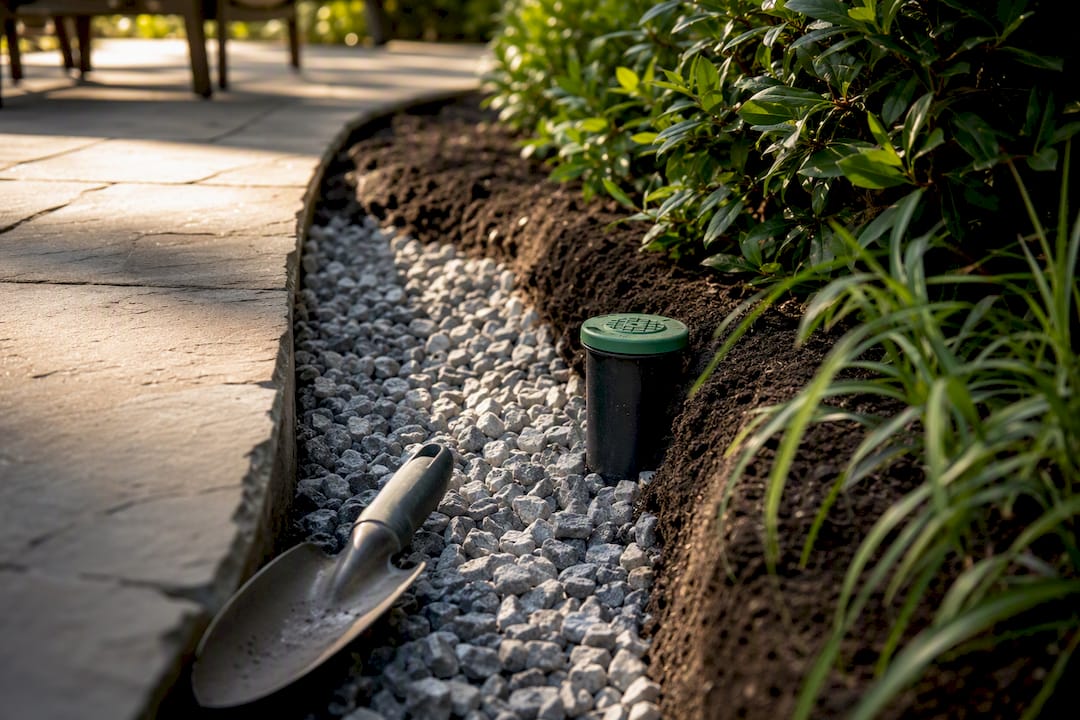
The system itself is straightforward: a trench holds a perforated pipe wrapped in landscape fabric, bedded in gravel, sloped consistently toward an outlet. Water percolates through the surrounding soil, enters through the pipe’s perforations, and travels downhill to daylight or a dry well.
You want a French drain specifically when:
- Groundwater sits close to the surface, especially seasonally after heavy rain
- Your soil is heavy clay that holds water instead of letting it pass through
- Your patio sits directly against a foundation wall, where hydrostatic pressure matters
- You’re seeing water intrusion into a basement or crawl space near the patio area
Installation runs deeper than most surface systems, typically 18 to 24 inches, and the trench needs consistent fall the entire run. No dips, no reverse grades, or the pipe becomes a stagnant water trap instead of a channel.
Long-term maintenance comes down to preventing siltation. Fine soil particles can work through the fabric over years and clog the gravel bed, so an inspection port at the high end of the run lets you check flow every few years without excavating the whole trench.
Do Permeable Pavers Actually Solve Drainage Problems?
Permeable pavers work, but they demand a base that’s dramatically deeper than what most homeowners picture when they hear “paver patio.”
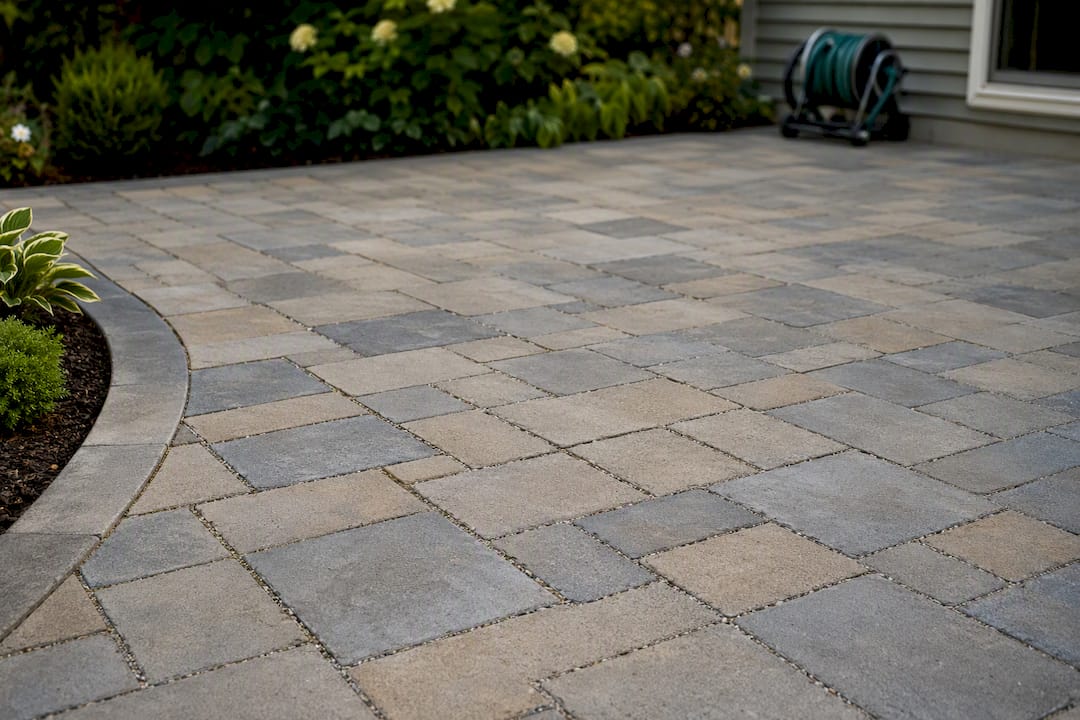
EPA guidance on permeable pavement confirms these systems cut runoff effectively, but the open-graded reservoir base beneath the pavers often needs to run far deeper than a traditional compacted-aggregate base, sometimes into the 8 to 36 inch range depending on your soil and how much water the system needs to store.
Pro Tip: Before committing to a full permeable system, ask whether a hybrid works better: permeable pavers over the low third of your patio where water collects, with standard pavers and a slight slope everywhere else. It’s often cheaper and just as effective.
The layer stack, from bottom to top, looks like this:
- Compacted subgrade, graded to the design slope
- Woven geotextile fabric to separate soil from aggregate
- Open-graded reservoir aggregate for storage and infiltration
- A bedding layer of smaller, clean aggregate under the pavers
- Permeable pavers set with open, gravel-filled joints
Maintenance is the part sellers gloss over. The joints need periodic vacuuming, usually annually in a dusty or tree-heavy yard, because silt and organic debris will clog the openings and turn a permeable surface back into an impermeable one within a few seasons. Joint stone also washes down over time and needs topping off. Homeowners who skip this maintenance often see infiltration drop noticeably within five to seven years. Our paver patio design guide walks through how we build these bases correctly on Arkansas clay, where the standard depth numbers usually need adjusting upward.
How Do Channel Drains and Point Drains Work?
The choice between a linear trench drain and a single inset point drain comes down to how the water arrives, not personal preference.
A linear (channel) drain makes sense when water sheets across a wide area, such as along an entire patio edge facing the yard’s low side, or across a threshold where a door meets the patio. It intercepts flow across its full length rather than at one location.
A point drain works better for a single, isolated low spot, like a corner where two slopes converge, since running a full channel there would be overkill.
Sizing comes down to grate capacity and the slope feeding into it. A quick working method:
- Grade all surrounding surfaces toward the drain at the standard 2 percent minimum
- Choose a grate rated for your expected flow; heavier storm events need wider or deeper channels, not just more grates
- Confirm the outlet pipe diameter can actually carry what the grate lets in, undersized outlet pipe is a common failure point
Outlet options include daylighting to a lower point in the yard, tying into a storm sewer connection where your municipality allows it, or connecting into a French drain run for combined subsurface and surface handling. Regular cleaning matters here too: industry installation guidance notes that channel drains handle high flow well but silt and leaf debris reduce their capacity fast if grates aren’t cleared each season.
Are Dry Wells a Good Alternative When You Can’t Drain to Sewer?
A dry well is a storage chamber, not a pipe to nowhere. It holds water temporarily and lets it infiltrate slowly into surrounding soil, which makes it a fit specifically when you have runoff to manage but no storm sewer connection and no way to daylight a pipe downhill.
Sizing depends on two numbers: your estimated runoff volume from the contributing patio and roof area, and your soil’s infiltration rate. A dry well sized for sandy soil will be badly undersized in clay, which is why the same percolation test from your site assessment matters again here.
Red flags that a dry well won’t work include standing water in your test hole after several hours, a water table that sits within a few feet of the surface, or a downhill neighbor whose yard already stays soggy after normal rain. In any of those cases, look at daylighting the pipe to a lower point on your own property or, where local rules permit, a municipal storm connection instead.
What’s the Right Sequence for Installing a Patio Drainage System?
Sequencing matters as much as material choice. Skip a step here and you’ll be digging the whole thing back up within a year.
- Call for utility locates and pull permits before any digging. Buried gas, electric, and irrigation lines don’t announce themselves, and many municipalities require permits for drainage work that alters grading or connects to storm systems.
- Excavate to the correct depth for your system. Standard grading needs only a few inches of adjustment; French drains typically run 18 to 24 inches; permeable paver bases can require substantially more, based on your storage needs.
- Compact the subgrade properly. Skipping compaction is the single most common cause of settlement failures down the road.
- Lay geotextile fabric before any gravel goes in, wrapping pipe trenches fully to prevent soil migration into the aggregate over time.
- Select aggregate and pipe by function, not by what’s cheapest at the yard. Perforated PVC or corrugated pipe for French drains, clean open-graded stone for permeable bases, and properly rated grates for surface collectors.
- Connect to downspouts or existing outlets as part of the same run rather than as an afterthought.
- Test before you finish the surface. Installation guidance from This Old House recommends running a hose through the completed system and watching the outlet before backfilling or setting final pavers, catching a mistake now is far cheaper than after the patio is finished.
Pro Tip: Photograph every trench and pipe run before you backfill. If a drain clogs or settles years later, those photos save hours of guesswork about what’s actually buried where.
If your project also involves clearing old stumps, roots, or overgrown vegetation before excavation, a proper grubbing and site-prep process keeps the area clean enough to excavate accurately without hitting hidden root masses that throw off your grade.
Why Do Patio Drains Fail, and How Do You Fix Them?
Most drainage failures fall into three categories, and figuring out which one you have determines whether the fix takes an hour or requires a full remediation.
- Clogged outlets or grates: the fastest fix, and the most common. Clear debris, flush the line with a hose, and check that water exits freely at the discharge point.
- Settlement: if a section of patio has sunk and now holds water where it didn’t before, the base beneath it compacted unevenly, often from inadequate compaction during installation. Small areas can sometimes be corrected with slabjacking; larger settlement usually means lifting and rebuilding that section.
- Design failure: if water pools in the same spot every time despite clean drains and no settlement, the original slope or drain placement was wrong from the start, and no amount of maintenance will fix a grading mistake.
Routine seasonal upkeep prevents most of this: clear grates each fall before leaves pile up, flush French drain lines annually if you have an inspection port, and vacuum permeable paver joints on the schedule we mentioned earlier. Winter care matters too. Standing water that freezes in a trench drain or dry well can crack fittings, so make sure everything drains fully before a hard freeze.
How Much Does Patio Drainage Cost and How Long Does It Take?
Cost scales with how much excavation and material a system needs, and timeline follows the same pattern.
Slope-only regrading on an existing patio is the cheapest option when it’s possible at all, though correcting an already-poured slab’s slope usually means partial or full replacement rather than a simple adjustment, since you can’t meaningfully change a concrete slab’s pitch after the pour. Channel and point drains add moderate cost for the trenching, grate, and pipe work but install in a day or two for most residential patios. French drains cost more due to deeper excavation and fabric-wrapped pipe, and typically take a few days depending on run length and soil conditions. Permeable paver systems carry the highest upfront cost because of the deep engineered base, and installation stretches longer to allow proper compaction of each layer.
Soil type drives both cost and duration more than any other factor. Rocky or heavy clay soil slows excavation and can require extra aggregate for compaction. Permits, where required for drainage work that alters grading or ties into storm systems, add lead time but rarely major cost.
DIY makes sense for small, simple grading corrections or a single point drain in an accessible area. Systems involving deep excavation, engineered permeable bases, or connections near a foundation wall are where hiring a pro pays for itself in avoided rework.
How We Approach Patio Drainage Design on Real Projects
Every project starts the same way for us: assess, plan, build, test. We walk the site during or right after rain whenever possible, because a dry-day inspection misses half the story. From there we map slope, soil type, and downspout discharge points before recommending a system, not the other way around.
On heavy Central Arkansas clay, we lean toward French drains or combined grading-plus-channel-drain designs more often than pure permeable systems, since clay’s slow infiltration rate limits how much a permeable base alone can handle. Sandier, well-draining lots open up more options, including permeable pavers as a standalone solution. With more than 1,750 completed projects, we’ve seen which combinations hold up through Arkansas winters and which ones need revisiting within a few years, and that history shapes every recommendation we make.
— Ty
Get Expert Help With Your Patio Drainage Project
Reading through slope calculations and base-depth requirements is one thing. Excavating a French drain trench to a consistent grade, or building a permeable paver base that actually performs after five years of Arkansas storms, is another. Patio drainage systems are best designed and built as part of every hardscape project, not as an afterthought bolted on after the pavers are down.

A consultation typically starts with site assessment: flow paths, soil type, downspout locations, and runoff estimates, with input from experienced professionals familiar with many projects in Central Arkansas. We’ll tell you plainly whether your site needs a simple regrade, a French drain, a permeable system, or some combination, and what that actually costs before any work begins. If you’re planning a new patio or fixing an existing one that pools water after every storm, start with our patio design and installation page or schedule a landscaping consultation to get a site-specific plan instead of guessing.
Sources
- International Residential Code (IRC) 2021 — Chapter 4 (Foundations)
- Patio slabs, porch slabs, walkways, and driveways: slope away from house — Building America Solution Center (BASC)
- Permeable pavement (EPA Soak Up the Rain)
- How to install a patio drainage system — This Old House
FAQ
What Is the Best Drainage System for a Patio?
There’s no single best system. The right choice depends on your soil and site: grading alone often suffices on well-draining lots, while clay soil or high groundwater usually calls for a French drain, and surface pooling near doors responds best to a channel or point drain.
How Do You Create Drainage in a Patio?
Start by grading the surface to a minimum 2 percent slope, about 1/4 inch per foot, moving water away from your house, then add a collection or infiltration system like a channel drain, French drain, or permeable pavers if slope alone can’t handle the runoff.
Can I Just Use Gravel for Drainage?
Gravel alone doesn’t drain water anywhere; it needs a slope, a perforated pipe, or a permeable base structure to actually move or store water. A gravel-filled trench without pipe and fabric will clog with silt and stop working within a season or two.
What Does Proper Drainage on a Paver Patio Look Like?
A properly drained paver patio slopes at least 2 percent away from the house, uses a compacted base appropriate to the paver type, and includes a collection or infiltration system, such as a channel drain or permeable joints, sized for local rainfall.