


A sunken sidewalk can be fixed five ways: grind the lip down, patch the surface, pump a cement slurry under the slab (mudjacking), inject polyurethane foam under it, or tear the slab out and pour a new one. Those are the standard methods, and the right one depends on how far the slab dropped, whether it is cracked, and why the soil underneath gave way. Lifting a sound slab is usually the smart move. Replacing a broken one is usually the honest one. Fixing the cause matters more than either.
This guide walks you through how to size up the problem, how each method works, where each one falls short, and what to do about the trip hazard while you wait for a repair.
TL;DR
- A slab sinks because the soil or base beneath it lost support, usually from settling, poor compaction or water erosion. Repair the cause, or the slab will drop again.
- Measure the lip at the worst joint. A change of more than 1/4 inch is where public standards start treating a walk as a problem.
- Grinding suits small lips. Mudjacking and foam lifting suit sound slabs that dropped as a unit. Replacement suits slabs that are cracked, broken or still moving.
- Foam injection does not fix bad soil on its own, so drainage and base conditions need attention in the same visit.
- Cost depends on slab size, how far it must lift, access, and whether the base needs rebuilding. We do not publish price ranges, and we explain the drivers below.
Table of Contents
- Why sidewalks sink in the first place
- How to tell whether your sidewalk is a real hazard
- The five repair options, compared
- Lift or replace: a decision framework
- Foam vs mudjacking on a sidewalk
- What affects the total on a sunken sidewalk job
- What to do about the trip hazard right now
- Who is responsible for the repair?
- Our perspective: fix the ground, then the concrete
- When to call us
- FAQ
- Sources
Why sidewalks sink in the first place
A concrete walk looks like a solid thing, but it is only as good as what carries it. Slabs pass their load through the concrete and the aggregate base into the soil. When that support is destabilized by settlement, inadequate compaction or groundwater erosion, the slab drops, cracks, breaks at the corners or tilts, and trip hazards follow.
In Central Arkansas, the usual suspects are easy to spot once you know where to look:
- Water. A downspout that dumps beside the walk, a low spot that holds water, or a sprinkler head that leaks all wash fines out from under the slab. Clay soil also swells and shrinks as it wets and dries, which moves the base unevenly.
- Poor compaction at install. Backfill left loose after utility work or construction settles over a few seasons.
- Tree roots. Roots can heave one end of a panel while the other end sinks.
- Voids. Once a hollow forms, the slab bridges it until traffic or a wet spring pushes it down.
If water is the driver, read our guide to why backyard water pools and how to stop it. Lifting a slab while the same downspout still pours beside it only resets the clock.
How to tell whether your sidewalk is a real hazard
You do not need special tools. A long level or straightedge laid across three or more panels shows which panel dropped or rose, and you can measure the lip at the worst joint with a tape or ruler.
Then compare what you find to published thresholds:
| Measurement at the joint | What published guidance says |
|---|---|
| Up to 1/4 inch | The U.S. Access Board’s accessible route guidance allows a vertical change in level up to this amount |
| Between 1/4 and 1/2 inch | Must be beveled at no steeper than 1:2 under the same guidance |
| Over 1/2 inch | Must be ramped under the same guidance |
| More than 1/4 inch of vertical movement | The City of Fargo’s sidewalk replacement criteria call for repair at this point |
Fargo also flags settlement or heave that creates a slope greater than 1/4 inch per foot, and any walk that holds water. These are one city’s rules and one federal accessibility standard, not an Arkansas statute, but they give you a sensible yardstick. If your lip is past 1/4 inch, treat it as something to fix this season, especially if children, older neighbors, delivery drivers or customers use the walk. For a deeper look at slope and level checks, see our field guide to ADA walkway slope checks.
The five repair options, compared
1. Grinding the raised edge
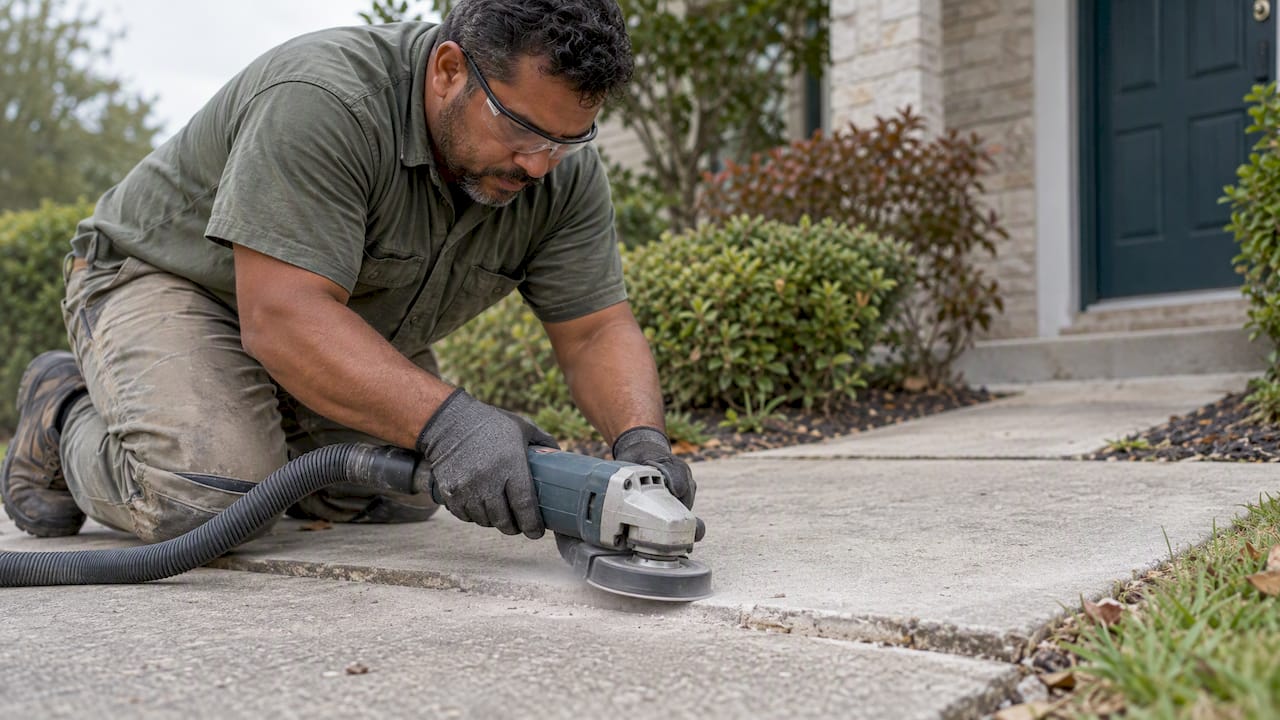
A crew grinds the high side of the joint into a gentle bevel. It is quick, leaves the slab in place and works for lips that are small. The tradeoff is that grinding removes concrete and does nothing about the sunken side. If the slab keeps settling, you will be back for more. It is a good fit for a modest lip on a slab that is otherwise stable.
2. Patching
Patching compound fills surface defects and can bridge a small transition. It is a cosmetic and temporary fix at best on a sunken panel. Use it for spalls and chips, or as a stopgap, not as the plan.
3. Mudjacking
Mudjacking pumps a cement-based slurry through holes drilled in the slab. The slurry fills voids and pushes the slab back up. It has been used for decades and works well on large, flat areas with a sound slab. The holes are larger than foam holes, the material is heavy, and it can add weight to a subgrade that is already struggling. We compare the two in detail in our article on mudjacking vs polyurethane foam.
4. Polyurethane foam injection
This is the method most readers are searching for when they ask about concrete leveling with foam. Small holes are drilled, a two-part foam is injected beneath the slab, and it expands to fill voids and lift the concrete. The foam is light, the holes are small and the walk is typically usable soon after. Contractors who specialize in it often describe a job as a matter of hours rather than days.
The limits are real, though. The American Concrete Institute’s slabjacking guidance notes that drill holes can remain visible and that the method does not inherently correct poor underlying soil, so future settlement is possible if the root cause stays unaddressed. The same document warns that slabs can be difficult or impossible to move because of binding or other conditions, and that removal and replacement should be weighed against cracking, distress and expected future movement.
5. Full replacement
Replacement means breaking out the slab, removing the bad base, compacting a new aggregate layer and pouring or setting new material. It costs more in labor and takes longer, since concrete must cure. It is also the only option that lets you rebuild the base, fix slope and drainage, and change the material entirely. Interlocking pavers are one choice that can be lifted and reset if the ground moves again.
Lift or replace: a decision framework
One local-contractor guide that ranks for this topic says minor sinking can often be corrected by lifting, while severe sinking or a badly cracked slab typically calls for replacement. That matches what we see in the field. Use these questions in order.
- Is the slab in one piece? A slab that dropped as a unit with few cracks is a candidate for lifting. A slab broken into rubble is not.
- How far did it drop? A small lip may only need grinding. A drop of an inch or more usually needs lifting or replacement.
- Is the soil still moving? If settlement is ongoing, because of a slope, a leak or a failing drain, fix that first or plan on replacement with a rebuilt base.
- Does the walk hold water or slope the wrong way? Lifting can adjust slope, but a walk that was poorly pitched from the start is often better rebuilt.
- What do you want the result to look like? Visible patches from drill holes are minor on a sidewalk, but if appearance matters at a front entry, factor it in.
| Situation | Likely best fit |
|---|---|
| Small lip, slab otherwise stable | Grinding |
| Single panel dropped, few cracks, dry soil | Foam lifting or mudjacking |
| Large flat area dropped evenly | Mudjacking or foam lifting |
| Cracked into pieces or corners broken off | Replacement |
| Ongoing erosion, roots or poor drainage | Fix the cause, then replace or lift |
| Walk needs new slope or material | Replacement |
A useful side-by-side explanation of how contractors compare lifting methods is in this breakdown of foam lifts for sunken sidewalk panels, which also covers when each approach is appropriate.
Foam vs mudjacking on a sidewalk
For a narrow walk, the differences come down to a handful of traits.
- Hole size. Mudjacking typically needs larger holes, roughly an inch or two across. Foam jobs use small holes. Smaller holes mean less to patch.
- Weight. Slurry is dense. Foam is a fraction of that weight, which matters over soft or voided soil.
- Cure time. Foam sets quickly. Slurry needs more time before it carries load.
- Material cost and equipment. Mudjacking is often the lower-cost material on big, flat jobs. Foam tends to earn its keep on tight, narrow or sensitive spots.
- Durability. Neither fixes poor soil. Both can hold for years when the cause of the settlement is handled.
The decision usually turns on slab size, access and soil condition rather than on any single winner. A good contractor will explain why they picked one and will not push the same method on every job.
What affects the total on a sunken sidewalk job
We do not publish price ranges, and we would be wary of any article that promises a number without seeing the walk. Here is what moves the total:
- How much concrete is involved. Number of panels and total square footage.
- How far each slab must lift, and how large the voids are underneath.
- Method. Grinding is a small job. Lifting sits in the middle. Replacement involves demolition, hauling, base work and curing.
- Access. Narrow side yards, steep grades or limited equipment access add labor.
- Drainage and base work. Correcting the water source or rebuilding the base adds scope but protects the result.
- Surrounding features. Steps, landings, tree roots or irrigation lines near the walk change the plan.
- Timing and scheduling. Wet weather can delay concrete and base work.
If you want to understand how Arkansas pros think about slab and foundation costs more broadly, our guide to foundation repair for patios and slabs in Arkansas lays out the same drivers.
What to do about the trip hazard right now
A permanent repair may be weeks away. In the meantime:
- Mark the edge. Bright paint or a cone at the lip makes it visible, especially at dusk.
- Bevel or bridge it. You can grind the raised edge into a ramp or use a temporary patching compound to bridge the transition.
- Redirect water. Keep downspouts, sprinklers and runoff from aiming at the sinking area so the void underneath does not grow while you wait for a professional to look at it.
- Photograph and measure. Record the lip height and date. It helps your contractor and, if you manage property, your records.
- Keep it clear. Remove leaves and ice-melt residue, and add lighting if the walk is dark.
Call a professional sooner when the slab is rocking underfoot, when cracks are widening, or when the settling is near a foundation wall.
Who is responsible for the repair?
This depends on your city. Some cities place the duty on the adjacent owner. For example, Oakland, California makes property owners responsible for damaged sidewalks next to their property. That is California, not Arkansas, so check your own city or county street department, or your POA, before you spend money. Walks inside your property line are yours to maintain in any case.
On insurance, do not assume a policy will pay. Gradual settling and wear are commonly treated differently from sudden damage, so read your policy and ask your agent or adjuster before you start work.
Our perspective: fix the ground, then the concrete
We work on slabs, patios, walkways and foundations across Central Arkansas, and the pattern is consistent: the concrete is rarely the real problem. The soil under it is. Since 2020 we have completed more than 2,000 projects, and the ones that last share a few traits. The base is compacted aggregate, not leftover fill. Water has somewhere to go. The new surface has a clear pitch away from structures.
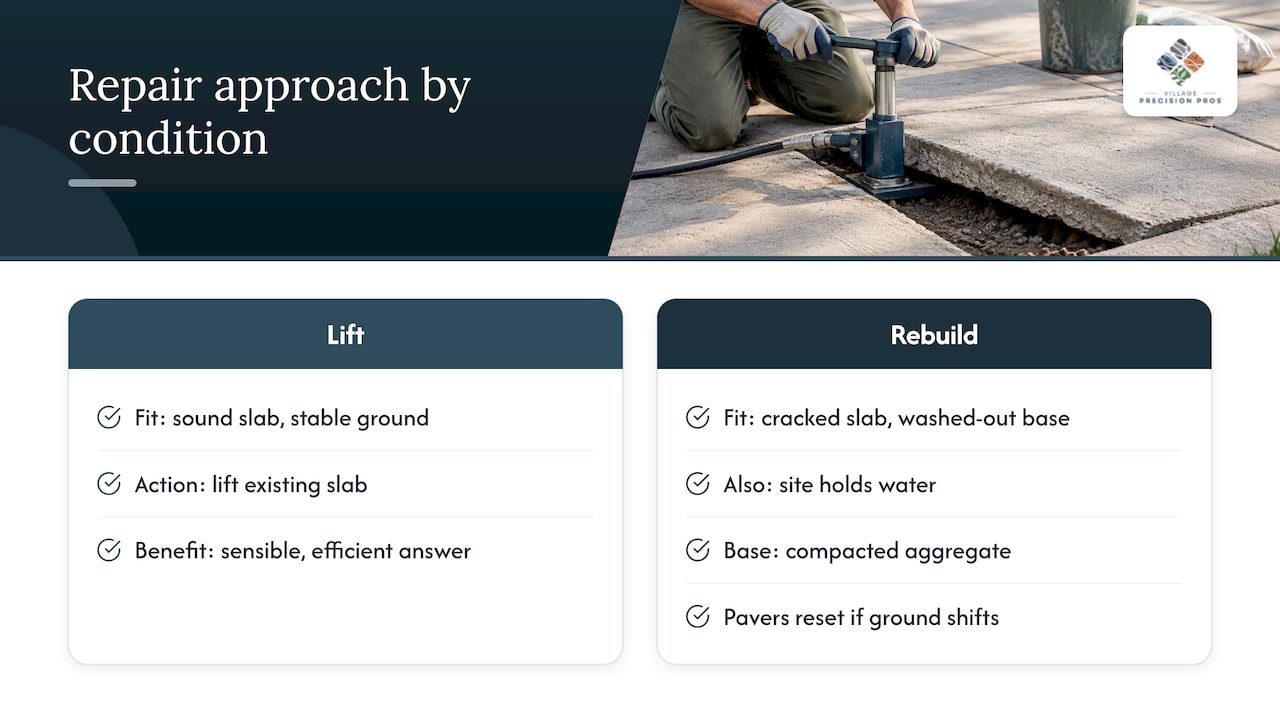
That is why we do not start with a method. We start with a walk of the property, a level and a look at the downspouts. If a slab is sound and the ground is stable, lifting can be a sensible, efficient answer. If the slab is cracked, the base is washed out or the site holds water, we would rather rebuild it properly, with a compacted base and, where it suits the site, interlocking pavers that can be reset if the ground shifts. Our hardscape and masonry quality checks show what to ask any contractor before you sign.
One more thing we tell homeowners: a repair that hides a drainage problem is a repair with an expiration date. Fixing the cause costs a little more up front and tends to save you the second visit.
Ty
When to call us
If your walk, patio or entry has settled and you are weighing repair against rebuild, we can look at the slab, the base and the drainage together and tell you which path fits. Our crews handle hardscape and stone masonry, patios, drainage and irrigation correction, and foundation leveling for residential and commercial properties in Central Arkansas. If you manage several properties, an annual maintenance plan lets us catch settling early, before a small lip becomes a liability. You can start at our services page or reach us through the site.
FAQ
How do I fix a sunken concrete patio?
The same logic applies as with a walk. If the patio slab is in one piece, lifting by mudjacking or foam injection can bring it back to grade. If it is cracked or the base has washed out, replacement or rebuilding with pavers is the better choice. Check where roof and yard water goes first, since that is often the cause.
Will homeowners insurance cover sidewalk repair?
Often not, when the cause is gradual settling, erosion or wear, but policies differ. Read your policy language and ask your agent before you start work. If the damage came from a sudden covered event, ask about a claim before you hire anyone.
How much does it cost to lift a sunken sidewalk?
The total depends on how many panels are affected, how far each must lift, the method, access and any drainage or base work. Grinding is the smallest job and replacement is the largest. A contractor needs to see the walk to quote it honestly, and we do not publish ranges.
What causes a sidewalk to sink?
The soil or base under the slab loses support. Common causes are settling, poor compaction and water erosion, plus tree roots and leaking irrigation or downspouts. Once a void forms, the slab drops under its own weight and traffic.
Can I leave a small lip alone?
A lip under 1/4 inch sits within the accessible-route allowance, but it can still catch a toe. If the lip is growing, the slab is moving, or the walk serves the public, repair it sooner.
Sources
- Advantages of Mud-Jacking Grout for Use in Slab Leveling
- Chapter 3: Building Blocks, U.S. Access Board
- City of Fargo, Sidewalk Criteria for Replacement
- Sidewalk Settlement: Trip Hazards and Who Is Responsible
- How to raise a sunken sidewalk block and restore a level walkway
- Slabjacking, American Concrete Institute
- Property Owner Responsibilities for Sidewalks, City of Oakland