

The main landscape edging options are a hand-cut trench, brick, pavers, cast concrete curbing, natural stone, wood, metal and plastic. Each one solves a slightly different problem. A cut edge is the lowest-cost choice, brick and pavers give the best mix of cost, durability and style, metal gives the cleanest line, and plastic bends around curves with the least effort. The right pick depends on how the edge will be used, how long you want it to last, and who will be mowing beside it. Below, we walk through each material, where it earns its place, and where it lets homeowners down.
TL;DR
- Cut-edge trenches cost the least but need regular re-cutting. Brick and pavers set flush with the ground are the best all-around balance of cost, durability and style.
- Plastic is the most common homeowner choice because it is inexpensive and easy to install, but it wears out faster and looks artificial.
- Metal edging makes a thin, crisp line, but only if it is set low enough that grass cannot grow under it.
- Concrete curbing is permanent and usually professionally installed, so decide on the final bed shape before you commit.
- Match the edge to the job: a mowing strip, a gravel patio border and a flower bed each ask for something different.
Table of Contents
- What landscape edging actually does
- Landscape edging options compared
- Cut-edge trenches: the no-material option
- Brick and pavers: the best balance for most yards
- Natural stone edging
- Concrete curbing
- Wood edging
- Metal vs. plastic edging
- Matching the edge to the job
- What drives the total cost
- Rules to check before you install
- Our perspective
- Let us build the edge for you
- FAQ
- Sources
What landscape edging actually does
Edging has three jobs. It keeps grass out of beds, keeps mulch, gravel or soil in place, and gives the eye a clear line between one part of the yard and the next. Most failures come from asking an edge to do a job it was not built for, such as holding back a gravel patio with a thin strip of plastic.
Landscape Management has made the point that function should come before form: edging exists to keep landscape elements where they belong rather than to draw attention to itself (Landscape Management). We agree. Choose for the job first, then pick the finish you like.
University of Illinois Extension adds a useful test: the best edging material is long-lasting, strong and visually in keeping with the landscape around it (University of Illinois Extension). K-State Research and Extension raises another question worth asking early: do you want a permanent edge that limits future expansion, or a flexible one that can change as the beds do (K-State Research and Extension)?
Landscape edging options compared
The table summarizes how the common materials stack up. Descriptions follow the guidance from K-State and University of Illinois Extension, plus what we see on installations.
| Edging type | Best for | Main strength | Main drawback |
|---|---|---|---|
| Cut-edge trench | Informal beds, low-cost starts | Needs no material | Must be re-cut as grass creeps back |
| Brick | Formal beds, mowing strips | Cost, durability and style | Needs a level, well-prepared base |
| Pavers | Mowing strips, patio borders | Strong, distinct line | More labor to set properly |
| Concrete curbing | Permanent, sweeping borders | Very durable | Permanent and professionally installed |
| Natural stone | Informal, natural looks | Blends with the landscape | May need hand trimming around it |
| Wood | Raised beds, rustic gardens | Warm look, easy to cut | Rots over time |
| Metal | Crisp lines, curves | Thin and nearly invisible | Can be hard to install, and tricky to set at the right height |
| Plastic | Temporary or curved beds | Easy and inexpensive | Short life, artificial look |
Cut-edge trenches: the no-material option
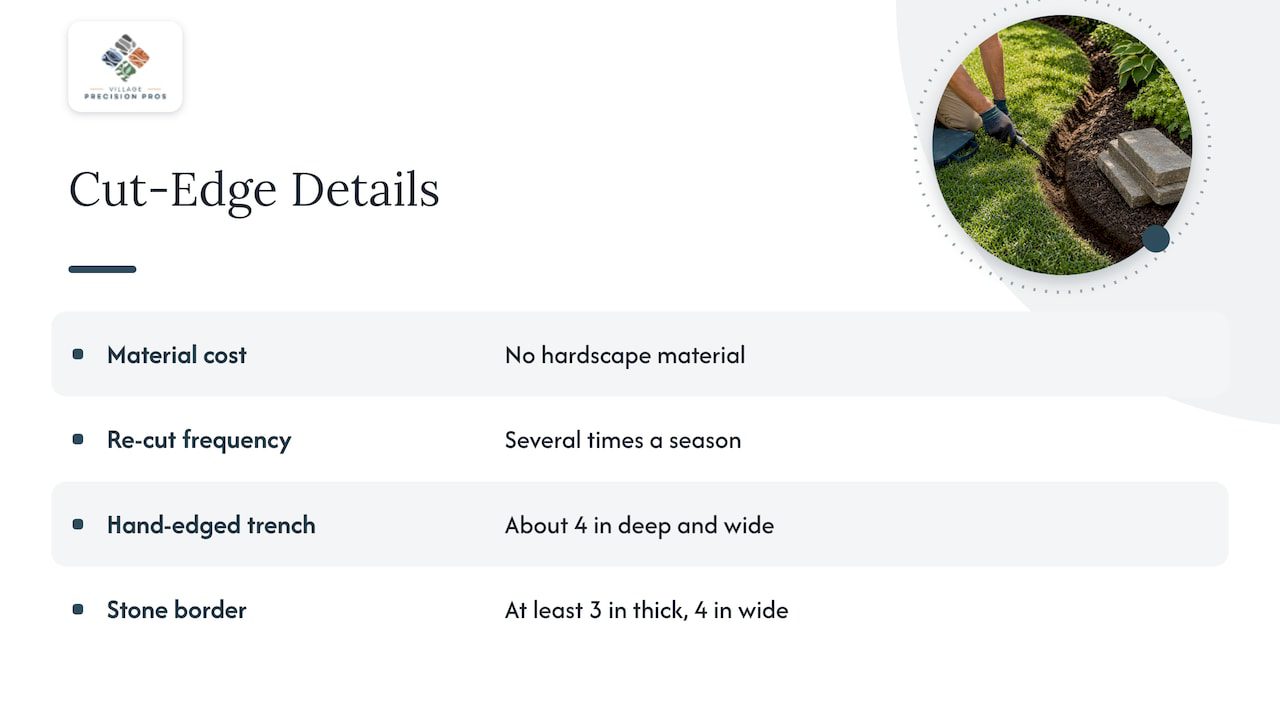
If you are wondering what to use instead of edging, the answer is a sharp spade or edger. K-State describes cutting a clean, V-shaped trench between the lawn and the bed, and notes that this is the least expensive approach because it needs no hardscape material (K-State Research and Extension).
The tradeoff is time. Grass fills the trench again, so you re-cut it several times a season. For hand-edged beds, University of Illinois Extension suggests making the cut about 4 inches deep and 4 inches wide to contain bluegrass (University of Illinois Extension). That is the figure behind the “3 inch” rule people search for: the guidance is closer to four inches for a cut edge, and a stone border should be at least 3 inches thick and 4 inches wide to block grass.
A cut edge suits a bed you plan to reshape, a first-year planting, or a yard where someone enjoys the routine. It is a poor fit for a busy household or a rental property where nobody wants a recurring chore.
Brick and pavers: the best balance for most yards
K-State ranks bricks and pavers as the best options for cost, durability and style. Set flush with the ground, they double as a mowing strip, so the mower wheel rides on the edge and you can skip the weed trimmer (K-State Research and Extension).
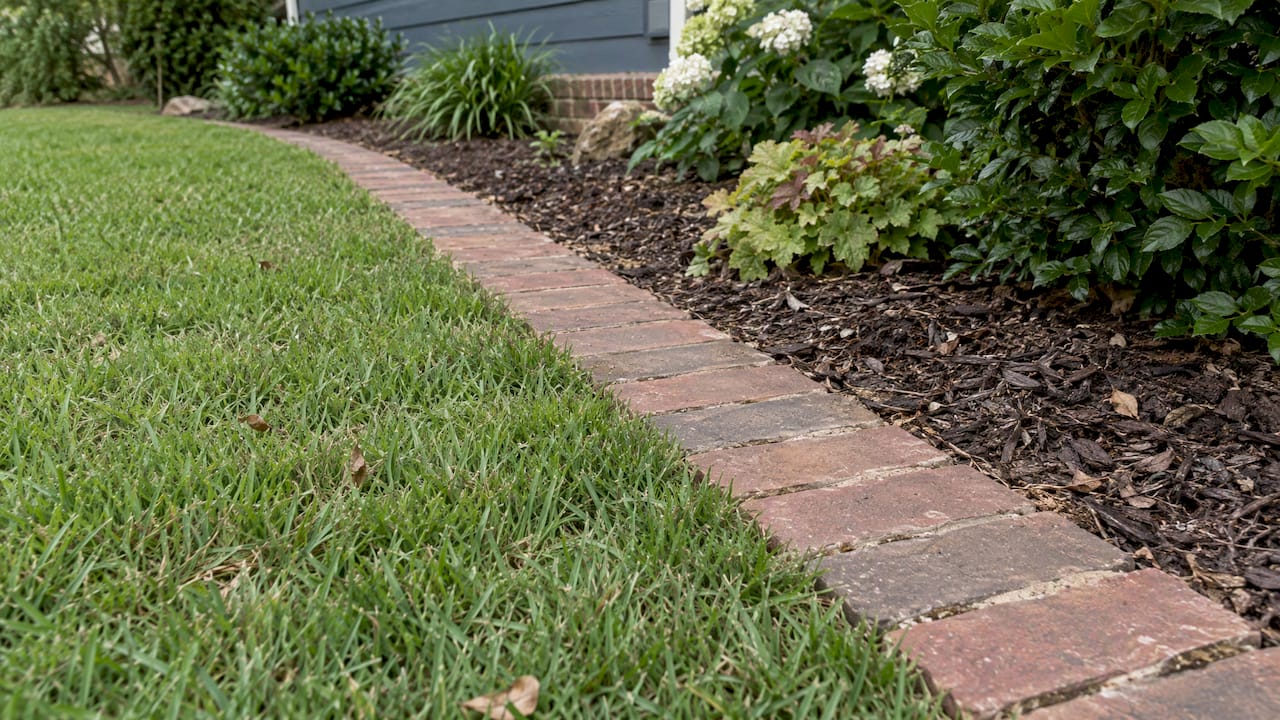
What separates a border that lasts from one that wanders is the base. Our crews excavate, lay a compacted aggregate base, and set the units level with tight joints, because a border laid on bare soil will heave and shift through freeze-thaw and heavy rain. If you want help choosing between materials, our guide to the most durable hardscape materials covers compressive strength, absorption and upkeep in more detail.
Brick reads classic and formal. Pavers give you more color, size and pattern choices, and you can match a border to an existing patio so the yard looks designed as one piece. You can see finished examples in our patios and pavers portfolio.
Natural stone edging
Stone looks like it grew out of the landscape. K-State notes that gathered stone gives an informal look, though stone may need some hand trimming where grass meets it (K-State Research and Extension).
Size matters. University of Illinois Extension says stone should be at least 3 inches thick and 4 inches wide if it is going to block grass (University of Illinois Extension). Thin flat rocks laid on the surface look fine for a season, then grass walks right over them.
Stone also changes how the whole yard reads. If you are weighing stone against poured or manufactured products for borders, walls and patios, see our comparison of natural stone vs. concrete hardscaping. For loose rock inside the bed, the size and layering of the stone decides whether it stays tidy, which we cover in our landscape rock size guide.
Concrete curbing
Cement curbing is durable and gives a smooth, continuous line that can sweep through curves. K-State’s caution is the one we repeat to every client: it is permanent, and it is usually installed by a professional (K-State Research and Extension).
That permanence is the whole decision. If your beds will stay as they are for a decade, curbing is a quiet, low-upkeep choice. If you might add a patio, move a tree or enlarge a planting, a modular border is easier to change.
Wood edging
Timber and wood strips are easy to cut and give a warm, rustic look, especially around vegetable and raised beds. Their weakness is moisture. Wood in contact with soil eventually rots, so expect to replace it on a schedule rather than treat it as a permanent fixture. If you are thinking about timber borders, this overview of wood edging durability and rot concerns explains what to expect.
Wood also has a good supporting role. University of Illinois Extension suggests nailing a 1 by 1 inch treated wood strip along the bottom of flat plastic edging to keep it stable (University of Illinois Extension).
Metal vs. plastic edging
This is the choice most homeowners actually face, so here are the plain differences.
Plastic
University of Illinois Extension calls plastic the most common homeowner choice because it is inexpensive and easy to install, and also names its drawbacks: poor durability and an artificial appearance (University of Illinois Extension). According to Lowe’s, simple plastic edging is sold in long rolls, with basic versions held by spikes and no digging, while heavier professional-grade resin versions need a slim trench (Lowe’s buying guide).
Plastic flexes, so it follows tight curves without fuss. It is a reasonable answer for a temporary bed, a short-term planting or a rental. In full sun it is the first material to look tired.
Metal
K-State groups metal and hard plastic together as reasonably priced but sometimes difficult to install and weaker on looks. Where metal wins is the finished line: when only the top edge shows, it nearly disappears and leaves a crisp separation at soil level (K-State Research and Extension).
Height is where metal edging goes wrong. Landscape Management warns that aluminum set too high lets grass and weeds grow underneath, which defeats the purpose (Landscape Management). Keep the lip just above the soil or mulch line and no higher.
How to choose
- Choose metal for permanent beds, walkways and high-traffic areas where you want a clean, structural line that stays put.
- Choose plastic for short-term beds, curved layouts you will probably change, or places where appearance matters little.
- Choose neither when the edge has to hold heavy material. A gravel patio or a paver field needs a proper restraint, not a decorative strip.
Matching the edge to the job
Flower and shrub beds
Any of the options works. Pick by style: brick or stone for a traditional house, metal for a modern one, a cut edge for a cottage-style planting. Mulch beds need an edge tall enough to hold the mulch without spilling onto the grass.
Mowing strips
A flush border of brick or pavers wins here. The mower rides along it, and the trimmer stays in the garage. Make it wide enough for a wheel, and set it low enough that the blade never catches it.
Gravel patios and paths
Loose surfaces push outward, so the border has to resist that force. For a pea gravel patio, Lowe’s recommends keeping the border about 1/2 inch above the finished gravel surface (Lowe’s). Pair the edge with the right base layers, a topic we cover in the landscape rock size guide.
Curves
Before you buy anything, lay a rubber hose or rope on the ground to outline the bed. K-State recommends this to produce smooth curves that a mower can follow (K-State Research and Extension). Flexible plastic and thin metal bend easily; brick and pavers follow curves if you cut or space them carefully.
Artificial turf
Turf needs a firm perimeter to stay tight and flat. Edging in this case is part of the installation, not an add-on. See our artificial turf installation service for how we handle borders and base.
What drives the total cost
We do not publish dollar figures, but we can tell you what moves the number:
- Material. A cut edge needs none; brick, pavers and stone cost more per linear foot than plastic or metal.
- Length and shape. Long, curved runs take more labor and cutting than straight ones.
- Site preparation. Excavation, compacted base and drainage work take the most time on a border that must last.
- Access and removal. Tearing out failed edging, hauling spoil and working in tight spaces add hours.
- Upkeep over time. A low-cost edge that you replace or re-cut often can cost more in effort than a sturdier one set once.
K-State suggests weighing your budget alongside installation difficulty and the maintenance time you are willing to give (K-State Research and Extension). We would add one more: ask what the edge costs you in weekends.
Rules to check before you install
University of Illinois Extension notes that municipalities may regulate vegetation height and that homeowners associations often have strict requirements (University of Illinois Extension). Those findings come from Illinois, so check your own city and neighborhood covenants. Before a permanent border goes in, confirm what your POA allows for materials and colors, and call 811 before any significant digging.
Our perspective
We have completed more than 2,000 projects across Central Arkansas since 2020, and the edging mistakes we repair are almost always the same: a border laid straight on soil with no base, a thin strip asked to restrain gravel, or metal set too high. In our experience, an edge is only as good as what is underneath it.
We lean toward flush brick or paver borders for yards that get regular mowing, and toward metal where a clean modern line is the goal. We use plastic sparingly, mostly for short-term or tightly curved work. And we would rather talk a client out of permanent curbing than have them regret it in three years. Quality materials and skilled craftsmanship cost more effort up front, and they shrug off weather for years of easy long-term upkeep.
Ty
Let us build the edge for you
If you would rather have a border installed once and correctly, our crews handle excavation, base prep and finished edges as part of hardscape and stone masonry work, and we design borders to match your patio and beds. We also take care of the beds afterward through our annual maintenance plans.

To talk through your yard, start at villageprecisionpros.com and tell us what you are trying to solve. If you are also planning to reduce yard upkeep overall, our low-maintenance landscaping ideas are a good next read.
FAQ
What is the best type of landscape edging?
For most mowed yards, brick or pavers set flush with the ground give the best balance of cost, durability and style, according to K-State. Metal is better when you want a thin, nearly invisible line. The best choice is the one that fits the job and the amount of upkeep you will tolerate.
What is the 3 inch edging rule?
It usually refers to stone: University of Illinois Extension says stone edging should be at least 3 inches thick and 4 inches wide to block grass. For hand-cut beds, the same source suggests a cut about 4 inches deep and wide for bluegrass. Use these as minimums, not targets.
What is the lowest-cost landscape edging?
A hand-cut trench, because it needs no material. It trades money for time, since you re-cut it as grass creeps back. Plastic is the next-lowest option but wears faster, particularly in full sun.
What can I use instead of landscape edging?
A sharp spade or edger that cuts a clean V-shaped trench between the lawn and the bed will do the job without any material. Brick or pavers set at ground level are a more lasting substitute that also serve as a mowing strip.
Sources
- All About Edging, K-State Research and Extension
- Bed Edges, University of Illinois Extension
- Leading edge(ing), Landscape Management
- Simplifying Municipal Codes for Gardeners, University of Illinois Extension
- Choose the Right Landscape Edging, Lowe’s
- Creating a Relaxing Backyard Oasis, Lowe’s