


For most home projects, pea gravel sized under about 3/8 inch works well for paths and patio fill, crushed stone in the mid-fine range stabilizes walkways, medium-sized river rock is suited for decorative beds, and larger clean stone is preferred for drainage and erosion control. Size drives comfort underfoot, how well a surface locks together, and whether water moves through or pools. Get the size wrong and you end up with a path that shifts, a bed that washes out, or a drain that clogs.
TL;DR:
- Driveways need angular 1/2 to 3/4 inch crushed stone, often with fines, because rounded river rock shifts under tires instead of locking together.
- Decorative beds need 1 to 2 inches of rock; walkways need 2 to 3 inches over a compacted base, and vehicle areas need thicker bases.
- French drains need clean 2 to 4 inch stone wrapped in geotextile; fines clog the open spaces that let water pass through.
- Rock sizes vary between suppliers, so request the actual sieve specification when a project depends on a tight range, particularly for drainage.
- Keep decorative rock shallow and away from tree trunks; stone adds no nutrients and can run hotter than organic mulch.
Table of Contents
- Landscape Rock Size Chart by Name and Use
- Which Rock Size Fits Your Project?
- Crushed Stone vs. River Rock: Picking the Right Material
- How Deep Should Landscape Rock Be?
- What Rock-Size Decisions Look Like on Real Sites
- What Homeowners Get Wrong About Rock Size
- FAQ
- Sources
Landscape Rock Size Chart by Name and Use
Suppliers sort rock by a mix of names and numbers, and the terminology trips up a lot of homeowners before they even get to the yard. Here is how the sizes typically break down:
- Pea gravel: 3/8 inch and smaller, rounded, used for paths, playgrounds, and loose decorative fill.
- Crushed stone (3/8 inch): fine angular gravel, good for compacting under pavers and light foot traffic.
- Crushed stone (1/2 to 3/4 inch): mid-size angular aggregate, common for driveways and parking areas.
- River rock (3/4 to 2 inch): rounded and smooth, chosen mostly for looks in flower beds and borders.
- Spalls (2 to 4 inch): medium clean stone, used in drainage trenches and transitional ground cover.
- Riprap and boulders (4 inch and up): heavy stone for erosion control, slope stabilization, and retaining features.
A few terms matter more than they look like they should. “Minus” (as in 3/4 inch minus) means the mix includes everything from 3/4 inch down to fine particles and dust, which is exactly what you want for a compactable base under a driveway or patio. “Clean” means the opposite: no fines, just uniform stone, which is what you want in a drain where water needs to pass through freely rather than pool against packed sediment.
Measurement itself is not perfectly standardized. One supplier’s “3/4 inch river rock” might run slightly larger or smaller than another’s, since screening tolerances vary by quarry and by region. If a project depends on a tight size range, such as a French drain that needs consistent clean stone, it pays to ask the supplier for the actual sieve specification rather than trusting the bin label alone.
Which Rock Size Fits Your Project?
Picking a size starts with asking what the rock needs to do: carry weight, stay comfortable to walk on, look good, or move water.
- Driveways and parking areas: use angular crushed aggregate in the 1/2 to 3/4 inch range, often with fines included (minus gravel), because the sharp edges interlock and compact into a surface that resists rutting under vehicle weight. Rounded gravel will not do this. It rolls under tires and migrates toward the edges within a season.
- Walkways and patios: pea gravel or 3/8 inch crushed stone gives the most comfortable footing, especially for bare feet or bicycle traffic. Loose rock scatters without a border, so edging (steel, stone, or plastic) keeps the path material where you put it.
- Flower beds and around plants: 3/4 to 2 inch river rock is the common decorative choice, laid in a shallow layer. Keep rock pulled back from tree trunks. Piling stone against bark the way mulch sometimes gets mounded restricts the oxygen tree roots and trunk tissue need, a pattern extension guidance on rock mulches specifically warns against.
- Drainage and French drains: specify clean 2 to 4 inch stone with no fines mixed in. Fines clog the voids between stones and defeat the purpose of the drain, which is why constructed underdrain guidance calls for uniform, washed stone rather than a minus blend.
- Erosion control: on slopes or near moving water, step up to riprap or boulders starting around 4 inches. Larger stone bridges the flow instead of washing downstream with it, which is the whole point on a bank or steep grade where smaller rock would just relocate itself after the first hard rain.
Edges, depth variation, and settling eat into the total faster than most people expect.*
Crushed Stone vs. River Rock: Picking the Right Material
Shape matters as much as size. Angular crushed stone has sharp, irregular faces that lock against each other under load, which is why it is the standard choice anywhere traffic, vehicles, or foot pressure will compact the surface over time. Rounded river rock, by contrast, has smooth faces that slide past each other. It never locks into a stable mass, which rules it out for driveways but makes it a natural fit for decorative beds, borders, and anywhere movement does not matter.
- Fines clog drainage. A blend with fine particles and dust compacts well underfoot but will choke a French drain or underdrain over time.
- Clean stone keeps water moving. Uniform, fines-free stone in drainage applications maintains the open voids water needs to pass through.
- Rock does not feed plants. Unlike organic mulch, stone contributes no nutrients to soil, and university extension guidance notes it can also run hotter than organic alternatives, which matters in beds with heat-sensitive plants.
- Organic mulch often wins near root zones. Where plant vigor is the priority, a layer of bark or wood mulch improves soil over time in a way rock never will, something extension comparisons of mulch types lay out directly.
How Deep Should Landscape Rock Be?
Depth depends entirely on what the surface needs to do. Decorative beds only need 1 to 2 inches of rock, enough to cover the ground without smothering root zones. Walkways need 2 to 3 inches of finish stone over a compacted base, and anything that will carry vehicle weight needs a thicker, well-compacted base course beneath the finish layer or it will rut and settle within a year.
Drainage structures follow their own rule. A French mattress or constructed underdrain needs clean stone wrapped in geotextile, with a substantial compacted cover over the stone, a standard drawn from technical bulletins on constructed underdrains that keeps the structure from collapsing under load while still allowing water through.
For coverage math, the standard layer sequence is: subgrade, geotextile fabric (when separating soil from stone or preventing weed growth and silt intrusion), compacted base aggregate, then finish rock on top. Compact the base before placing finish stone, not after, since compacting through a finish layer just grinds decorative rock into the base and wastes material.
- Convert cubic yards to coverage area based on your target depth before ordering.
- Run a quick depth check with a tape measure partway through installation, not just at the end.
- Call in a professional if the site has standing water, a slope over a gentle grade, or clay soil that resists compaction.
Rock mulch left bare of tree root zones and kept to a shallow depth avoids the oxygen starvation that deep rock mounding causes, according to UC ANR extension guidance, which is one of the more overlooked rules in decorative rock projects.
What Rock-Size Decisions Look Like on Real Sites
On a stone walkway installation over heavy clay, our crews sized up from a standard minus base to a slightly coarser aggregate before compacting, since clay resists settling and a thin base invites frost heave over a few winters. The finish layer stayed at a comfortable 3/8 inch for foot traffic, but the base did the structural work underneath it.
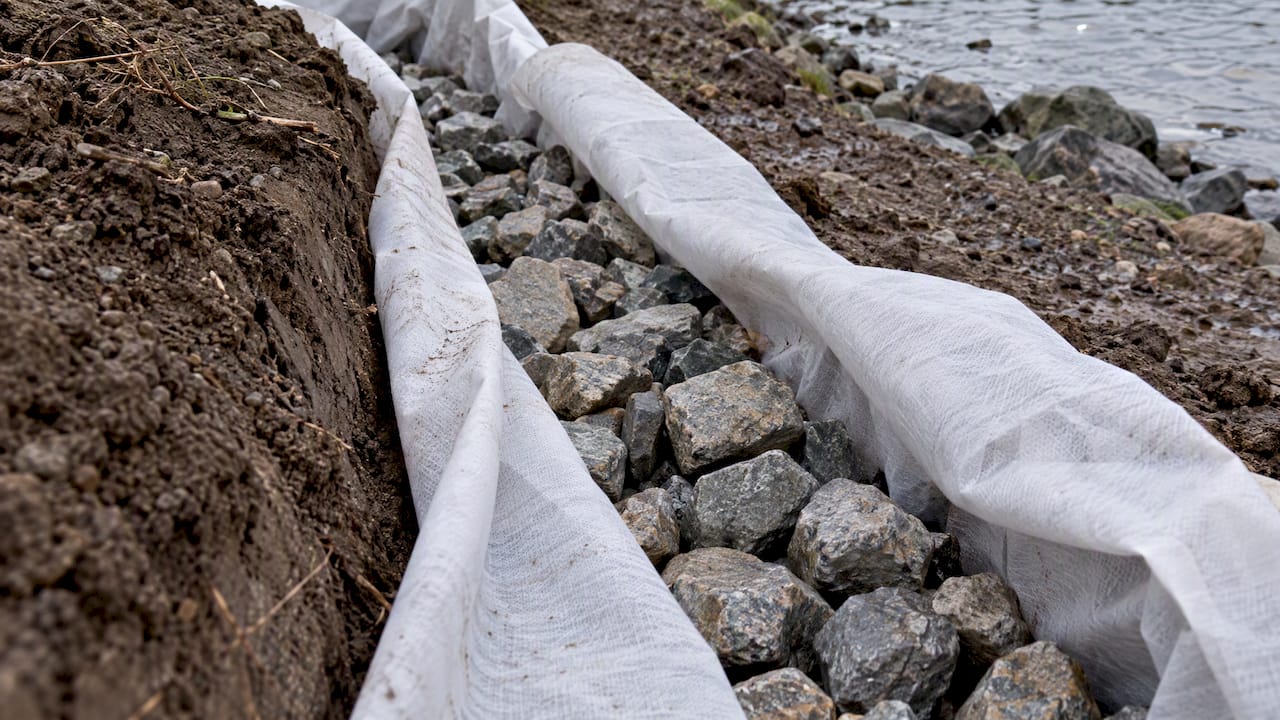
On a shoreline drainage project, clean 2 to 4 inch stone wrapped in non-woven geotextile was specified for the underdrain, matching the fines-free standard that keeps constructed drains working for years instead of clogging within a season. Projects like these are exactly where site-specific sizing matters most: soil type, slope, and water exposure all shift the right answer, and getting it wrong is expensive to fix after the fact.
What Homeowners Get Wrong About Rock Size
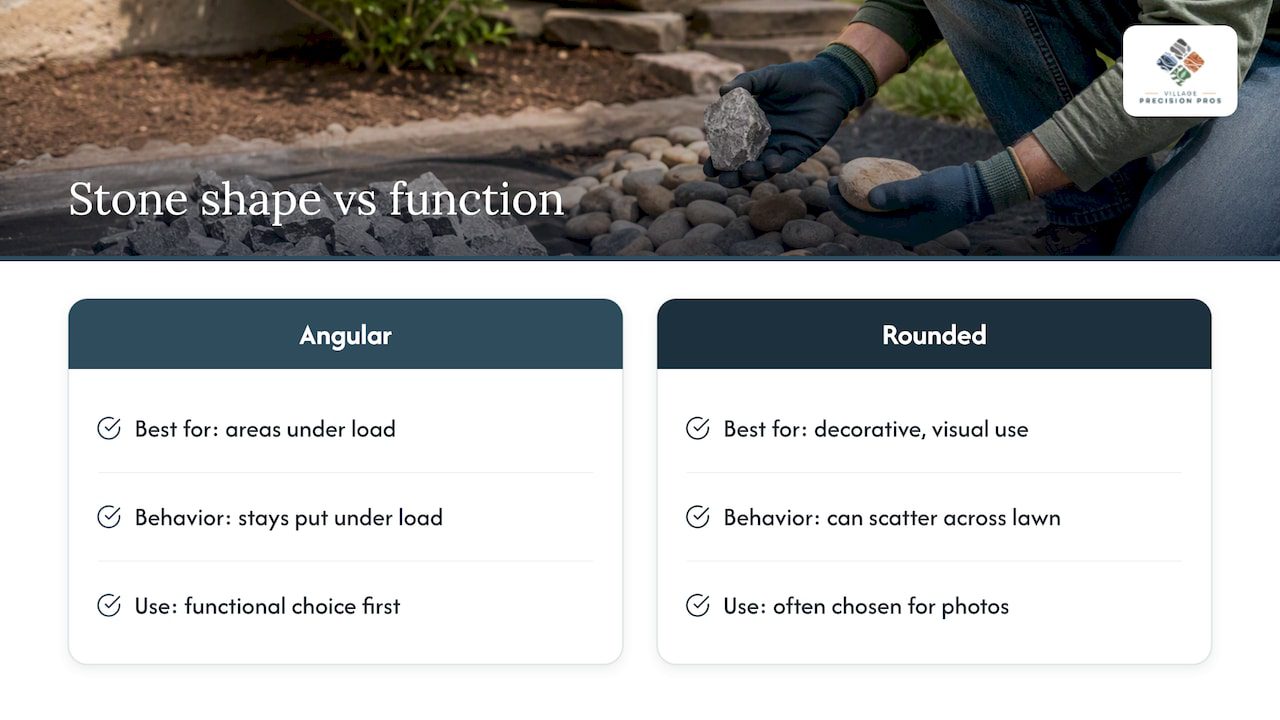
The biggest misstep we see is treating rock size as a cosmetic decision first and a functional one second. Homeowners pick river rock for a walkway because it looks good in photos, then wonder why it scatters across the lawn within a month. Size and shape are mechanical choices before they are visual ones: angular stone for anything that needs to stay put under load, rounded stone for anything that just needs to sit there and look good.
The second miss is depth. More rock is not better rock. A thick mound of decorative stone piled against a tree trunk feels generous, but it is one of the fastest ways to stress a tree’s root system, and it rarely gets questioned until the tree starts declining years later. Shallow and correctly placed beats deep and decorative almost every time.
If you take one thing from this guide, let it be this: match the stone’s shape and size to the job it has to do, not to the look you want first. The look usually follows anyway once the function is right.
— Ty
FAQ
What is the best size rock for landscaping?
There is no single best size. It depends on the job: pea gravel and 3/8 inch crushed stone suit walkways and patios, 3/4 to 2 inch river rock works for decorative beds, and 2 to 4 inch clean stone handles drainage.
What are standard rock sizes?
Common standard sizes run from pea gravel under 3/8 inch, through 3/8 to 3/4 inch crushed stone for bases and driveways, up to 2 to 4 inch spalls for drainage and 4 inch-plus riprap for erosion control and slope work.
What does 1 cubic yard of rock look like?
A cubic yard of rock fills a space roughly 3 feet by 3 feet by 3 feet, enough to cover a modest patio or walkway section at a few inches of depth once spread out.
How much does 1 yard of landscape rock cover?
Coverage depends on the depth you spread it at: a shallower layer covers more ground, while drainage or driveway applications that call for thicker depths will use up a yard of material much faster.