


A drainage dry well fails for a short list of reasons: clogged stone or fabric, soil that will not absorb water, a high water table, or a layout that sends it more water than it can hold. Most of these are visible from the surface if you know what to look for. Here in Central Arkansas, where heavy clay is common, the soil and the design matter as much as the pit itself, which is why we treat a dry well as a drainage plan and not just a hole with gravel in it. If yours is holding water, backing up into a gutter or overflowing, this guide shows how to find the cause and what a lasting fix looks like.
This article is about the underground drainage structure that catches roof and yard runoff. It is not about a private drinking water well that has run low, which is a question for a licensed well driller.
TL;DR
- A dry well that still holds water 72 hours after a storm is clogged or sitting in soil that cannot absorb it.
- The usual culprits are silt and leaves, worn filter fabric, tree roots, clay soil, a high water table and too much roof area feeding one pit.
- Seasonal checks and a silt trap at the inlet keep most wells working.
- A fully clogged gravel pit is only cleaned by removing and replacing the gravel, which is a job for a crew with equipment.
- If the soil is the problem, a different drainage layout is the answer, not a bigger hole.
Table of Contents
- What a dry well does, in plain terms
- How to tell your dry well is not draining
- The common causes of dry well problems
- What you can safely check yourself
- Dry well maintenance: what and when
- When cleaning is not enough
- Our perspective
- Getting it fixed in Central Arkansas
- FAQ
- Sources
What a dry well does, in plain terms
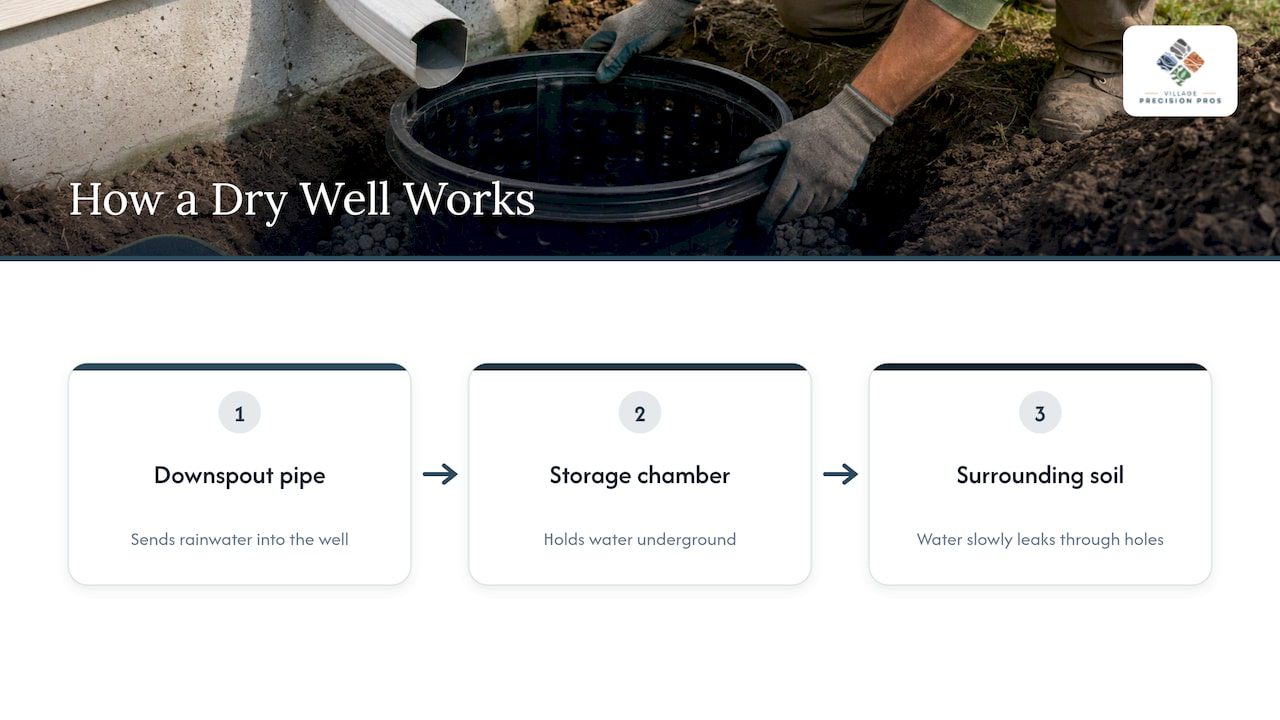
A dry well is an underground container with holes, buried and surrounded by drain rock. A pipe from a downspout sends rainwater into it, and the water slowly leaks out through the holes into the ground. It can be a pit filled with gravel or a prefabricated plastic chamber. Either way, it only works as fast as the surrounding soil can take water in.
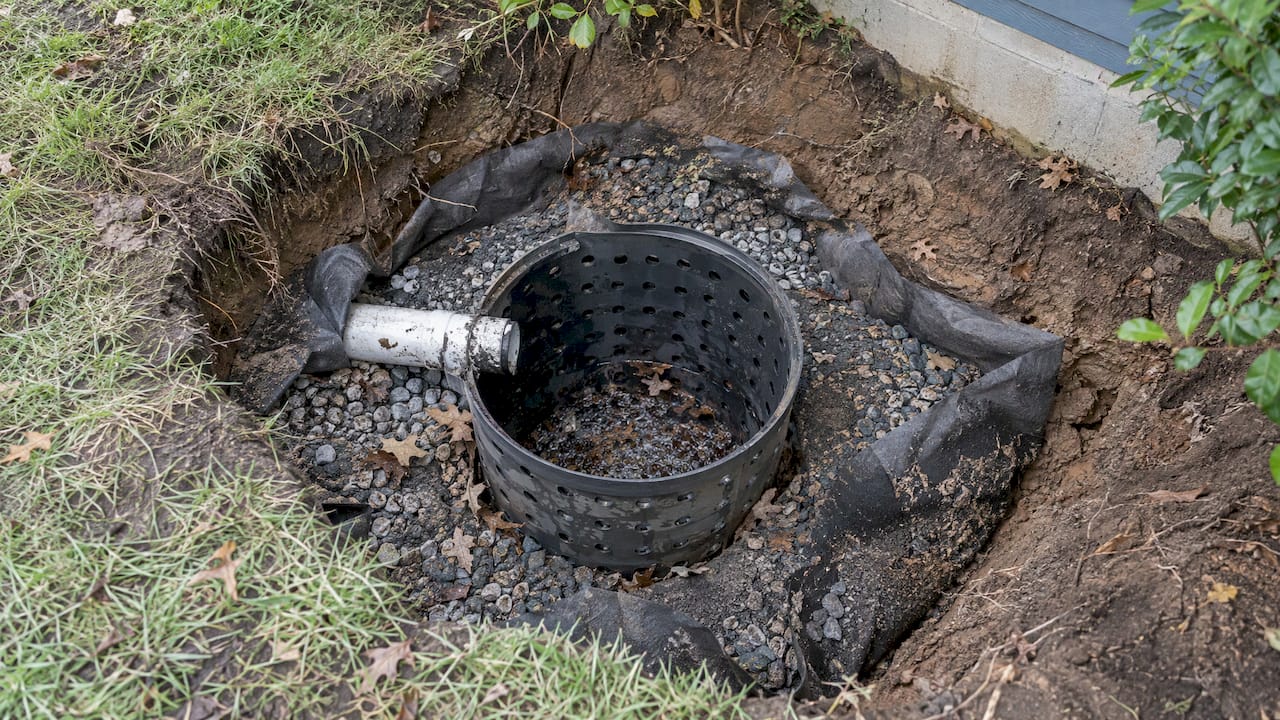
The parts that matter when something goes wrong are the storage chamber, inlet pipes, stone, filter fabric and an observation port that lets you look inside. Filter fabric keeps soil from migrating into the stone, and the observation port is how you check the water level without digging.
How to tell your dry well is not draining
The simplest test is time. Check the well after a significant rain. Guidance from a stormwater demonstration site says that if standing water persists after 72 hours, the system is clogged and needs cleaning or new stone and soil at the bottom of the excavation. Penn State’s design guide likewise says dry wells should empty within 72 hours of a rain event.
Other signs to watch for:
- Ponding at the surface above or near the well.
- Water backing up into the gutter or out of the downspout joint.
- Overflow at the start of a storm. This points to sediment or leaf debris in the pipe or buried gravel, according to Annapolis guidance.
- A soggy patch that returns in the same spot after every rain.
Water that sits for more than a day or two is more than a nuisance. It can soften soil next to a foundation, undermine a patio base and breed mosquitoes. If you see it near your slab, call us before the next storm.
The common causes of dry well problems
Clogged stone and filter fabric
Runoff from a roof carries shingle grit, pollen and leaves. Without a trap, that silt settles in the stone and coats the fabric until water cannot pass. Oregon State’s extension service says runoff must be treated before it enters a drywell and recommends a silt basin in addition to gutter screens for roof water. Silt traps are used to prolong the life of the facility.
Soil that cannot absorb the water
A dry well depends on permeable soil. Reduce Flood Risk notes dry wells are only a good option if there is a permeable soil layer within about four feet of the surface. Much of Central Arkansas sits on clay, which drains slowly. In that soil, a well can fill and overflow faster than it empties, and no amount of cleaning changes that. Our dry well vs French drain guide walks through how to choose when the soil is the limiting factor.
A high water table or shallow rock
Penn State recommends the bottom of a dry well sit 2 feet above the seasonally high water table or bedrock. If groundwater rises into the pit during wet months, the well has nowhere to send runoff. This is common near lakes and creeks, and it cannot be fixed by digging deeper.
Too much water for the size
A dry well stores water temporarily, then releases it. A standard residential well 36 inches across and 36 inches deep holds roughly 50 gallons, according to one construction guide. A single downspout on a large roof can deliver more than that in a short storm. The fix is a properly sized system, more than one outlet, or an overflow route. Oregon State says that when a drywell reaches saturation, a bypass or overflow system is needed, and excess runoff should never be sent to a neighbor’s property without an easement.
Tree roots and planting over the top
Roots find moisture and can invade pipe joints and stone. Portland.gov advises against planting large shrubs or trees over a drywell so access stays open for maintenance.
Poor placement and installation
The same Bob Vila feature quotes a plumber who says a dry well is very easy to install wrong. Placement rules matter. Penn State recommends about 10 feet of separation from building foundations and roughly 1 foot of cover on top. A municipal stormwater booklet lists places infiltration should not go: beneath impervious surfaces, over utility lines or above a septic field, or where bedrock or the water table is less than two feet below the trench bottom.
What you can safely check yourself
Some steps are simple and safe for a homeowner:
- Clear the inlet. Remove leaves and debris at the drain entry and verify the access lid is not buried or missing.
- Clean the gutters and downspout screens. Less debris upstream means less silt in the well.
- Flush the line. This Old House suggests a handheld plumbing snake or a hose with a high-pressure nozzle to clear clogs in the inlet pipe.
- Look at the downspout. Make sure it is connected tightly and not dumping beside the foundation instead. Our downspout drainage ideas page covers common layouts, and a guide on downspout extension lengths explains how far to carry water from the house.
- Watch the next storm. Note how long the water takes to drop.
If the pipe is clear and the well still holds water for days, the clog is in the stone or fabric, or the soil is saturated. That is where a surface fix ends.
Dry well maintenance: what and when
Good upkeep is mostly inspection. New Hampshire’s environmental agency recommends inspecting seasonally and after large storms for ponding or water backing into the gutter. A stormwater demonstration site lists an annual routine:
- Check and clean the sediment pre-trap at least yearly and after big storms.
- Clear leaf and yard debris at the entry.
- Confirm the access lid is visible and intact.
- Inspect the interior for pipe condition and make sure sediment is not more than one third full.
- Check for erosion around the inlet and outflow.
This Old House also recommends a catch basin or filter at the entrance of the pipe to stop debris before it falls in, and replacing worn fabric.
For property managers and agents, the practical point is the paper trail: Penn State says a homeowner should receive a maintenance plan that includes the well’s location and long-term requirements. A buried structure nobody can locate is the one that never gets checked. Our annual maintenance plans are built for exactly this kind of recurring inspection.
When cleaning is not enough
Penn State states that the only way to clean a clogged gravel-pit dry well is removal and replacement of the gravel. That means excavation, new stone, new fabric and a pre-treatment sump with a cleanout hatch so the next clog is a ten-minute job instead of a dig. It is also the moment to correct the root issues: depth, distance from the foundation, overflow route and roof area served.
Call a professional when:
- Water stands for more than 72 hours even after the inlet is cleared.
- The well sits close to the foundation, a septic field or utility lines.
- Overflow runs toward a neighbor, a driveway or a retaining wall.
- Soil is heavy clay or the ground stays wet most of the year.
In those cases the right answer may be a different system: a French drain, a regrade, a dry creek bed or a surface swale. We lay out the options in our yard drainage solutions and dry creek bed drainage guides.
Our perspective
Most dry well calls we hear about are really drainage design calls. The pit is only one piece. What matters is where the water comes from, how much of it there is, what the soil beneath can take, and where the extra goes when the ground is full.
Our crews work on drainage, grading and hardscape together, so we look at the whole yard: the downspouts, the slope, the patio base and the foundation. That is how a repair holds. A well that is cleaned out but still draws water from an oversized roof area will clog again.
We prefer to build in access: a silt trap, an observation port and a clear overflow path. Then maintenance is a quick seasonal check, and the owner always knows where the system is.
Ty
Getting it fixed in Central Arkansas
If your dry well is not draining, or you are not sure what is buried in the yard, we can assess the drainage and recommend the fix that suits your soil and property. Our Landscape & Irrigation service covers drainage work, and our Hardscape & Stone Masonry crews can rebuild any patio or walkway that standing water has undermined. Property managers and agents can ask about recurring checks through a maintenance plan.

To start, visit Village Precision Pros and request a visit.
FAQ
Why is my dry well not draining?
The usual causes are a clogged pipe, stone or filter fabric, clay soil, a high water table, or more roof runoff than the well can hold. Standing water after 72 hours means the well is not working as designed. Clear the inlet first, then have the rest evaluated.
How often should I maintain a dry well?
Inspect it each season and after large storms, and clean the silt trap and inlet at least once a year. Keep gutters clear and the access lid uncovered. Look for ponding or water backing up in a gutter.
Do dry wells come back after they clog?
A clogged dry well can be restored, but a fully clogged gravel pit generally needs its stone and fabric removed and replaced. If the cause was soil or water table, it will clog or flood again unless the design changes.
Can I plant over a dry well?
Grass is fine. Large shrubs and trees are not, because roots can reach the well and block access for maintenance.
Sources
- Drywells, Portland.gov
- What Is a Dry Well? Bob Vila
- Dry Well, Green Stormwater Demo Site
- Design and Construction of Dry Wells in Pennsylvania, Penn State
- Drywells fact sheet, OSU Extension
- Install dry wells, Reduce Flood Risk
- Stormwater Booklet, City of Johns Creek
- Dry Well, New Hampshire DES
- How to Build a Simple Dry Well, This Old House
- French Drain and Yard Drainage Guide, Projul
- Downspout extension lengths