

Yes, you can put artificial turf on a slope, and on gentle to moderate grades it can hold up for years. The turf is the easy part. What decides the result is the ground under it: a compacted base, a plan for where the water goes, and an edge that locks the whole surface in place. Steeper or longer slopes need more reinforcement or a different structure altogether, such as terraces or a retaining wall.
If you own a sloped yard in Central Arkansas, you already know how our clay-heavy soil and heavy spring rain move earth around. This guide explains what to check before you commit, how a sloped installation is built, and where the common failures start. It is written for homeowners, property managers, agents and business owners who want a result that stays put. Our crews install artificial turf in Central Arkansas and handle the drainage and grading that a slope demands.
TL;DR
- Artificial turf works on gentle to moderate slopes when the base is compacted, the edges are anchored and water has a planned exit.
- Measure your grade first: rise divided by run, times 100. Steeper grades call for fabric reinforcement and tighter anchoring.
- Very steep or long runs are better broken up with terraces or a retaining wall than covered in one sheet of turf.
- Most failures trace back to drainage: runoff from above, or no outlet at the bottom edge.
- Sloped lots take more preparation than flat ones, so the scope of the base work drives your total more than the turf itself.
Table of Contents
- Start by measuring your slope
- Drainage comes before turf
- Build the base to hold the slope
- Anchoring, seams and edges
- Curves and uneven ground
- When a slope is too steep for turf alone
- Where sloped turf goes wrong
- Who this works well for
- What drives the total
- Our perspective
- Plan your sloped turf project with us
- FAQ
- Sources
Start by measuring your slope
Before you look at turf samples, find out how steep the yard really is. Slope is usually written as a percent, and the math is simple: divide the vertical rise by the horizontal run, then multiply by 100.
Here is a worked example. Stake a string level at the top of the slope and run it out horizontally to a point 10 feet away. Measure straight down from the string to the ground at that point. If the drop is 2 feet, your grade is 2 divided by 10, times 100, which is 20 percent. A 3 to 1 slope, meaning 3 feet of run for every foot of rise, is about 33 percent.
That number tells you what kind of project you have. These are the working ranges we use for planning, and the final design always depends on soil, slope length and water flow:
| Grade | What it looks like | Typical approach |
|---|---|---|
| Under about 15% | A gentle yard slope you can mow or walk without effort | Standard compacted base, firm edge restraint |
| About 15% to 33% | Noticeable hillside, steep enough to feel in your calves | Fabric under the base, denser anchoring, planned drainage |
| Over about 33% | Steep bank, 3 to 1 or steeper | Terraces or a retaining wall, then turf on the level sections |
Two more factors matter as much as the percentage. Length is one: a short slope sheds water in seconds, while a long one builds speed and volume. Soil is the other. Sandy soil drains but washes out, and clay holds water and turns slick and heavy. Both are common here.
Drainage comes before turf
Water is the real opponent on a slope. Artificial turf has drainage holes and sits on a permeable base, but the system still has to move everything it receives somewhere safe. Two sources matter: rain landing on the turf itself, and runoff arriving from higher ground, a roof, a downspout or a neighbor’s yard.
The U.S. Department of Energy’s Building America Solution Center advises sloping the surface away from the house, with swales where space allows and drains where it does not. It describes a French drain as perforated pipe wrapped in rock and landscape fabric that carries collected stormwater to a lower part of the site, a drywell, a storm sewer or a retention pond. It also reminds homeowners to follow local stormwater ordinances and to do final grading after the soil settles.
A swale is a shallow, broad channel that carries water around or away from an area. The same guidance recommends a longitudinal grade of 2% to 4% for a swale: flatter than 2% can leave water standing, and steeper than 4% can speed the flow and cause erosion. That is a useful rule for the channel you build above or beside your turf, even though the turf slope itself can be steeper.
For a sloped turf project, we think about drainage in three places:
- Above the top edge. Intercept runoff before it reaches the turf with a shallow swale or a drain. Our guide to drainage swale design shows how that channel works.
- Under the surface. The base must let water pass without carrying soil along with it. Fabric and compacted stone do that job.
- At the bottom edge. Water that travels through or over the turf needs a curb, buried edge or gravel trench with a drain, so it does not cut a gully at the toe.
If roof water is part of the problem, deal with it first. Our article on downspout drainage ideas covers how to carry it away from the slope, and yard drainage solutions explains what to try first. Hard surfaces beside the turf, such as a patio or driveway, benefit from channel drainage for patios and driveways so runoff from them does not wash across the new surface.
Build the base to hold the slope
A sloped base is built in layers, and each layer has one job.
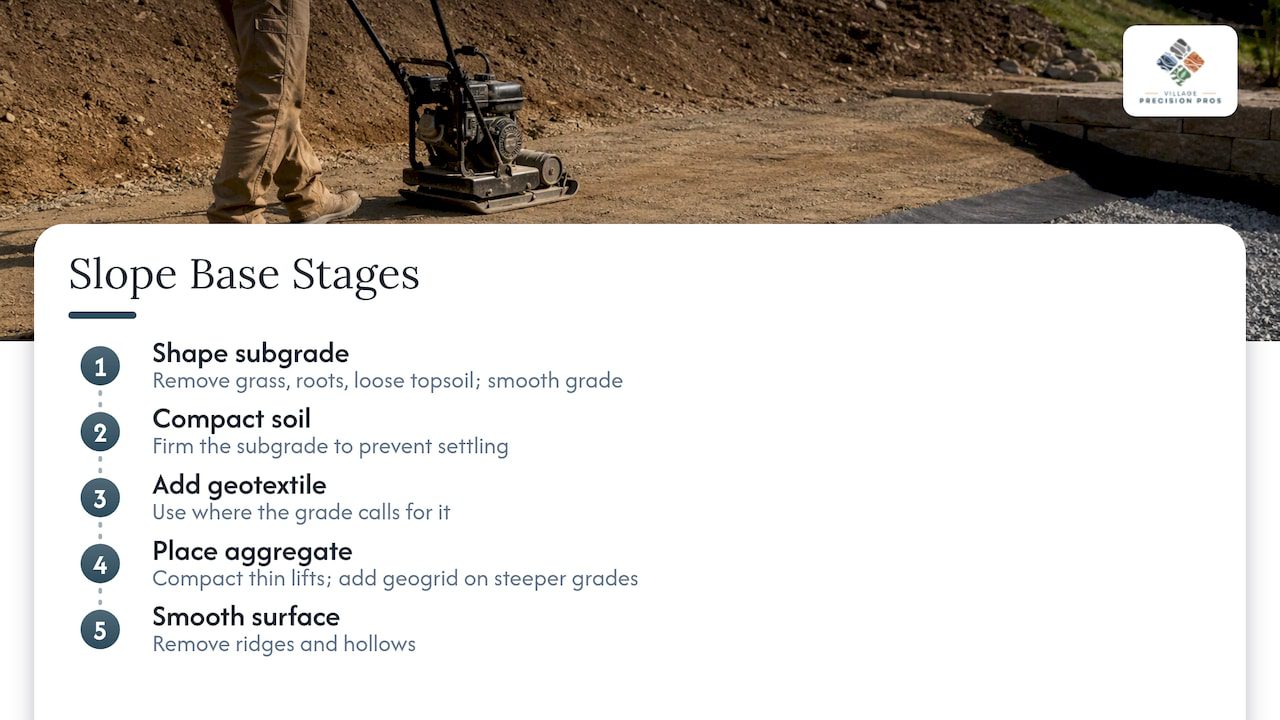
Remove and shape the surface. Existing grass, roots and loose topsoil come out. Soft, organic material under a turf slope compresses unevenly and creates sliding planes. The subgrade is shaped to a smooth, consistent grade without dips where water could pool.
Compact the subgrade. On a slope, compaction is not optional. Loose soil settles, and settling on a hill turns into creep. Plate compaction works the ground until it is firm underfoot.
Add geotextile where the grade calls for it. Geotextile is a woven or non-woven filter fabric laid over the soil. The Maine Department of Environmental Protection’s erosion field guide explains that geotextile separates or reinforces soil and rock layers while holding soil in place and letting water through, and that the fabric type should suit its use. On a slope that matters: it keeps the stone base from mixing into clay and gives the base something to grip.
Install a compacted aggregate base. Crushed stone goes down in thin lifts, each one compacted before the next. Thin lifts matter because a thick, loosely tamped layer looks fine on day one and slumps by the first wet season. On steeper grades, a geogrid, a stiff plastic mesh embedded in the stone, adds interlock so the base resists sliding.
Finish the surface smooth. Turf telegraphs every ridge and hollow. A slope with a lumpy base will show it, and wet turf on a slick grade is also harder to walk on.
If you have already read our step by step guide to installing artificial turf, the sequence is the same. On a slope, each step is done with less margin for error.
Anchoring, seams and edges
Gravity pulls on turf all day, and water and foot traffic add to it. A sloped installation survives by anchoring.
- Roll direction. Rolls are laid so seams run with the fall of the slope rather than across it. A seam that runs across the hill collects water and takes the strain of the downhill pull.
- Pull it taut, then fasten. Turf is stretched downhill before it is nailed. If it is fastened first, wrinkles and bagging develop below the top edge as the material relaxes.
- Perimeter restraint. The outer edge is fixed to a curb, a buried edge board or a firm gravel trench, and fastened at a tight interval. Edges are where turf lifts first.
- Extra anchors on steeper grades. Moving up the grade, the spacing of fasteners tightens and extra anchors go into the field of the turf, not only the perimeter.
- Seams. Seam tape and adhesive hold neighboring pieces together. A poor seam shows up as a visible line and can open under load.
- Infill. Infill weighs the turf down and supports the blades. On slopes, heavier or bound infill resists migrating downhill.
The edge fastening interval varies by product and by how many corners and curves the design has, so follow the manufacturer’s installation guidelines for the product used, and tighten the spacing where the grade increases.
Curves and uneven ground
Turf does lay over curved slopes, but not by being forced. A smooth, gently rounded contour is no problem. A sharp convex hump or a concave hollow is where wrinkles, gaps and standing water appear.
The fix happens in the grading. We shape the subgrade into smooth transitions before the base goes in, so the turf follows the ground without being stretched. Curves also use more material, because the cuts and the offcuts add up. Irregular layouts take more turf than a plain rectangle, which is one reason curved projects need a careful measure.
If the ground is uneven because of a deeper issue, such as a soft spot or soil that is moving, covering it with turf will not solve it. Settling near the house can also be a foundation question. We offer foundation leveling as well as landscape work, and it is better to sort out structural movement before anything goes on top of it.
When a slope is too steep for turf alone
Past about a 3 to 1 grade, the smarter move is usually to change the slope rather than cover it. Two common ways:
- Terraces. The hill is broken into level steps with short walls between them. Each step can hold turf, a patio, planting or a seating area. Water is slowed and captured on every level.
- A retaining wall. A wall holds back the upper ground and lets you create a flat, usable pad at the bottom or top.
These are masonry jobs, not turf jobs, and they are where a long, steep yard becomes genuinely useful. See our retaining walls and terraces work, and our piece on building a patio on a sloped backyard for how level space is created on a hill. Our hardscape and stone masonry crews build these structures.
If your slope is only part of a bigger plan, artificial turf versus natural grass can help you decide which areas get which surface.
Where sloped turf goes wrong
Most problems on slopes are predictable, and most come from skipping base work.
| What you see | Usual cause |
|---|---|
| Wrinkles or bagging below the top edge | Turf fastened before being pulled taut downhill |
| Washout or a gully at the bottom edge | No curb, edge or drain at the toe |
| Soft or sinking patches | Base laid in thick layers or not compacted |
| Water streaming across the surface | Uphill runoff not intercepted |
| Edges lifting | Perimeter fastening too wide or edge not restrained |
| Turf creeping downhill | Light infill, too few anchors, or a base that moved |
Two other practical points. Wet turf on a steep grade can feel slick underfoot, so smooth-soled shoes need care, and families with kids or older relatives should think about how the slope will be used. Also, south and west facing slopes in a hot climate get hotter in summer afternoons, a real consideration in an Arkansas July. Plan seating and play areas around shade, and keep the turf where you will actually use it.
Who this works well for
Homeowners and families. A sloped side yard or a bank behind the house that is hard to mow can become a clean, green surface that does not need cutting. Planning for safe footing and drainage makes it usable, not just good looking.
Real estate agents. A steep, patchy bank hurts curb appeal. A stabilized, finished slope reads as a maintained property.
Property managers and businesses. Medians, embankments and retention-adjacent slopes are expensive to maintain by hand. See our write up on commercial artificial turf in Arkansas and our low maintenance commercial landscapes article, and consider our annual maintenance plans for the areas around the turf.
What drives the total
We do not quote from a keyword, because a sloped project is priced by the site. These are the factors that move the total:
- Steepness and length of the slope. More grade means more reinforcement and more anchoring.
- Soil condition. Soft or clay soils need more excavation and a deeper stone base.
- Drainage work. Swales, French drains and toe drains add labor and material.
- Removal of what is there. Old sod, roots, rocks and debris all take time.
- Access. Hauling stone and equipment up or down a steep yard is slower than working on flat ground.
- Edges and structures. Curbs, walls or terraces add scope.
- Turf grade, infill and total area. The product itself is one line among many.
The practical consequence: two yards of the same square footage can have very different totals, and the sloped one carries more of its cost in the work you cannot see once it is finished.
Our perspective
We see sloped turf as a drainage and base project that happens to end in grass. The turf is the finish. What decides whether the yard still looks right in five years is what sits underneath and where the water goes.
That is why we start with the grade and the water, not with a sample. We look at where runoff arrives, what the soil does when it is wet, and whether the slope is a turf job or a wall job. Many homeowners are surprised how often the honest answer is a little of both: a short retaining wall or terrace to tame the steepest part, and turf on the level ground it creates.
Because our crews do artificial turf, stone masonry, drainage and irrigation, and foundation leveling, we can design the slope as one system rather than handing pieces from one trade to the next. Our focus is quality materials and careful craftsmanship, so the edges, seams and base are done to last.
Ty
Plan your sloped turf project with us
If you have a slope in Central Arkansas and want it to be usable, green and stable, we can look at the grade, the drainage and the soil, and tell you whether turf, terraces, a wall or a combination fits. Our artificial turf installation service covers the base, anchoring and finishing, and our landscape and irrigation team handles water control around it.

We have completed more than 2,000 projects across Central Arkansas since 2020. To talk through your slope, start at villageprecisionpros.com.
FAQ
Can you do turf on a slope?
Yes. Gentle to moderate slopes work well with a compacted aggregate base, seams that run with the fall, and tight edge anchoring. Steeper grades need fabric reinforcement and more anchors, and very steep or long runs are better divided with terraces or landings.
How steep is too steep for artificial grass?
As a planning rule, grades up to about 15% are straightforward, and 15% to 33% need extra reinforcement and drainage design. Beyond about 3 to 1, we recommend terraces or a retaining wall rather than turf alone. Soil and slope length can change that answer, so the yard should be assessed on site.
Will rain wash out the base under sloped turf?
It will if the water has nowhere planned to go. Intercepting runoff above the turf, using fabric that holds soil while letting water pass, and building a curb or drain at the bottom edge keep the base in place.
Can artificial grass go on a curved slope?
Yes, as long as the contours are smooth. The subgrade is shaped so the turf follows the ground without being stretched, and curved layouts use more material because of the extra cuts.
Do I need a retaining wall first?
Sometimes. If the grade is steep or the slope is long, a wall or terrace creates level sections that hold turf far better. We can tell you which approach suits your yard after seeing it.
Sources
- Swales, Drains, and Site Grading for Stormwater Control, Building America Solution Center
- Maine Erosion and Sediment Control Practices Field Guide, Maine Department of Environmental Protection