

The best base for artificial turf is a compacted layer of crushed stone, usually about four inches of Class 2 road base, topped with a thin, smooth layer of decomposed granite or sand, all graded so water has somewhere to go. The turf itself is the visible part. The base is what keeps it flat, firm and dry for years. At Village Precision Pros, we build turf bases for Central Arkansas homes and businesses, and this guide explains what goes in the ground, why each layer is there and where installations go wrong.
TL;DR
- A typical turf base is about four inches of compacted Class 2 road base plus a half inch to one inch of sand or decomposed granite on top.
- The base has two jobs: a firm, flat foundation and a path for water to leave. A base that only does the first one fails in the first heavy rain season.
- Flat areas need a slight slope toward a runoff point, at least 1/4 inch per foot.
- Heavy clay soil usually calls for a thicker, more open base, and sometimes a drain line.
- Most base failures are hidden for a season, so the preparation matters more than the turf you pick.
Table of Contents
- What the base under artificial turf actually does
- The layers, from the ground up
- Which base material is best?
- How to prepare a turf base, step by step
- Drainage: where a turf base succeeds or fails
- Matching the base to how you use the yard
- What drives the total on a turf base
- Where Village Precision Pros fits
- Our perspective on turf bases
- FAQ
- Sources
What the base under artificial turf actually does
Artificial turf is a thin, flexible carpet. It has almost no structure of its own, so it copies whatever is underneath it. Every dip, bump and soft spot in the ground shows through the blades.
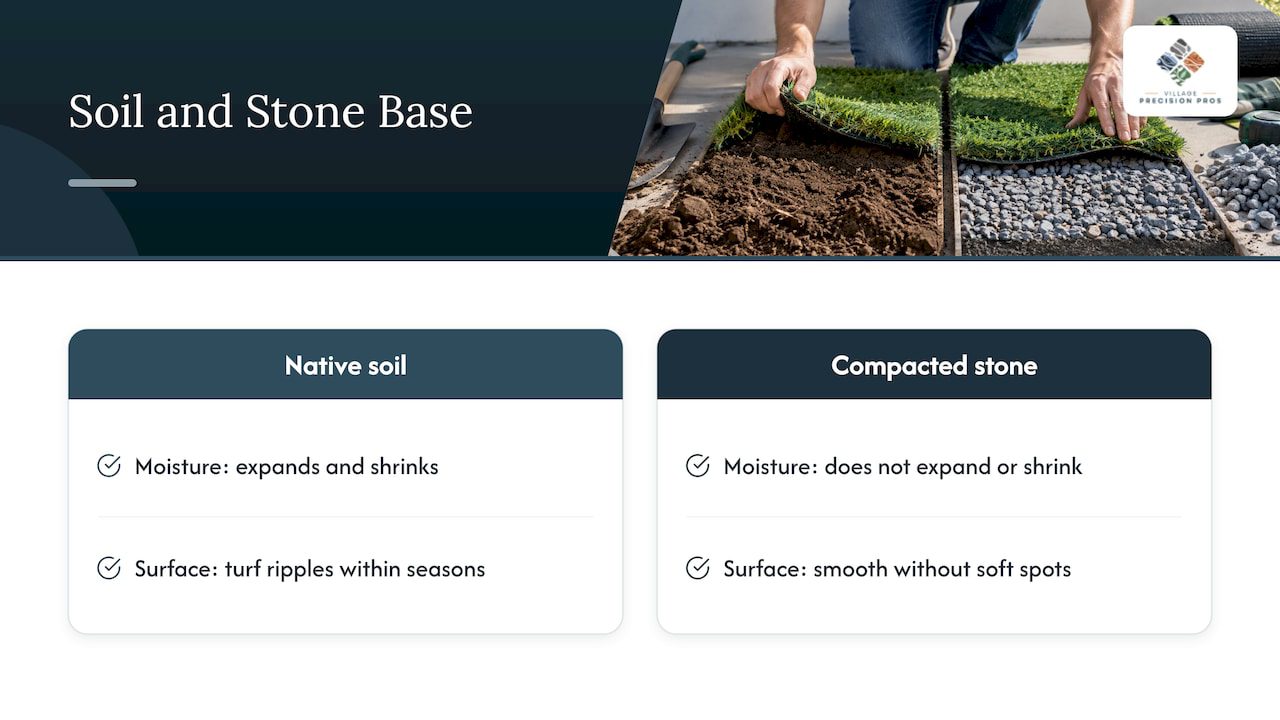
Native soil is a poor foundation for that reason. Soil expands as it takes on moisture and shrinks as it dries, clay most of all, while a compacted stone base does not. That difference is why a properly built base gives you a smooth surface without wrinkles or soft spots, and why turf laid straight on dirt tends to ripple within a couple of seasons.
The base does a second job that homeowners often overlook. The Synthetic Turf Council’s base guidelines describe the base as a structural foundation and a drainage medium at the same time. Turf backing is perforated so rain passes through it. What happens next depends on the stone and soil below.
The layers, from the ground up
A turf installation is a stack. Each layer has a purpose, and skipping one usually shows up later as a problem you can see.
- Native soil (subgrade). The existing ground, cleared of sod, roots and organic material, then shaped and compacted. Whatever slope and firmness you build here carries through to the surface.
- Separation fabric, where the soil needs it. A woven or non-woven fabric that keeps clay and soft soil from mixing up into the stone. It is not needed everywhere, but on clay it earns its place.
- Base rock. The structural layer, typically about four inches of crushed stone such as Class 2 road base, compacted until it is solid.
- Finishing layer. A half inch to one inch of decomposed granite or sand, compacted as a smooth underlay.
- Turf. Seamed, fastened at the edges and brushed.
- Infill. Sand or another infill that holds the blades upright and gives the turf weight.
The depth of the base rock changes with the site. A shaded side yard with sandy, free-draining soil can get by with less. A play area that sees daily traffic, or a yard where water already stands after storms, needs more.
Which base material is best?
Most installers talk about three families of material. They overlap, and the names vary by region, so here is how they differ in plain terms.
| Material | What it is | Where it fits |
|---|---|---|
| Crushed stone or gravel | Angular rock broken to a consistent size | Main base layer, especially where drainage matters |
| Class 2 road base | Crushed rock blended with fines so it packs tight | Main base layer for most residential yards |
| Decomposed granite | Weathered granite in fine, sand-like pieces | Thin finishing layer under the turf |
| Sand | Fine, uniform grains | Thin finishing layer, or bedding in some cases |
Crushed stone and gravel
Angular crushed rock locks together when compacted and leaves gaps between the pieces for water. The Synthetic Turf Council says the stone should be tightly graded, free of silts and fines that block water, and have enough void space for water to move both down and sideways. Rounded pea gravel is a different story. It rolls underfoot and never locks, so it is a poor structural base.
Road base for turf
Road base is the workhorse of residential turf. It is crushed rock with a mix of particle sizes, and those smaller particles let it compact into a hard, stable layer. Pros commonly specify a compacted four-inch layer of class 2 road base or something similar.
The trade-off to understand is the fines. More fines mean easier compaction and a firmer surface. Too many fines slow drainage. That is why the quality and grading of the road base matter, and why we match the material to the yard’s soil and water conditions instead of ordering whatever is cheapest to haul.
Decomposed granite and sand
A thin top layer of decomposed granite or sand fills the tiny voids in the stone and gives a smooth plane for the turf backing to rest on. It is a finishing layer, not a replacement for the road base. Using it alone, several inches deep, is a common shortcut that tends to wash and settle unevenly.
How to prepare a turf base, step by step
Here is the sequence a well-run installation follows, with the places it most often goes wrong.
1. Mark the area and remove what is there
Strip the sod, roots, weeds and any soft topsoil. Turf over organic material is turf over something that will rot and shrink. Removal depth usually matches the combined depth of your base and finishing layers, so the finished turf sits at the right height against sidewalks, patios and borders.
Where it goes wrong: leaving roots, especially near trees. Our guide to turf around trees explains how to keep root zones protected while still getting a clean install.
2. Set the grade and the slope
This is the step that decides how your yard handles water. Flat areas of new turf need a minimum slope of 1/4 inch per foot toward a runoff point, so water does not collect under the turf and break it down. The runoff point might be a lawn edge, a catch basin, a drain line or a planting bed.
Where it goes wrong: building a perfectly flat surface. It looks right to the eye and holds water in practice. The Synthetic Turf Council warns that a flat subgrade can collect water below the stone, saturate the soil and cause long-term stability problems, and that incomplete drainage raises the risk of frost heave.
3. Compact the subgrade
The native soil gets compacted before any stone goes down. Skipping this leaves a soft layer under the base that settles over time, and the settling telegraphs to the surface as a low spot.
4. Add fabric where the soil calls for it
On heavy clay, a separation fabric keeps the base from pushing into the soil and the soil from pushing up into the stone. In sandy, well-draining soil it is often unnecessary. Judging which case you have is a site call, not a formula.
5. Spread and compact the base rock in layers
Base rock goes down in even lifts, lightly moistened and compacted with a plate compactor or roller until the surface is dense and does not shift underfoot. One thick pass of loose stone never compacts evenly all the way through. The result is a base that feels firm on top and soft below.
Where it goes wrong: rushing this step. It is hard, loud, repetitive work, and it is the part that cannot be repaired after the turf is down without lifting everything.
6. Add and smooth the finishing layer
The decomposed granite or sand layer is spread thin, screeded flat and compacted. The goal is a surface you can run your hand over and feel no ridges. A half inch to one inch is the typical range, and one inch is the bare minimum the source calls for solidity, comfort and drainage.
7. Install the turf, edge it and infill
Only now does the turf come out of the roll. It is laid, seamed, nailed or fastened along a firm border, then infilled and power-brushed. A clean edge detail matters as much as the base: turf that is not anchored to something solid can creep at the borders.
Drainage: where a turf base succeeds or fails
It is tempting to assume that because turf is perforated, water is solved. The turf passes water quickly. The base and soil decide whether the water leaves.
On sandy or loamy ground, water usually moves through the stone and into the soil without help. On heavy clay, it often does not. Water comes through the turf, meets a subgrade that will not accept it and backs up in the base. The usual signs are a damp surface after rain, a sour smell and weeds growing at the seams, often a season or more after installation.
The fixes are straightforward when planned at the start:
- A thicker layer of open, clean crushed stone that holds more water.
- Separation fabric between clay and stone.
- Grading that shapes the surface toward a designated outlet.
- A perforated drain line in the base, running to a legal outlet, where the volume of water is significant.
Roof runoff is another common culprit. A downspout that dumps beside a turf area can overload even a good base, so we often tie it into a solution described in our downspout drainage ideas. For the broader picture of how water moves across a property, see our guide to landscape water drainage solutions.
Matching the base to how you use the yard
The right base is not the same for every property. Think about the load and the water.
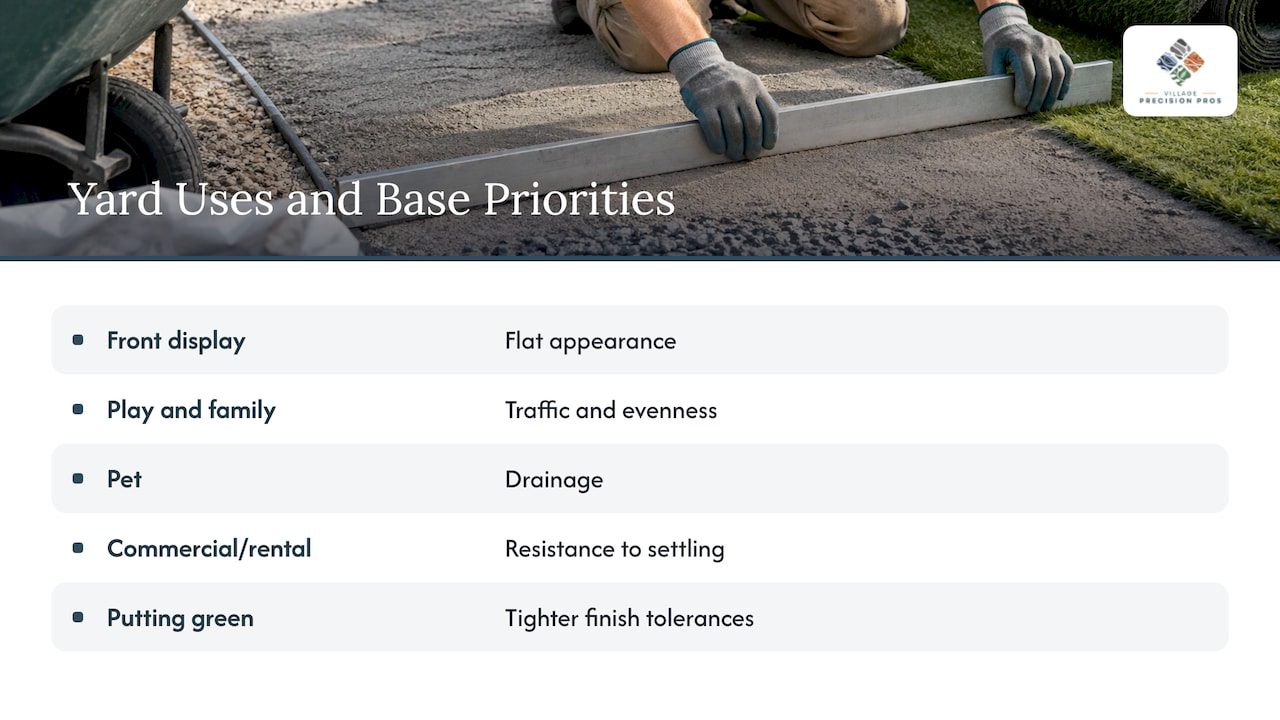
Front yards and display areas. Appearance and flatness drive the decision. A well-compacted four-inch base with a smooth finishing layer covers most of these.
Play areas and family yards. Heavier traffic and the need for a soft, even surface make compaction and a consistent finishing layer especially important.
Pet areas. Dogs add a daily liquid load, so the base needs to drain freely and cleanly. We cover that in our pet turf installation guide.
Commercial strips, medians and rental properties. Low maintenance is the goal, so a base that does not settle matters more than usual, because a repair means a work order. Our piece on commercial artificial turf walks through that case.
Putting greens. These use tighter tolerances and finer finishing layers, which is a separate build from a landscape lawn.
What drives the total on a turf base
We do not quote numbers in an article, because a base is priced by the site, not by the roll. These are the factors that move the total:
- Square footage and shape. Large, simple rectangles are more efficient than small, curved areas with many edges.
- Excavation depth and removal. Thick sod, old landscaping, roots or hauling away spoil add labor.
- Base depth and material. A thicker or more open base needs more stone.
- Soil conditions. Clay may add fabric, extra depth or drainage.
- Access. Gates, slopes and distance from the street affect how equipment and material move.
- Drainage work. Drain lines, catch basins and tie-ins add scope.
- Edging and borders. Patios, pavers or timber borders need their own prep.
A written scope that lists these items lets you compare quotes fairly. The cheapest-looking line is often the one with a thinner base or no drainage plan.
Where Village Precision Pros fits
Our artificial turf installation service in Central Arkansas covers the full build, from excavation and grading through base work, turf installation and finishing. Drainage and uneven ground are the problems our approach is built around, and we have completed more than 2,000 projects since 2020. If your yard has a low spot, a downspout problem or soil that holds water, tell us up front so the base is designed for it.
If you want to see the process in more detail, our guide on how to install artificial turf lays out the full sequence, and our look at the four specs that decide how turf ages in Arkansas covers the turf side.
Ready to plan your project? Contact Village Precision Pros to talk through your yard.

Our perspective on turf bases
Homeowners spend most of their attention on the turf: the color, the pile height, the feel. We understand that. It is the part you see. But in our experience of building outdoor spaces across Central Arkansas, the lawn you will be happy with in year five is decided by what happens in the first two days, when the ground is open.
That is why we treat the base as a design and drainage problem, not a material delivery. We look at where water comes from, where it should go and what the soil underneath will allow. Then we choose the depth, the stone and the grade to fit.
Our crews pair that with the same attention to detail we put into patios, pathways and other hardscapes, where a compacted aggregate base is also the difference between a surface that stays flat and one that shifts. Whether your project is a turf lawn, a patio or both, a good foundation is how we deliver long-term value, and it is why we would rather talk about the ground with you before we talk about the turf.
Ty
FAQ
What should I put down before laying artificial turf?
Clear and compact the soil, then add a compacted layer of crushed stone, typically about four inches of Class 2 road base. Finish with a thin layer of decomposed granite or sand, a half inch to one inch, compacted smooth. Grade the whole surface so water runs toward an outlet.
Can I lay artificial turf directly on soil?
It can be done, but every small bump and depression shows through, and soil moves as it wets and dries. Clay in particular expands and contracts, which leads to wrinkles and soft spots. A compacted base keeps the surface smooth over time.
Does rain drain through artificial turf?
Yes, the backing is perforated so water passes through it. Whether it keeps draining depends on the base and soil beneath. The Synthetic Turf Council says an efficient drainage path is integral to the system, which is why slope and outlet planning matter.
Is road base good for artificial turf?
Yes. Compacted road base is the most common structural layer under residential turf because it packs into a firm, stable surface. The key is its grading: too many fines slow drainage, so we match the material to the yard and add a finishing layer on top.
Does the base change in clay soil?
Often. Clay drains slowly, so a thicker, more open base, separation fabric and sometimes a perforated drain line help water leave. Planning this before installation is far easier than fixing a wet spot after the turf is down.
Sources
- Everything You Need to Know About Artificial Grass Sub-Base (Angi)
- The Homeowner’s Guide to Artificial Turf Grass Installation (Family Handyman)
- Guidelines for Synthetic Turf Base Systems (Synthetic Turf Council)