
Artificial turf typically lasts about 8 to 20 years in a residential yard. University of California extension specialists put it at perhaps 8 to 20 years, depending on quality, use, climate, maintenance and installation. Where your lawn lands in that range is mostly decided before the first roll is unrolled: by the base underneath it, the seams and edges, and how hard one part of the yard gets used. That is why a professionally prepared and installed lawn is the surest way to reach the long end of the range, and it is the work our crews do across Central Arkansas through our artificial turf installation service.
TL;DR
- Expect roughly 8 to 20 years from residential turf. Extension sources from California and Florida both describe a finite life in that neighborhood.
- Lifespan is a system question. Fibers, backing, seams, infill and the compacted base all have to last, and the weakest part sets the end date.
- The most heavily used strip, such as the gate path or the dog route, usually decides when you replace, even if the rest looks fine.
- Routine rinsing, debris removal and brushing keep a lawn looking and draining the way it should for longer.
- Turf is hard to recycle, so getting the installation right the first time is the best way to avoid an early tear-out.
Table of Contents
- How long does artificial turf last?
- Why estimates vary so much
- What typically fails first
- Signs it is time to repair or replace
- Care that helps turf last longer
- A worked example: two lawns, two outcomes
- Who this matters most to
- Perspective: where we see lifespan decided
- Planning your turf for the long run
- Have us build it to last
- FAQ
- Sources
How long does artificial turf last?
The honest answer is a range, not a single number. Different public sources agree on the general shape:
| Source | Stated lifespan |
|---|---|
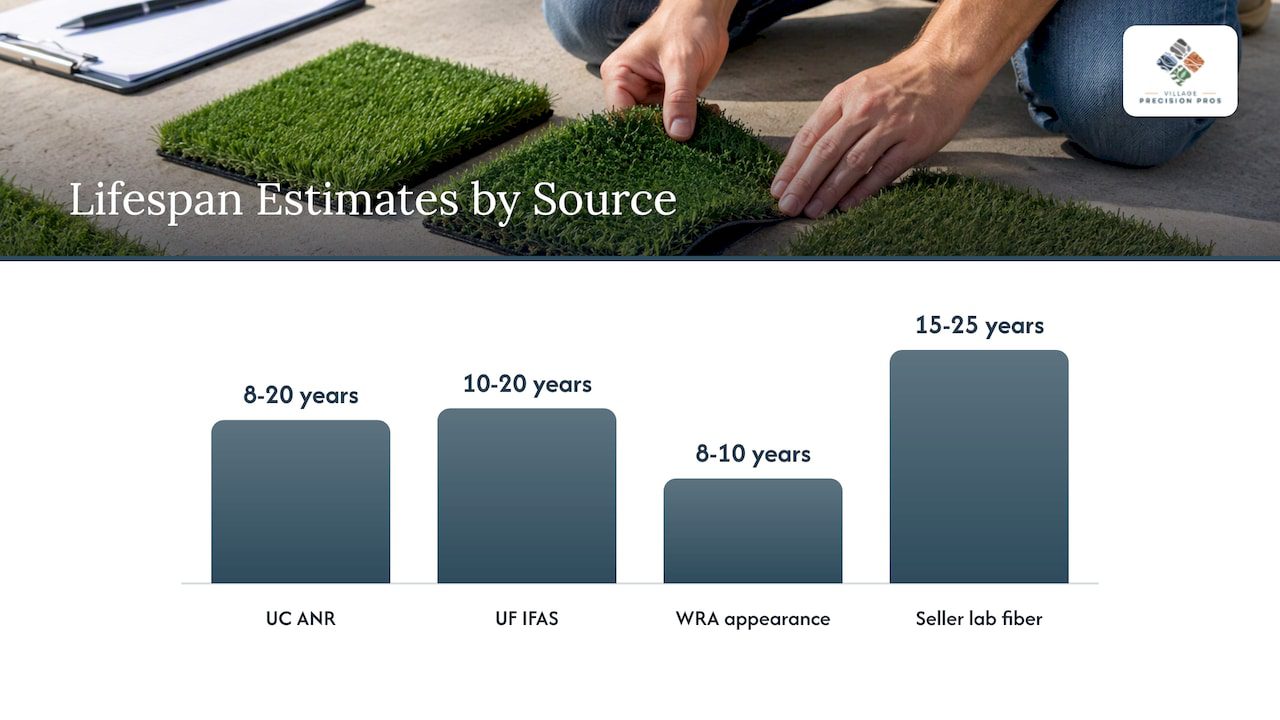
| University of California Agriculture and Natural Resources | Perhaps 8 to 20 years, depending on quality, use, climate, maintenance and installation |
| University of Florida IFAS Extension | Perhaps 10 to 20 years, depending on the quality of ongoing care |
| Western Resource Advocates, 2022 report | An average of 8 to 10 years before a residential lawn loses its lush appearance |
Notice what the range depends on. The low end describes turf that is thin, poorly installed, heavily used or neglected. The high end describes a good product on a well-built base in a yard with moderate traffic and regular care. You do not get to pick a number from a brochure. You get to influence which end you land on.
Some sellers quote 15 to 25 years. Those figures usually come from laboratory tests on the fiber alone, and a real yard is more than fiber. A side yard that nobody walks on can age slowly, while a backyard with kids, a dog and weekend gatherings wears faster along its busiest paths. When you plan, use the harder number for the hardest-used zone, not the average for the whole lawn.
Why estimates vary so much
Four things account for most of the spread you see online.
1. The sun
Ultraviolet light is the slow, steady enemy of any plastic left outdoors. Over time it breaks down the polymer in the blades, which shows up first as fading, then as brittleness, then as thinning. Arkansas gets long, hot summers, so a lawn in full afternoon sun ages differently than one under a shade tree. Higher-quality fiber with good UV stabilization holds up longer, which is one reason the product itself matters.
2. The base
The layer under the turf does more work than most homeowners expect. A properly compacted aggregate base keeps the surface from settling, which prevents low spots, stressed seams and puddles. A base that is thin, uneven or poorly compacted will telegraph every flaw upward within a few seasons. In central Arkansas, where clay soils and heavy rain can leave water sitting, drainage in that base is not optional. If you want the specifics we look at for local yards, our guide to the four numbers that decide how turf ages in Arkansas goes through them.
3. Traffic and use
Wear is rarely even. Dog patrol routes, the path to the gate, the spot under a swing set and the area around a grill all take a beating while the rest of the lawn looks new. Those corridors usually decide when a lawn gets replaced. The practical answer is to plan for them: denser turf or a different surface for the busiest zones, and a layout that spreads foot traffic out instead of funneling it down one line. If pets are part of your household, our pet turf installation guide covers drainage and layout for heavier use.
4. Installation quality
Seams, edges and anchoring are where many lawns fail first. A corroded or loose edge lets the perimeter lift. A poorly joined seam opens up. Neither is a fiber problem, and neither is covered by the kind of warranty that protects against UV fade. Warranties are generally written around the material, and they commonly exclude problems tied to installation, normal wear and matting. So the person who installs your lawn has as much influence on its life as the person who manufactured it.
What typically fails first
In a home yard, the first thing to go is often not UV damage. It is more likely to be one of these:
- A worn traffic lane. The fibers in the busiest strip flatten and thin out.
- A failing edge. The perimeter loosens, lifts or corrodes where it meets a border.
- A settling base. Dips and low spots appear, and water collects.
- Open seams. Gaps show where two pieces meet.
- Matting. Blades stay flattened and no longer spring back after brushing.
A practical way to think about it: your turf has reached the end of its useful life when the most heavily used part of the lawn looks worn, even if the rest still looks good. That is a more useful test than counting years.
Signs it is time to repair or replace
Repair is often enough for a localized problem. Replace when the problem is widespread or the surface no longer performs. Watch for:
- Seams or edges pulling apart in more than one place.
- Heavy matting that does not improve when you brush the lawn against the grain.
- Standing water or slow drainage, which can point to a base problem rather than a turf problem.
- Fading and brittleness across the whole lawn, not just one sunny corner.
- Hard, compacted infill that makes the surface feel stiff underfoot.
- Visible thinning in the main traffic areas.
Sports-turf specialists note that the base under a field is often still in good shape when the surface is spent, which makes a replacement less involved than the original build. The same logic applies at home: a well-built base can outlast the first layer of turf, so the quality of that foundation pays off twice. You can read how different infill materials affect feel, drainage and odor in our turf infill guide.
Care that helps turf last longer
Turf needs far less work than a natural lawn, but not none. UC extension specialists describe it as a plastic rug with some drainage, and that is a useful way to think about care. Dirt and debris get ground in if you leave them, and pet waste does not break down the way it does in soil. The routine they recommend is simple:
- Clear spills, debris and pet waste promptly.
- Brush against the grain in high-traffic areas to keep blades upright and prevent matting.
- Rinse regularly, weekly or monthly depending on use, to wash away odors.
- Pull weeds as they appear. Crabgrass and other weeds can grow up through the surface.
- Keep leaves and organic matter off the surface, since they hold moisture and feed weeds.
The University of Florida’s extension guidance makes a similar point: the quality of ongoing care, including rinsing and removing leaves, is what separates the 10-year lawn from the 20-year lawn. Arkansas has plenty of leaf drop, pollen and storms, so this routine is worth setting up from the beginning. Our artificial turf maintenance guide for Arkansas walks through the seasonal version, and our annual maintenance plans are available if you would rather have a crew handle upkeep.
A worked example: two lawns, two outcomes
Take two backyards in the same Central Arkansas neighborhood, both with turf from the same quality tier.
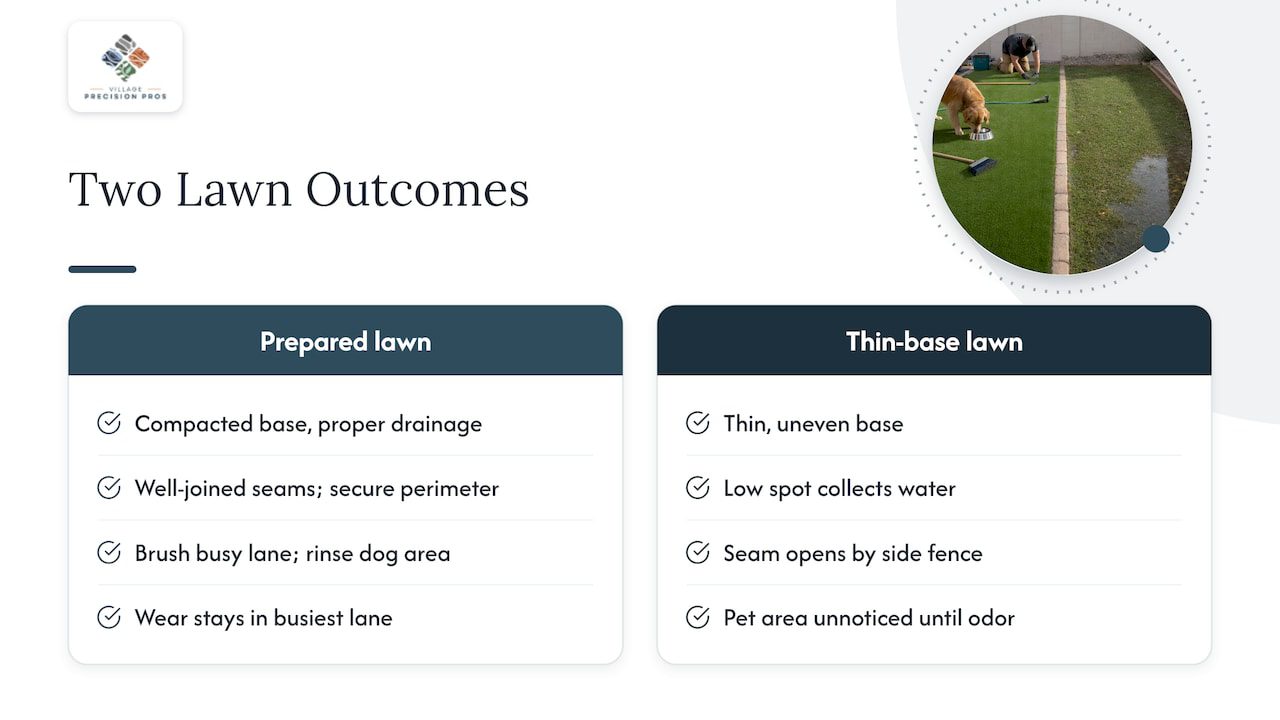
The first has a compacted aggregate base with proper drainage, well-joined seams and a secure perimeter. The family brushes the high-traffic strip every few weeks and rinses the dog area. The busiest lane eventually shows wear, but the rest of the lawn is in good shape, so they patch or replace only that section.
The second has a thin, uneven base. Within two or three seasons, a low spot near the patio collects water. A seam opens along the side fence. Nobody notices the pet area until it smells. By year six or seven, the whole lawn needs attention, not because the fiber gave out, but because the system under it did.
Same turf. Very different lifespans. The difference was preparation, installation and routine care.
Who this matters most to
Homeowners and families. If the lawn is your gathering space, plan for the zone your family uses most and ask how it will hold up in year ten, not just on installation day.
Real estate agents. A turf lawn that looks sharp and drains properly photographs well and reads as low-maintenance to buyers. Wavy seams, puddles or matting do the opposite.
Businesses and property managers. For medians, common areas and entryways, the goal is predictable upkeep. Our write-up on commercial artificial turf in Arkansas covers how to think about it across a property.
Perspective: where we see lifespan decided
Most of the conversations we have about turf lifespan start with the product and end with the ground. People ask how many years the fiber will last, and that is a fair question. But the answer we keep coming back to is that the lawn you will have in ten years is built in the first few days of the job.
Our approach at Village Precision Pros has always joined design with function. Drainage, uneven ground and grade are the things that quietly shorten a lawn’s life, and they are the things we address before turf goes down. With more than 1,750 completed projects since 2020, we have learned to treat the base, seams and edges as the main event, not as prep work.
We also think about how you will live on the lawn. A patio gathering area, a dog run, a play zone and a decorative side yard each wear differently, so each deserves its own plan. Quality materials and skilled craftsmanship matter most at the points where the lawn takes the most abuse.
If you are choosing turf for your home or property, we would encourage you to judge it by how it is built, not just by what it is made of. A well-built lawn shrugs off weather and traffic, needs only simple upkeep and gives you a clean, usable yard for years.
Ty
Planning your turf for the long run
A few decisions at the start make the biggest difference to how long your lawn lasts.
- Match the turf to the use. Pet areas, play zones and entertaining spaces need denser, more durable options than a decorative front yard.
- Get the base right. Compaction and drainage under the turf prevent most settling and puddling problems.
- Think about edges and seams. These are the places where installation skill shows.
- Choose an infill that suits your household. It affects how the lawn feels, drains and handles odor.
- Set up a care routine. A few minutes of brushing and rinsing each month protects the investment.
- Plan for the end. In the United States, there are no regulations on disposal or recycling of artificial turf, and most spent turf goes to a local landfill. A lawn that lasts longer means fewer tear-outs.
If you are weighing turf against a natural lawn, our artificial turf vs grass decision guide lays out the tradeoffs, and our overview of the advantages of artificial grass explains what you gain in daily use. If you want to see how the job is done, our step-by-step installation guide goes through the process.
Have us build it to last
Village Precision Pros installs artificial turf for homes and commercial properties across Central Arkansas, and we pair it with the drainage, grading and hardscape work that keeps a yard performing. If you want a lawn planned around how your family or property actually uses the space, talk to us about artificial turf installation. We can also set up ongoing upkeep through our annual maintenance plans.

You can see more of what we build, from patios to pathways, on our main site.
FAQ
How long does artificial grass last?
Most residential artificial grass lasts about 8 to 20 years. University extension sources in California and Florida both describe that kind of range. Product quality, installation, sun exposure, traffic and maintenance decide where your lawn falls within it.
Does artificial turf last longer in a backyard or a front yard?
Usually the less-used area lasts longer. A decorative front or side yard with little foot traffic ages mainly from sun exposure. A backyard with kids, pets and gatherings wears faster along its main paths, so it benefits from denser turf in those zones and a layout that spreads traffic out.
Does a warranty tell me how long my turf will last?
Not exactly. Warranties are generally written around the material, such as UV fading or fiber breakdown, and they usually exclude normal wear, matting and installation problems. Your lawn’s real lifespan depends on the whole system, including the base, seams and edges.
What can I do to make my turf last longer?
Keep the surface clear of debris and pet waste, brush against the grain in busy areas, rinse regularly and pull weeds as they come up. Starting with a well-compacted, well-drained base matters even more. Our team can build that foundation and set up ongoing care for you.
What happens when artificial turf wears out?
Spent turf is hard to recycle. In the United States there are no regulations on its disposal, and most of it ends up in landfills. That is one more reason to invest in a durable installation that keeps your lawn in service as long as possible.
Sources
- Artificial Turf: What to Consider, University of California Agriculture and Natural Resources
- Synthetic Turfgrass and the Nine Principles, University of Florida IFAS Extension
- Is Artificial Turf a Beneficial Water Conservation Tool, Western Resource Advocates