


The best paver pattern depends on what the surface has to do. Herringbone is the strongest choice for driveways and any area where tires turn and brake. Running bond and basketweave suit patios and walkways. Stack bond gives a clean, modern grid. Modular and ashlar layouts add variety to larger patios and pool decks. Below we walk through each pattern, how it looks, how it behaves under load, and what it means for cuts, waste and installation.
TL;DR
- Use herringbone (45 or 90 degrees) for driveways and other vehicle areas, because its interlock resists the pushing and twisting of tires.
- Running bond is the easy, classic choice for patios and straight or curved walkways, and it produces the least waste of the common patterns.
- Basketweave looks traditional and woven, but it only works cleanly when the pavers are a true 2:1 ratio.
- Stack bond looks sharp and modern, and it is best on foot-traffic areas with a solid edge restraint.
- The pattern is only as good as the base, edging and joint sand under it, so plan all of them together.
Table of Contents
- Paver Patterns at a Glance
- Running Bond: The Dependable Default
- Basketweave: Woven Texture With a Strict Rule
- Herringbone: The Strongest Pattern for Driveways
- Stack Bond: A Clean Modern Grid
- Modular, French and Ashlar Patterns
- Circles, Fans and Cobblestone Looks
- Matching the Pattern to Your Space
- How Crews Lay Out a Pattern
- What Drives the Total Project Cost
- Perspective
- Plan Your Paver Project With Our Crew
- FAQ
- Sources
Paver Patterns at a Glance
Here is how the most common patterns compare for a typical Central Arkansas homeowner choosing between looks, durability and installation effort.
| Pattern | Look | Best for | Installation notes |
|---|---|---|---|
| Running bond | Classic brickwork, offset joints | Patios, walkways, pool decks | Simple, few cuts, follows curves well |
| Basketweave | Woven, traditional | Patios, courtyards, entries | Needs a true 2:1 paver and careful grid starts |
| Herringbone | Zigzag, V-shaped field | Driveways, high-traffic areas | More edge cuts, more material, needs precise lines |
| Stack bond | Straight, uniform grid | Modern patios, large-format pavers | Joints align both ways, so squareness shows |
| Modular or French | Mixed sizes in a repeating set | Larger patios, pool decks | Follow the set order, buy full kits |
| Ashlar | Varied rectangles, random feel | Contemporary or classic patios | Needs a planned ratio of sizes |
| Circular or fan | Focal point | Patio centers, entries | Border first, then the circle, then the field |
The descriptions of look and use come from manufacturer guidance such as Belgard’s pattern guide, and the rest of this article explains what each one means on the ground.
Running Bond: The Dependable Default
Running bond resembles traditional brickwork. Each row is offset from the one before it, so the joints never line up in a straight line across the field. That offset gives it a calm, familiar look that works with almost any home style.
It is also one of the most forgiving layouts. It handles straight paths and gentle curves, and it can direct the eye along a narrow space, which is why designers often reach for it on small or long patios and side-yard walkways. Techo-Bloc notes that running bond guides the eye along a space, while large-format slabs reduce visible joints and make an area feel wider.
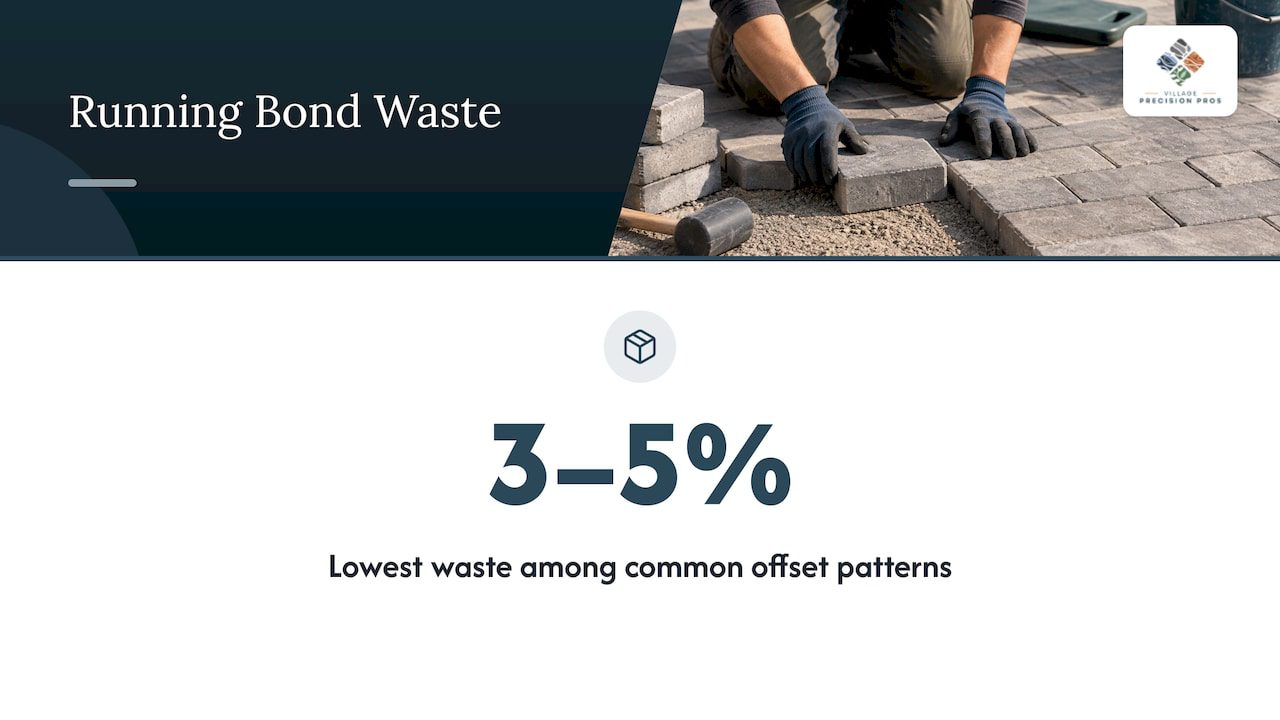
For installation, running bond is simple. Crews start from a straight edge, set the border, and fill in. According to the Tool Grit estimating guide, running bond typically produces about 3 to 5 percent waste, the lowest of the common offset patterns. Less waste means fewer extra pavers to order and fewer cuts to make.
If your pavers are not a perfect 4 by 8 inches, running bond is also the safer fallback. This Old House contractor Roger Cook points out that a brick is not always exactly twice as long as it is wide, and when that happens a basketweave can show gaps or force extra cuts. In that case a running bond or cross bond is the cleaner answer.
Basketweave: Woven Texture With a Strict Rule
Basketweave, sometimes called parquet, alternates pairs of pavers. Two are laid one way, then two the other, so the surface looks woven. With standard 4 by 8 inch units, each pair forms an alternating 8 inch square, as This Old House describes.
It is one of the oldest patterns in American masonry, and it still suits older homes, brick entries, courtyards and cottage-style gardens. Readers who search for the basketweave pattern are usually after that traditional character.
The 2:1 rule
Basketweave works only when the paver length is twice its width, so two pavers side by side make a perfect square. Even a small departure from that module adds up. The error shows as drift across the field, with gaps or cuts that interrupt the weave. So the real measurement of the paver matters more than the nominal size on the label.
Planning a no-cut basketweave
If you want to avoid cuts, size the space to the pattern. Pine Hall Brick says its basketweave options can be laid without cuts when the project dimensions are multiples of 8 inches, and it suggests leaving some edges open until the full pavers are down. A border, such as a 4 inch soldier course, can also absorb any leftover width at the edge.
This is the kind of detail we settle on paper before the first paver goes down. Changing a patio by a few inches can save a lot of cutting and a lot of visible patchwork.
Herringbone: The Strongest Pattern for Driveways
Herringbone sets rectangular pavers at 45 or 90 degrees to form a zigzag or V-shaped field. The pavers lock against each other from several directions, which is why it is the pattern engineers point to for vehicles.
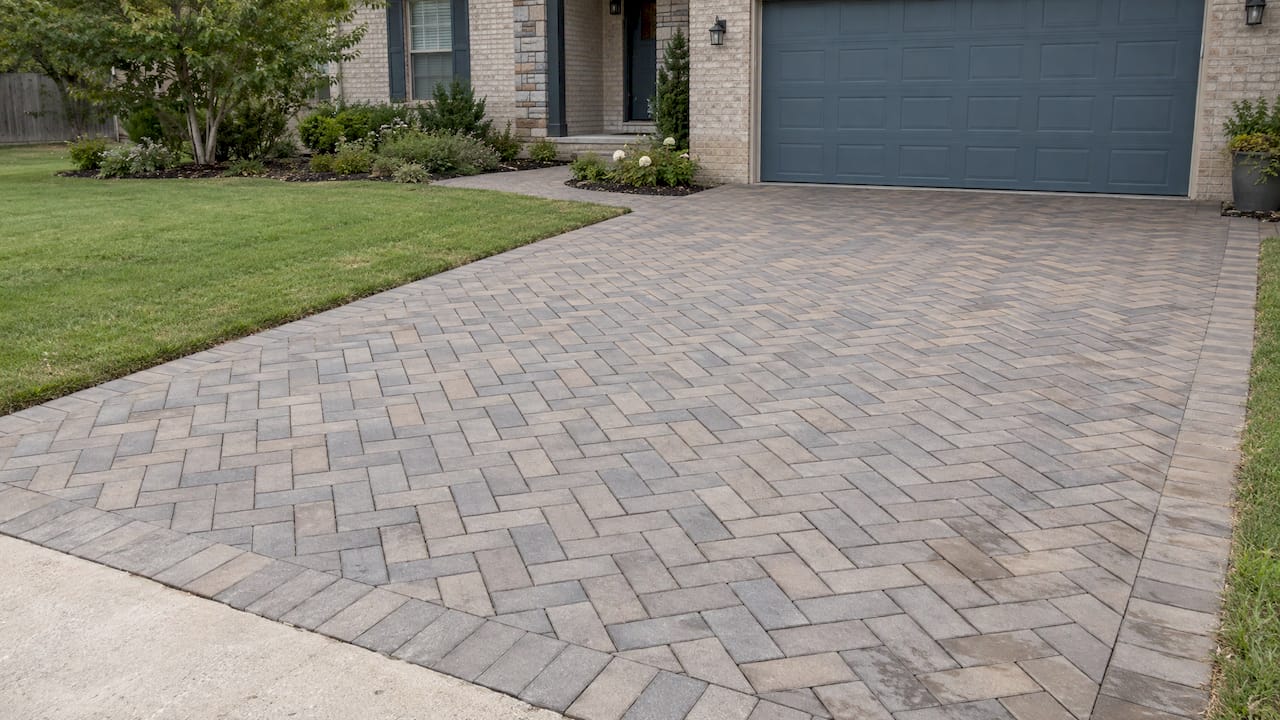
The ICPI Installation Manual says herringbone patterns should be used in vehicular pavements because they resist the horizontal creep caused by turning, braking and accelerating tires. The same manual says interlock generally works with plan ratios roughly between 2:1 and 3:1, and that 2 3/8 inch (60 mm) units are typical for pedestrian areas and residential driveways, while 3 1/8 inch (80 mm) pavers are used for vehicular pavements because loads are higher.
Manufacturers agree. Belgard’s technical note says herringbone, at 45 or 90 degrees, is the most effective pattern for maintaining horizontal interlock where traffic frequency or loading is high. It also explains that three kinds of interlock have to work together:
- Horizontal interlock, which comes from the laying pattern and spreads the forces of turning, braking and accelerating.
- Vertical interlock, which comes from load transfer between pavers through the joint material.
- Rotational interlock, which comes from rigid edge restraints, proper paver thickness and a slight crown in the surface.
That last point matters. The pattern alone does not hold a driveway together. The CMHA technical specification, revised in February 2023, calls stable edge restraints essential for horizontal interlock under repeated tire loads, and it recommends a 45 or 90 degree herringbone with sailor courses at the perimeter. It also advises that no less than one third of a cut paver should be exposed to tire traffic. For thickness guidance, see our page on driveway paver thickness.
The tradeoff in installation
Herringbone needs more material and more edge cuts than a simple offset pattern, which adds installation time. It also rewards precision: a line that drifts by a fraction of an inch can pull the whole pattern off course, as the This Old House mason in that same guide explains. That is the reason experienced crews run multiple string lines and check them often. According to the Tool Grit guide, herringbone typically produces 10 to 15 percent waste at 45 degrees and 8 to 12 percent at 90 degrees, so the order quantity should reflect it.
Many homeowners also choose herringbone for patios because they like the look, and it works well there. Just plan for the extra cuts at the edges.
Stack Bond: A Clean Modern Grid
Stack bond aligns the joints in both directions, creating a straight, uniform grid. It pairs well with modern architecture and large-format pavers, as NT Pavers notes. Used with restrained colors and simple joints, it gives a patio a crisp, architectural look.
Because every joint lines up, any crookedness in the layout is visible. Squaring the starting corner and holding straight string lines are essential. Stack bond also produces minimal waste, typically 2 to 4 percent according to the Tool Grit guide, since most pavers go in whole.
One caution that serves the finished result: a grid has no offset joints to help distribute load, so it fits foot-traffic areas such as patios and walkways better than driveways. Solid edging and a well-compacted base keep the grid tight. Our guide to patio edging options covers how to choose the edge.
Modular, French and Ashlar Patterns
These layouts mix paver sizes. Modular or French patterns combine several sizes in a repeating set, which creates visual variety and works well on patios and pool decks. The ashlar pattern uses varied rectangles that fit together so that the surface feels random yet harmonious, and it can look contemporary or classic depending on the paver color and texture, according to Belgard’s guide.
Techniques that help these layouts look their best:
- Keep the set order. Mixed-size kits are designed to repeat, and skipping around breaks the rhythm.
- Blend pavers from several pallets as you work, so color differences do not form patches.
- Use a border in a coordinating color to frame the field and give the cut edges a clean finish.
Techo-Bloc suggests that mixed-size modules add interest without producing a visually busy field, particularly when paired with simple joints and a restrained palette.
Circles, Fans and Cobblestone Looks
Circular and fan patterns create a focal point, such as the center of a patio or the landing at a front entry. Unilock’s technical guide recommends installing a soldier-course border first where the edge is fixed, placing any circle immediately after the border, and then filling in the main field. That order keeps the curves crisp.
Cobblestone patterns use a random, flowing layout for a natural, rustic look. They suit informal gardens and older homes. If you are weighing a natural stone look against interlocking pavers, our comparison of flagstone versus pavers for an Arkansas patio walks through the differences.
Matching the Pattern to Your Space
Unilock recommends choosing a pattern based on style, the size and shape of the space, and traffic flow. Here is how we put that into practice.
Driveways and parking areas
Choose herringbone, with a sailor-course border and rigid edge restraints. Thickness, base depth and compaction matter as much as the pattern.
Patios
Running bond, basketweave, stack bond and modular layouts all work. Let the architecture of the house lead: traditional brick homes pair naturally with basketweave or running bond, while modern homes look best with stack bond or large-format pavers. Our paver patio ideas guide shows more design directions.
Walkways
Running bond follows straight and curved paths well. Basketweave suits formal entries. Herringbone gives a refined look and holds its shape where a path doubles as a service route.
Pool decks and gathering areas
Modular, French and running bond patterns are popular here. Choose a paver texture with good traction when wet. For families who entertain, we usually recommend allowing room for tables and traffic flow before picking the pattern, because the layout should work around the furniture as well as look good from the kitchen window.
How Crews Lay Out a Pattern
A good pattern starts on the ground, long before the first paver. These are the layout steps we follow, consistent with common manufacturer and installer guidance:
- Mark the area with stakes and string, then check that the diagonals are equal so the layout is square. A line level helps confirm the strings are level.
- Set string lines for finished height and slope. Cambridge Pavingstones recommends starting from a right-angle corner and using multiple string lines to keep joints straight.
- Build the base correctly. A pattern cannot hide a weak foundation. See our page on paver base materials for what goes under a patio.
- Install the borders first where the edge is fixed, then fill between them. Start laying against a hard, straight edge.
- Use string or chalk lines every 3 to 5 feet, and keep joints at about 1/8 inch (3 mm). Unilock’s technical guide also advises placing each paver down beside the previous one rather than sliding it across the sand bed.
- Blend pavers from several cubes as you go, so color variation looks natural.
- Mark and cut the edge pavers last, then sweep in joint sand and compact.
For a basketweave, the Aspire walkway guide says the layout can start 4 inches down and 4 inches over from the top-left corner of the grid, so the pattern connects across adjacent grids, with the leftover edge trimmed or filled with a 4 inch border.
What Drives the Total Project Cost
We do not publish price ranges here because every yard is different, but we can tell you what moves the total on a paver project, and the pattern is one of the factors:
- Pattern complexity. Herringbone and circular layouts require more cuts and more labor time than running bond or stack bond.
- Waste allowance. Patterns with more cuts need more extra material in the order.
- Paver type and size. Large-format slabs, textured faces and mixed-size kits all change material and handling needs.
- Site conditions. Slope, drainage, access for equipment and soil all affect excavation and base work.
- Base and edging. Depth of compacted aggregate, edge restraints and any drainage correction are part of a durable result.
- Area and borders. Square footage, curves, steps and border courses all add to the work.
If drainage is a concern in your yard, take a look at our permeable paver patio guide too.
Perspective
Homeowners often come to us with a picture of a pattern they love. We take that picture seriously, then we walk the site. The pattern has to suit the paver, the traffic, the slope and the edge, or it will not look the same in five years as it does on day one.
Our crews think of pattern as part of the structure, not only a finish. A herringbone driveway with proper edge restraints behaves very differently from a pretty layout set on a thin base. A basketweave that starts from a squared corner with a measured grid looks deliberate, while one that drifts looks tired within the first few feet.
That is why we plan layouts before we dig. We confirm the paver dimensions, set the borders and string lines, and think about where cuts will land so they sit in the least visible places. With more than 2,000 projects behind us in Central Arkansas, we have learned that careful planning does more for a patio than any single design choice.
Ty
Plan Your Paver Project With Our Crew
If you are ready to turn a pattern into a finished patio, walkway or driveway, our team designs and installs hardscapes across Central Arkansas for homeowners, property managers, real estate agents and businesses. We start with how you use the space, then recommend the layout, materials and edging that fit it. You can see our work in the patios and pavers portfolio.

Explore our hardscape and stone masonry services or our decks and patios services, then reach out through our website to talk through your project.
FAQ
What is the best pattern for pavers?
It depends on the use. For driveways, herringbone at 45 or 90 degrees is the pattern engineering guidance recommends. For patios and walkways, running bond is the dependable all-rounder, and basketweave, stack bond or modular layouts fit particular styles. We pick based on traffic, space shape and the look of your home.
Which paving pattern is the strongest?
Herringbone. Its interlocking layout resists the horizontal creep caused by turning and braking tires, which is why the ICPI manual and manufacturer technical notes point to it for vehicle areas. It still depends on rigid edge restraints, correct paver thickness and a well-built base to perform.
Does basketweave need special pavers?
It works best with rectangular pavers whose length is twice their width, so two pavers form a perfect square. If the real dimensions fall short of that ratio, gaps or extra cuts appear, and running bond is usually the cleaner choice. We measure the actual pavers before recommending a layout.
How do I lay out a paver patio?
Mark the area with stakes and string, check that diagonals are equal, build a compacted base, and install borders first. Then fill the field from a straight edge, keep joints at about 1/8 inch, and cut edge pavers last. Many homeowners hire a crew so the pattern stays straight and the base holds up.
Sources
- This Old House: A Guide to Selecting the Perfect Brick Pattern
- Belgard: Paver Pattern Guide
- Belgard: Paver Selection Guidance for Vehicular Applications
- ICPI Installation of Concrete Pavers manual
- CMHA Technical Specification 4
- Pine Hall Brick: No-Cut Paver Patterns
- Cambridge Pavingstones: Installation Instructions
- Tool Grit: Brick and Paver Estimating Guide
- Techo-Bloc: Paver Patio Designs
- NT Pavers: Paver Patterns Guide
- Aspire: How to Install a Paver Walkway
- Unilock: Patio Paver Patterns
- Unilock: Advanced Tech Guide