

A sinking garage floor is fixed in two parts: you find out why the soil under the slab moved, and then you restore the slab to level. Lifting the concrete without dealing with the cause only buys time. In Central Arkansas, where clay soils swell and shrink and heavy rain moves water around a property, the cause is usually water, poorly compacted fill, or both. We handle foundation leveling and the drainage work around it, so the diagnosis and the repair can be planned together.
This guide is for homeowners, property managers and agents who have a slab that has dropped, tilted or pulled away from the wall and want to know what is happening, what the repair options are, and how to keep the floor from sinking again.
TL;DR
- A garage slab sinks when the soil or fill beneath it settles, washes out or shifts. The concrete itself is rarely the problem.
- Check the size of the drop, whether cracks are growing, and whether the walls and door frame show new cracks or sticking. Those signs separate a simple slab repair from a structural one.
- Your main options are lifting the slab with injected material, or removing and replacing it. Lifting levels the slab but does not fix poor soil.
- Drainage correction is what keeps the repair from failing. Gutters, grading and downspouts matter as much as the lift.
- If the movement is ongoing or the walls are involved, have a professional look before you pick a method.
Table of Contents
- Why a garage floor sinks
- How to tell what kind of settlement you have
- Your repair options
- What a repair day looks like
- Fix the water and soil, or the floor will drop again
- What drives the total for a garage floor repair
- Mistakes that shorten a repair’s life
- Our perspective
- Getting it handled in Central Arkansas
- FAQ
- Sources
Why a garage floor sinks
A concrete slab is heavy, but it does not hold itself up. It rests on soil and a base layer of compacted stone. When that support layer loses volume, the slab follows it down. Three things do most of the damage.
Poorly compacted fill. Garages are often built on soil that was brought in and spread to bring the pad to grade. If it was not compacted well in thin layers, it keeps consolidating for years. Building-inspection references describe uniform settlement of a slab as often being the compaction of fill left from original construction, and they point out that the key question is whether the movement is still going on (Inspectapedia).
Water under the slab. Water is the most common driver we see described by homeowners in this area. A downspout that dumps beside the garage, a driveway that slopes toward the door, or a low spot that holds water after rain will soften the soil and carry fine particles away. Voids form, and the slab bridges them until it cannot.
Clay that swells and shrinks. Expansive clay takes on water in wet seasons and dries in summer. Over years that cycle leaves uneven support, so one corner or edge drops while another holds.
Leaking plumbing, a failed drain line, and tree roots pulling moisture from one side of the pad can add to any of these.
How to tell what kind of settlement you have
You do not need tools beyond a long level, a tape measure and a phone camera. The goal is to learn how far the slab has dropped, where, and whether it is still moving.
- Find the low spot. Lay a long straightedge or level across the slab in two directions. Note where the gap appears under it and how big it gets.
- Measure the gap at the walls. If the slab has pulled away from the wall or the door track, measure in several places and photograph each one with a tape in the frame.
- Tap the area. Rap on the low spot with a hammer handle. A hollow sound suggests a void below, and a solid sound suggests the soil is still in contact.
- Mark the cracks. Draw a small line at the end of each crack and write the date. Recheck after a few weeks and after a heavy rain. A crack that grows is telling you the movement has not stopped.
- Look beyond the floor. Check the interior walls, the door between the garage and house, the garage door operation and the brick or siding line outside for new cracks, sticking or gaps.
- Note what sits nearby. A water heater, a floor drain or a plumbing line in the settled area changes how the repair is planned.
Old, stable settlement with no cracks in the supporting walls is usually a tripping, drainage and appearance problem rather than an emergency. Fresh movement, a slab dropping away from walls, or cracks that show up in the house at the same time point toward a bigger soil or foundation issue. Our guide on when foundation cracks are a worry walks through what those cracks look like.
Signs to get a professional look soon
- The floor is still dropping, or cracks keep widening.
- One side of a crack sits higher than the other.
- Walls, door frames or windows show new cracks or start to stick.
- Water comes up through cracks after heavy rain.
- More than one slab or area is sinking at once, including the driveway or a patio.
Any of these suggests the problem extends past the garage slab, and that is the point to get it evaluated before money goes into a surface repair.
Your repair options
There are really three routes, and the right one depends on how far the slab dropped, what is under it, and whether the concrete is still in good shape.
Lifting the slab with injected material
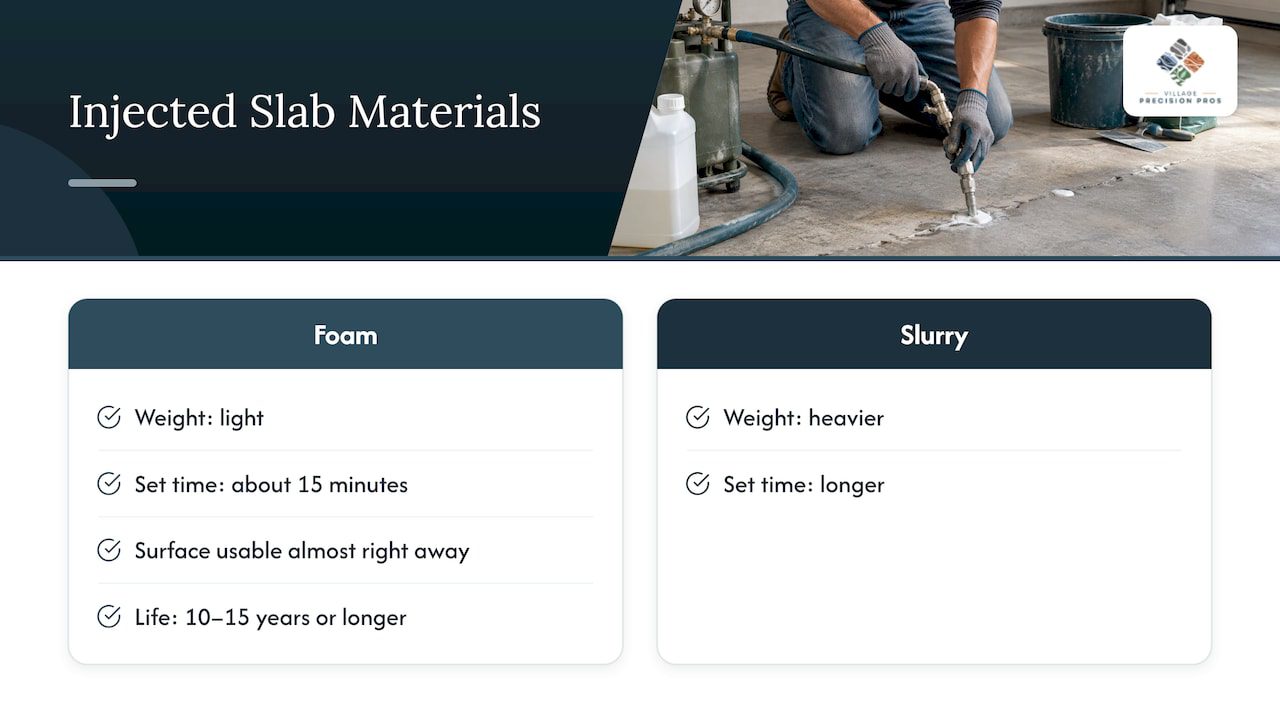
Slabjacking raises a settled slab, or fills voids under it, by pumping material through small holes under pressure. The American Concrete Institute’s field guide defines it that way and lists cementitious, non-cementitious and asphaltic materials as the options (ACI RAP-11). In practice homeowners meet two versions: a cement-based slurry, often called mudjacking, and expanding polyurethane foam, often called polyjacking.
Foam is light and cures fast. One cost guide notes the foam sets in about 15 minutes, so the surface is usable almost right away, and that it can last 10 to 15 years or longer when properly installed and maintained (HomeGuide). Slurry is heavier and takes longer to set. We compare the two in detail in mudjacking vs. polyurethane foam.
The benefit of lifting is that the slab stays in place. There is no demolition, no haul-off, and the existing finish, control joints and any coating stay intact if the concrete is sound. The limit is the soil. ACI’s guide states that slabjacking levels the slab but does not correct underlying poor soil conditions, and that if settlement is still occurring the lift may need repeating. It also notes that the weight of the added material and the slab can itself cause further settlement in weak soil, so soil conditions should be understood before lifting.
That is why a good lift starts with a question about the ground, not the concrete.
Replacing the slab
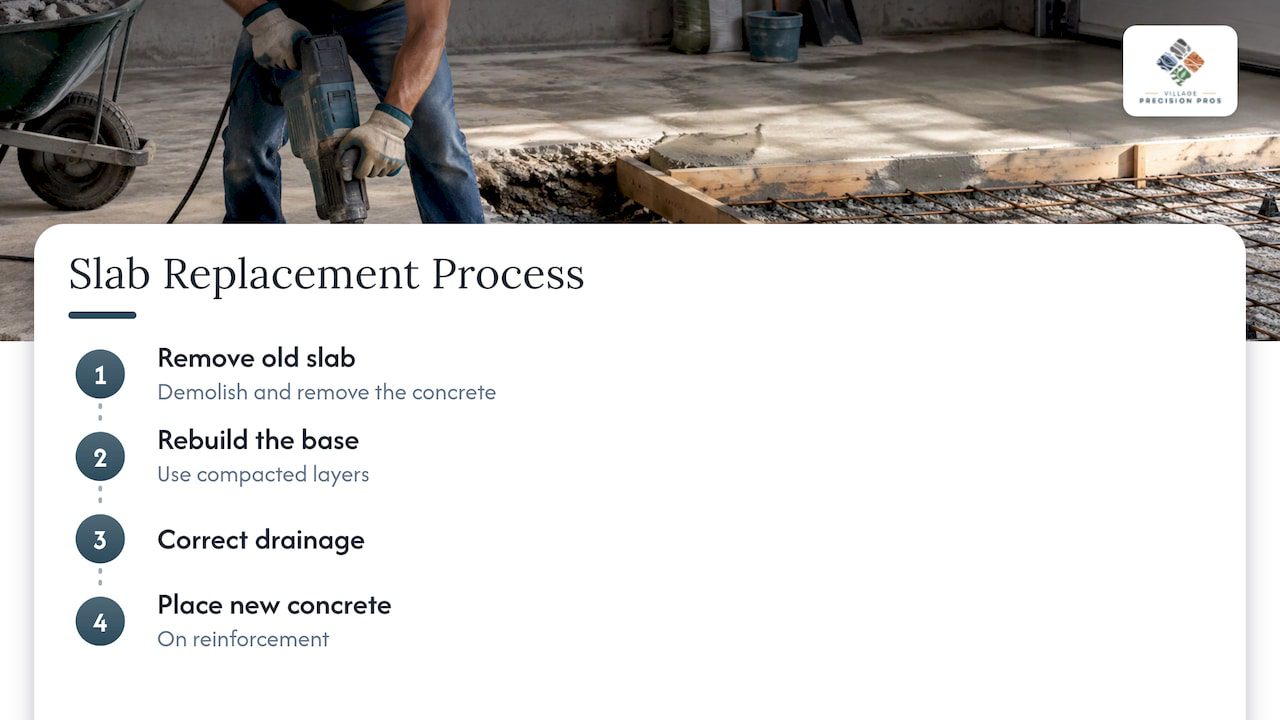
When the concrete is broken into many pieces, badly heaved, or has dropped far enough that lifting would leave it cracked and uneven, replacement makes more sense. The old slab is demolished and removed, the base is rebuilt in compacted layers, drainage is corrected, and new concrete is placed on reinforcement.
Replacement costs more disruption, because the garage is out of service for the work and curing, but it resets the support layer completely. It is the right call when you can see that the fill beneath is poor, or when the slab has failed structurally rather than just moved.
Leveling the structure, not only the slab
Sometimes the garage floor is not sinking alone. If the garage shares a foundation with the house, or the walls and door frames are moving too, the slab is following a larger shift. Then the work is about the foundation, using piers or other structural methods, and the floor is leveled after the structure is stable. Two of our guides explain the difference: structural leveling in Arkansas and foundation leveling vs. structural leveling.
Quick comparison
| Approach | Best when | What it does not solve |
|---|---|---|
| Slab lifting (slurry or foam) | Slab is intact, drop is moderate, soil is stable or can be corrected | Weak or washing-out soil, ongoing settlement |
| Slab replacement | Concrete is broken, heaved or heavily cracked, fill is poor | Water sources left uncorrected |
| Structural or foundation leveling | Walls, door frames or the house are moving with the floor | Surface finish and drainage around the building |
What a repair day looks like
Homeowners are often surprised how little the process looks like construction. Here is what to expect for a lift.
- Assessment. The crew measures the low areas, finds voids by sound, checks drainage and notes anything in the slab such as drains or utility lines.
- Drilling. Small holes are placed across the settled area. Foam and slurry jobs use different hole sizes.
- Injection and monitoring. Material goes in gradually while the crew watches the slab rise, stopping at level and working around the area so the slab does not crack from lifting too fast.
- Patching. The holes are filled and the surface is cleaned.
- Return to use. Foam jobs can be driven on quickly, as noted above. Slurry typically needs more time, so ask your contractor for the specific wait.
Replacement adds demolition, base rebuilding, forming and a curing window before you can park on the new slab.
Fix the water and soil, or the floor will drop again
This is the step that decides whether the repair lasts. A level slab on soil that is still washing out will sink again, and lifting twice is a poor use of anyone’s money.
Work through the water path around the garage:
- Gutters and downspouts. Gutters should be clear, and downspouts should discharge well away from the slab, not at the foundation edge.
- Grading. Soil and the driveway should slope away from the garage. A driveway that funnels water to the door is a common culprit.
- Low spots and hardscape edges. Water pooling beside the slab can be redirected with grading, a drain, or a properly built channel.
- Irrigation. A sprinkler head spraying the foundation or a leaking line will keep that soil saturated.
- Trees. Large roots pulling moisture from one side of the pad can dry and shrink clay unevenly.
Drainage and irrigation are part of our landscape work, and our guide to landscape water drainage explains how water is moved off a property. If a leak is suspected under the slab, such as water appearing at cracks after dry weather or a floor drain that backs up, a plumber should check the lines before any repair.
What drives the total for a garage floor repair
We do not publish a number here, because the same garage can need very different work. These are the factors that move the total:
- Size of the area. Square footage of the settled section matters more than the whole garage.
- How far it dropped. A small lift is quick. A large lift needs more material and more careful sequencing. Some guides caution that settlement of several inches often points to a soil or foundation problem that injection cannot permanently resolve (ConcreteCalculate).
- Material. Slurry and foam are priced differently, and a garage slab that carries vehicles can call for a denser foam than a patio.
- Access and obstacles. Water heaters, drains and finished floors take more time to work around.
- Soil and drainage work. Correcting grading, downspouts or voids adds scope, but it is what keeps the result in place.
- Replacement vs. lift. Demolition, hauling, base rebuilding and curing add labor and time.
On insurance, one cost guide notes that homeowners policies typically do not cover this kind of repair because settling is treated as normal wear, though partial coverage may apply if a covered event such as a plumbing leak caused it (HomeGuide). Ask your insurer about your own policy if a leak or sudden ground shift was involved.
Mistakes that shorten a repair’s life
- Lifting before finding the cause. A level slab over a washed-out base is temporary.
- Ignoring a growing crack. Mark and date it. If it moves, have it evaluated.
- Leaving the downspout where it is. The cheapest part of the job is often the most important one.
- Treating a structural problem as a slab problem. If the walls and door are moving, the slab is a symptom.
- Coating the floor too soon. Epoxy and other coatings belong on a stable, level slab. Once the repair is done and the floor is stable, our epoxy garage floor coatings give the garage a finished, durable surface.
Our perspective
We approach a sinking garage floor as a landscape and ground problem first and a concrete problem second. The slab shows you where the soil has given up, but the fix lives in how water moves across the property and how the base beneath the slab was built.
That is why we like to look at the whole picture: the drop, the cracks, the walls, the downspouts and the grade. Our work covers foundation leveling along with drainage, irrigation, hardscape and stone masonry, so the floor repair and the water correction can be planned together instead of handled as separate fixes.
Since 2020 we have completed more than 2,000 projects across Central Arkansas, and the ones that last share one trait: the cause was dealt with, not just the symptom. Our crews take the same care with a compacted aggregate base under a garage as under a patio, because both depend on what you cannot see.
Ty
Getting it handled in Central Arkansas
If your garage floor has dropped, our team handles foundation leveling and related services for homes and commercial properties across Central Arkansas, along with the landscape and drainage work that keeps repairs stable. If your property is managed under a recurring agreement, our annual maintenance plans keep gutters, grading and drainage areas looked after through the seasons.

Send us photos of the low area and the wall gaps, with the measurements you took, and we can talk through what is happening on your property.
FAQ
Can a sunken garage floor be raised without replacing it?
Often, yes. If the concrete is intact, material injected beneath the slab can fill voids and lift it back toward level. The soil beneath has to be stable or corrected first, because lifting does not fix poor ground. A heavily broken slab is usually better replaced.
Why is my garage floor sinking only on one side?
Uneven settlement usually comes from water or soil differences on that side: a downspout, a low yard slope, a tree, or fill that was compacted less than the rest. It can also be a sign that the garage foundation is moving. Check the walls and door frame on the same side for cracks or sticking.
Is a sinking garage floor a foundation problem?
Not always. A slab that settles by itself, with no cracks in the walls and no new movement, is often a base and drainage issue. When the walls, door frames or windows are also affected, or the cracks keep growing, the foundation may be moving and should be evaluated.
How long does a lifted garage floor last?
It depends on the soil and the water around it. Foam work is described as lasting 10 to 15 years or longer when properly installed and maintained (HomeGuide). Correcting drainage is the best thing you can do to help any repair last.
Can I put epoxy on the floor right after it is leveled?
Coatings go on a stable, clean, level slab, so the timing depends on the method used and how the concrete has cured. Confirm the wait with whoever did the repair, then plan the coating once the floor is settled.
Sources
- ACI RAP-11 Slabjacking field guide
- HomeGuide: How Much Does Polyjacking Cost?
- Inspectapedia: Slab Settlement Cracks
- ConcreteCalculate: Polyjacking Cost Calculator