

Hydrated evaporative infill, targeted irrigation, and strategic shade deliver the fastest, most reliable drops in surface temperature. Cooling infills can pull down surface heat by 10°F to 40°F when properly hydrated, but the effect fades within an hour or two without repeat watering. For barefoot backyard zones, start with cooling infill and a watering habit. For sports fields, pair irrigation cycles with a heat-monitoring protocol.
TL;DR:
- Hydrated evaporative infill can lower surface temperatures by up to 40°F, but its effect diminishes within a few hours without regular watering.
- Surface temperatures of unshaded synthetic turf can reach 150°F to 175°F on a 100°F day, posing a burn risk in seconds.
- Managing turf heat effectively requires site planning with shade and drainage strategies before choosing cooling products or infill types.
- Regular maintenance, including daily watering and brushing, is crucial to sustain cooling effects and prevent turf from baking in hot weather.
- Combining hydration routines with shade and lighter fiber or infill options offers the most reliable long-term mitigation against turf heat.
Table of Contents
- Turf Heat Solutions Ranked by Speed and Cost
- How Do Cooling Infills Lower Turf Surface Temperature?
- What Irrigation and Misting Options Cool Turf Best?
- Which Turf Materials and Fibers Stay Coolest?
- Where Should Shade and Hardscape Go to Cut Turf Heat?
- How Often Should You Water and Brush Turf to Keep It Cool?
- How Hot Does Turf Get, and When Should You Stop Using It?
- What Do These Turf Cooling Methods Cost Over Time?
- How a Professional Turf Install Handles Heat From the Start
- Why Most Turf Heat Advice Misses the Real Problem
- Get a Cooling-Smart Turf Installation Done Right
- Sources
- FAQ
Turf Heat Solutions Ranked by Speed and Cost
Not every homeowner needs the same fix, and not every fix costs the same. We rank these by how fast they work and how much they demand from your budget or your hose.
- Quick spray-down (free to low cost): A five-minute hose-down drops surface temps fast, but the relief lasts 20 to 40 minutes before rebounding.
- Shade sails or strategic tree placement (moderate cost, one-time install): Cuts direct solar load on the hottest hours without any water use.
- Evaporative cooling infill retrofit (moderate to higher cost): Requires brushing in new infill across the existing turf; effect depends on regular hydration.
- Reflective/light-colored infill swap (moderate cost): Smaller temperature drop, but it works even when dry, which matters for water-restricted properties.
- Sub-surface capillary irrigation (higher upfront cost, lower ongoing cost): Best for new installs or full turf replacements where you can build the water layer into the subbase.
For a family patio or play area, a cooling infill retrofit paired with a simple watering routine solves most of the problem. For a commercial sports field, we’d start with monitoring and irrigation scheduling, then evaluate infill upgrades at the next resurfacing cycle.
How Do Cooling Infills Lower Turf Surface Temperature?
Cooling infills work through two different mechanisms, and knowing which one you’re buying matters. Evaporative infills absorb water and release it slowly as vapor, pulling heat out of the surface the same way sweat cools skin. Reflective infills instead bounce more sunlight away from the surface using lighter pigments or coated granules, cutting down how much solar energy the turf absorbs in the first place.
Cooling by the numbers: Hydrated evaporative infill typically cuts surface temperature by 10°F to 40°F depending on product and water volume, while dry reflective infill manages a more modest 5°F to 15°F reduction on its own.
That gap explains why evaporative infill gets more attention. It works harder, but it needs a hydration source to keep working.
- Standard installation depth runs similar to conventional infill, brushed evenly across the base layer.
- Regular brushing prevents compaction that would block water absorption.
- Most evaporative infills are compatible with existing turf systems, making retrofits realistic without a full tear-out.
What Irrigation and Misting Options Cool Turf Best?
Watering turf directly delivers the most dramatic short-term drop of any method, but it’s a brief one. Older field studies documented surface temperatures falling from 174°F to 85°F after watering, only to climb back up within minutes once the water evaporated off. That rebound speed is the single biggest limitation of any spray-and-forget approach.
Sub-surface capillary systems solve the rebound problem differently. Water gets stored beneath the turf and wicks upward continuously rather than sitting on the surface and evaporating all at once. Research plots using capillary-fed systems held surface temperatures significantly closer to natural grass levels than conventional dry turf, though performance depends heavily on local rainfall and climate.
- Manual or scheduled sprinkler cycles: cheapest option, most labor.
- Micro-spray or drip lines built into the base: better water efficiency, needs planning at install.
- Capillary-fed subbase with stored water: lowest ongoing water draw, best suited to climates with regular rainfall to recharge the reservoir.
Pro Tip: Water turf in the early morning rather than midday. You get a longer cooling window before peak sun hits, and less water is lost to immediate evaporation.
Professional landscape irrigation design can integrate any of these into a broader yard watering plan instead of running turf cooling as a separate system.
Which Turf Materials and Fibers Stay Coolest?
Fiber color and density decide a huge share of your baseline heat problem before any cooling product enters the picture. Darker fibers absorb more solar energy, and the industry has known for years that black crumb rubber infill runs especially hot. Modeling work found that swapping black crumb rubber for a lighter, higher-conductivity infill and boosting overall surface albedo produced modeled peak reductions of 14°C to 20°C in some cases, roughly 25°F to 36°F.
- Lighter, tan-toned or coated fibers reflect more sunlight than dark green or black blends.
- Denser pile can trap heat by limiting airflow through the canopy, so density needs balancing against durability goals.
- Shock pads improve player safety but can act as insulation, raising surface peaks even when they help with impact protection.
Choosing the right infill type for your yard at install time avoids an expensive retrofit later.
Where Should Shade and Hardscape Go to Cut Turf Heat?
Site layout does a surprising amount of the work before any product gets installed. Shade from a pergola, mature tree canopy, or shade sail positioned over the hottest afternoon exposure reduces direct solar load on the turf for hours at a time, not minutes.
- Place shade structures over west-facing or south-facing turf sections that catch the harshest afternoon sun.
- Break up large unshaded turf expanses with lighter-colored hardscape, since dark pavers and dark turf together compound radiant heat.
- Keep drainage paths clear so infill doesn’t wash out and leave bare, hotter backing exposed.
Good drainage planning protects both the cooling infill and the subbase underneath it.
How Often Should You Water and Brush Turf to Keep It Cool?
Maintenance is what separates turf that stays cool from turf that looks cool on a spec sheet and bakes anyway. A consistent routine matters more than any single premium product, and pros generally see steadier results from disciplined watering and brushing than from infill claims alone.
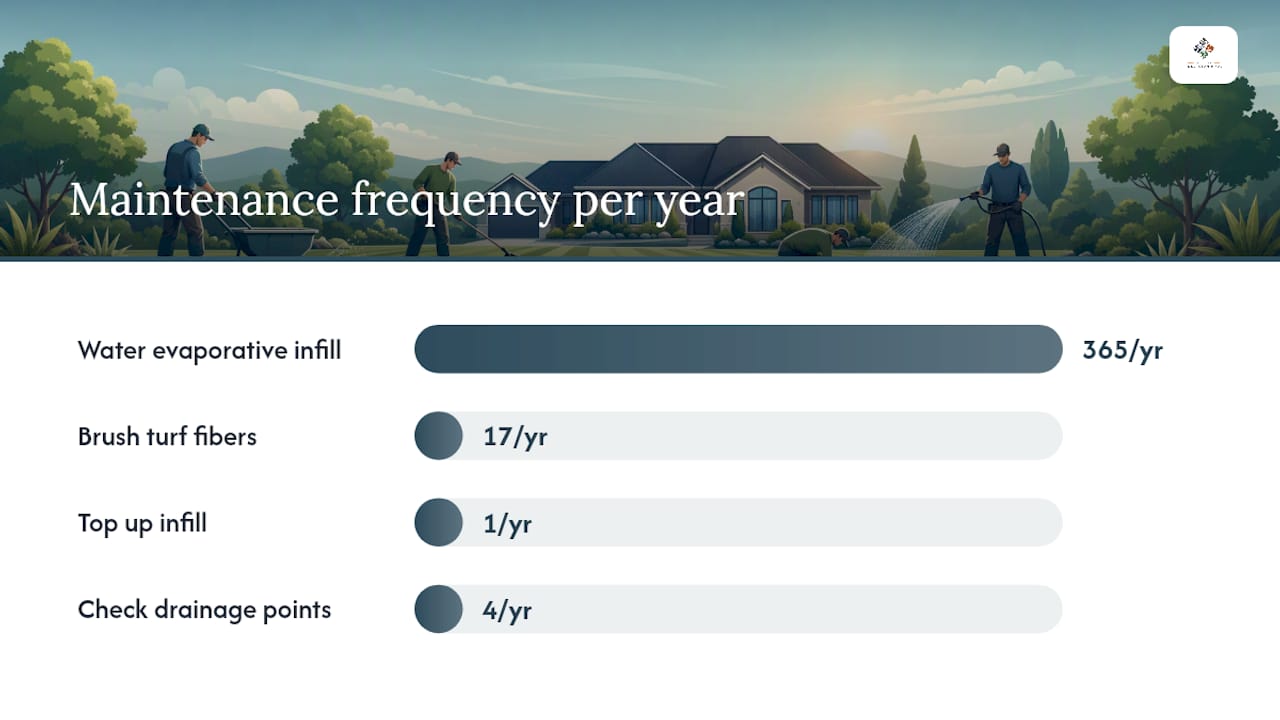
- Water evaporative infill areas at least once daily during peak summer heat, more often in dry, low-humidity climates.
- Brush turf fibers upright every two to four weeks to prevent matting that traps heat and blocks infill hydration.
- Top up infill annually or when levels visibly drop below the fiber tips, since thin infill loses its cooling capacity fast.
- Check drainage points each season to keep water reaching the infill layer instead of running off.
Pro Tip: Set a phone reminder for early morning watering during heat advisories. It’s the single easiest habit that keeps a cooling system actually working.
For an ongoing plan, our artificial turf maintenance guide breaks down a full seasonal schedule.
How Hot Does Turf Get, and When Should You Stop Using It?
Surface temperature checks matter more than air temperature readings, since turf can run far hotter than the air above it. Measured differentials show synthetic turf commonly running 9.4°C to 33.7°C hotter than natural grass, which translates to roughly 17°F to 60.6°F above a grass field nearby under the same sun.
On a 100°F day, unshaded synthetic turf can reach surface temperatures well past thresholds where skin contact becomes a burn risk within seconds.
- Measure with an infrared thermometer at the actual playing or walking surface, not from a nearby weather app reading.
- Treat sustained surface readings above roughly 120°F to 140°F as a trigger to mist, shade, rotate use, or pause activity.
- Follow public-health guidance like Washington State’s synthetic turf recommendations, which call for shade, hydration breaks, and activity modification rather than treating turf as inherently safe.
What Do These Turf Cooling Methods Cost Over Time?
Budget and water access usually decide which method makes sense more than raw effectiveness does. Evaporative infill retrofits sit in the moderate cost range but carry an ongoing water bill. Shade structures cost more upfront but need zero water and zero seasonal maintenance beyond occasional cleaning. Capillary sub-surface systems cost the most to install correctly, especially retrofitted into existing turf, but they use less potable water over time than daily sprinkler cycles because the reservoir recharges from stored or rain-fed sources.
- Lowest upfront, highest ongoing effort: manual hose watering.
- Moderate upfront, moderate ongoing water use: cooling infill retrofit.
- Higher upfront, low ongoing water use: capillary sub-surface system.
- Higher upfront, zero water use: shade structure or hardscape redesign.
Match your choice to what you can sustain. A gorgeous cooling system that nobody waters on schedule performs worse over a summer than a simple shade sail installed correctly the first time.
How a Professional Turf Install Handles Heat From the Start
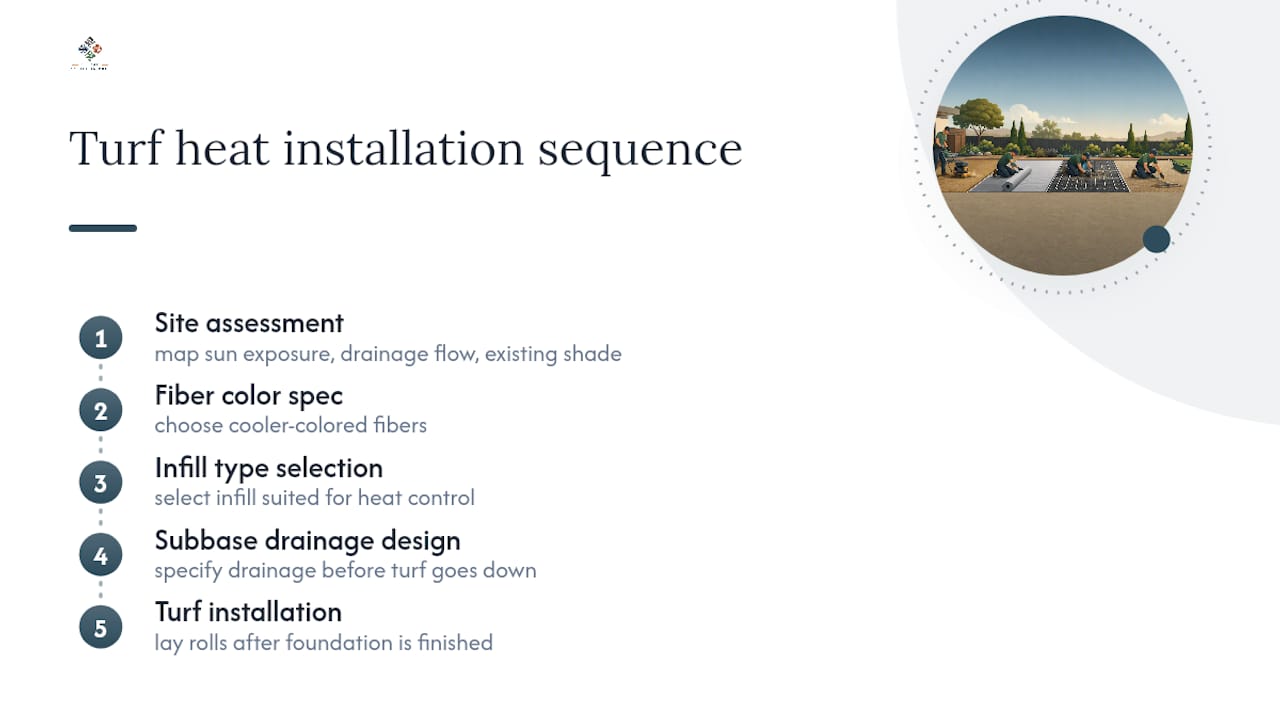
We approach turf heat as a design problem, not an afterthought. Our process starts with a site assessment that maps sun exposure, drainage flow, and existing shade, then moves into specifying fiber color, infill type, and subbase drainage before a single roll of turf goes down. That sequence catches heat issues that a DIY install often finds only after the first hot summer.
Homeowners handling a small patch of turf can often manage watering and brushing themselves. Complex sites, sports surfaces, or anything involving subbase drainage and infill selection benefit from a professional turf installation that gets the foundation right before cooling products even enter the conversation.
Why Most Turf Heat Advice Misses the Real Problem
Most guides treat turf heat like a shopping decision: buy the right infill, problem solved. That’s backwards. The infill matters, but the bigger driver is whether anyone actually maintains a hydration routine once the excitement of a new install wears off. We’ve seen plenty of premium cooling infill installations underperform simple hose-and-shade setups, purely because nobody kept up the watering.
The other overlooked piece is that turf heat isn’t a single-technology problem. Shade placement, fiber color, and infill choice all interact, and no one product fixes a poorly sited installation. If your turf runs hot, the fix usually starts with the site plan, not the product aisle. Get the layout and drainage right first, then layer cooling technology on top of a foundation that was already working with the sun instead of against it.
— Ty
Get a Cooling-Smart Turf Installation Done Right
Turf heat management can be built into the installation itself, so you’re not chasing fixes after the fact like homeowners who bought infill online without a drainage or shade plan to back it up.

We map sun exposure and drainage before we ever roll out turf, then specify fiber color, infill type, and irrigation compatibility to match how you’ll actually use the space, whether that’s a barefoot backyard or a commercial play area. That upfront planning is the difference between turf that needs constant babysitting through July and turf that just works. If your current setup runs hotter than it should, or you’re planning a new install and want it built to handle Arkansas summers from day one, schedule a landscaping consultation and we’ll walk the site with you before anything gets installed.
Sources
- The thermal behaviour and surface temperature differentials of artificial turf — PMC
- Sub-surface water storage and capillary irrigation for cooled artificial turf — Frontiers in Sustainable Cities (2024)
- Does Cooling Infill Work for Artificial Grass? Real Results — FusionTurf answers
- Artificial Turf — Washington State Department of Health
FAQ
How hot is turf on a 100-degree day?
Unshaded synthetic turf can reach 150°F to 175°F on a 100°F day, since surface temperatures commonly run 17°F to 60.6°F hotter than natural grass under the same sun.
Does cooling infill really work?
Yes, when hydrated regularly. Studies and field data show hydrated evaporative infill can lower surface temperature by 10°F to 40°F, though the effect drops off quickly if the infill dries out.
How hot is too hot for turf?
Sustained surface readings above roughly 120°F to 140°F warrant caution, and public-health guidance recommends shade, hydration, and activity modification once turf reaches those levels.
How do you stop artificial grass from getting hot?
Combine hydrated cooling infill or scheduled irrigation with shade over the hottest exposure and, where possible, a lighter fiber color. No single fix eliminates turf heat, but layering these approaches together gets the most reliable result.