

Artificial turf can be a safe, code-compliant playground surface, but only when it sits over a properly tested shock-absorbing underlayment and passes an installed-surface field test after installation. The standards that matter most are ASTM F1292 for impact attenuation and ASTM F3313 for field verification, along with the CPSC Public Playground Safety Handbook as the guiding federal reference. Before you sign a contract, request the critical fall height documentation and a written field test report. If an installer can’t produce both, keep looking.
TL;DR:
- A properly tested shock-absorbing underlayment is essential for turf safety, with certification required for impact attenuation and impact field verification after installation.
- The impact performance can degrade over time due to improper substrate grading, infill displacement, and weather effects, making ongoing retesting critical.
- For compliance, demand documented critical fall height ratings, field test reports, and substrate specifications before installation, especially when using imported or alternative standards.
- Impact injuries, turf burn, and seam separation can be prevented through correct installation, fiber quality control, and regular maintenance checks of infill and seams.
- Chemical exposure risks are real but inconsistent; regular cleaning, lead testing if needed, and balancing chemical safety with impact protection are recommended.
Table of Contents
- Playground Turf Safety Standards Every Buyer Should Know
- What a Safe Turf System Actually Looks Like Underneath
- Chemical Exposure: What the Evidence Actually Shows
- Inspection and Maintenance That Keeps Turf Certified
- The Procurement Checklist: What to Demand From Installers
- What Village Precision Pros Delivers on a Playground Turf Project
- Matching Surfacing to the Full Use Zone, Not Just the Landing Spot
- International and Alternative Standards Worth Knowing
- Common Turf-Related Injuries and How to Prevent Them
- Emergency Response Planning for Turf-Related Incidents
- Why the Paperwork Matters More Than the Marketing
- Request a Turf Safety Assessment From Village Precision Pros
- Sources
- FAQ
Playground Turf Safety Standards Every Buyer Should Know
Three ASTM standards govern whether a turf system belongs under playground equipment, and each one answers a different question. Get familiar with the terminology now, because vendors will use it loosely, and knowing the difference protects your budget and your liability exposure.
Critical fall height is the single number that matters most. It represents the maximum height from which a child can fall onto a surface without exceeding injury thresholds established through ASTM F1292 lab testing, which measures g-max and Head Injury Criterion (HIC) values under controlled impact conditions. If your tallest platform stands 8 feet off the ground, your surfacing needs a certified critical fall height rating of at least 8 feet. Anything less is a liability problem waiting for an incident report.
Lab testing only tells you how a sample performs in a controlled facility, not how your actual installed surface performs after grading, weather, and installation quirks. That’s where ASTM F3313 comes in. It’s the standard test method for verifying impact attenuation on the installed surface, in the field, under ambient conditions. A surface can pass F1292 in a lab and still fail once it’s compacted improperly or laid over a poorly drained base. Reputable installers schedule F3313 testing shortly after installation and again on a recurring cycle, not just once at handover.
Accessibility is a separate but equally binding requirement. ASTM F1951 measures whether a surface allows safe passage for wheelchairs and assistive mobility devices, which matters for any site receiving federal funding or falling under ADA obligations. A surface that scores well on impact attenuation can still fail F1951 if it shifts, ripples, or creates drag under a wheelchair caster.
When you’re reviewing procurement documents or lab reports, look for these specific items:
- A stated critical fall height rating, tied to a specific equipment height, not a vague “meets ASTM standards” claim.
- The test method cited by number (F1292 for lab, F3313 for field), not just “ASTM tested.”
- A test date within a reasonable window of your installation, since materials degrade and old lab data on a different lot number tells you little about your actual surface.
- F1951 accessibility results if any part of the use zone connects to an accessible route.
- The testing lab’s name and accreditation, since self-reported figures without a named third party are worth far less.
The CPSC handbook was updated to clarify that synthetic turf can be considered acceptable playground surfacing when sufficient test data support it, a notable shift from earlier editions that focused almost entirely on loose-fill materials. That update, detailed in the Federal Register, does not give turf a blanket approval. It puts the burden of proof on documentation, which is exactly why the paperwork conversation with your installer matters as much as the material choice itself.
What a Safe Turf System Actually Looks Like Underneath
The turf you see is the least important safety component in the whole system. What lies beneath it determines whether a fall ends in a scraped knee or a trip to the emergency room.
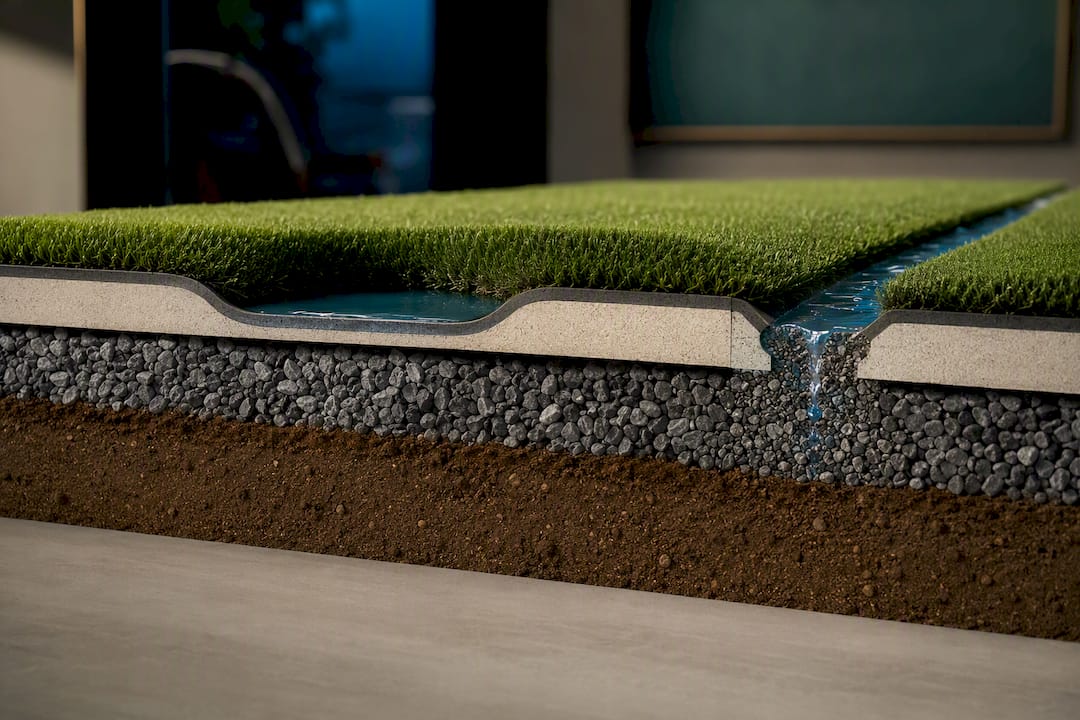
A properly built playground turf system has four functional layers working together:
- Compacted aggregate base. This provides drainage and a stable foundation. Skip this step or compact it poorly, and every layer above it will settle unevenly within a season or two.
- Drainage layer. Standing water beneath turf accelerates infill migration and creates freeze-thaw heaving in colder climates, both of which quietly erode impact performance.
- Shock-absorbing underlayment. This is the actual safety layer. Foam pads, rubber shock pads, or engineered composite mats absorb fall energy, and their thickness and density are matched to your equipment’s fall height, not chosen off a generic spec sheet.
- Turf and infill. The visible surface and its infill (often silica sand, rubber, or organic alternatives) provide the wear layer and help the fibers stand upright, but they contribute only a fraction of the total impact protection.
Loose-fill materials like engineered wood fiber and rubber mulch remain common alternatives, and they carry their own dedicated standards: engineered wood fiber must meet ASTM F2075 and pass F1292 testing, while rubber mulch products are held to ASTM F3012, according to the CPSC handbook. Loose-fill systems are cheaper upfront but require constant raking, top-ups, and depth checks. Turf over a unitary underlayment costs more initially but doesn’t compact into a rock-hard layer the way wood fiber does after a rainy season, and it holds a consistent critical fall height without daily maintenance.
The tradeoff runs both ways, though. Unitary turf systems are harder to repair locally if damaged, and a poorly seamed section can create a trip hazard that a raked loose-fill surface never would.
Pro Tip: Ask your installer for the underlayment’s specific thickness and density spec in writing, tied to your equipment’s actual fall height, not a generic “playground grade” description. Underlayment sold for residential landscaping often looks identical to playground-rated product but tests at a lower critical fall height.
The most common installation failure isn’t a bad material choice. It’s inadequate substrate grading that leaves low spots where water pools, slowly undermining the shock pad’s performance from below, invisible until a field test catches it.
Chemical Exposure: What the Evidence Actually Shows
The evidence on turf chemical exposure is real but incomplete, and pretending otherwise in either direction does families a disservice. Peer-reviewed research has documented hazardous substances, including PAHs, phthalates, and PFAS, in various turf components, while also finding limited direct epidemiological data connecting those substances to health outcomes in children who play on the surfaces, according to a peer-reviewed review of turf hazards and evidence gaps.
Lead is the specific concern with the most documented history. Some studies have found elevated lead levels in synthetic turf fibers and turf-derived dust, and researchers have noted there’s no standardized national method for testing lead in turf, which has led experts to propose interim testing approaches, per environmental health literature on regulating lead in synthetic turf. Older turf products and certain fiber colorants carry higher risk than newer manufacturing runs, but without a uniform test protocol, buyers can’t simply assume a “new installation” means a “low lead” installation.
over 190,000 playground injuries are treated in U.S. emergency rooms annually, with falls identified as a leading hazard, according to CPSC injury data cited in the agency’s handbook.
That figure is a reminder that impact protection and chemical safety aren’t competing priorities. A surface engineered purely to minimize chemical content but tested poorly for fall protection solves the wrong problem first.
Practical mitigation steps that fit within a normal maintenance budget:
- Commission independent lead testing on turf fiber and surface dust if the product’s country of origin or manufacturing date is unclear.
- Establish a regular surface cleaning routine to reduce dust accumulation, particularly on sites serving toddlers who put hands in mouths more frequently than older children.
- Route stormwater runoff away from adjacent gardens or water features if infill contains recycled rubber, since runoff controls limit off-site chemical migration.
- Weigh chemical uncertainty against fall-injury risk rather than treating either factor in isolation. A chemically pristine surface with poor impact attenuation is not the safer choice.
Inspection and Maintenance That Keeps Turf Certified
A turf system that passed its field test on installation day doesn’t stay compliant automatically. Compaction, infill migration, and weather exposure erode impact performance gradually, which is exactly why a maintenance schedule belongs in your contract, not just your good intentions.
- Weekly visual walk-throughs. Look for seams pulling apart, low spots where water collects, and infill that has migrated toward drains or fence lines.
- Monthly infill checks. Measure infill depth in high-traffic zones like under swings and slide exits, where displacement happens fastest.
- Seasonal deep inspections. Check for compaction after freeze-thaw cycles or heavy rain seasons, since compacted underlayment loses its shock-absorbing capacity long before it looks visibly damaged.
- Post-installation field test. Schedule an ASTM F3313 test within the first few months of installation to confirm the system performs as specified once real foot traffic and weather have had their effect.
- Recurring field retest. Field performance declines with use and age, so budget for a documented retest on a recurring cycle, sooner for high-traffic sites like elementary school recess yards.
Keep a maintenance log with dates, findings, and corrective actions. This isn’t paperwork for its own sake. If an incident ever leads to a liability claim or an insurance review, a documented maintenance history is what separates a defensible safety program from a guess. Our turf maintenance guide breaks down seasonal tasks in more detail for facilities managing this in-house.
Pro Tip: Photograph infill depth at the same three or four reference points every month. A photo log makes it obvious when displacement is accelerating, long before a visual walk-through alone would catch it.
The Procurement Checklist: What to Demand From Installers
The documents you request during procurement matter as much as the product you choose. Vague assurances aren’t a substitute for paper.
Ask every bidder for these items before signing anything:
- A lab report citing ASTM F1292 results and a specific critical fall height number, not a general safety claim.
- A written commitment to perform an installed-surface field test under ASTM F3313 after installation, with the report delivered to you, not just kept on file at the installer’s office.
- Substrate preparation specifications, including base depth, compaction method, and drainage design, since these determine whether the lab-rated performance survives contact with your actual soil conditions.
- Warranty terms that specify what’s covered (material defects, seam failure, drainage issues) and for how long.
- A maintenance contract or clear plan for who performs future field retesting, infill replenishment, and repair work, and how quickly they respond to a reported hazard.
Contract language should explicitly require periodic retesting intervals, infill top-up schedules, and a defined repair response window, ideally measured in business days, not “as soon as possible.” An installer who can’t answer basic substrate questions or who treats a written critical fall height report as an unusual request is a red flag worth taking seriously. Absence of that written verification is a real compliance risk, not a paperwork technicality, because it leaves you with no defensible record if the surface underperforms later.
What Village Precision Pros Delivers on a Playground Turf Project
Grading comes before anything else on our job sites, and that order isn’t negotiable. A shock pad laid over an uneven or poorly drained base loses its rated impact attenuation within months, regardless of how good the lab report looked on paper. We correct substrate issues first, because that’s where most turf safety failures actually originate, long before the visible turf layer ever gets installed.
At project completion, our crews hand over documentation that matches what procurement teams need to keep on file: test reports tied to the specific materials installed, a maintenance schedule broken down by season, and as-built notes showing exactly where the underlayment and drainage extend relative to the equipment layout. Check that the paperwork you receive matches the equipment actually installed, not a generic template.
The defects we correct most often on existing sites are drainage that was never properly routed and infill that was installed too shallow to meet its rated performance. Both are preventable with proper prep work up front. For facilities that want ongoing assurance rather than a one-time installation, we support maintenance agreements that include scheduled field retesting and infill top-ups, so the surface keeps performing the way it did on day one. Our artificial turf installation service outlines the full process, from substrate work through handover documentation.
Matching Surfacing to the Full Use Zone, Not Just the Landing Spot
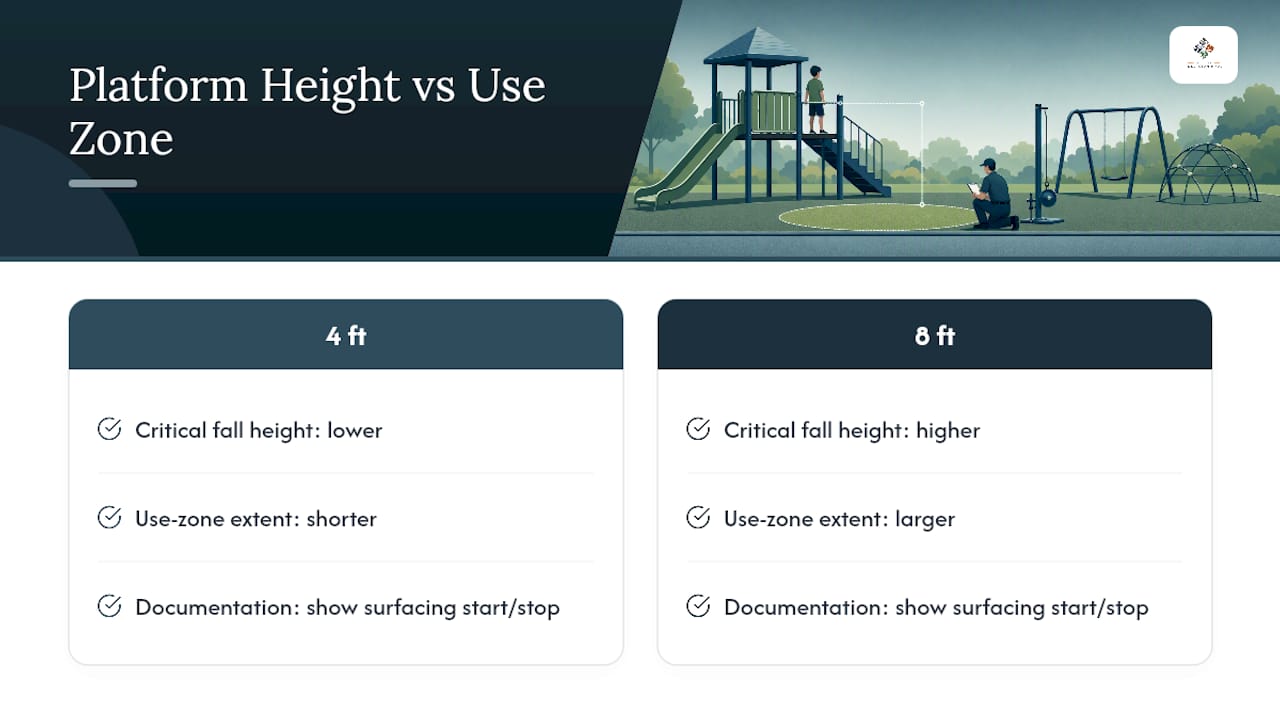
Protective surfacing has to extend across the entire defined use zone around each piece of equipment, not just the direct fall zone beneath it. The use zone typically extends outward from elevated equipment in every direction a child could plausibly fall, and equipment height determines both the required critical fall height rating and how far that surfacing must reach.
A common and costly mistake is installing tested, rated turf directly under a climbing structure while leaving an untested transition strip where the use zone extends toward a walkway or fence line. That gap creates a false sense of compliance. The equipment sits over safety-rated surfacing, but the zone a falling child would actually land in during a lateral tumble may not be covered at all.
Verify use zone extents against the actual fall height of each piece of equipment on-site, not a single blanket assumption for the whole playground. A 4-foot platform and an 8-foot platform on the same playground require different critical fall height ratings and, often, different use zone dimensions. Contractor invoices and as-built drawings should explicitly show where surfacing starts and stops relative to each structure, so there’s a documented record if a fall occurs near a boundary. This detail gets missed more often than any single material choice, and it’s the kind of gap a site visit or an aerial photo review catches quickly.
International and Alternative Standards Worth Knowing
ASTM and CPSC guidance dominate playground surfacing decisions, but they aren’t the only frameworks in circulation, particularly for facilities operating internationally or working with imported turf products. The EN 1177 standard, used widely across Europe, establishes impact attenuation testing methods roughly analogous to ASTM F1292, though the test procedures and rating scales differ in ways that matter if you’re comparing a European lab report to a domestic one.
ISO frameworks touch playground equipment safety more broadly (ISO 8124 for toy safety and related equipment standards), though surfacing-specific impact attenuation testing in the U.S. context still runs through the ASTM family. If an installer presents an EN or ISO certification instead of an ASTM one, ask for a direct comparison or a supplementary domestic test, since a European rating doesn’t automatically satisfy CPSC or local code expectations.
Accessibility standards intersect here too. Designing a use zone that meets both impact and accessibility requirements benefits from looking at how inclusive outdoor programming approaches surfacing choices more broadly, including inclusive outdoor activity design that treats accessible routes as a core design requirement rather than an afterthought bolted onto a finished layout.
The practical takeaway: if your facility receives federal funding, ASTM and CPSC guidance governs your compliance picture. If you’re evaluating an imported product tested to a foreign standard, treat that certification as a starting point for questions, not a final answer.
Common Turf-Related Injuries and How to Prevent Them
Fall-related head and limb injuries dominate the injury profile on any playground surface, turf included, which is exactly why critical fall height ratings exist in the first place. Beyond falls, turf-specific injury patterns tend to cluster around a few predictable causes.
Turf burn, a friction abrasion that happens when skin drags across synthetic fibers during a slide or fall, is more common on lower-quality turf with shorter, coarser fibers. Longer, softer fiber blends reduce this risk, and it’s worth asking installers about fiber specifications, not just infill and underlayment.
Seam separation creates a trip-and-catch hazard that’s easy to miss during a casual visual inspection but obvious the moment a shoe catches on an exposed edge. This ties directly back to installation quality, since properly glued or stitched seams under regular inspection rarely fail suddenly.
Infill displacement toward drains, fence lines, or low spots gradually reduces cushioning depth in high-traffic zones, quietly raising effective fall risk even though the surface looks fine at a glance. Regular depth checks, covered in the maintenance section above, catch this before it becomes a hazard rather than after.
Prevention across all three categories comes down to the same fundamentals: proper installation, fiber quality appropriate for the traffic level, and a maintenance schedule that catches degradation before an incident does. None of these are exotic fixes. They’re routine tasks that get skipped when budgets tighten.
Emergency Response Planning for Turf-Related Incidents
Every facility with playground equipment should have a written incident response plan specific to fall injuries, and turf surfaces don’t eliminate the need for one just because they look softer than asphalt.
The plan should designate who assesses the child immediately (trained staff, not just the nearest available adult), establish a clear protocol for when to call emergency services versus administering basic first aid on-site, and specify how the incident gets documented. That documentation should include the exact location on the playground, which piece of equipment was involved, and whether the surfacing showed any visible damage or displacement at the time.
Photograph the incident location before anyone touches or repairs the surface, including infill depth and any visible seam or underlayment issues nearby. This record matters for two reasons: it supports appropriate medical follow-up if injury severity isn’t immediately clear, and it gives your facility an honest look at whether a maintenance gap contributed to the incident.
After any fall requiring medical attention, schedule an out-of-cycle field test on the affected area rather than waiting for the next scheduled maintenance window. If the surface failed to prevent an injury it was rated to prevent, that’s a signal worth investigating immediately, not filing away for the annual review.
Train staff to recognize the difference between a fall that reflects normal childhood risk-taking and one that suggests a surfacing or equipment problem. The former needs comfort and a bandage. The latter needs an inspection report.
Why the Paperwork Matters More Than the Marketing
Most playground turf marketing leads with softness, color retention, and low maintenance, and almost none of it leads with critical fall height documentation. That’s backwards for anyone actually responsible for a child’s safety on that surface, and it’s the gap this guide has tried to close.
The conventional advice tells buyers to “choose ASTM-compliant turf,” as if compliance were a single checkbox rather than a chain of documentation running from lab test to installed-surface field test to ongoing maintenance record. A product can be ASTM-compliant on a spec sheet and still fail in your specific use zone if the substrate prep was careless or the field test never happened. The standard protects you only when someone actually verifies it against your installation, in writing.
If there’s one priority to take from this, it’s sequencing: demand the written critical fall height report and the field test schedule before you evaluate color, fiber length, or price. Everything else is negotiable. That specific verification step isn’t.
— Ty
Request a Turf Safety Assessment From Village Precision Pros
Village Precision Pros gives Central Arkansas facilities a direct path to compliant playground turf, without piecing together separate contractors for grading, drainage, installation, and testing coordination. We handle substrate preparation, drainage remediation, turf installation, and maintenance agreements as one connected process, so the documentation you need for procurement records actually reflects the work performed on your site.

A first site visit typically covers a substrate and drainage assessment, a review of your equipment layout and fall heights, and a walkthrough of what testing and maintenance documentation you’ll receive at handover. You’ll leave that visit knowing exactly what your use zone requires and what a compliant installation actually costs, not a generic estimate. If your facility is weighing turf against other surfacing options, our artificial turf versus grass guide and our breakdown of infill types are useful starting points before your visit.
Ready to move forward? Visit our artificial turf installation page to request a quote and schedule your site assessment.
Sources
- Public Playground Safety Handbook — U.S. Consumer Product Safety Commission
- Hazards and evidence gaps about artificial turf and playground surfaces — peer-reviewed review (PMC)
FAQ
Is turf safe for kids to play on?
Turf can be safe when it’s installed over a properly rated shock-absorbing underlayment and verified with an ASTM F3313 field test. Turf without adequate underlayment or documented testing carries real fall-injury risk regardless of how soft it looks.
What do CPSC guidelines say about playground surfacing?
The CPSC handbook requires surfacing to have a critical fall height rating equal to or greater than the equipment’s fall height, tested to ASTM F1292, and recognizes synthetic turf as acceptable when sufficient test data support the claim.
What is the safest material to put under a playground?
There’s no single “safest” material; engineered wood fiber (ASTM F2075), rubber mulch (ASTM F3012), and unitary shock pads under turf can all meet safety requirements when properly tested and matched to equipment fall height. The right choice depends on maintenance capacity, traffic volume, and budget for ongoing testing.
What is the safest artificial grass for a playground?
Look for turf paired with a rated shock-absorbing underlayment, backed by an ASTM F1292 lab report and a post-installation ASTM F3313 field test showing a critical fall height matching your tallest equipment. Choosing a company that provides both substrate preparation and documented field testing reduces the risk of a compliance gap between the lab rating and the installed surface.