

Most white, powdery haze on pavers responds to dry brushing followed by a mild detergent scrub with a nylon brush, then a thorough rinse and dry. A purpose-made efflorescence cleaner handles what soap and water leave behind. If the same spot keeps clouding over after repeated cleanings, that pattern usually points to a moisture problem underneath, and it is time to bring in a professional.
TL;DR:
- Efflorescence often peaks within the first months after paver installation and usually responds to dry brushing and mild detergent cleaning.
- Repeated surface cleanings without fixing underlying moisture issues, such as poor grading or leaky downspouts, lead to recurrent deposits.
- Using acid cleaners is a last resort and can damage natural stone or pavers if not diluted and rinsed properly; testing on a hidden area first is essential.
- Proper drainage, joint sand stabilization, and moisture source correction are key to preventing salts from resurfacing over time.
- Professional intervention is necessary when efflorescence persists after multiple cleanings or when moisture problems require excavation, regrading, or base repair.
Table of Contents
- What efflorescence is and how to identify it on pavers
- Removing efflorescence from pavers step by step
- Safety, tools, and pressure washing guidance
- Why efflorescence can return and how to stop it
- When to call in a professional
- Village Precision Pros’ field perspective on recurring efflorescence
- What homeowners get wrong about efflorescence
- How Village Precision Pros restores pavers and stops the cycle
- Sources
- FAQ
What efflorescence is and how to identify it on pavers
Efflorescence is a crust of soluble salts, mostly calcium compounds, that rides moisture up through concrete or stone and dries on the surface as a chalky white film. It is cosmetic at first, but it is also a signal: water moved through your pavers to get there.
New installations are the most common trigger. Fresh concrete pavers carry water and lime from the curing process, and that moisture works its way out over the following weeks. ICPI technical guidance notes that efflorescence often peaks within the first months after installation, which is why many homeowners see it right after a new patio goes in and assume something went wrong.
Before you treat it, confirm what you are looking at:
- Efflorescence is a dry, powdery, whitish film that brushes off easily when fresh.
- Mold or algae looks greenish black, feels slick or fuzzy, and often shows up in shaded, damp corners.
- Mortar smears are grayish and cling to joints rather than spreading across the paver face.
- Polymeric sand haze appears as a thin, sometimes tinted film left after installation and does not brush away like salt.
Getting this right matters because the wrong treatment wastes effort and can make some stains worse.
Removing efflorescence from pavers step by step
Work from gentle to aggressive. Most homeowners solve the problem in the first two steps and never need the rest.
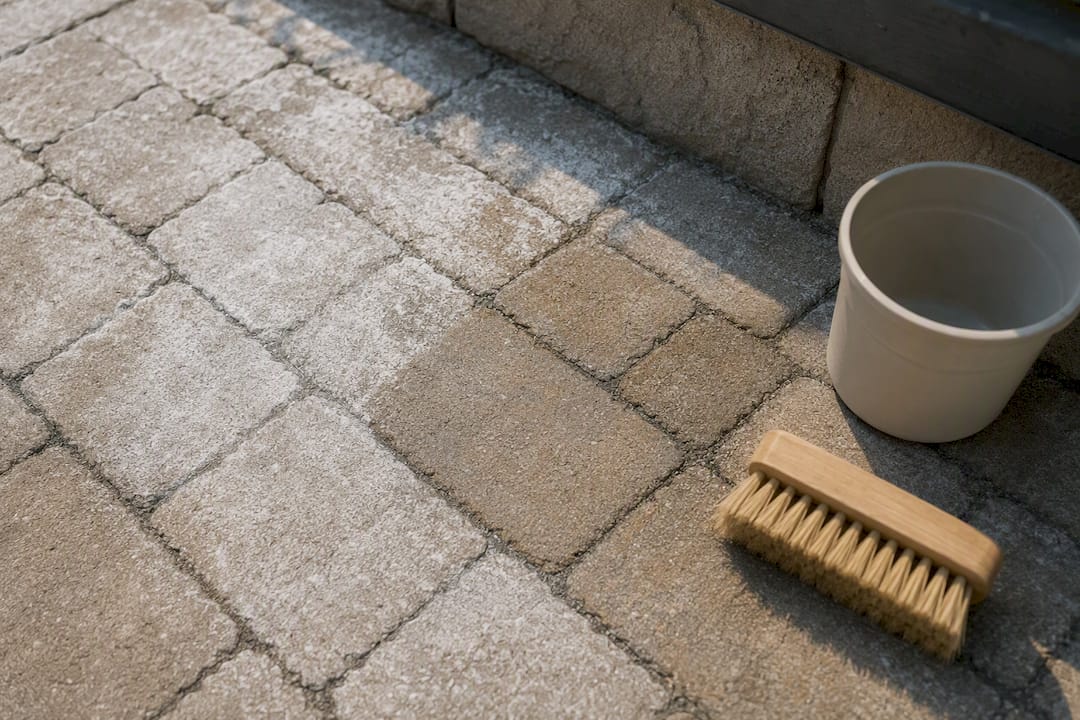
- Dry brush and sweep first. Use a stiff natural or nylon bristle brush to knock loose salt crystals off the surface before introducing any water, since wetting the deposit too early can just redistribute it.
- Wash with mild detergent. Mix a nonionic, neutral detergent with water, scrub with a nylon brush, rinse thoroughly, and let the pavers dry fully before judging the result. Many light cases clear up completely at this stage.
- Apply a proprietary efflorescence cleaner if residue remains. Test it on an inconspicuous corner first, since buffered cleaners can still cause slight color change depending on the acid type, concentration, and how long it sits. Follow the label’s dilution and dwell time exactly, agitate with a brush, then rinse well and let the surface dry.
- Reach for acid only as a last resort. Muriatic acid dissolves stubborn deposits, but GSA cleaning procedures warn that acids can etch or damage masonry if left too long, so dilute correctly, neutralize afterward, and rinse thoroughly. Skip acid entirely on natural stone or acid-sensitive materials.
Severe or long-standing efflorescence often needs a second or third pass. That is normal, not a sign you did something wrong.
Pro Tip: Always test any cleaner, even a mild one, on a hidden section of pavers and let it dry completely before judging the color match.
Safety, tools, and pressure washing guidance
Chemical-resistant gloves, eye protection, and closed-toe boots belong on your hands, eyes, and feet any time you handle detergent or acid-based cleaners, even diluted ones.
- Stick to natural or nylon bristle brushes and skip steel or wire brushes, which can scratch pavers and leave rust stains that are harder to remove than the efflorescence itself.
- Work in an area with good airflow, since fumes from concentrated cleaners build up fast in enclosed spaces.
- Keep runoff away from plant beds, storm drains, and anything downhill that could be affected by acidic wash water.
New York State’s masonry cleaning specification allows a controlled low-pressure water rinse for general rinsing, with anything higher requiring engineer approval. That ceiling exists for a reason: too much pressure blasts sand out of the joints and can etch or pit the paver face, creating new problems while solving the old one. Start low, widen the nozzle fan, and keep the tip moving with professional pressure washing services to avoid damage.
Why efflorescence can return and how to stop it
Cleaning treats the symptom. If salts keep resurfacing in the same spot, water is still finding a way through, and no cleaner fixes that on its own.
- Check grading first: pavers should slope away from the house, and pooling water near a patio edge is often the culprit.
- Route downspouts and irrigation heads away from paver surfaces so they are not feeding moisture into the base.
- Confirm joint sand is properly compacted, since loose or washed-out sand gives water an easy path down to the base layer.
- Investigate repeated recurrence in one spot for subflorescence, salts crystallizing beneath the surface rather than on top, which points to trapped moisture that surface cleaning cannot reach.
Sealing is a finishing step, not a fix. NPS preservation guidance notes that cleaning can actually draw more salts to the surface, so sealing before the pavers are completely dry and salt-free can trap the problem beneath a coating instead of solving it.
Pro Tip: Wait until pavers have dried fully after cleaning, often several days in humid conditions, before applying any sealer.
When to call in a professional
Some efflorescence problems are a weekend project. Others are a plumbing or grading issue wearing a cosmetic disguise.
- Call a pro when the same area keeps clouding over within weeks of cleaning.
- Bring in help for large paver surfaces where DIY scrubbing and repeat treatments are not practical.
- Get a diagnosis if you suspect subflorescence, since that requires addressing moisture below the surface, not just the crust on top.
- Ask any contractor about their experience specifically with pavers, what diagnostic steps they take before cleaning, and what aftercare or maintenance they recommend.
A qualified contractor does more than scrub. Real remediation includes diagnosing the moisture source, correcting drainage or grading, replacing compromised base material or joint sand, and sealing only once the surface is confirmed dry.
Village Precision Pros’ field perspective on recurring efflorescence
On the projects we see across Central Arkansas, recurring efflorescence almost always traces back to a moisture path homeowners did not know existed: a downspout draining under a patio edge, a sprinkler head aimed at the wrong angle, or a base that never had proper drainage built in. Our diagnostic approach starts with tracing water, not scrubbing salt. When cleaning alone will not hold, we regrade the surrounding soil, reroute downspouts, and rebuild the base or joint sand where it has washed out or compacted poorly, so the fix outlasts the next rain.
What homeowners get wrong about efflorescence
The instinct to reach for the strongest cleaner first is understandable and usually backward. Most efflorescence responds to nothing more than a brush, mild detergent, and patience, and jumping straight to acid risks damaging the very surface you are trying to save.
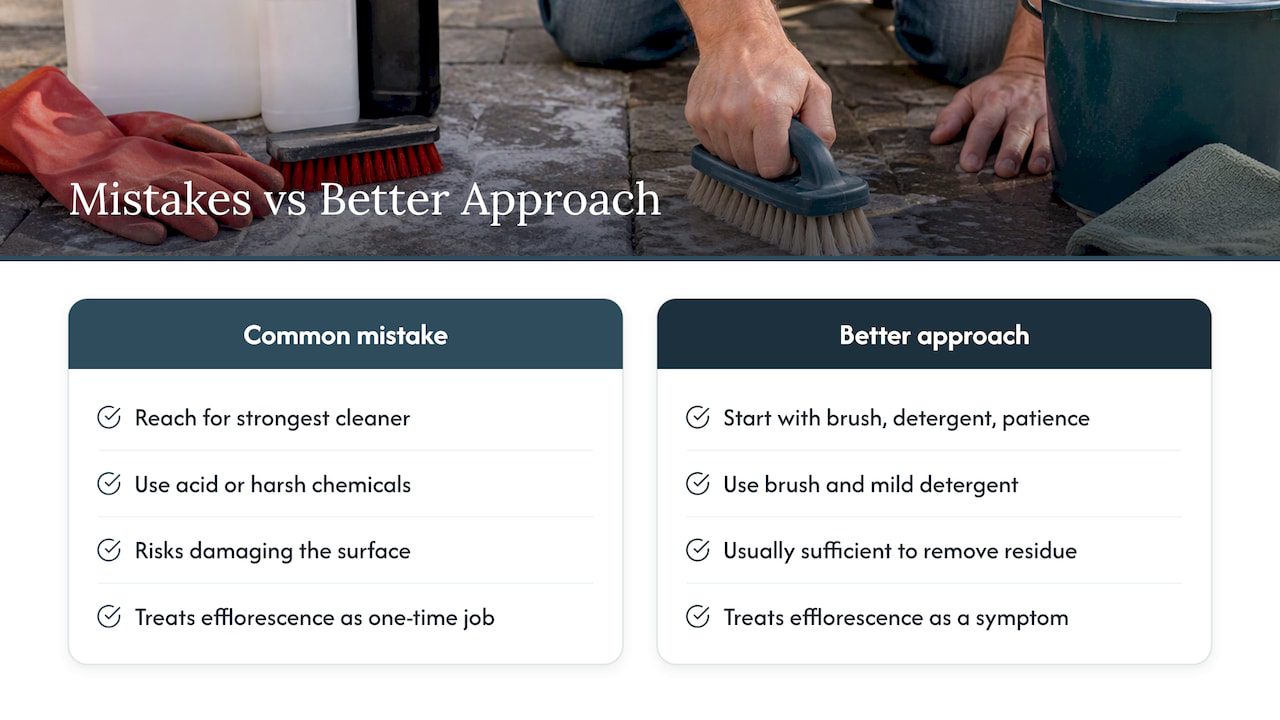
The bigger blind spot is treating efflorescence as a one-time cleaning job instead of a symptom. Conventional advice leans hard on product recommendations and light on the plumbing and grading work that actually stops recurrence. If you have cleaned the same section twice in one season, the answer is not a stronger cleaner. It is tracing where the water is coming from.
Prioritize diagnosis over product strength. A homeowner who fixes a misdirected downspout will get more lasting results than one who upgrades from detergent to acid.
Ty
How Village Precision Pros restores pavers and stops the cycle
We handle both sides of this problem: cleaning the surface and correcting whatever is sending moisture through it. Services often include cleaning and restoration for patios, walkways, and pool decks, drainage correction such as regrading and downspout rerouting, joint sand stabilization and base repair where needed, and annual maintenance plans for homeowners seeking scheduled inspections.

The result is pavers that stay clean because the water problem behind the stain got fixed too. Explore our hardscape and stone masonry services to get a plan built around your property.
Sources
For homeowners who want the underlying technical guidance: GSA’s masonry cleaning procedures cover test patches and pressure limits, and ICPI publishes technical notes on efflorescence timing and cleaner formulation for interlocking pavers.
- ITEM 560.10090008: CLEANING HISTORIC STONE MASONRY AND CONCRETE SURFACES
- A Glossary of Historic Masonry Deterioration Problems and Preservation Treatments | NPS
- Interlocking Concrete Pavement Institute (ICPI)
FAQ
How do you get white efflorescence off pavers?
Start with a dry brush to remove loose salt, then wash with a mild, nonionic detergent using a nylon brush and rinse thoroughly. If haze remains after the surface dries, a proprietary efflorescence cleaner applied per the label usually finishes the job.
Will paver efflorescence go away on its own?
Light efflorescence from a new installation often fades on its own within the first few months as the paver finishes curing, according to ICPI technical guidance. Recurring or heavy deposits usually will not resolve without cleaning and, often, a fix to the moisture source feeding them.
Can efflorescence be removed permanently?
You can remove the surface deposit permanently in most cases, but it will return if water keeps carrying salts to the surface. NPS preservation guidance notes that lasting results depend on addressing the moisture source, not just repeating the cleaning.
What is the best efflorescence remover for pavers?
A proprietary, buffered efflorescence cleaner formulated for pavers is generally safer than raw acid and still effective when used per the manufacturer’s dilution and dwell time. Village Precision Pros applies controlled cleaning methods alongside drainage fixes so results hold instead of reappearing within weeks.