


A permeable paver patio is a surface built with open joints that let water pass through into a stone reservoir below, where it is stored and slowly infiltrated into the soil instead of running off. This approach works best on sites with soils that drain reasonably well, or with an engineered underdrain when they do not, and it only pays off long term if you commit to routine maintenance. Before you buy a single paver, run a simple percolation test or talk with a contractor who can evaluate your site.
TL;DR:
- Proper design and routine maintenance, including joint cleaning, are crucial for permeable pavers to last 20 to 40 years effectively.
- Site conditions such as soil infiltration rates, slope, and drainage are key factors in determining suitability and whether an engineered underdrain is necessary.
- Installation costs are 25 to 35% higher than traditional paving due to the need for skilled labor and precise layering, which impacts long-term performance.
- The typical cross-section includes a gravel bedding, filter base, and a subbase reservoir, with specific layering and material quality critical for permeability.
- Maintaining the system involves regular vacuum sweeping and avoiding over-compaction to prevent clogging and preserve infiltration ability.
Table of Contents
- How a permeable paver patio works
- Benefits and drawbacks for homeowners
- Types of permeable patio surfaces and when to choose each
- How a permeable paver patio is built, layer by layer
- Site suitability checklist: soil, slope and drainage
- Maintenance essentials and clogging prevention
- Planning your project: DIY versus hiring a pro
- Practitioner perspective from Village Precision Pros
- A homeowner’s honest take on permeable patios
- If you prefer a pro: our services and how to start
- FAQ
- Sources
How a permeable paver patio works
A permeable paver patio looks much like a standard paver patio from above, but the joints between units are filled with small, clean aggregate instead of polymeric sand. Water drains through those open joints into a bedding layer, then into a stone reservoir that temporarily stores it while it soaks into the native soil. According to the EPA’s guidance on permeable pavement, this system can function well for 20 to 40 years when it is properly designed and installed.
The stone reservoir does more than hold water. As stormwater passes through the aggregate, sediment gets filtered out, which can improve the quality of water that eventually reaches the groundwater table. That filtering only works, though, if the layers beneath the surface are built correctly:
- The surface course handles foot traffic and light vehicle loads while allowing water through its joints.
- The bedding and base layers hold the pavers in place and move water downward.
- The subbase reservoir stores water temporarily and lets it infiltrate at the soil’s own pace.
Skipping or shortcutting any one of these layers undermines the whole system, no matter how good the pavers look on top.
Benefits and drawbacks for homeowners
A well-built permeable patio reduces the volume of stormwater leaving your property, helps recharge local groundwater, and can lessen the load on other drainage infrastructure around your home. Those are real advantages for homeowners dealing with soggy yards or runoff that pools near a foundation.
The trade-offs are just as real. Permeable systems require more planning than a standard patio, skilled installation to get the layering and compaction right, and a maintenance routine you cannot skip without consequence.
- Hydrologic benefits include reduced runoff volume and improved on-site water quality through natural filtration.
- Installation complexity is higher, since base and subbase layers must be engineered to the site’s soil and drainage conditions.
- Ongoing maintenance, particularly joint cleaning, is required to keep the surface infiltrating properly.
According to the University of New Hampshire’s review of permeable interlocking concrete pavement, paver surface and bedding costs run 25 to 35% higher than traditional concrete, largely because of the skilled labor and routine vacuum sweeping these systems need. That premium buys decades of service life when the system is built and maintained correctly.
Types of permeable patio surfaces and when to choose each
Most residential patios use one of a handful of permeable surface types, and the right one depends on how the space will be used and how it should look.
- Permeable interlocking concrete pavers (PICP) are the most common choice for patios, with open joints filled by clean aggregate and a wide range of colors and patterns available.
- Open-joint modular pavers offer a similar look with slightly larger gaps, suited to casual seating areas and walkways.
- Grid pavers and reinforced turf grids work well where you want a greener appearance or need to support occasional vehicle loads, such as a parking pad beside a patio.
- Pervious concrete and porous asphalt are more common on driveways and commercial lots than on residential patios, though a contractor may suggest them for larger, more utilitarian spaces.
For most homeowners planning a seating or entertaining area, PICP strikes the best balance of appearance, performance, and long-term durability.
How a permeable paver patio is built, layer by layer
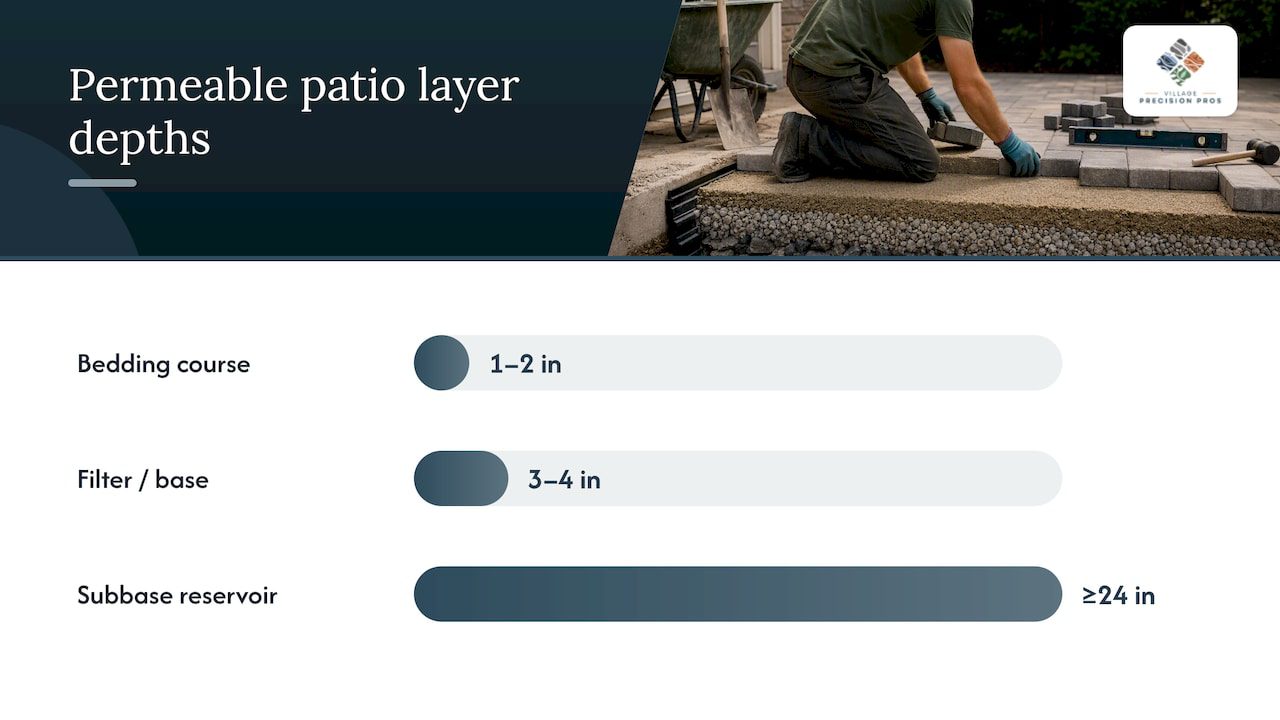
Getting the substructure right is what makes a permeable patio actually permeable. According to the EPA’s stormwater best management practice guidance, a typical cross-section includes a choker or bedding course of roughly 1 to 2 inches, a filter or base reservoir of about 3 to 4 inches, and a subbase reservoir whose thickness varies by site, sometimes exceeding 24 inches depending on how much storage the design calls for.
- The surface and joint fill should use clean, washed aggregate rather than fine sand, which clogs quickly and defeats the purpose of the system.
- The bedding course sits directly beneath the pavers and helps distribute loads evenly.
- The base course filters water and provides additional structural support.
- The subbase reservoir, built from larger aggregate, stores water and allows it to infiltrate into the native soil.
- Geotextile fabric and underdrains are added when soils drain too slowly on their own, and the subgrade should never be overcompacted, since that defeats infiltration before the project even starts.
For specific depth recommendations and how much material to order, our guide on paver base depth and ordering math walks through the numbers in more detail.
Pro Tip: Ask any contractor bidding your project what aggregate gradation they plan to use in each layer; vague answers are a warning sign.
Site suitability checklist: soil, slope and drainage
Not every yard is a good candidate for a permeable patio, and figuring that out early saves you from an expensive redo. A simple percolation test, digging a small hole and timing how fast water drains, gives you a rough sense of your soil’s infiltration rate. Municipal design guidance commonly requires an engineered underdrain when native soils fall below a set infiltration threshold, and many documents call for the system to fully drain within 24 to 72 hours after a storm.
- Maintain adequate vertical separation between the base of the reservoir and the seasonal high water table.
- Favor flat to gently sloped sites, since steep grades push water laterally instead of letting it soak in.
- Keep runoff from vegetated beds, mulch, and disturbed soil away from the patio, since loose sediment is one of the fastest ways to clog the system: for expert help with perimeter landscape protection and maintenance coordination, visit YardWoo Lawncare.
Our patio drainage design guide covers slope targets in more detail if your yard has any grade to manage.
Maintenance essentials and clogging prevention
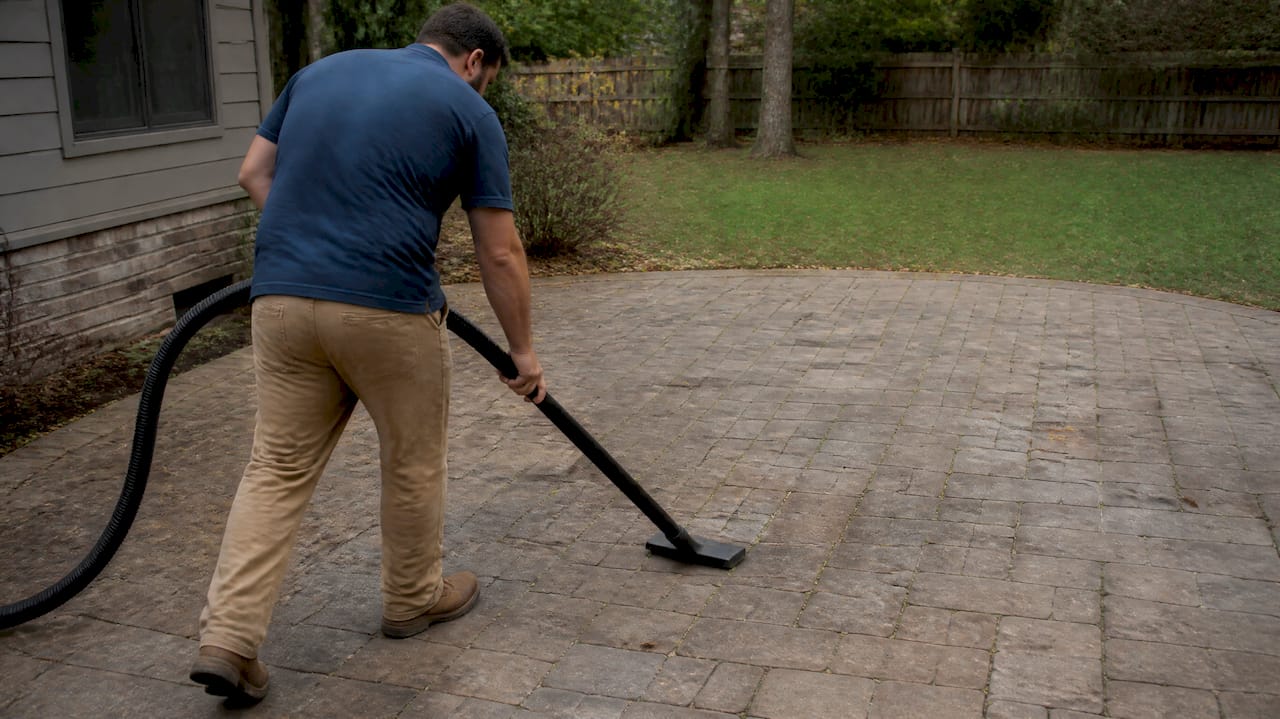
Clogging is the single biggest threat to a permeable patio’s performance, and it is almost always preventable with routine care. A peer-reviewed review of permeable pavement maintenance identifies vacuum-assisted dry sweeping, regenerative air sweeping, and pressure washing paired with suction as the main recovery methods once sediment builds up in the joints.
- Inspect the surface a few times a year for standing water, slow drainage, or visible sediment buildup in the joints.
- Schedule vacuum-assisted sweeping as routine upkeep rather than waiting until the surface is visibly clogged.
- Avoid pressure washing alone, since it can push fine sediment deeper into the joints instead of removing it.
Professionals sometimes confirm performance with standardized infiltration testing, checking how quickly water moves through the surface compared to the design target.
Pro Tip: Vacuum sweeping twice a year keeps most residential permeable patios performing well without ever needing deeper intervention.
Planning your project: DIY versus hiring a pro
Building a permeable patio involves more steps than a standard installation, and each one affects whether the finished system actually works.
- Evaluate the site, including a percolation check and a look at slope and drainage patterns.
- Excavate to the depth required by your base and subbase design.
- Build the base and subbase layers with the correct aggregate gradation, compacting carefully without overcompacting the subgrade.
- Install edge restraints to keep the pavers from shifting over time.
- Set the pavers and fill the joints with clean, washed aggregate, then compact the surface.
Excavation and compaction equipment, plus the judgment to adjust the design for your specific soil, are where most DIY projects run into trouble. If you decide to hire out the work, ask any contractor about their soil testing process, the exact aggregate they specify, their maintenance recommendations, and whether they can show past project photos or references.
Practitioner perspective from Village Precision Pros
We have experience handling drainage problems, uneven subgrade, and long-term maintenance handoffs on patio projects in the region, with numerous completed projects behind us. A scoping visit typically includes a site review, a recommendation on whether infiltration testing is needed, and a maintenance plan the homeowner can follow after project completion. Uneven ground and poor drainage are the two issues we see most often, and both are solvable with the right base design.
A homeowner’s honest take on permeable patios
A permeable patio rewards owners who treat maintenance as part of the deal, not an afterthought. If you are weighing the decision, test your soil’s infiltration rate or get a professional opinion before you order a single paver.
Ty
If you prefer a pro: our services and how to start
If digging, grading, and sourcing the right aggregate sounds like more than you want to take on, our Hardscape & Stone Masonry team handles the full process from soil evaluation through joint fill and compaction. We also build traditional Decks & Patios projects and offer annual maintenance plans to keep a permeable system draining properly for years.

A consult typically starts with a site walk, covers drainage and soil conditions, and ends with a maintenance plan tailored to what we install. Reach out through our Hardscape & Stone Masonry page to schedule a visit and see whether a permeable patio makes sense for your yard.
FAQ
What are the disadvantages of permeable pavers?
Permeable pavers cost more upfront than traditional paving, require skilled installation to get the layering right, and need routine maintenance to prevent clogging. According to UNH’s review of permeable interlocking concrete pavement, surface and bedding costs run 25 to 35% higher than traditional concrete largely because of these added requirements.
What are the pros and cons of permeable pavers?
The main benefits are reduced stormwater runoff, improved water quality through natural filtration, and a service life of 20 to 40 years when properly built. The main drawbacks are higher installation complexity and the need for ongoing joint maintenance to avoid clogging.
Are permeable pavers expensive?
Permeable pavers cost more than standard pavers mainly because of the specialized base design, clean aggregate, and skilled labor required for proper installation. Our guide on paver patio installation cost drivers explains what affects the total without quoting specific figures.
What goes under permeable pavers?
Permeable pavers sit on a bedding course, a base course, and a subbase reservoir built from clean, washed aggregate in specific gradations. The EPA’s stormwater management guidance describes typical layers as a 1 to 2 inch choker course, a 3 to 4 inch filter or base layer, and a subbase reservoir whose depth depends on site-specific storage needs.
Sources
- Soak Up the Rain: Permeable Pavement, EPA
- Permeable Interlocking Concrete Pavement (PICP) for Stormwater Management, UNH
- Permeable Asphalt Pavements: Benefits, clogging factors and maintenance, PMC