

Yard leveling is defined as the process of reshaping your lawn’s surface to create a controlled slope that moves water away from your home and toward safe discharge points. The industry term for this work is yard grading, and it is the foundation of every healthy outdoor space. A proper drainage slope of 2–5% away from your foundation prevents pooling, basement mold, and costly structural repairs. Skipping this step is not just an aesthetic problem. Pooling water near a foundation increases hydrostatic pressure that damages foundation walls and can trigger remediation bills running into the thousands. This guide covers every stage of how to level an uneven yard, from tool selection through long-term maintenance, so you can protect your home and reclaim your outdoor space.
What tools and materials do you need to level a yard?
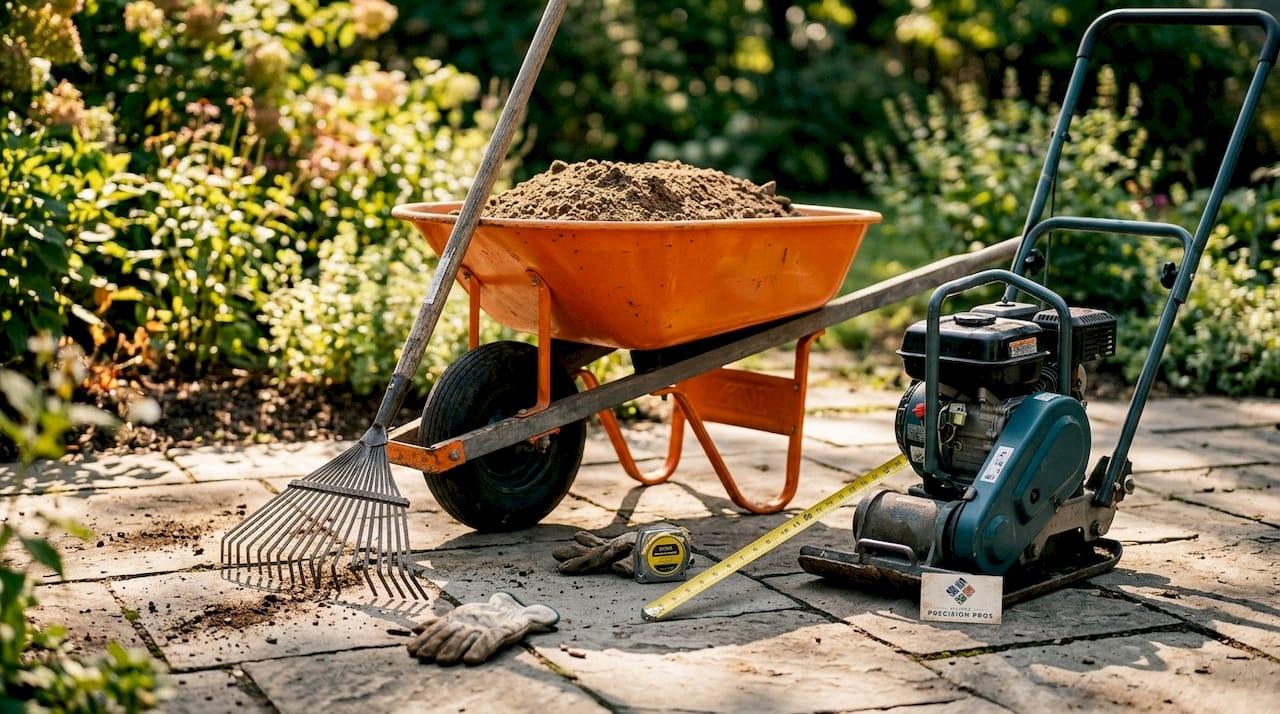
The right tools make the difference between a grade that holds and one that fails after the first heavy rain. For most DIY yard leveling projects, you need a flat spade, a bow rake, a wheelbarrow, a string level or line level, and a hand tamper or plate compactor. A plate compactor is the better choice for any fill area larger than a few square feet because it delivers consistent compaction that a hand tamper cannot match.
Fill material selection matters just as much as the tools. Structural fill dirt goes below the final surface layer because it compresses well and does not decompose. Topsoil, which is rich in organic matter, belongs only at the top 4–6 inches where grass roots grow. Using topsoil as fill causes it to break down over time, creating new low spots within a season or two. A mix of coarse sand and compost works well for minor surface corrections under 2 inches deep.
| Material | Best use | Depth |
|---|---|---|
| Structural fill dirt | Deep grading, subsoil layer | Below 4–6 inches |
| Topsoil | Final surface layer, lawn growth | Top 4–6 inches |
| Coarse sand and compost | Minor surface corrections | Under 2 inches |
| Gravel | Drainage swales, base layers | As needed |
Pro Tip: Rent a plate compactor from a local equipment supplier for large fill areas. Compacting in 4-inch lifts costs you more time but prevents the uneven settling that sends homeowners back to square one.
How do you prepare and measure your yard for leveling?
Accurate measurement before you move a single shovelful of soil saves you from creating new drainage problems. Walk your yard after a rain and mark every low spot where water sits for more than 30 minutes. Those marks become your grading targets.
Follow these steps to measure and plan your grade:
- Mow the lawn short. Cut grass to 1–2 inches so you can see the ground surface clearly.
- Set a string level. Drive stakes at your home’s foundation and at the yard’s edge, then run a string line between them. Adjust until the string reads level using a line level tool.
- Measure the drop. The string gives you a reference plane. Measure down from the string to the ground at multiple points to find high and low spots.
- Calculate your slope. A 2–5% slope for drainage equals roughly 1/4 inch of drop per foot near the foundation. For open lawn areas, a 1–2% slope, about 1–2 inches of drop per 10 feet, prevents pooling without creating a noticeable hill.
- Mark utilities. Call 811, the national dig-safe line, before any digging. Hitting a buried line is dangerous and expensive.
- Map drainage paths. Identify where water should exit your yard, whether that is a street gutter, a swale, or a dry creek bed.
- Check neighbor boundaries. Redirecting runoff onto a neighboring property creates legal liability. Your grade must terminate at a shared discharge point or your own property line.
Setting target elevations before you start gives you a clear finish line. Without them, you are guessing, and guessing leads to re-work.
What are the step-by-step techniques to level an uneven yard?
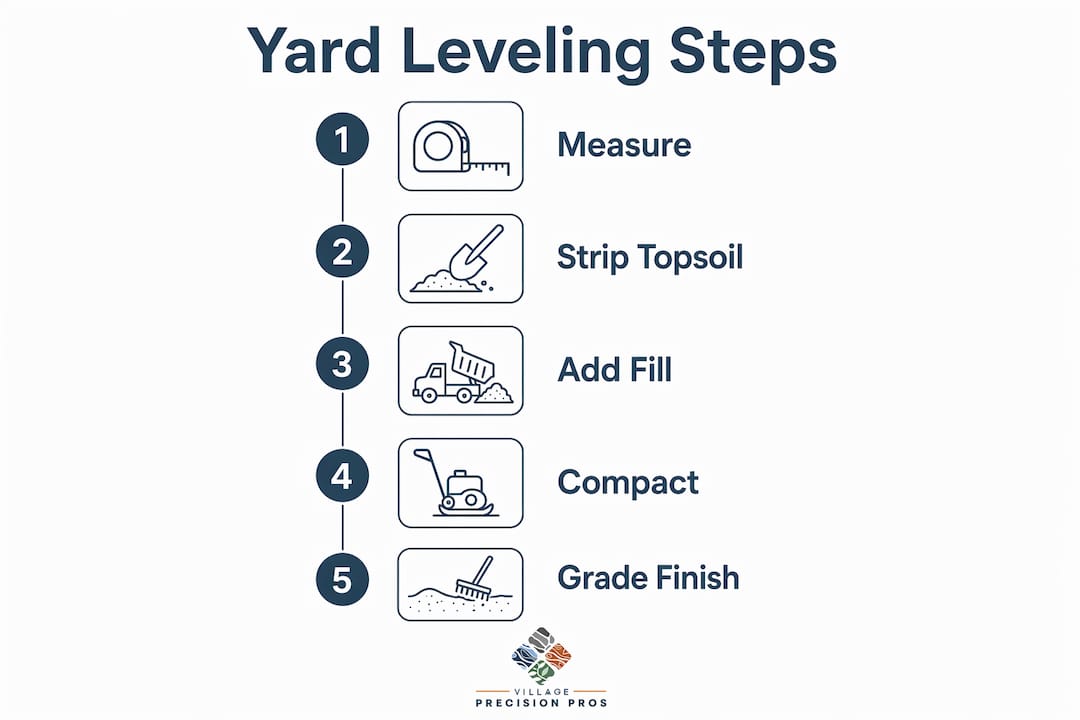
Executing a yard leveling project correctly requires patience and a commitment to compaction. Rushing the fill and compaction stages is the most common DIY mistake we see in Central Arkansas, and it always shows up as new low spots within a year.
- Clear the area. Remove rocks, roots, and debris. Mow grass short.
- Strip and stockpile topsoil for deep grading. For any soil movement deeper than 2 inches, strip 4–6 inches of topsoil and pile it to the side. This preserves the organic layer your lawn needs to recover.
- Cut high spots. Use a flat spade to shave down raised areas. Move that soil to low spots rather than hauling it away.
- Fill low spots with structural fill dirt. Add structural fill in layers, not all at once. Each layer should be no more than 4 inches deep before compaction.
- Compact each lift. Compact fill soil in 4-inch lifts using a plate compactor. Uncompacted soil looks fine on day one but creates drainage failures within months.
- Replace the topsoil layer. Spread your stockpiled topsoil back over the graded subsoil. Rake it smooth to a consistent 4–6 inch depth.
- Check your slope. Re-run your string level and verify the grade matches your target. Correct any remaining low spots now, before the lawn goes back in.
- Water lightly and wait. A light watering settles the soil and reveals any remaining dips. Fill and rake those spots before seeding or sodding.
- Seed or sod. Restore grass cover quickly to prevent erosion. Bare soil on a fresh grade washes away fast, especially during Arkansas spring rains.
Pro Tip: Check your slope at every stage, not just at the end. Catching a grade error after one lift is a 10-minute fix. Catching it after the topsoil goes back on is a half-day job.
The goal is not a perfectly flat yard. Experts confirm that a perfectly flat surface causes drainage failure because water has no gradient to follow toward discharge points. A gentle, controlled slope is the target every time.
| Stage | Key action | Common mistake |
|---|---|---|
| Topsoil stripping | Remove 4–6 inches, stockpile | Skipping this step on deep fills |
| Filling low spots | Use structural fill dirt | Using topsoil as fill material |
| Compaction | Compact in 4-inch lifts | Filling full depth without compacting |
| Slope verification | Check grade with string level | Assuming the eye is accurate enough |
| Lawn restoration | Seed or sod immediately | Leaving bare soil exposed to rain |
How can you troubleshoot common issues and maintain your leveled yard?
Even a well-executed grade needs attention over time. Arkansas gets heavy spring rainfall, and that water tests every yard’s drainage path every season.
Watch for these signs that your grade needs attention:
- Standing water after rain. Water sitting for more than 30 minutes in the same spot signals a low point or a blocked drainage path.
- Soil settlement near the foundation. The ground directly against your home can settle over years. Check this area each spring and add topsoil to maintain the slope.
- Erosion channels. Ruts or channels in your lawn show that water is moving too fast in one direction. A shallow swale redirects that flow more gently.
- Soggy patches in open lawn. These often indicate a buried drainage obstruction or a compaction layer just below the surface.
For minor corrections, top-dress the low spot with a topsoil and coarse sand mix, rake smooth, and overseed. For persistent drainage problems, a French drain or a graded swale may be the right fix. Extending downspouts at least 6–10 feet from the foundation prevents concentrated runoff from undoing your grading work. Avoid mowing new fill areas until grass is fully established, typically 4–6 weeks after seeding, because mower weight compresses soft soil and creates new ruts.
When should you hire professionals for yard leveling?
Some grading projects exceed what a homeowner can safely handle with a shovel and a rented compactor. Knowing when to call in a crew protects your home and your budget.
Hire a professional when:
- Grading runs within 10 feet of your foundation. Errors here cause the most expensive damage.
- Utilities are present. Professional crews work with utility maps and know how to grade around buried lines safely.
- Soil displacement is large. Moving more than a few cubic yards of soil by hand is exhausting and imprecise. Professional equipment rentals run $100 or more per hour, and pros bring that equipment with the labor.
- Drainage failures are recurring. If you have fixed low spots before and they keep coming back, the problem is likely a subsurface issue that needs professional diagnosis.
- Local codes apply. Soil testing and local building code compliance are required in many Arkansas municipalities, especially for grading near shared property lines.
Professional yard grading projects typically cost between $1,022 and $3,334, depending on the size of the area, the amount of soil movement, and drainage complexity. Site preparation alone, including debris removal and initial grading, generally runs $300–$1,000. Those numbers reflect the equipment, labor, and precision measurement that a professional crew brings to the job. The cost of fixing a foundation drainage failure runs far higher. Proper grading also protects your landscaping investment, much like trenchless repair methods protect underground infrastructure without tearing up a finished yard.
Villageprecisionpros has completed over 1,750 projects across Central Arkansas, including complex grading and drainage solutions near foundations, utilities, and sloped lots. Our crews use precision measurement tools and compaction equipment to deliver grades that hold through Arkansas’s wet seasons.
Key Takeaways
Proper yard grading requires a controlled 2–5% slope away from your foundation, structural fill dirt compacted in 4-inch lifts, and preserved topsoil to support healthy lawn recovery.
| Point | Details |
|---|---|
| Slope is non-negotiable | Grade 2–5% away from your foundation for the first 6–10 feet to prevent water damage. |
| Use the right fill material | Structural fill dirt goes below the topsoil layer; topsoil as fill decomposes and creates new low spots. |
| Compact in lifts | Fill soil in 4-inch layers and compact each one before adding the next to prevent future settling. |
| Strip and replace topsoil | For deep grading, remove and stockpile topsoil first, then replace it after subsoil grading is complete. |
| Know when to call a pro | Grading near foundations, utilities, or large soil volumes requires professional equipment and code knowledge. |
What I’ve learned after watching hundreds of Arkansas yards drain poorly
The most common mistake I see is homeowners treating yard leveling as a surface problem. They rake in some topsoil, smooth it out, and call it done. Six months later, the same low spots are back, and the foundation is wetter than before.
The real issue is almost always below the surface. Soil compaction, buried debris, or a subsurface clay layer traps water and defeats any surface fix you apply. That is why we always ask: has this area been filled before? Previous fill that was never compacted is the hidden cause behind a lot of recurring drainage calls we get in Central Arkansas.
Planning matters more than effort. A homeowner who spends two hours measuring grades and mapping drainage paths will outperform one who spends a full weekend moving soil without a plan. The string level is the most underused tool in DIY grading. Most people skip it because it feels slow. It is not slow. It is the step that makes every other step count.
My honest advice for complex cases: get a professional assessment before you move soil. A one-hour consultation costs far less than correcting a grade that redirects water toward your neighbor’s property or, worse, back toward your own foundation. The long-term value of a properly graded yard shows up in lower maintenance costs, a healthier lawn, and a home that shrugs off heavy rain instead of absorbing it.
— Ty
Villageprecisionpros yard leveling and grading services
An uneven yard is a solvable problem, and you do not have to figure it out alone. Villageprecisionpros serves Central Arkansas homeowners with expert grading assessments, precision soil work, and complete drainage solutions built to last through every season.

Our team evaluates your yard’s current slope, maps drainage paths, and delivers a grading plan that protects your foundation and restores your lawn’s usability. We handle everything from minor surface corrections to full-scale regrading near foundations and utilities. Schedule a landscaping consultation to get a clear picture of what your yard needs and what it will cost. You can also review our foundation leveling services for projects where grading and structural work overlap.
FAQ
What is the correct slope for yard drainage?
The minimum slope for drainage away from a home’s foundation is 2–5% for the first 6–10 feet, which equals roughly 1/4 inch of drop per foot. Open lawn areas need only a 1–2% slope to prevent pooling.
What is the best soil for leveling a yard?
Structural fill dirt is the best material for filling low spots below the surface layer. Topsoil should only be used for the final 4–6 inches where grass roots grow, because topsoil decomposes and causes settling when used as deep fill.
How do I fix low spots in my yard without killing the grass?
For low spots under 2 inches deep, top-dress with a mix of coarse sand and topsoil, rake it thin over the existing grass, and water lightly. The grass grows through the mix within a few weeks without needing to be removed.
When does yard leveling require a permit in Arkansas?
Permit requirements vary by municipality, but grading that significantly alters drainage patterns or involves large soil displacement near property lines often requires local approval. Contact your city or county planning office before starting any major grading project.
How much does professional yard leveling cost?
Professional yard grading typically costs between $1,022 and $3,334, depending on the size of the area, the volume of soil moved, and drainage complexity. Site preparation costs alone generally run $300–$1,000.