


Most overgrown shrubs can be fixed, but not in a single afternoon with a hedge trimmer. The method that works is renewal pruning: you remove the oldest, thickest stems at the base over one to three years, in late winter or early spring, and you keep the shape wider at the bottom than at the top. Some plants, like boxwood and yew, do not bounce back from hard cuts, and those are better removed and replaced.
It is early November as we write this, so the practical answer for most Central Arkansas yards is to plan now and make the big cuts when the plants are dormant. Below we cover how to assess what you have, how to cut, what tools to use, how to care for the plants afterward, and when it makes sense to bring in a crew.
TL;DR
- Wait for late winter or early spring to do heavy pruning. Fall cuts push new growth that may not harden off before winter.
- Fix a badly overgrown shrub gradually: take out no more than one-third to one-half of the oldest stems each year, cutting them at the base.
- Avoid shearing the outside into a flat box. Thin and head back instead, and keep hedges narrower at the top.
- Boxwood and yew often will not refill from old wood. If the plant is too big for its spot, replacing it is the lasting fix.
- Water well after a hard cut, because the plant is living off root reserves until new leaves open.
Table of Contents
- Why Overgrown Shrubs Get Out of Hand
- Assess the Shrub Before You Cut
- When to Cut Back Overgrown Shrubs and Hedges
- The Renewal Method That Works
- Cutting Back an Overgrown Hedge
- Tools That Match the Branch
- Care After a Hard Prune
- When Removal Is the Better Fix
- Our Perspective
- Let Our Crews Handle the Heavy Cutting
- What Drives the Total on a Shrub Project
- FAQ
- Sources
Why Overgrown Shrubs Get Out of Hand
Shrubs are planted small and sized for the space on the day they go in. Left alone, they keep growing, and pruning only on the outside makes it worse. The University of Maryland Extension notes that pruning does not stop growth, it stimulates it, and that a plant too large for its space will not be held at a set size by pruning alone.
The typical pattern looks like this: a few years of light trimming on the outside, a dense shell of leaves on top, and bare, woody stems underneath. Light cannot reach the interior, so the inside stops leafing out. The shrub then blocks windows, crowds walkways, and hides the foundation of the house.
There are two ways to fix that. One is renovation, which means cutting the plant back in stages so it regrows with a healthier structure. The other is removal and replacement. Which one you pick depends on the species, the condition of the wood, and whether the plant belongs in that spot at all.
Assess the Shrub Before You Cut
Twenty minutes of looking saves a plant. Walk around it and check three things.
Identify the plant
Know the species before you prune. Epic Gardening advises identifying the plant first so you know whether it tolerates harsh cuts or needs gentle reshaping. Some shrubs, such as butterfly bush, Annabelle hydrangea, potentilla, and Japanese spirea, can be cut to within 4 to 10 inches of the ground while dormant. Others, particularly many evergreens, will not regrow from bare wood.
Find the dead wood
Scratch a small patch of bark on a suspect branch. Branches are dead when they are brown under the cambium, while live ones are green underneath, and dead limbs also lack buds and new growth. Mark the dead stems first, since they come out regardless of the season.
Look at the structure
A shrub without leaves is easier to read. MyRGV notes that a leafless shrub lets you see the overall shape and possible health problems and shows where the cuts should go. Look for crossing branches, rubbing stems, and the oldest, thickest canes. Those are your first targets.
When to Cut Back Overgrown Shrubs and Hedges
The short answer is late winter to early spring, before buds swell. Tennessee Extension says the best time to prune is late winter and early spring while plants are dormant, and that late summer and early fall are poor times because the new growth they trigger cannot mature enough to survive winter freezes. Iowa State recommends March or early April for rejuvenating large shrubs. The University of Georgia suggests severe pruning when spring growth begins, mid-March in north Georgia and mid-February in south Georgia. Arkansas sits between those climates, so a late winter window ahead of bud swell is the safe target.
Is October too late?
For major cuts, yes. The University of Maryland advises against pruning in fall, generally August to late October, and says that when in doubt you should prune in early spring. If it is already November, remove only dead, broken, or hazardous branches now and hold the rest of the work until the plant is dormant and the worst of the cold has passed.
There is a reason winter works: energy reserves are highest while the plant is dormant, and lowest during spring growth. Tennessee Extension explains that a plant pruned in active spring growth has to spend low reserves on new shoots and wound healing at once.
The Renewal Method That Works
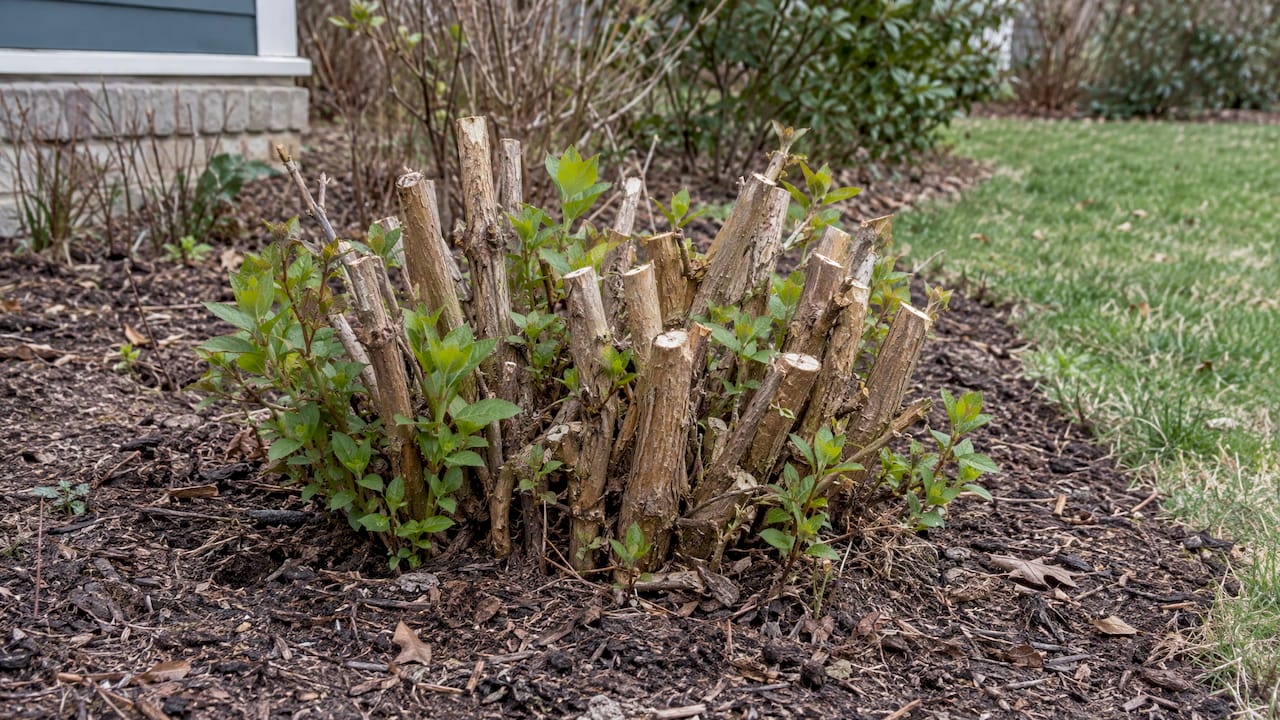
Renewal pruning is selective. You are not trimming the outline, you are removing the oldest, heaviest stems close to the ground so that new, vigorous shoots take their place. Missouri Botanical Garden describes it as removing the oldest stems as close to the ground as possible.
The three-year plan
For shrubs that have been neglected a long time, spreading the work out is gentler on the plant.
- Year one: In late winter, cut out all dead wood first. Then remove about one-third of the oldest, thickest stems at ground level.
- Year two: Repeat with another third of the old stems. By now the first round of new shoots should be filling in.
- Year three: Remove the last of the old wood and lightly thin the new growth so the shrub keeps an open, natural form.
Iowa State describes this 3-year method, and Missouri Botanical Garden suggests removing one-third to one-half of the old heavy stems each year over three years for badly neglected plants. The University of Maryland adds that staggering renewal over several years lessens plant shock. The University of Arizona gives a useful ceiling for any single season: never remove more than one-quarter to one-third of the live canopy when revitalizing a sheared shrub.
The hard-cut option
For tough, fast-growing deciduous shrubs, you can do it all at once. Iowa State describes cutting the shrub to within 4 to 6 inches of the ground in March or early April. University of Wisconsin Extension gives 4 to 10 inches for dormant shrubs that tolerate it, and the University of Georgia describes renewal pruning as cutting plants back 6 to 12 inches above ground. The shrub will look stark for a season, then come back with a fresh, dense form. Use this only on species known to resprout from the base.
Why not just shear it?
Shearing feels faster, but it makes the problem worse. Missouri Botanical Garden explains that a haircut approach destroys the natural form and sends new shoots up just below each cut, which gives you taller, leggier plants. Renewal pruning pushes growth from ground level instead. The University of Maryland describes the proper approach for an overgrown shrub as thinning and heading cuts, not shearing.
Making a clean cut
For heading-back cuts on branches you are keeping, cut on a slight angle to within 1/4 inch above a bud and do not leave a stub. University of Wisconsin Extension also recommends disinfecting tools after each cut with alcohol or a 10% bleach solution when disease is a concern. For thinning cuts, go all the way back to the base or to a main branch.
Cutting Back an Overgrown Hedge
Hedges have the same underlying problem, a thick outer shell and a bare center, but you also have to keep a clean line. The most common mistake, according to University of Florida IFAS, is cutting the hedge into a sharp-edged box. The top should be narrower than the bottom so sunlight reaches every leaf. The University of Georgia puts it the same way: a pyramidal shape tapering from a wider base lets light into the lower canopy, so foliage stays dense to the ground.
Here is how we approach a hedge that has gotten away from its owner:
- Thin first. Each year, remove about one-third to one-fourth of the oldest branches near the ground before spring growth, as the University of Maryland recommends.
- Reduce the height in steps. For an overgrown, bare-bottomed deciduous hedge, Maryland suggests pruning to one foot below the desired height, then trimming often over the next few years.
- Shape as a narrow pyramid or inverted V. This keeps the lower branches from being shaded out.
- Follow the contour. Step back after every few passes so the line stays even.
If you want a second walkthrough with photos of cutting a neglected hedge, this guide to pruning a neglected hedge correctly shows the technique on a mature planting.
Tools That Match the Branch
The right tool makes cleaner wounds, and clean wounds heal faster. University of Maine Cooperative Extension gives a simple size guide: hand pruners for stems up to 1/2 or 3/4 inch, lopping shears for 3/4 to 1.5 inches, and a pruning saw for anything thicker. Iowa State’s equipment guide uses nearly the same breakpoints.
| Branch diameter | Tool | Notes |
|---|---|---|
| Up to about 3/4 inch | Hand pruners | Use bypass-style cuts close to a bud or branch |
| 3/4 to 1.5 inches | Lopping shears | Long handles give leverage for thicker stems |
| Over 1.5 inches | Pruning saw | Make the cut flush to the base or parent branch |
The University of Maryland notes that loppers give better leverage on branches up to three inches, and that sharp tools leave a smooth wound with no stubs, split branches, or torn bark where decay can set in. Sharpen blades before you start, and clean them with 70% alcohol or a 1 to 9 bleach and water mix, as the University of Maine advises.
Wear gloves and eye protection, and plan for the debris. A single hard renewal cut on a large shrub can fill a truck bed.
Care After a Hard Prune
A shrub with no leaves is not making food. Expert Hirvela, quoted by Country Living, explains that after a cut-back the plant relies on energy stored in its roots and is more susceptible to stress, so a few months of extra care help it recover.
In practice:
- Water deeply during dry spells through the first growing season.
- Add supplemental fertilizer to support recovery, as that same source suggests.
- Keep mulch a few inches off the base of the stems.
- Rub off or thin weak, crowded shoots in the second year so the strongest ones carry the new framework.
When Removal Is the Better Fix
Some plants are the wrong plant for the spot. Iowa State says boxwood and yew hedges that become too large or unattractive need to be removed and replaced, because they do not readily fill gaps with new growth. Expert Bennett, in Country Living, points to conifers planted too close to the house that will not re-flush as cases where removal is almost necessary.
The University of Arizona recommends that when a plant is simply too big for the space, you remove it and plant something that grows slower or stays smaller. That is often the most durable decision: you stop pruning against the plant’s nature, and the bed stays tidy with less work.
If you are replanting, think about maintenance from the start. Our guide to low-maintenance landscaping for Arkansas yards covers plant choices and bed layouts that stay in bounds with less effort.
Our Perspective
We see the same thing in yard after yard across Central Arkansas: a shrub that was fine four years ago, now pressed against a window or swallowing a walkway. The owner has been trimming the outside every season, and the inside has gone bare.
Our view is that overgrown shrubs are rarely a pruning problem alone. They are a planning problem. The question to ask first is whether the plant fits the space at maturity. If it does, renewal pruning in stages brings it back with a better structure. If it does not, replacing it with something sized for the spot saves years of cutting.
We also think the cleanup matters as much as the cuts. Heavy stems, tangled debris, and roots near a patio edge or foundation need to be handled carefully, and our crews are set up for that kind of work. Pairing the pruning with tidy beds, fresh mulch, and a plan for the year ahead is what keeps the result looking intentional rather than rescued.
Ty
Let Our Crews Handle the Heavy Cutting
If the shrubs are tall, the stems are thick, or you would rather not spend a weekend hauling debris, that is work we do. Village Precision Pros offers landscape and irrigation work, general maintenance, and annual maintenance plans for homes and commercial properties in Central Arkansas, including reshaping beds once the overgrowth is cleared.

To talk through what your yard needs, schedule a landscaping consultation and tell us what you are looking at. If you also want the beds cleaned up before growth begins, our spring clean-up and leaf removal service pairs well with a late winter prune. You can also see more of what we do on our services page.
What Drives the Total on a Shrub Project
We do not publish prices, and every yard is different, so here is what shapes the total on a shrub restoration or removal job:
- Number and size of the plants. Ten waist-high shrubs and three that are twelve feet tall are very different jobs.
- Renewal or removal. Cutting stems at the base takes less labor than digging out a root ball.
- Debris hauling. Large volumes of limbs have to be chipped or carried away.
- Access. Tight side yards, slopes, and fenced areas slow the work.
- Follow-up work. Replanting, mulch, edging, and an ongoing maintenance schedule add to the scope.
A site visit is the quickest way to scope it accurately.
FAQ
When should I trim overgrown bushes?
Late winter to early spring, while the plant is dormant and before buds swell, is the best window for major cuts. Tennessee Extension and Iowa State both point to this period. Dead or broken branches can come off anytime.
Is October too late to prune?
For heavy pruning, yes. The University of Maryland advises against pruning in fall, roughly August through late October, because new growth will not harden off before winter. Wait until the plant is dormant, and if you are unsure, early spring is the safer choice.
How do I cut back an overgrown hedge without ruining it?
Thin out about one-third to one-fourth of the oldest branches near the ground each year, and reduce height gradually instead of chopping it all at once. Shape the hedge so the top is narrower than the bottom, which lets light reach the lower branches.
Can I cut an overgrown shrub all the way to the ground?
Only some species tolerate it, such as butterfly bush, Annabelle hydrangea, potentilla, and Japanese spirea. Extension sources give a cut height of about 4 to 12 inches in late winter. Boxwood and yew do not refill well from old wood, so identify the plant first.
How do I take out a large shrub I do not want anymore?
Cut the stems down in sections, then remove the root ball. For big or deep-rooted plants near a house, patio, or irrigation lines, our crews can handle the removal and prepare the bed for new planting.
Sources
- Pruning Shrubs and Hedges in the Home Garden, University of Maryland Extension
- Pruning Large, Overgrown Shrubs, Iowa State University Extension
- Gardening Help FAQs, Missouri Botanical Garden
- Pruning Deciduous Shrubs, University of Wisconsin Extension
- Pruning Ornamental Plants in the Landscape, University of Georgia CAES
- Pruning Shrubs and Hedges, University of Florida IFAS Gardening Solutions
- Best Management Practices for Pruning, Tennessee Extension
- Bulletin #2169, Pruning Woody Landscape Plants, University of Maine Cooperative Extension
- Pruning Tools, University of Maryland Extension
- Shrub Pruning, University of Arizona Extension
- How to Prune an Overgrown Shrub, Country Living
- How to Rejuvenate an Overgrown Hedge, Epic Gardening
- Steps to Pruning Shrubs, MyRGV.com