


For most yard drainage, the choice comes down to the route. PVC is rigid and holds a precise slope, so it suits straight, exact runs, downspout tie-ins and lines under driveways. HDPE, usually sold as corrugated pipe with a smooth interior, bends with the land, so it suits long runs, curves and French drains across changing ground. Both work when they are installed correctly, and the installation matters more than the plastic.
We design and build drainage into patios, walls and yards across Central Arkansas, so we handle this decision often. Below is how the two pipes compare, where each one belongs, and what to check before anyone digs a trench on your property.
TL;DR
- Choose PVC for short, precise, load-bearing runs: downspout tie-ins, lines under driveways, and anywhere a steady slope has to be held exactly.
- Choose HDPE (corrugated, smooth interior) for long runs, curves, French drains and uneven terrain, where flexibility saves time and fittings.
- HDPE is less brittle in cold weather, while PVC holds line and grade better. Neither fixes poor slope, poor bedding or poor outlets.
- Plan at least a 1% slope, a stable bed, proper backfill and a clear outlet. Those four things decide whether a drain works for decades.
- Mixed systems are normal. Many good yard drains use PVC near the house and HDPE out in the field.
Table of Contents
- HDPE and PVC at a glance
- Strength and cold-weather behavior
- Flow, slope and clogging
- When PVC is the better pipe
- When HDPE is the better pipe
- Lifespan and durability
- Installation details that decide the outcome
- Can you connect HDPE to PVC?
- How to choose for your yard
- Our perspective: the pipe matters less than the plan
- Plan your drainage with our crews
- FAQ
- Sources
HDPE and PVC at a glance
PVC is a rigid vinyl pipe. HDPE is a polyethylene pipe that is much more flexible. In residential drainage, HDPE almost always means dual-wall pipe: a corrugated outside for strength and a smooth inside for flow. The solid black or white pipe you see in a hardware aisle is more likely to be PVC or a corrugated pipe with perforations.
| Factor | Smooth-wall PVC | Corrugated HDPE (smooth interior) |
|---|---|---|
| Flexibility | Rigid, straight lengths and fittings | Flexible, bends around obstacles |
| Holding slope | Excellent, stays on line and grade | Depends on bedding, can sag if poorly supported |
| Cold-weather handling | Can turn brittle in the cold | Less brittle, tolerates cold-weather impacts |
| Heavy loads | Schedule 40 is the usual pick under driveways | Works with correct cover and backfill, can deform if shallow |
| Long runs | More joints and fittings | Fewer joints, easier to lay |
| Best fit | Downspout tie-ins, driveways, precise gravity lines | French drains, curved runs, uneven or sloped ground |
Treat the table as a starting point. Your soil, slope, outlet and traffic decide the final answer.
Strength and cold-weather behavior
Strength is not a single number. A pipe has to resist crushing from soil and traffic, survive being handled and backfilled, and stay intact through freezing nights.
On handling, the two materials behave differently. A manufacturer’s brochure for its corrugated, smooth-interior HDPE describes the pipe as less brittle than PVC and better able to withstand cold-weather impacts. The same brochure lists a pipe stiffness of 50 psi for that product against 46 psi for PVC SDR 35. In other words, on paper they sit close together, and the bigger practical difference is how each one reacts to a dropped length, a rock in the backfill or a cold morning on the jobsite.
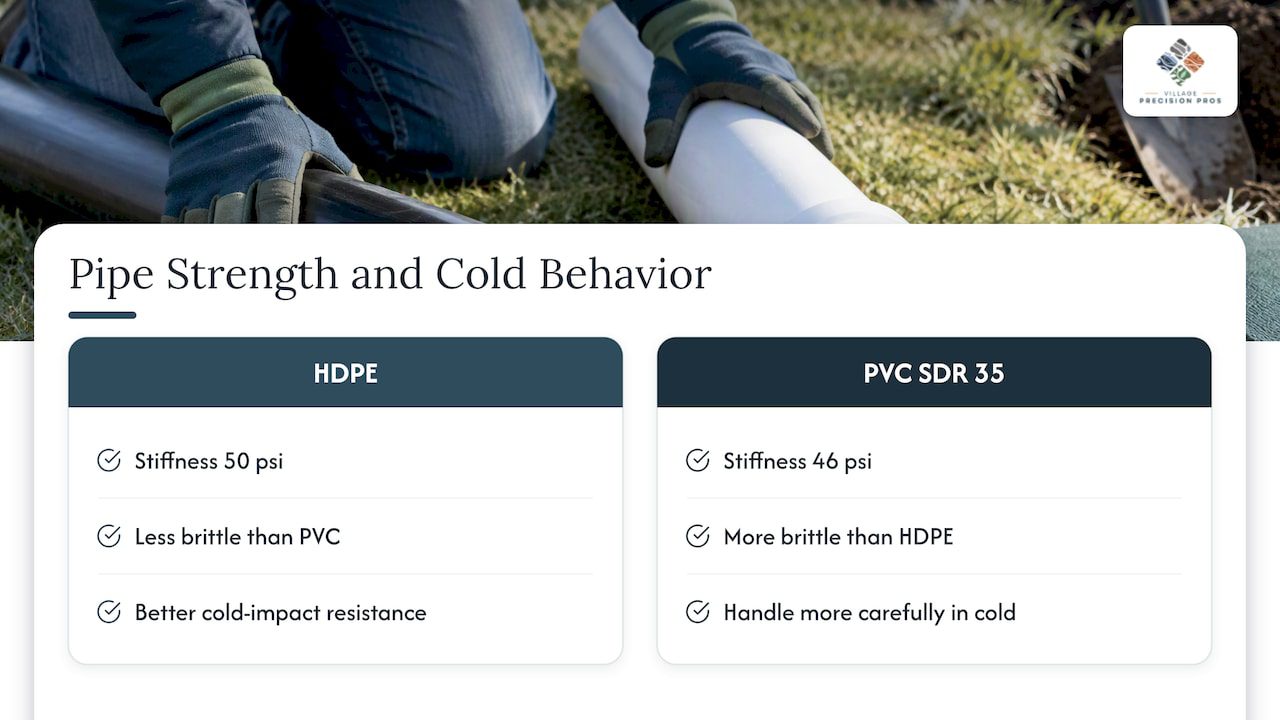
Arkansas gets freezing weather, though not Minnesota winters, so brittleness matters mostly during installation season. A crew laying pipe on a cold January day will treat PVC more carefully than HDPE. Once buried below the frost line in a stable bed, either material sits in ground that moves far less than the surface does.
Strength also depends on the soil around the pipe. Corrugated plastic pipe is designed to interact with surrounding soils and carry HL-93 highway live loads with 12 inches of cover in most cases. That phrase, interact with the soil, is the key idea. A flexible pipe gets much of its strength from well-compacted material beside it. Skip the compaction and you lose the strength you paid for.
Flow, slope and clogging
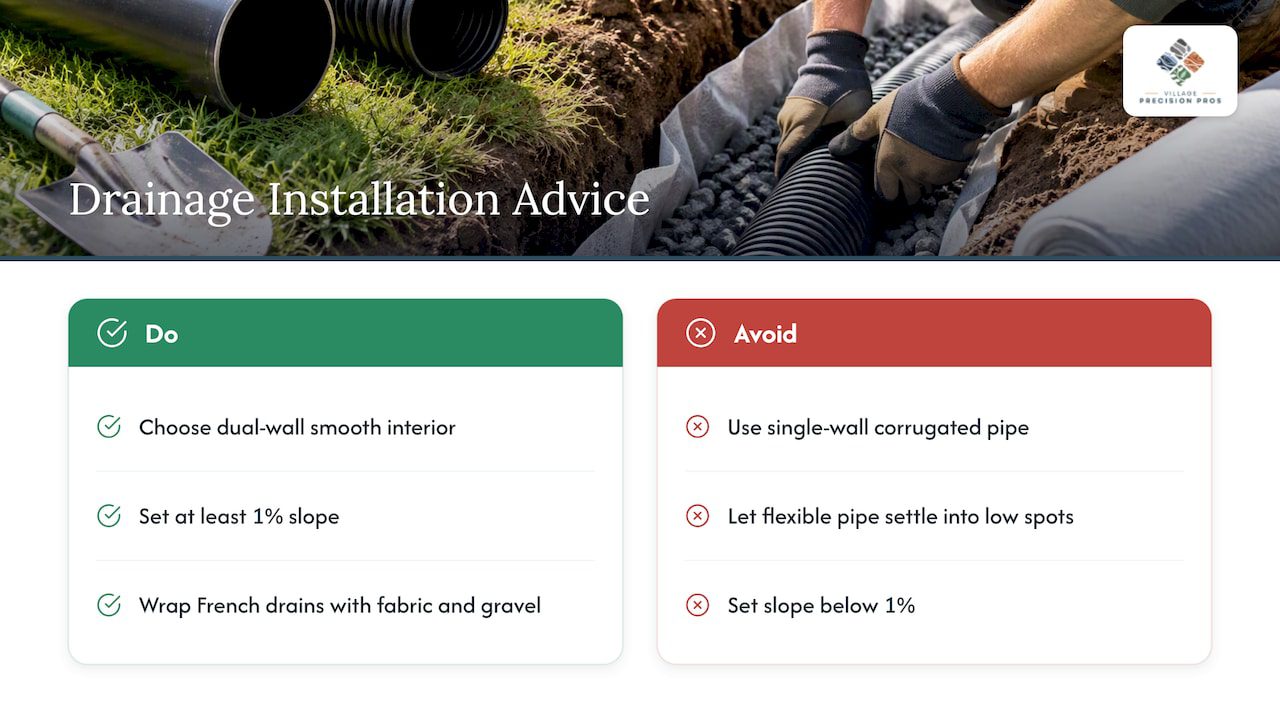
Dual-wall HDPE has a smooth inner wall, and manufacturers describe it as giving high hydraulic efficiency with structural strength. That smooth interior is what separates it from older single-wall corrugated pipe, which has ridges inside that catch silt and slow water. If someone suggests corrugated pipe for your yard, ask whether it is dual-wall with a smooth interior.
Slope is where PVC earns its place. Rigid pipe is easier to set at a consistent fall and keep there, while a flexible pipe that settles can form low spots that hold water and sediment. Sediment is what eventually clogs a drain, so a sag is a slow failure that you may not notice for years.
For either material, plan on at least a 1% slope, which is about 1 inch of drop for every 8 feet of pipe. Practical yard-drain guidance uses the same 1% minimum, along with sizing the pipe for the area it drains and the rainfall it has to handle. Steeper is fine up to a point. Flatter is where trouble starts.
Perforated pipe also needs thought. In a French drain, holes let groundwater in, and a wrap of geotextile fabric plus washed gravel keeps soil out of the pipe. If you are weighing a French drain against a dry well, our guide on dry well vs French drain walks through the decision.
When PVC is the better pipe
PVC wins where precision and strength under load matter more than flexibility.
- Downspout tie-ins. Roof water arrives in a rush and needs a clean, straight, tight path away from the foundation. Rigid pipe with glued joints stays put. Our article on downspout drainage ideas covers layouts that work.
- Lines under driveways and parking areas. Yard drainage guidance recommends Schedule 40 PVC under driveways and heavy traffic, noting that corrugated pipe can deform under heavy loads. That matches how we think about it: the more traffic over the pipe, the stiffer and more predictable you want it.
- Short, straight gravity runs. If the line is 20 to 40 feet and goes from a catch basin to a pop-up emitter, PVC is simple, and the slope is easy to verify with a level.
- Tight spots near structures. Near patios and walls, we want exact elevations. Rigid pipe makes that easier to control.
When HDPE is the better pipe
HDPE wins where the land is not cooperative.
- Long runs. Flexible pipe comes in long lengths or coils, which means fewer joints, and every joint is a place where something can separate or leak.
- Curves and changing terrain. Corrugated pipe is highly flexible and lightweight, which suits difficult terrain and unusual site conditions. You can follow the contour of a yard without a pile of elbows.
- French drains. Perforated dual-wall pipe in a gravel-filled trench is the standard residential build, and it is easy to work with.
- Rocky or acidic ground. Corrugated plastic pipe is chemically inert and resists corrosion from acidic soils and road salts, which is useful near driveways and roads.
The same guidance sums up the split this way: PVC for precise runs and driveway crossings, HDPE for long runs, French drains and curves. We agree with it in the field.
Lifespan and durability
Both pipes last a long time when buried properly. The industry association for corrugated polyethylene says corrugated plastic pipe can be expected to have a service life of 100 years in typical drainage applications. That is an industry expectation under good conditions, not a warranty on any specific installation, and ours is no exception: a pipe lasts as long as its bed, its outlet and its surroundings allow.
What shortens a drain’s life in real yards is rarely the plastic itself. It is usually one of these:
- A joint that was left open or poorly connected. A 2003 research report on buried pipe warns that water moving through an open joint can wash away backfill soil and eventually create a sinkhole.
- Poor compaction beside and under the pipe.
- An outlet buried in leaves, mulch or soil, so the pipe has nowhere to discharge.
- Roots that find a joint or perforation and grow in.
Installation details that decide the outcome
A pipe is only one part of a drainage system. Standards bodies treat the installation as seriously as the product. ASTM D2321 is the practice that gives recommendations for installing buried thermoplastic pipe in gravity-flow applications, and it notes that local or regional conditions may call for changes. The Plastics Pipe Institute makes a similar point: the structural performance of buried polyethylene pipe relies heavily on engineered soil structure, which means careful control of the bedding and the compaction around the pipe’s sides and lower haunches.
In plain terms, our crews focus on a short list:
- A firm, even trench bottom with a compacted aggregate base, so the pipe cannot settle into low spots.
- Consistent fall checked with a level or laser before any backfill goes in.
- Washed gravel and fabric around perforated pipe, so fines do not migrate in.
- Backfill in layers, compacted beside the pipe and not just dumped on top.
- A real outlet: daylight, a pop-up emitter, a swale or a dry well sized for the water it receives.
- Compatible fittings from the same system, rather than improvised adapters.
Groundwater, fire and other site factors
Two cautions are worth knowing. First, when groundwater sits above the bottom of the pipe, plastic pipe can float or buckle. Professional guidance says that enough soil cover or anchoring can counter buoyancy. That matters for low, wet yards and lakefront lots, which are common here.
Second, thermoplastic pipe burns. The same document notes that HDPE storm drain sections melted in the 2017 Santa Rosa, California fires. For a buried yard drain this is a minor point. For stored pipe, keep stock away from burn piles, grills and fire pits, and keep exposed outlet ends clear of dry brush.
Can you connect HDPE to PVC?
Yes, mixed systems are common, and they are how we often build. A rigid PVC section near the house or under a driveway can hand off to flexible HDPE across the yard. What matters is the connection: use a coupling or adapter made for joining the two pipe types and sized to the actual outside diameters, because corrugated pipe and PVC do not share the same wall profile. Check that the fitting seals against soil and fines, support both sides of the joint with compacted bedding so it cannot sag or pull apart, and wrap the joint area with fabric where perforations are nearby. Never rely on tape or an improvised sleeve. If your downspout lines meet a French drain, the connection point is the first thing we inspect on a failing system.
How to choose for your yard
Run through these questions before you pick a pipe.
- Where is the water coming from? Roof water, surface runoff and groundwater call for different designs. Our yard drainage solutions guide explains what to try first.
- What is above the pipe? Lawn, patio, driveway or planting bed? Traffic pushes you toward Schedule 40 PVC.
- How long and how curved is the run? Long and winding favors HDPE. Short and straight favors PVC.
- How steep is the ground? Gentle slopes need careful grading to get the 1% minimum. Steeper ground gives you room, and may call for energy control at the outlet.
- Where does the water end up? An outlet that discharges onto a neighbor, or into soil that is already saturated, solves nothing.
- What else is being built? Walls, patios and lawns change the drainage plan. See our notes on retaining wall drainage and patio drainage design.
What drives the total cost of a drainage project is less the pipe than the digging, the volume of gravel, the access for equipment, the outlet and the restoration afterward. That is why two yards of similar size can quote very differently, and why we walk the property before giving an estimate.
Our perspective: the pipe matters less than the plan
We have completed more than 2,000 projects since 2020, and drainage shows up in a large share of them. Patios, pathways, retaining walls, turf and foundation work all depend on water going somewhere predictable. When a client asks whether to use HDPE or PVC, we start by asking a different question: where does the water need to go, and what will sit on top of the line?
Our approach is to use each material where it does its best work. We like rigid PVC for exact, load-bearing runs where grade has to be right, such as the line that carries roof water under a driveway. We like dual-wall HDPE for the long, curving French drain that follows a yard’s natural shape. We rarely treat it as an either-or. We also build the drain with the hardscape in mind, so the base under a patio, the grade of a path and the buried pipe work together instead of fighting each other.
Our view is that a drain is only as good as its bed and its outlet. We build to a compacted aggregate base, check the fall before backfill, and use fittings made to work together. The right design is one that you stop thinking about, because your yard dries after storms and your patio stays level.
Ty
Plan your drainage with our crews
If you would rather have the question settled by someone who builds these systems, we can help. Village Precision Pros handles drainage as part of landscape and irrigation work and alongside patios and hardscapes across Central Arkansas. We look at the grade, the soil, the roof water and the outlet, then recommend the pipe and layout that suit your property. For homeowners comparing providers, our guide to yard drainage contractors in Arkansas explains what to look for.

To talk through your yard, visit villageprecisionpros.com and send us the details. If water is also pooling or washing mulch out of your beds, our pages on a soggy backyard fix and mulch washout solutions are good places to start.
FAQ
Is corrugated pipe or PVC better for a French drain?
Dual-wall corrugated HDPE with perforations is the usual choice for a French drain. It bends with the trench, comes in long lengths and is easy to wrap in fabric and gravel. PVC works too, but long runs need more fittings, and the pipe must be set carefully to keep a steady slope.
Which pipe is stronger, HDPE or PVC?
It depends on what you ask of it. Published stiffness figures for common drainage pipes are close, at 50 psi for one corrugated HDPE product against 46 psi for PVC SDR 35. HDPE tolerates impacts and cold better, while rigid PVC under driveways is the common recommendation for heavy traffic. Bedding and cover often matter more than the material.
How much slope does a drain pipe need?
Plan for at least a 1% slope, which is roughly 1 inch of drop for every 8 feet of pipe. More is fine in most yards. Less risks standing water and sediment build-up inside the pipe.
Can HDPE and PVC be used in the same drain?
Yes. Many yards use PVC near the house or under hard surfaces and HDPE for the longer run beyond. Use an adapter designed for joining the two types, support the joint with compacted bedding, and keep soil from entering at the connection.
Does HDPE drain pipe last as long as PVC?
Both are expected to last for decades when installed correctly. The corrugated pipe industry cites a 100-year service life in typical drainage conditions. Real-world failures usually come from poor compaction, open joints or blocked outlets, not the plastic.
Sources
- Small Diameter N-12 Pipe and Fittings brochure
- Corrugated Polyethylene Pipe Association: drainage
- Eagle Green PE brochure
- PVC Versus HDPE Drainage Pipe
- Best Yard Drainage Pipes: PVC vs Corrugated Compared
- HDPE pipe report on joints and backfill (2003)
- ASTM D2321 standard practice
- Plastics Pipe Institute: Underground Installation of PE Piping
- Know the Risks and Specifications for Using Plastic Drainage Pipe