

A commercial landscape maintenance checklist works best organized into five tracked categories: irrigation, turf, plant health, seasonal tasks, and inspections. Assign each item to a crew or vendor, require dated photos at every visit, and log results in a monthly inspection so deficiencies get caught before they become liabilities. The zone-based templates and seasonal schedules below build directly on that structure.
TL;DR:
- Weekly visits must include specific standards for mowing, bed maintenance, debris removal, irrigation spot checks, and consistent documentation with standardized photos.
- Monthly inspections require scoring zones against set outcomes, tracking quality, deficiency closure, irrigation issues, and safety concerns for accurate reporting and defending budgets.
- Seasonal checklists emphasize timely spring startup, winterization, and adjusting irrigation schedules based on plant cycles and weather, to prevent common failures like summer emergencies.
- Proper irrigation management involves designated personnel, defined response times for repairs, and overrides based on evapotranspiration rates to avoid emergency calls.
- Ongoing staff training, drainage assessments after storms, and soil testing every two to three years are crucial practices to maintain site health and prevent costly repairs.
Table of Contents
- Weekly and Routine Tasks: What Every Visit Should Cover
- Monthly Inspection Checklist: A Zone-Based Site Walk
- Seasonal Checklist: Spring Startup Through Winterization
- Irrigation and Water Management: Controller Rules and Zone Checks
- Plant Health, Pest Monitoring, and Fertilization Planning
- Turf Management Standards and Remediation
- Hardscape, Drainage, and Safety Checks
- Equipment Maintenance and Quality-Control Routines
- Budgeting and Prioritization for Predictable Spend
- Practitioner Templates We Use in the Field
- Tree and Shrub Pruning: Clearance and Inspection Standards
- Soil Testing and Amendments: The Step Most Checklists Skip
- Environmental Compliance and Sustainability Practices
- Staff Training and Scheduling for Maintenance Tasks
- Drainage Assessment and Management
- Author Perspective: Two Habits That Actually Move the Needle
- How Village Precision Pros Can Help You Run This Checklist
- Sources
- FAQ
Weekly and Routine Tasks: What Every Visit Should Cover
Most contract disputes trace back to vague expectations, not bad work. A weekly checklist closes that gap by giving crews and managers the same yardstick.
- Mowing standards. Hold turf at the species-appropriate height (typically 2.5 to 3.5 inches for cool-season lawns), mow on a consistent weekly or biweekly cycle, and keep edges crisp along walkways and beds.
- Bed maintenance. Hand-weed visible beds every visit and maintain mulch depth at 3 to 4 inches, deep enough to suppress weeds without smothering root crowns. Flag bare spots for replanting rather than letting them spread.
- Debris and litter control. Clear high-traffic entry zones and hard surfaces of trash, clippings, and organic debris before crews leave the site.
- Irrigation spot-checks. Walk active zones for obvious leaks, broken heads, or dry patches, and photograph anything abnormal.
- Documentation. Require one wide-angle photo per zone, a close-up of any flagged issue, a one-line note field, and a timestamp on every submission.
Pro Tip: Standardize the photo angle for each zone (same corner, same direction) so month-over-month comparisons actually mean something instead of a random snapshot.
Monthly Inspection Checklist: A Zone-Based Site Walk
A repeatable monthly inspection turns landscape upkeep from guesswork into a paper trail you can defend during budget season or in an bedrijfspand bouwkundige inspectie checklist insurance claim. Facility management guidance recommends scoring each zone against defined outcomes rather than relying on subjective impressions, and logging the results with photos attached to every entry, as outlined in this facility manager’s guide to landscaping management.
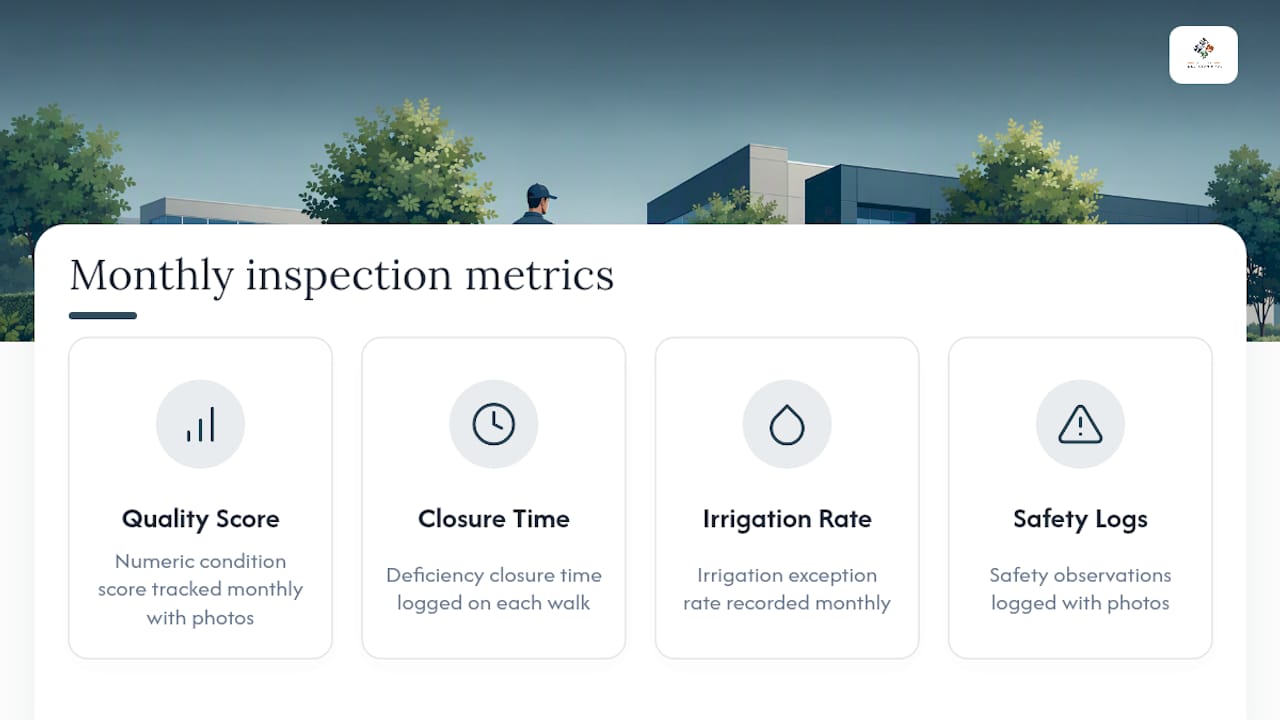
Track four numbers over time: quality condition score, deficiency closure time, irrigation exception rate, and safety observations logged. That same scorecard structure doubles as documentation if a slip-and-fall claim or warranty dispute ever lands on your desk.
Seasonal Checklist: Spring Startup Through Winterization
Seasonal checklists exist because the same failures repeat every year, usually because someone skipped a step during the transition month. Missing a spring task is one of the most common causes of summer irrigation emergencies, according to seasonal grounds maintenance guidance for facilities.
- Spring startup: Activate irrigation and test every zone, review controller programs against current plant needs, refresh beds, finish dormant pruning, and walk the site for winter storm damage.
- Summer operations: Adjust irrigation run times as heat rises, increase turf inspection frequency to catch stress early, and monitor for pest and disease pressure before it spreads.
- Fall prep: Shut down and winterize irrigation before the first hard freeze, manage leaf accumulation on turf and drains, and decide where overseeding will pay off next spring.
- Winter readiness: Confirm snow and ice response procedures, check exterior lighting for burned-out fixtures, and keep an emergency response log for storm events.
Aligning these tasks with plant cycles and local weather, instead of a fixed calendar date, is what separates a proactive commercial landscape plan from a reactive one.
Irrigation and Water Management: Controller Rules and Zone Checks
Irrigation failures cause more emergency calls than any other landscape category, mostly because nobody defined who’s allowed to touch the controller.
- Name one authorized party (property manager, contractor lead) who can change watering schedules, and require written sign-off on seasonal program adjustments.
- Walk each zone for head alignment, leaks, and overspray onto pavement, adjusting run times against evapotranspiration rates rather than a fixed schedule.
- Schedule backflow testing to stay current with local municipal compliance requirements.
- Set a clear threshold: minor head adjustments get fixed on-site, while valve or main-line issues get reported with a defined contractor response window, typically 24 to 48 hours.
Pro Tip: Put the controller access rule in the maintenance contract itself, not just a verbal understanding. Vague authority is how a well-meaning tenant fries a zone’s programming every August.
Plant Health, Pest Monitoring, and Fertilization Planning
Routine scouting, not calendar-based spraying, is what keeps plant health problems from becoming plant replacement bills. Crews should walk beds and turf on a fixed schedule and log what they find, even when the answer is nothing.
- Follow the monitor first, then set a threshold, then apply a targeted treatment model rather than blanket chemical applications, consistent with EPA guidance on Integrated Pest Management.
- Time fertilization to the plant’s active growth window and keep dated records of every application.
- Build a decision point into the checklist: replace stressed plant material during its proper establishment window rather than letting it limp along another season.
Turf Management Standards and Remediation
Turf takes the most visible damage from small mistakes, so the standards need to be explicit rather than assumed.
- Mow to a season-appropriate height and never remove more than a third of the blade in one pass to avoid scalping stress.
- Aerate and overseed during the turf’s active growth window; expect two to four weeks for visible recovery.
- Spot-treat weeds once they cross a coverage threshold rather than blanket-spraying the whole lawn.
- Convert low-visibility, high-cost turf areas to ground cover or hardscape where irrigation and mowing expenses outweigh the aesthetic payoff.
Hardscape, Drainage, and Safety Checks
Plants aren’t the only liability risk on a commercial site. Walkways, signage, and drainage infrastructure deserve their own line items.
- Inspect walkways and curbs for root heave, cracking, and trip hazards near entrances.
- Check monument signs and path lighting for visibility, trimming shrubs that block sightlines.
- Clear sediment from drainage swales and watch for slope erosion after heavy rain.
- After any storm event, mitigate immediate safety hazards first and photograph the damage for the record.
Property managers dealing with recurring hardscape cracking or settling issues may need more than a maintenance fix. Hardscape and stone masonry repair addresses the structural causes that a mowing crew can’t touch.
Equipment Maintenance and Quality-Control Routines
None of this holds together without equipment that runs and a crew that’s checked in on. Scope language only means something if someone verifies it.
- Inspect blades, belts, fluid levels, and tires before each use, and require PPE checks at the start of every shift.
- Run brief safety touchpoints on ladder use, chemical handling, and equipment operation rather than a once-a-year training dump.
- Conduct monthly site walks with a deficiency log and photo proof attached to every flagged item.
- Write scope language around outcomes (“turf height maintained at 3 inches”) instead of vague activity descriptions (“mow regularly”).
Before signing a new contract, it helps to know what to ask a landscaper about equipment standards and response times.
Budgeting and Prioritization for Predictable Spend
Split the budget into four buckets: fixed recurring costs (mowing, irrigation checks), variable operating costs (fertilizer, mulch), corrective maintenance (emergency repairs), and capital renewal (turf replacement, hardscape rebuilds).
- Fund safety and high-visibility zones first; simplify or harden remote perimeter areas to protect the budget without hurting the overall impression, a tiered approach backed by landscaping performance research for 2026.
- Watch for repeated corrective spending on the same asset. That’s usually the signal to push for capital renewal instead of another patch job.
- Start planning several months before budgets finalize; that lead time lets teams spot multi-site efficiencies and line up contractors before pricing tightens, per commercial landscape budgeting guidance.
A detailed breakdown of typical cost drivers is available in our commercial landscape maintenance cost guide.
Practitioner Templates We Use in the Field
Our spring landscape maintenance checklist and property maintenance program guides come out of work on more than 1,750 completed projects across Central Arkansas, which is where realistic timelines and common failure points actually get learned.
- Download and adapt the spring checklist as your zone-based starting template rather than building one from scratch.
- Use a monthly inspection template with required fields for zone name, condition score, photo, and follow-up deadline.
- Cross-reference our property maintenance program guide for recurring maintenance structure.
Tree and Shrub Pruning: Clearance and Inspection Standards
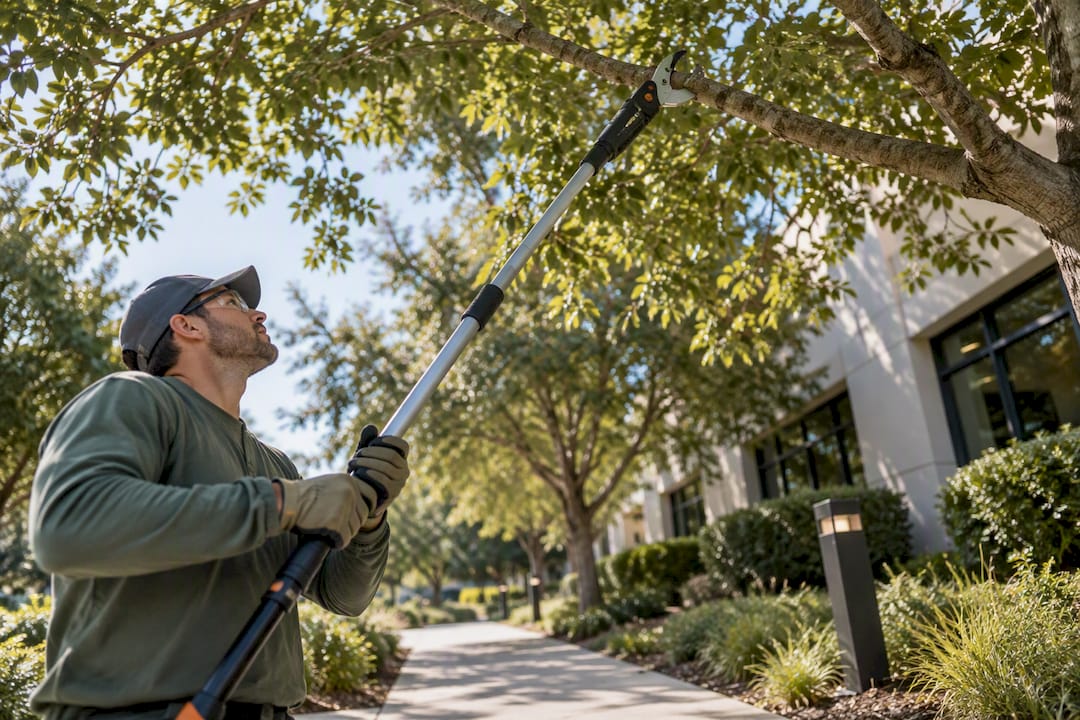
Pruning gets treated as cosmetic maintenance when it’s actually a liability control. Overgrown limbs block sightlines to signage and lighting, drop debris on walkways, and eventually interfere with roofs, gutters, or power lines. A checklist needs specific clearance targets, not a general “trim as needed” line.
Set a minimum clearance of 7 to 8 feet over walkways and 12 to 14 feet over vehicle drive lanes, adjusting upward near loading docks or delivery routes. Inspect trees each season for deadwood, cracked limbs, and canopy density that blocks light to turf below. Shrubs near entries and monument signs need shape maintenance on a defined cycle, typically every 4 to 6 weeks during active growth, to keep sightlines open for both visibility and security cameras.
Timing matters as much as technique. Most flowering shrubs should be pruned right after bloom, while structural tree pruning is best done during dormancy to reduce stress and disease exposure. Cutting into live wood at the wrong time can trigger dieback or leave the plant vulnerable to pests it would otherwise resist.
Inspection should also flag structural risk, not just appearance. Look for split unions, hanging deadwood, and lean angles that have changed since the last walk. Any tree showing root heave near a hardscape surface or visible trunk decay needs a written note and a follow-up deadline, the same way a cracked walkway would. Document pruning work with before-and-after photos, since canopy reduction is one of the most common items tenants and owners question on invoices. A photo record settles that argument before it starts.
Soil Testing and Amendments: The Step Most Checklists Skip
Fertilizer schedules built without a soil test are a guess dressed up as a plan. A basic soil test, run every 2 to 3 years for established commercial turf and beds, tells you pH, nutrient levels, and organic matter content, the three factors that determine whether fertilizer actually helps or just runs off into a storm drain.

Most turf and ornamental plants prefer a pH between 6.0 and 7.0. Outside that range, plants struggle to absorb nutrients no matter how much fertilizer goes down, which means a low-performing zone might need lime or sulfur, not more feeding. Compacted soil, common in parking islands and high-traffic entry beds, benefits from core aeration and organic matter amendments rather than a heavier fertilizer application.
Build soil testing into the seasonal checklist as a spring task, with results reviewed before the fertilization plan for the year gets finalized. Keep test results on file alongside inspection records. When a bed underperforms for two seasons running despite normal maintenance, a soil test is the first diagnostic step, not the last resort. It’s cheaper than replacing plant material twice.
Environmental Compliance and Sustainability Practices
Municipal water restrictions, fertilizer runoff rules, and pesticide application limits vary by jurisdiction, and a maintenance checklist should reference local requirements rather than assume a one-size-fits-all standard. Backflow testing, already covered under irrigation governance, is one of the most commonly enforced compliance items on commercial sites.
Sustainability and compliance often overlap in practical ways. Reducing turf in low-visibility, high-water-demand zones cuts both irrigation costs and runoff risk. Native and drought-tolerant plant selections in bed renovations reduce long-term water use without sacrificing curb appeal in the areas tenants actually see. IPM-based pest control, which relies on monitoring and thresholds instead of routine spraying, directly reduces chemical volume entering storm drains, aligning with EPA integrated pest management principles.
Fertilizer timing rules matter too. Many municipalities restrict nitrogen application during specific months to limit runoff into local waterways. Build these blackout windows into the seasonal schedule so crews aren’t caught applying product during a restricted period. Document compliance steps the same way you document deficiencies: dated, photographed, and filed. If a compliance question ever comes from a municipality or an insurer, a paper trail beats a memory every time.
Staff Training and Scheduling for Maintenance Tasks
A checklist is only as good as the crew executing it, and turnover in landscape labor is high enough that training can’t be a one-time event. New crew members need a walk-through of site-specific standards before their first solo visit, not after a mistake gets flagged.
Short, frequent training touchpoints beat annual seminars. A five-minute review of mowing height standards, PPE requirements, or chemical handling procedures at the start of a shift sticks better than a once-a-year classroom session. Rotate topics weekly: irrigation basics one week, pruning clearance standards the next, pest identification after that.
Scheduling should match crew skill level to task complexity. Routine mowing and debris cleanup can go to less experienced staff, while pruning, irrigation controller adjustments, and pest treatment decisions belong to trained leads. Cross-train at least one backup person per skill area. A single point of failure, where only one technician knows how to program the irrigation controller, creates real risk when that person is out sick during a heat wave.
Keep a simple training log alongside the equipment and inspection records: who was trained, on what, and when. That log becomes useful during contract renewals, insurance reviews, and whenever a client asks how quality control actually works on their site.
Drainage Assessment and Management
Standing water after a storm isn’t a cosmetic problem. It’s a sign that grading, drainage infrastructure, or soil compaction is failing, and it tends to get worse every season it goes unaddressed.
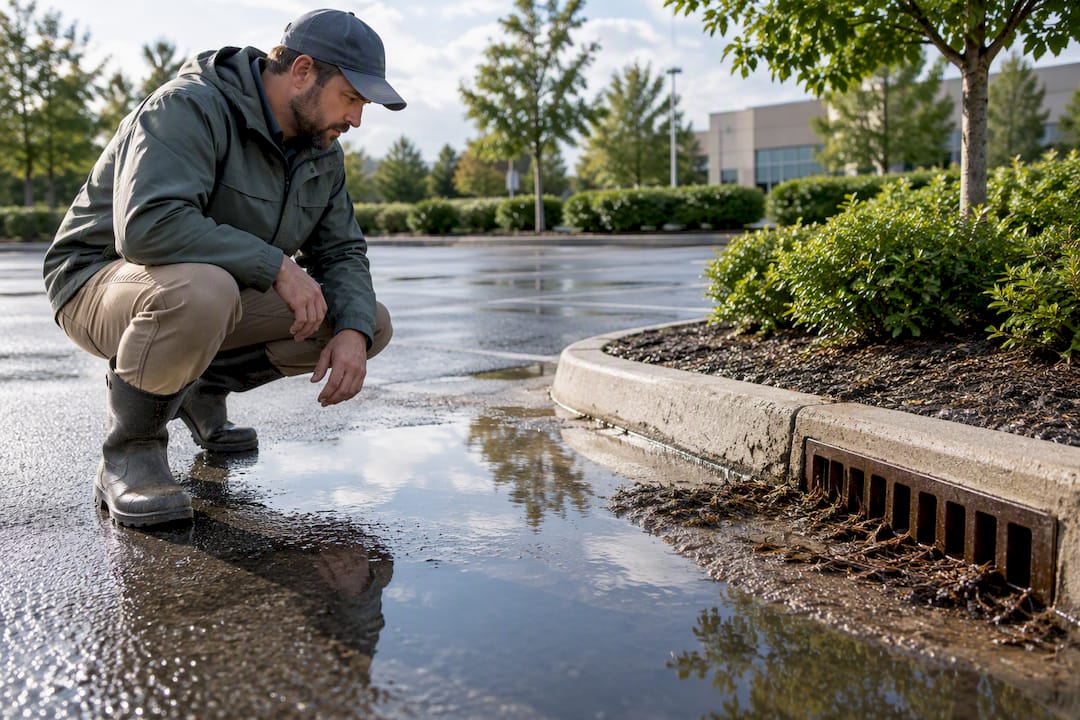
Walk the site after significant rain events and note where water pools for more than 24 hours. Common trouble spots include parking islands, the base of retaining walls, and low points along walkways where grading was never quite right. Sediment buildup in swales and catch basins reduces their capacity over time, so clearing debris from these areas should be a standing item on the monthly inspection, not an afterthought after a flood.
Erosion along slopes and swale banks often shows up first as exposed soil or small channels cut by repeated runoff. Left alone, that erosion undermines nearby turf, mulch beds, and sometimes hardscape footings. Regrading, adding erosion-control fabric, or installing additional drainage piping are all capital-level fixes worth flagging for the budget rather than patching repeatedly.
Persistent drainage failures near a building foundation deserve particular attention, since long-term water intrusion can affect structural stability, not just landscaping. If a site has chronic pooling near a foundation wall, a drainage assessment that looks at grading and subsurface flow is worth more than another season of mulch replacement in the same spot.
Author Perspective: Two Habits That Actually Move the Needle
Treat the landscape as an asset, not a line-item expense. Two habits separate well-run sites from the rest: tight irrigation oversight with a real monthly scorecard, and a strong spring reset that sets the tone for the entire year. Skip either one, and you’re managing from crisis to crisis instead of a schedule.
— Ty
How Village Precision Pros Can Help You Run This Checklist
Running this checklist in-house works if you have the staff hours to spare. Most property managers don’t, which is exactly why Villageprecisionpros built its annual maintenance plans around turnkey execution instead of a menu of one-off visits.

Our teams handle the landscape and irrigation work directly, from controller programming to zone-by-zone head checks, so the seasonal schedule above gets executed without you chasing down separate vendors for turf, beds, and irrigation. That matters most for property managers overseeing multi-zone commercial sites where a missed spring startup or a skipped monthly inspection turns into a much bigger repair bill by August.
If you want a professional assessment of your site before committing to anything, request a walk-through and priority issues will be flagged using an inspection scorecard. Start with the annual maintenance plans page to see how the program fits a commercial property like yours.
Sources
For more technical detail, see EPA’s IPM principles, industry statistics from the National Association of Landscape Professionals, and seasonal maintenance planning guidance.
- EPA — Integrated Pest Management (IPM) principles
- Facility Management Insights — Landscaping management: A facility manager’s guide
FAQ
What Is Included in Landscape Maintenance?
Landscape maintenance covers mowing, edging, bed weeding, mulch upkeep, irrigation checks, pruning, pest and disease monitoring, fertilization, and seasonal tasks like spring startup and fall winterization. A full program also includes monthly inspections and documentation to track condition over time.
What Is Commercial Grounds Maintenance?
Commercial grounds maintenance refers to the routine upkeep of landscaped areas at business properties, including turf care, plant health, irrigation management, and hardscape safety checks. It’s typically governed by a maintenance contract with defined scope, frequency, and reporting requirements.
What Do Most Landscapers Charge Per Hour?
Hourly rates for landscape maintenance vary widely by region, service type, and property complexity, so there’s no single national figure that applies everywhere. Property managers get more accurate numbers by requesting a site-specific quote, which factors in property size, service frequency, and irrigation needs; see our commercial landscape maintenance cost guide for cost drivers to expect.
What Is the Checklist for Grounds Maintenance?
A grounds maintenance checklist typically covers weekly tasks (mowing, weeding, debris removal), monthly inspections with condition scoring, seasonal schedules for irrigation and pruning, and ongoing categories like pest monitoring, soil health, and drainage checks. The sections above walk through each category in detail, from routine visits to seasonal transitions.
Does Village Precision Pros Offer Ongoing Maintenance Plans?
Yes, Villageprecisionpros offers annual maintenance plans that cover recurring landscape upkeep for Central Arkansas properties. Current pricing details are available directly on the plans page since costs depend on property size and service scope.