

Prioritize five moves: a redesigned entrance with layered planting, several large-canopy shade trees, durable common-area hardscape, a resilient plant palette, and a real irrigation and maintenance schedule. Together, these upgrades boost curb appeal, support tenant retention, and lower long-term replacement costs. We’ve built these plans for Central Arkansas properties, and the ones that hold up over five years all start with the same five priorities.
TL;DR:
- Focusing on planting beds with staggered, evergreen, and drought-tolerant species reduces long-term maintenance and enhances resilience.
- Prioritize entrance landscaping improvements with low-cost upgrades like container plants and lighting to boost perceived value and safety quickly.
- Use permeable surfaces, native pollinator plants, and noise-reducing plant layers to decrease maintenance needs and promote environmental benefits.
- Design hardscape features with durable, modular materials like pavers to minimize repair costs and facilitate easier access for maintenance.
- Establish an adaptive, phased plan starting with site assessments, then move through quick wins, irrigation, and hardscape upgrades to stay within budget and maintain quality.
Table of Contents
- Design Principles Behind Smart Apartment Complex Landscaping Ideas
- Front-Door Landscaping That Actually Improves Curb Appeal
- Shared Seating and Common-Area Landscaping That Holds Up
- Color and Seasonal Interest Without the Constant Replanting
- Privacy Screening and Plant Groupings Residents Actually Notice
- Adding Wildlife-Friendly Features Without Adding Maintenance Headaches
- Landscaping for Noise Reduction and Tenant Privacy
- Eco-Friendly Hardscape and Permeable Surfaces for Stormwater Control
- Seasonal Planting Rotations That Keep Properties Looking Fresh
- Planting Palettes That Stay Healthy With Less Work
- Irrigation and Drainage Practices That Prevent Costly Failures
- Hardscape Features That Reduce Recurring Costs
- Building a Landscaping Budget That Proves Its Own ROI
- A Phased Checklist for Turning Ideas Into a Real Project
- How Village Precision Pros Approaches Apartment-Scale Projects
- What Property Managers Get Wrong Most Often
- Ready to Start? How Village Precision Pros Can Help
- Sources
- FAQ
Design Principles Behind Smart Apartment Complex Landscaping Ideas
The best apartment complex landscaping ideas share one trait: they’re designed for the crew that has to maintain them, not just the leasing photo. A property that looks stunning in March and ragged by July wasn’t designed with maintenance in mind. Every decision, from plant selection to bed shape, should answer one question first: who’s going to take care of this in year three?
Resilient, looser plant palettes matter more than picture-perfect symmetry. When one shrub in a tight, uniform row dies, it’s obvious and ugly. A more varied, adaptable planting scheme absorbs individual losses without looking broken, which is exactly the approach multi-family curb appeal experts recommend for reducing replacement labor over time.
Zoning matters just as much. Social hubs, grills, courtyards, fire pits, need to sit apart from quiet retreats where residents want a bench and some shade. Cramming both into one small courtyard guarantees neither works well.
Before finalizing any layout, weigh these constraints:
- Fire lane clearances and emergency vehicle access can’t be compromised for aesthetics.
- ADA-compliant path widths and slopes apply to every common walkway, not just the main entrance.
- Sight lines near parking and entries affect both safety and perceived security.
- Bed shapes should avoid sharp inside corners that trap trash and force crews to hand-trim.
Pro Tip: Design planting beds and turf strips to match your mower’s deck width. A bed that’s six inches narrower than the equipment forces manual trimming on every single visit, and that labor adds up fast across a full season.
Front-Door Landscaping That Actually Improves Curb Appeal
The entrance is the first and last impression every prospective tenant, current resident, and delivery driver gets. It’s also where a modest budget produces the most visible return, since attractive landscaping and mature tree cover at a property’s entrance has been linked to measurable increases in perceived value and even spending behavior in retail and mixed-use settings.
Tier your upgrades by budget so you can move fast on the cheap wins while planning capital projects separately.
- Low-cost quick wins: Add container plantings at the entry doors, clear overgrown sight lines near the sign, and install or upgrade solar or low-voltage path lighting.
- Mid-range investments: Build raised planters framing the entry drive, replace faded monument signage, and plant one or two specimen trees for immediate visual weight.
- Capital projects: Repave a cracked entry drive, add a small entrance plaza with seating, or regrade a drainage problem that’s been eroding the front bed for years.
Run a quick safety check alongside any entrance work: confirm lighting covers the full walkway from parking to lobby, verify the path meets ADA slope and width standards, and trim anything blocking a driver’s view of pedestrians at the curb cut.
Shared Seating and Common-Area Landscaping That Holds Up
Courtyards, fire pits, and grill stations are where tenant satisfaction gets decided, and where poor material choices get expensive fast. Furniture and flooring need to survive daily foot traffic, spilled drinks, and weather extremes without a constant repair cycle.
Choose materials built for heavy use:
- Powder-coated steel or teak furniture over untreated wood, which warps and splinters within a season or two.
- Stamped or exposed-aggregate concrete for grill zones, since it resists grease stains better than pavers with open joints.
- Fire pit surrounds built with a non-combustible border and at least three feet of clearance from any structure.
- Dog runs with mulch or rubber surfacing instead of turf, since concentrated dog traffic kills grass in weeks regardless of species.
Separate the loud zones from the quiet ones with distance, not just intention. A courtyard grill station eight feet from a reading nook guarantees complaints. Give each zone its own sightline and, where possible, a planting buffer between them.
Rooftop amenity decks come with their own rules. Weight limits, wind exposure, and waterproofing membranes all restrict what a rooftop landscape design can actually support, so bring in a structural engineer before selecting planters or hardscape for any elevated amenity space.
Pro Tip: Anchor movable furniture with cable tethers or weighted bases on rooftop and courtyard decks. Wind gusts and casual “borrowing” between units account for more furniture loss than actual wear.
Color and Seasonal Interest Without the Constant Replanting
Flowering shrubs and rotating annuals are what make a property feel alive, but annual-only color schemes get expensive when you’re replanting three or four beds every season. The smarter approach layers a few dependable flowering shrubs, like hydrangea, spirea, or crape myrtle depending on your zone, as the backbone, then reserves annuals for high-visibility spots: the entrance planters, the leasing office frontage, maybe one courtyard bed.
That combination gives you guaranteed seasonal color from the shrubs even in a year when the maintenance budget gets tight, plus the flexibility to refresh the highest-traffic areas without redoing the entire property. Crape myrtles, for example, bloom for months in summer heat and need almost no irrigation once established, a real advantage anywhere summers run hot and dry.
Think in bloom sequences rather than single moments. A property that peaks in April and goes flat by June feels neglected for five months of the year. Stagger bloom times: early spring bulbs or azaleas, summer-blooming shrubs, and a fall-interest plant like ornamental grass or aster that carries color into October.
Color placement matters as much as plant choice. Concentrate the boldest color at the entrance and leasing office, where first impressions form, and let interior courtyards lean on foliage texture and structure instead. It’s a more efficient use of a limited color budget, and it means residents get visual variety as they move through the property rather than the same palette repeated everywhere.
Privacy Screening and Plant Groupings Residents Actually Notice
Ground-floor units facing a parking lot or a neighboring patio need real screening, not a single row of shrubs that looks thin within two years. Effective privacy planting depends more on bed depth and grouping than on any one plant species.
Design screening beds at least 1.5 to 2 meters deep, and stagger the plants in two or three offset rows rather than one straight line. A single row leaves visible gaps at the base as plants mature and lower branches thin out; staggered rows fill those gaps naturally and recover faster if one plant in the group struggles.
Mix evergreen and deciduous species within the same screen. Evergreens like holly or arborvitae hold the line year round, while flowering deciduous shrubs mixed in add seasonal texture so the screen doesn’t read as a solid green wall. Vary height too, taller shrubs at the back, mid-height in front, so the grouping reads as a natural planting rather than a fence substitute.
For patios that need privacy fast, movable planters with tall ornamental grasses or bamboo-alternative screening plants buy time while permanent shrubs establish. That’s especially useful for newly turned-over units where the previous screening got damaged or removed.
Watch spacing closely. Overcrowded screening plants compete for root space, grow leggy, and often need full replacement within five years, which defeats the entire purpose of planting a “permanent” screen in the first place.
Adding Wildlife-Friendly Features Without Adding Maintenance Headaches
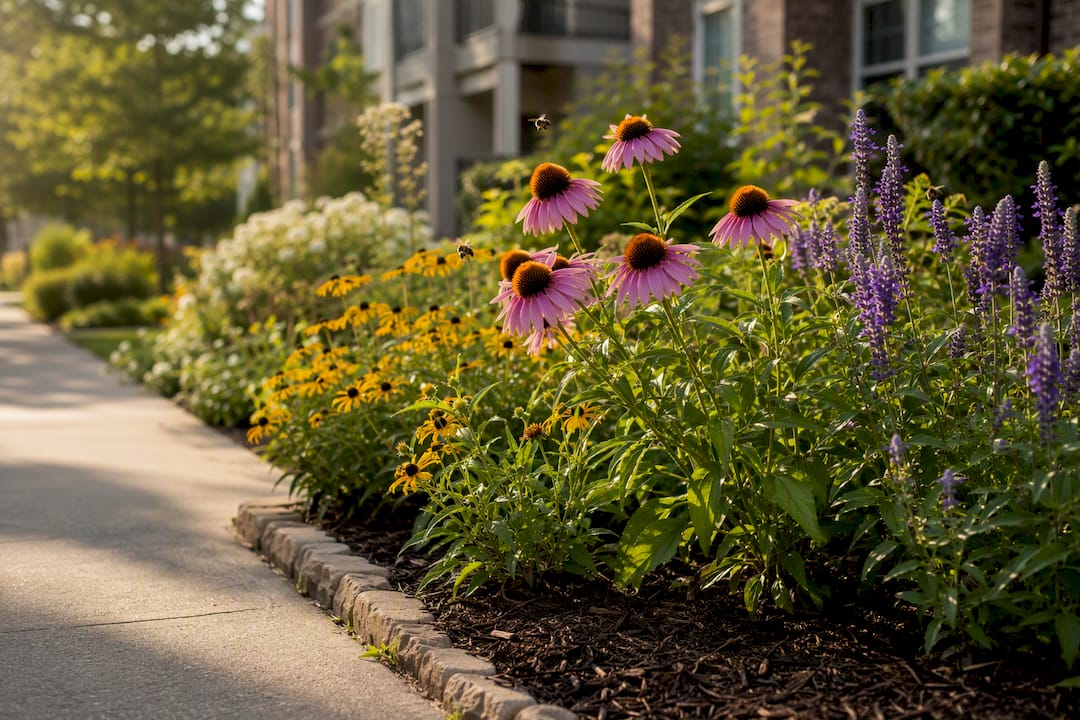
Pollinator gardens and bird feeders sound like a departure from a maintenance-first landscape plan, but done right they actually reduce work. Native pollinator plantings, coneflower, black-eyed Susan, and native salvias among them, tend to need less water and less fertilizer than ornamental exotics once established, because they’re adapted to the region’s rainfall and soil.
Dedicate one modest bed, not the whole property, to a pollinator mix near a courtyard or walking path where residents can actually see the activity. It becomes a talking point at lease renewals and a genuine amenity, without requiring the irrigation and pest management that a high-maintenance ornamental bed demands.
Bird feeders work best mounted well away from windows and high-traffic patios, both to avoid mess complaints and to keep feeders out of reach of loose pets. A single feeding station near a shared green space, paired with a small sign identifying common visiting species, tends to generate more resident goodwill than a scattershot approach with feeders on every building.
Skip pesticide-heavy turf programs near any pollinator planting. Broad-spectrum spraying undermines the whole point of the garden and can drift onto adjacent beds. If you’re managing integrated pest management already for your resilient plant palette, extending that same lighter-touch approach to pollinator zones costs nothing extra and keeps the two efforts working together instead of against each other.
Landscaping for Noise Reduction and Tenant Privacy
Traffic noise, HVAC units, and neighboring patios all get quieter with the right planting, though it takes more than a thin hedge to make a real difference. Dense evergreen plantings with layered heights, tall shrubs backed by a canopy tree, absorb and deflect sound far more effectively than a single-species hedge row.
Berms combined with planting amplify the effect. Even a modest two-foot earth berm topped with dense shrubs blocks sound and sightlines simultaneously, which is useful along property lines that face a busy road or a parking structure.
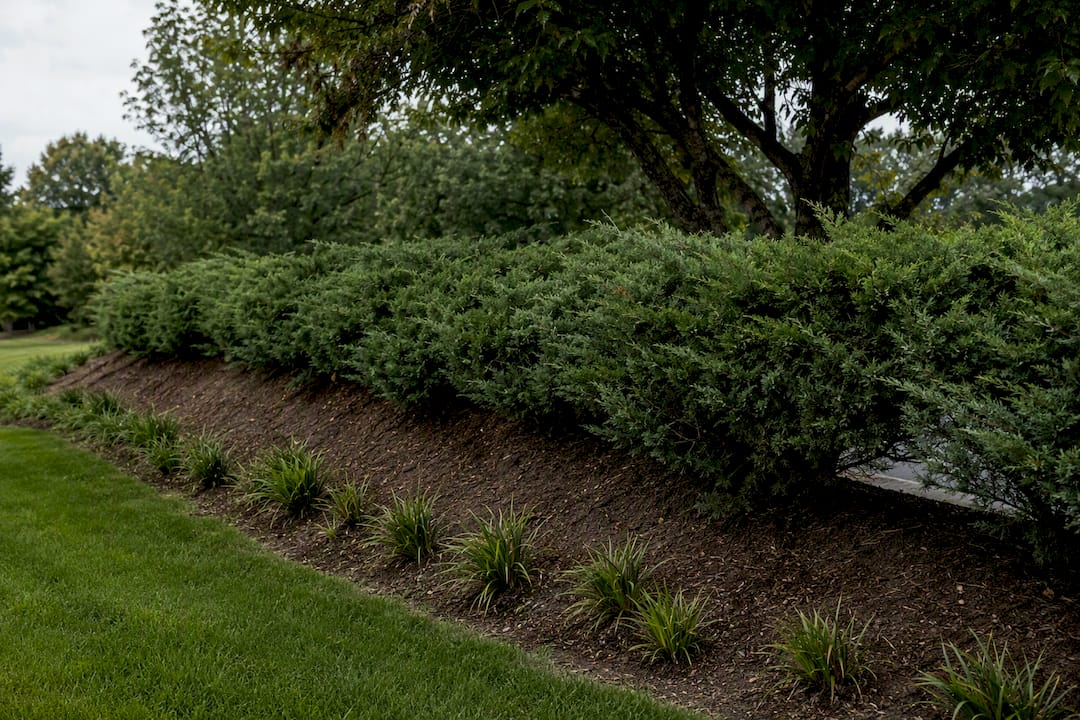
Evergreens matter most here because sound-dampening plantings lose most of their effectiveness once deciduous leaves drop for winter. Anchor noise buffers with hollies, junipers, or arborvitae, then layer deciduous flowering shrubs in front for seasonal interest without sacrificing the winter sound barrier.
For unit-to-unit privacy on ground floors, the same staggered screening approach used for visual privacy does double duty on noise. A dense, two-row planting between patios muffles conversation and reduces the sense of being overheard, which residents consistently rank as a comfort factor even when they can’t articulate why a space feels calmer.
Water features, a small fountain in a courtyard, add a pleasant layer of white noise that masks traffic and mechanical sound without any planting at all. It’s a low-maintenance option worth considering where space and budget allow, since a recirculating fountain needs far less attention than an equivalent-sized planting bed.
Eco-Friendly Hardscape and Permeable Surfaces for Stormwater Control
Standard concrete and asphalt shed stormwater fast, which overwhelms drainage systems and erodes planting beds downstream. Permeable pavers, pervious concrete, and gravel-stabilized surfaces let water soak through instead of running off, reducing both flooding risk and the load on municipal storm drains.
Permeable paver systems work especially well for overflow parking, walking paths, and patio surrounds where standing water has been a recurring complaint. They cost more upfront than standard concrete, typically 15 to 25% more depending on base preparation, but they eliminate the puddling and ice patches that generate maintenance calls every rainy season.
Bioswales, shallow, planted drainage channels, handle runoff from parking lots and roof drains while doubling as a landscaped feature instead of an unsightly drainage ditch. Planted with moisture-tolerant natives, a bioswale filters pollutants out of runoff before it reaches a storm drain or nearby waterway, which matters increasingly for properties near lakes or streams.
Recycled and reclaimed materials, crushed concrete aggregate for pathway bases, reclaimed brick for edging, cut material costs while reducing landfill waste. They’re not always visually distinguishable from new material once installed, so the sustainability angle doesn’t require a design compromise.
Seasonal Planting Rotations That Keep Properties Looking Fresh
A property that gets planted once and left alone always looks tired by the second year. Building a seasonal rotation calendar, tied to your specific climate zone, keeps color and texture cycling without requiring a full redesign every few months.
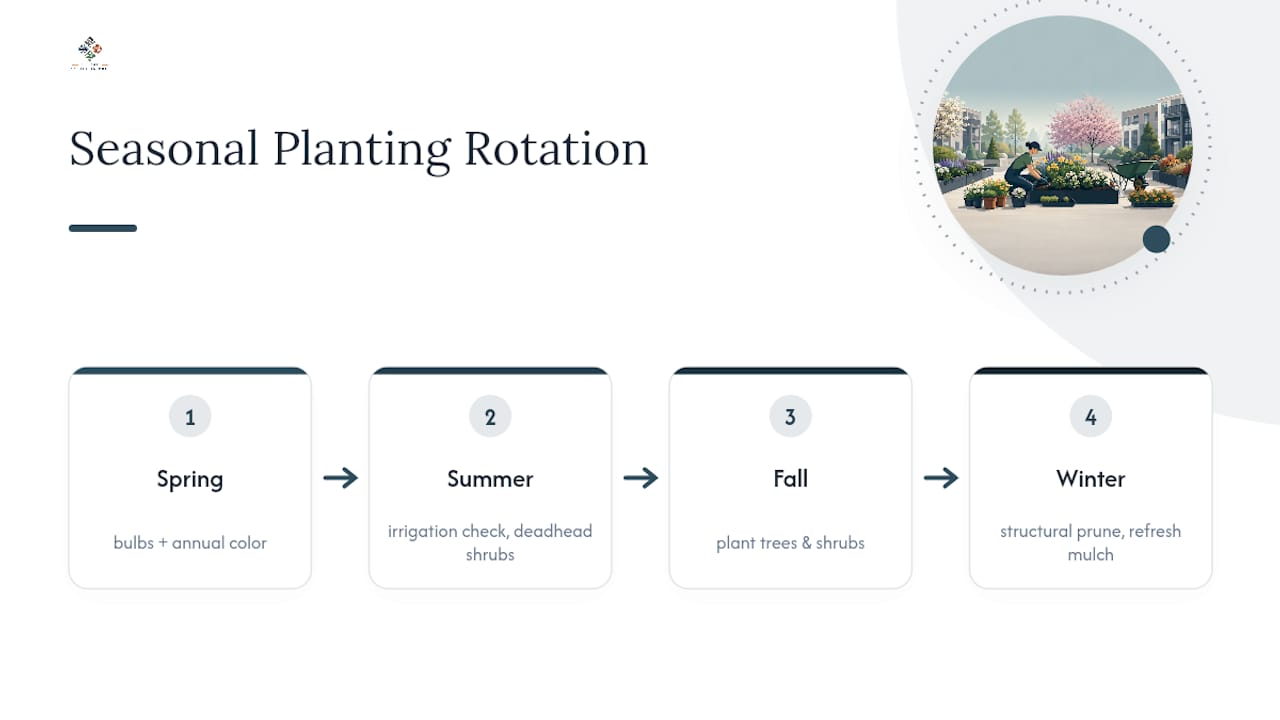
Spring calls for bulb displays near the entrance and the first round of annual color in high-visibility containers. Summer shifts the workload to irrigation monitoring and deadheading flowering shrubs to extend their bloom window. Fall is planting season for any new trees or shrubs, since cooler soil temperatures let root systems establish before summer heat stress hits the following year. Winter maintenance focuses on structural pruning and mulch refresh, prepping beds for the spring cycle to start again.
Tie your rotation calendar to your maintenance contractor’s service visits rather than a fixed date. A late frost or early heat wave shifts the ideal planting window by weeks, and a rigid calendar ignores that reality. The properties that stay consistently attractive year to year are the ones where the maintenance schedule adapts to conditions rather than a printed date, a distinction that separates a well-run multi-family maintenance program from a generic residential mowing route.
Planting Palettes That Stay Healthy With Less Work
A layered planting structure, canopy trees, understory trees, shrubs, groundcovers, and ornamental grasses, creates visual depth while spreading maintenance needs across different growth cycles instead of concentrating them all in one high-effort layer.
Follow a few field-tested rules when building any bed:
- Use the rule of three: plant in groups of three, five, or seven of the same species rather than singles, which reads as more intentional and survives individual losses without leaving an obvious gap.
- Give screening plants 1.5 to 2 meters of bed depth in staggered rows, not a single thin line, for real long-term privacy coverage.
- Space plants for their mature size, not their nursery size, even though it looks sparse for the first year or two.
- Match plant water needs within the same bed, mixing a thirsty hydrangea next to drought-tolerant native grass guarantees one of them struggles.
Soil health underpins all of it. A two to three inch mulch layer suppresses weeds, retains moisture, and moderates soil temperature, cutting both watering frequency and hand-weeding hours. Integrated pest management, monitoring first, targeted treatment only where needed, avoids the cost and plant stress of routine blanket spraying.
One point worth building your entire plant list around: using a resilient, adaptable palette instead of chasing a single perfect look means the landscape stays vibrant even when individual plants fail, which directly cuts the replacement labor that eats into most maintenance budgets year after year.
Irrigation and Drainage Practices That Prevent Costly Failures
Smart controllers that adjust watering based on weather data cut water waste significantly compared to fixed timers, and they catch problems, a stuck valve, a broken head, before they turn into a dead planting bed or a soggy foundation. Drip irrigation belongs on shrub and perennial beds; spray heads belong on turf. Mixing the two on one zone wastes water on whichever surface doesn’t need it.
Grading matters as much as the irrigation hardware. Water needs to move away from building foundations and toward a bioswale, a permeable surface, or a municipal storm drain, not pool against a wall where it slowly undermines a foundation over several seasons. A sustainable irrigation and grading plan built around soil health and water efficiency pays for itself in avoided repair costs.
Run this quick diagnostic checklist monthly during the growing season:
- Walk each zone during a manual run cycle and flag any head spraying pavement instead of planting.
- Check controller battery backup and confirm the rain sensor is functioning, not bypassed.
- Inspect for wet spots or unusually green turf patches, both signal a leak.
- Confirm bed mulch hasn’t buried drip emitters, which starves plants even while the system runs correctly.
Shut systems down properly before the first hard freeze and restart with a full pressure test each spring, catching winter cracks before they flood a bed in April.
Hardscape Features That Reduce Recurring Costs
Material choice for patios, pathways, and gathering plazas determines how much you’ll spend on repairs for the next decade, not just what the space looks like at ribbon-cutting.
Pavers offer the best long-term value for high-traffic common areas: individual units lift out for utility repairs without patching an entire slab, and interlocking joints flex slightly with ground movement instead of cracking. Poured concrete costs less upfront but any settling or freeze-thaw damage means replacing a whole section, not one unit. Modular decking works well for rooftop or elevated amenity spaces where weight and drainage matter more than raw durability.
Design pathways and patios wide enough for maintenance equipment to pass through without cutting across planting beds. A narrow strip between a building and a fence looks fine on a rendering, but it forces a crew to hand-carry a mower or hand-trim every edge, adding labor time on every single visit.
Durable finish options by budget tier:
- Entry-level: stamped concrete or basic clay pavers for patios and walkways.
- Mid-range: natural stone accents, upgraded edging, and integrated low-voltage lighting along paths.
- Premium: full custom hardscape plazas with built-in seating walls and woodworking features for pergolas or shade structures.
Whatever tier you choose, budget for integrated lighting and durable edging details from the start. Retrofitting either one after installation almost always costs more than building them in.
Building a Landscaping Budget That Proves Its Own ROI
Installation costs for a full property landscape overhaul vary widely based on square footage, existing drainage problems, and how much hardscape versus planting you’re doing, while recurring maintenance runs as a smaller, predictable monthly line item once the initial work is done. The gap between those two numbers is exactly why lifecycle framing matters more than sticker price. A cheap install with a fragile plant palette costs more over five years than a resilient design that costs more upfront.
The financial case is measurable, not just aesthetic. Attractive landscaping with mature tree cover has been linked to higher perceived value and increased spending behavior in comparable commercial settings, and tree canopy and street-level greenery correlate with measurable rent and property-value premiums in urban markets.
Set a maintenance-frequency baseline and stick to it:
- Turf: mowed weekly during growing season, edged biweekly.
- Planting beds: weeded and inspected regularly, mulched seasonally.
- Trees: inspected annually by an arborist, pruned periodically.
- Irrigation: audited regularly during the growing season, with comprehensive system checks each spring and fall.
Track a few simple numbers to make your case to ownership: average lease-up time on renovated versus unrenovated buildings, resident retention rate year over year, and landscaping-related maintenance requests per quarter. Our commercial landscape maintenance cost guide breaks down typical budget ranges by service tier if you’re building a proposal for ownership.
A Phased Checklist for Turning Ideas Into a Real Project
Start with a full site audit before spending a dollar. Bring in an arborist to assess existing tree health, an irrigation technician to test current system function, and a landscape contractor to evaluate soil, drainage, and hardscape condition.
- Audit and prioritize: rank findings into immediate safety fixes, quick curb-appeal wins, and larger capital projects.
- Phase the work: tackle entrance and irrigation upgrades first, since they’re visible and budget-friendly, then move to capital hardscape once funding is secured.
- Lock down contract details: confirm maintenance handoff requirements, service frequency, and warranty terms before signing anything.
- Communicate with residents: post a simple timeline near affected common areas and give at least 48 hours notice before any work that limits access.
A phased rollout, quick wins first, seasonal irrigation next, capital hardscape last, spreads the budget out and gives residents visible progress instead of one disruptive overhaul.
How Village Precision Pros Approaches Apartment-Scale Projects
Our team has handled numerous landscaping projects in the region, including work on multi-family properties that require attention to tighter timelines, resident communication, and durable hardscape for heavy daily use.
Our engagement flow starts with a scoping call, then a site visit where we assess drainage, soil, and existing plant health before recommending anything. From there we build a phased plan that separates immediate wins from capital work, and for properties that want ongoing care, we hand off into one of our annual maintenance plans rather than leaving you to find a new contractor every season.
Some jobs genuinely call for a professional crew rather than an in-house handyman fix: rooftop amenity decks with structural load limits, drainage failures undermining a foundation, and any large hardscape install where interlocking joints and a compacted aggregate base determine whether the patio lasts five years or fifteen.
What Property Managers Get Wrong Most Often
The recurring mistake is designing for a listing photo instead of a maintenance crew: fragile specimen plants, mower-hostile turf strips, beds that ignore where water actually drains. Fix it by testing every design choice against one question: can our crew service this efficiently in year three? If the answer is no, redesign it now, not after the plants fail. Drainage problems especially never fix themselves, they just get more expensive.
— Ty
Ready to Start? How Village Precision Pros Can Help
If you’re comparing DIY crews, a rotating cast of subcontractors, or a national maintenance franchise, the tradeoff usually comes down to consistency. A property that changes landscaping vendors every year loses the institutional knowledge of what’s been planted where and why, and that knowledge gap is exactly what drives up replacement costs over time. Village Precision Pros builds that continuity in from the start, with services scoped specifically for apartment-scale properties: Landscape & Irrigation, Hardscape & Stone Masonry, and annual maintenance plans that keep the same crew accountable for your grounds season after season.

An initial consult starts with a real site visit, not a phone estimate, because drainage problems, uneven ground, and soil condition are impossible to price accurately from a satellite photo. We’ll walk your property, flag priority issues, and build a phased plan that matches your actual budget cycle rather than a generic package. If you’re managing tenant satisfaction and a maintenance budget at the same time, that’s the exact combination we’ve built our process around since 2020. Reach out through our services page to schedule a site assessment and get a scoped plan back before you commit to a single dollar.
Sources
- How to enhance your curb appeal | Multi-Housing News
- Strategies for Multi Family Landscape Maintenance – Apartments and Condos | Green Industry Pros
- Sustainable Landscapes for Apartments & Condos | SavATree
FAQ
What Is the Rule of Three in Landscaping?
The rule of three means planting in groups of three, five, or seven of the same species instead of single specimens. Odd-numbered groupings read as more natural and intentional, and they survive the loss of one plant without leaving an obvious gap.
What Is the Most Low-Maintenance Landscaping for an Apartment Complex?
A layered, resilient palette of native shrubs, ornamental grasses, and drought-tolerant groundcovers, backed by mulch and drip irrigation, needs the least ongoing labor. This approach keeps beds looking full even when individual plants fail, cutting down on the replacement cycles that drive up maintenance costs.
Can ChatGPT Do Landscape Design?
AI tools can help brainstorm plant combinations or draft a rough layout concept, but they can’t assess your site’s drainage, soil condition, or local climate zone in person. For anything involving grading, irrigation, or hardscape, a site visit from a landscape contractor catches problems no software can see.
What Are Some Good Ideas for an Indoor Apartment Garden?
Indoor apartment gardens work best with low-light tolerant plants like pothos, snake plants, or ZZ plants near windows, paired with a simple self-watering container system for herbs on a kitchen sill. These are individual-unit choices rather than property-wide landscaping, so they sit outside a property manager’s common-area planning.
How Often Should Apartment Complex Landscaping Be Maintained?
Turf needs weekly mowing during the growing season, planting beds need biweekly weeding and inspection, and irrigation systems need a monthly audit, with trees checked annually by an arborist. Sticking to a set schedule catches small problems, a clogged emitter, an early pest issue, before they become expensive repairs.