

Riprap installation typically runs $70 to $400 per linear foot installed, and that spread is not a typo. Rock size, bank slope, and how far the stone has to travel from the quarry all swing the price hard in either direction. HomeAdvisor’s figures land in the same band, and contractors we talk to at Villageprecisionpros agree that site access is usually the single biggest wildcard on a quote.
TL;DR:
- Riprap costs depend heavily on rock size, site access, and proximity to the quarry, with coastal projects generally reaching higher per-foot prices.
- Site complexity, permits, and added features like bedding fabric or toe excavation often significantly increase total expenses beyond initial quotes.
- Equipment rental and labor contribute 30 to 45 percent of the project’s cost, with steeper or more remote sites requiring more specialized, costly machinery.
- Effective cost estimates require detailed breakdowns of material, delivery, labor, and permitting, as hidden costs like spoil disposal can escalate overall expenses.
- Coordinating bids with itemized scopes and timing during off-peak seasons helps reduce costs, especially when delivery and equipment sharing with nearby projects are possible.
Table of Contents
- What Are Typical Riprap Cost Ranges Per Foot?
- What Factors Change Riprap Price Per Foot?
- How Do You Calculate Your Own Per-Foot Cost?
- How Much Does Riprap Cost Per Ton or Cubic Yard?
- What Hidden Costs and Permits Add to the Price?
- How Can You Reduce Riprap Installation Cost?
- How Much of the Per-Foot Price Is Labor?
- What Do Equipment Rental Costs Add to a Riprap Job?
- How Does Project Timeline Affect the Total Cost?
- A Contractor’s View on Riprap Quoting Pitfalls
- Get a Transparent Riprap Estimate for Your Shoreline
- Sources
- FAQ
What Are Typical Riprap Cost Ranges Per Foot?
Coastal or high-energy bank projects push higher. ShoreProtect notes that many installers start around $150 per linear foot and climb toward $500 on tall banks facing heavy wave action.
Here’s how those per-foot numbers translate into real project totals:
| Shoreline length | Per-foot rate (typical) | Estimated total |
|---|---|---|
| 40 feet | $150–$250/ft | $6,000–$10,000 |
| 75 feet | $150–$300/ft | $11,250–$22,500 |
| 120 feet | $150–$400/ft | $18,000–$48,000 |
These ranges come from aggregated scenario tables that treat a 40-foot residential bank as a common baseline. Coastal sites tend to sit at the upper end because of tidal exposure, saltwater durability requirements, and barge access. Inland lake or pond banks, by contrast, often land in the lower half of the range since crews can usually work from land with standard excavation equipment.
What Factors Change Riprap Price Per Foot?
Every quote you get back will differ because contractors are pricing different combinations of these variables, not because someone is padding the bill.
- Rock size and type. Larger armor stone (8 inches or bigger) costs more per ton and takes longer to place than standard 4 to 6 inch riprap. Hand-placed, interlocking stone costs noticeably more than randomly dumped rock but holds its shape far longer against wave action and ice.
- Bank slope and section thickness. A steep bank needs a thicker rock layer and often a wider toe key to stay stable, which multiplies tonnage per foot.
- Access and equipment. A flat, drivable bank lets a standard excavator do the work. A steep or wooded bank might require a long-reach excavator or, on coastal jobs, a barge, and industry professionals point to site complexity as one of the biggest reasons quotes vary so much from property to property.
- Haul distance from the quarry. Rock is sold by weight, so a quarry 60 miles away costs more delivered than one 15 miles away.
- Labor, disposal, and permitting. Crew hours, spoil removal, and whether a structural engineer or environmental permit is required all land on the invoice as separate line items.
Access alone can swing the same wall’s price dramatically between two nearby properties, which is why a phone quote is never as reliable as a site visit.
Pro Tip: Ask every bidder to break out material, delivery, labor, and equipment as separate line items. If a quote is just one lump number, you can’t tell which variable is driving the price.
How Do You Calculate Your Own Per-Foot Cost?
Build your estimate with these inputs: shoreline length, cross-section (width times depth of the rock layer), stone tonnage needed, unit rock price per ton, delivery fee, labor hours and crew rate, equipment rental, and permit costs.
- Calculate cubic yards of the rock section, then convert to tons using the stone’s density.
- Multiply tonnage by the quarry’s per-ton price to get raw material cost.
- Add delivery, equipment rental, and permit fees to material cost.
- Add labor (crew hours multiplied by hourly rate).
- Divide the total by the shoreline length in feet.
Worked example A: A 40-foot inland bank using standard 4 to 6 inch stone might need roughly 60 tons of rock. At $45 per ton, that’s $2,700 in material, plus $800 delivery, $1,200 equipment, and $2,500 labor. Total: $7,200, or $180 per foot.
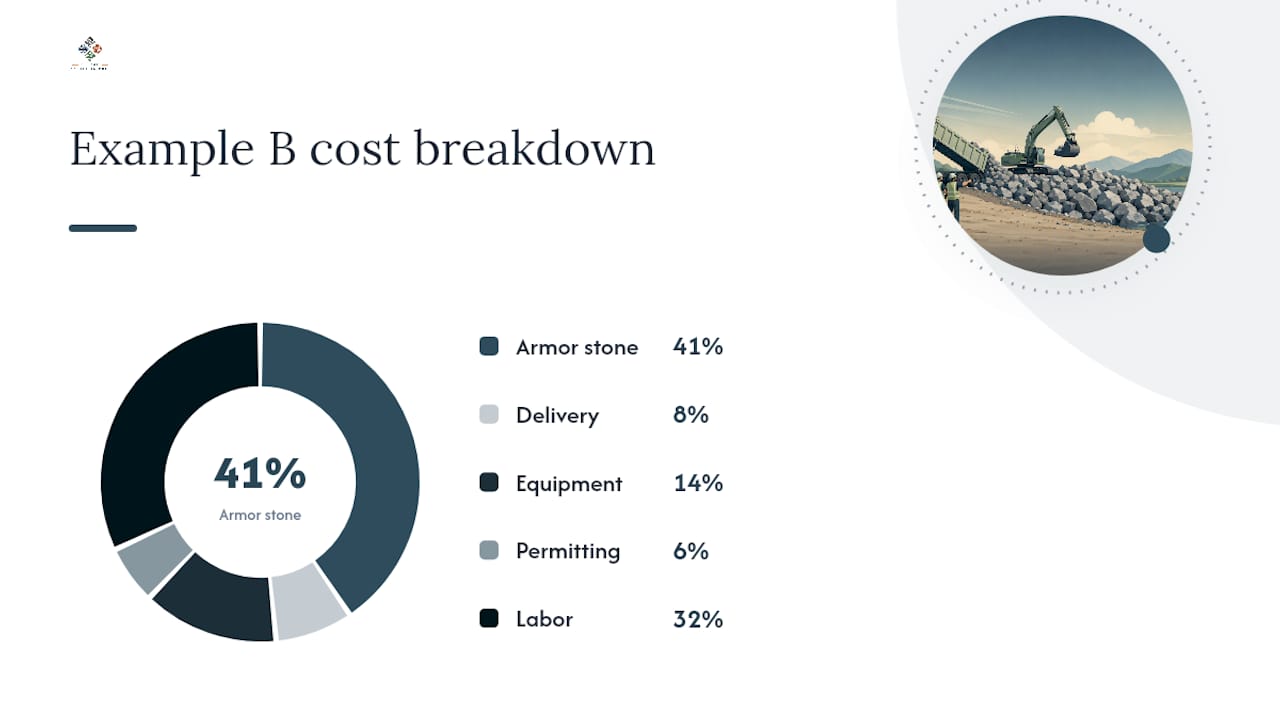
Worked example B: An 80-foot higher-energy shoreline using 6 to 8 inch armor stone might run 150 tons at $55 per ton ($8,250), plus $1,600 delivery, $2,800 equipment, $1,200 permitting, and $6,500 labor. Total: $20,350, or roughly $254 per foot. The jump in per-foot cost between the two examples traces almost entirely to rock size, tonnage, and the added permitting step.
How Much Does Riprap Cost Per Ton or Cubic Yard?
Unit pricing is where most estimating mistakes start, because quarries price by weight, not by the foot.
- Standard 4 to 6 inch riprap: roughly $35 to $60 per ton
- Larger armor stone (8 inches and up): roughly $50 to $90 per ton
- Bedding or filter stone: roughly $30 to $45 per ton
- Per cubic yard equivalents typically run $45 to $110 depending on stone class
As a rough rule of thumb, one ton of standard riprap covers about 1.5 to 2 linear feet of a typical 2 foot deep, 3 foot wide bank section. Prices shift by quarry, season, and region, and haul distance alone can raise material costs by 20 to 30 percent when delivery distance doubles.
What Hidden Costs and Permits Add to the Price?
The per-foot number on a contractor’s headline quote rarely includes everything you’ll actually pay.
- Permits and environmental review. Skipping required permits risks fines or forced removal of the work, so budget this as mandatory, not optional. Review early planning steps for shoreline permitting before you get quotes.
- Filter fabric and bedding stone. These sit under the riprap layer to stop erosion from washing soil out through the gaps.
- Toe key excavation. A buried anchor trench at the base of the slope keeps the whole structure from sliding.
- Spoil disposal. Excavated soil has to go somewhere, and hauling it off site adds a line item many first-time quotes leave out.
- Long-term maintenance. Ice heave, wave undercutting, and vegetation can loosen stone over time, and ongoing shoreline maintenance keeps small issues from becoming full rebuilds.
How Can You Reduce Riprap Installation Cost?
- Schedule delivery during a quarry’s off-peak season to avoid rush surcharges.
- Source stone from a regional quarry or a contractor with an established supply network rather than a single-order retail yard.
- Consider a mixed-size section (larger armor at the waterline, smaller stone above it) where site conditions allow.
- Bundle mobilization costs with a neighboring project if timing lines up.
- Get at least three itemized bids and compare scope, not just the bottom-line number, since HomeAdvisor specifically recommends this to catch differences in method and material grade.
Pro Tip: Coordinating deliveries with a nearby project, even an unrelated one, can split the trucking cost and shave real money off your per-foot rate.
How Much of the Per-Foot Price Is Labor?
Labor typically makes up 30 to 45 percent of the total installed cost per foot, with the rest split between material, delivery, and equipment. On a straightforward inland bank, a two to three person crew might average $50 to $85 combined hourly labor cost, translating to roughly $40 to $80 per linear foot of labor alone once you factor in placement time.
Hand-placing armor stone for an interlocking, engineered look takes considerably longer per foot than machine-dumping smaller riprap into a slope. That labor premium is exactly what buys the longer lifespan noted earlier: interlocked stone resists shifting far better than loosely dumped rock, but a crew can take two to three times longer to place it correctly.
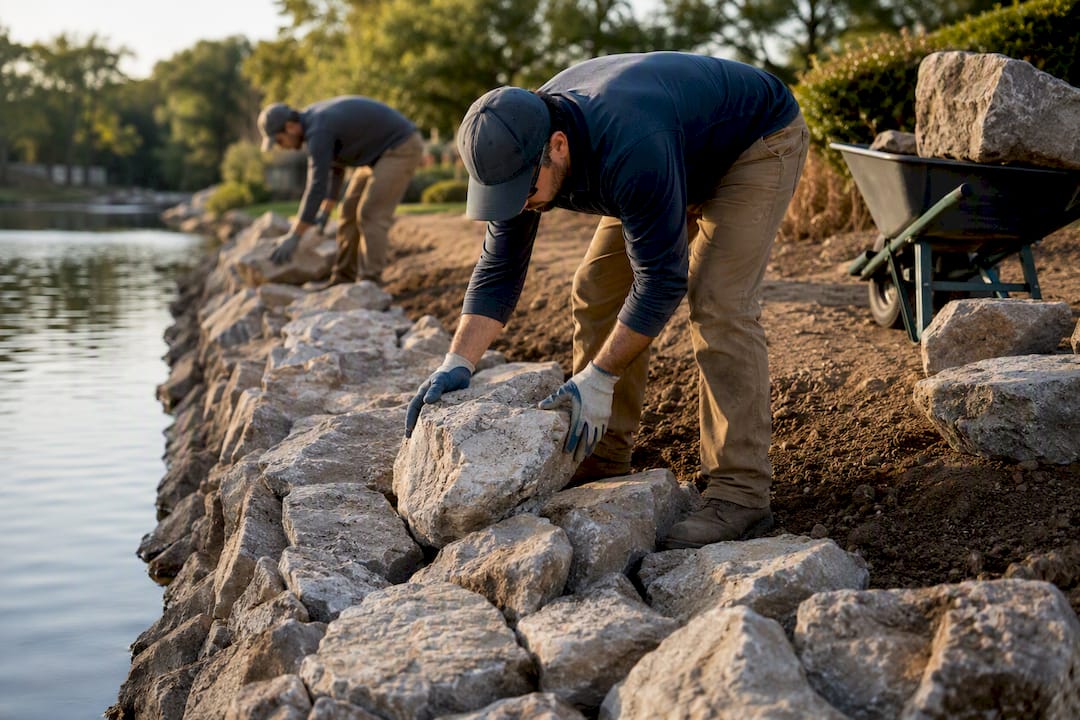
Steep banks also add labor hours because crews often need to work in stages, compacting and shaping the base before placing the armor layer. Disposal labor, if spoil has to be hand loaded rather than machine loaded, adds further hours. When you’re comparing bids, ask each contractor to state their crew size, estimated days on site, and hourly rate. A bid that looks cheap per foot but uses a smaller crew over more days might not actually save you money once delays and equipment rental days are factored in.
What Do Equipment Rental Costs Add to a Riprap Job?
Equipment is often the second biggest swing factor after labor, and it scales directly with how hard the site is to reach. A standard excavator or skid steer for an accessible inland bank might run $300 to $600 per day in rental costs, and a typical residential job wraps in two to four days of use.
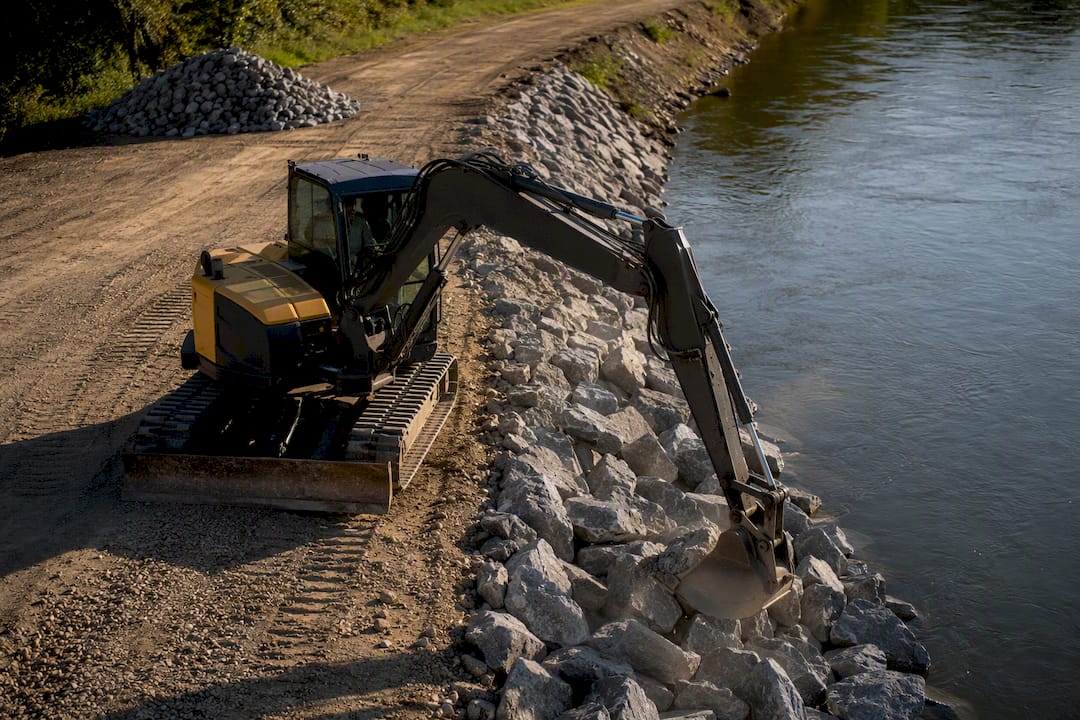
Steeper or larger jobs sometimes call for a long-reach excavator, which rents for noticeably more per day than a standard machine. Coastal or deep-water shoreline work can require a barge or crane setup, and mobilizing that kind of equipment to a job site is a meaningful cost even before the machine starts working. For context on how specialized equipment needs change a job’s economics, the excavation and demolition crews at Cornelius Wrecking deal with the same access tradeoffs on a larger scale.
Dump trucks for hauling in stone and hauling out spoil add another rental or contracted-hire line, usually billed per load or per day depending on the contractor. If your site has limited turnaround space, expect the crew to need more truck trips at smaller loads, which raises the effective equipment cost per foot even though the machines themselves haven’t changed. Always ask whether equipment costs are baked into the quoted per-foot price or billed separately, since that single detail explains a lot of the variance between bids.
How Does Project Timeline Affect the Total Cost?
A straightforward 40 to 60 foot inland job with easy access typically takes two to four days from mobilization to cleanup. Add permitting delays, difficult access, or a longer shoreline, and that timeline stretches to a week or more, with cost climbing alongside it.
Timeline matters to your per-foot price for a simple reason: equipment and crew are usually billed by the day, not strictly by the foot. A job that stalls for two extra days because of weather, a permit hold, or a supply delay adds real dollars that get spread back across your linear footage when the final invoice lands. Seasonal timing plays a role too. Spring and early summer tend to be the busiest window for shoreline work in most regions, which can mean longer scheduling waits and slightly higher demand pricing compared to late fall bookings.
Multi-phase permitting is the biggest wildcard. Projects touching regulated waterways sometimes need environmental review before work can start, and that approval process can add weeks to months before a crew ever breaks ground. Building that lead time into your planning, rather than assuming installation can start next week, keeps the eventual per-foot cost from creeping up due to rush scheduling or expedited permit fees.
A Contractor’s View on Riprap Quoting Pitfalls
The surprises that blow up a riprap budget are rarely the big-ticket items. It’s the hidden spoil that needs hauling off, root systems that have to be protected during excavation, or a gravel access road that gets torn up by equipment and needs repair afterward. Homeowners rarely budget for these because most online cost guides never mention them.
At Villageprecisionpros, we handle permitting and quarry sourcing directly and write line-item quotes that separate material, labor, equipment, and permit costs so you can see exactly where your money goes.
— Ty
Get a Transparent Riprap Estimate for Your Shoreline
Village Precision Pros handles shoreline riprap projects across Central Arkansas from permit application through final placement, so you’re not coordinating separate permitting consultants, quarry deliveries, and excavation crews on your own. That end-to-end approach is the real advantage over piecing a project together yourself: one point of contact, one line-item quote, and a crew that already knows how local bank conditions and quarry sourcing affect your per-foot price.

We build our estimates the same way this article breaks down cost: material, labor, equipment, and permits stated separately, not bundled into a vague number. If you’re planning a shoreline project and want a real per-foot figure instead of a guess, schedule a landscaping consultation and we’ll walk your bank in person before quoting anything. You can also browse our shoreline construction services to see the full scope of what we handle.
Sources
- How Much Does Riprap Cost? 2026 Data | Angi
- Who Should I Hire to Install Riprap? | HomeAdvisor
- Rip Rap Seawall Cost: Price Ranges, Drivers, and How to Budget 2026 – Current Cost
- Riprap rock seawall cost, materials, lifespan & installation | ShoreProtect
FAQ
How Much Does Riprap Cost Installed?
Riprap installation typically costs $70 to $400 per linear foot, with most straightforward inland jobs landing between $150 and $250 per foot once material, labor, and site prep are included.
How Much Does One Ton of Riprap Cover?
One ton of standard 4 to 6 inch riprap typically covers about 1.5 to 2 linear feet of a bank with a common 2 foot deep, 3 foot wide section, though coverage shifts with stone size and slope thickness.
What Does One Ton of Riprap Look Like?
A ton of riprap is roughly a pickup-truck-bed-sized pile of angular rock, usually ranging from fist-sized stones to pieces 6 to 8 inches across depending on the grade ordered.
How Much Is 20 Tons of Riprap?
At typical per-ton pricing of $35 to $90 depending on stone size, riprap material cost varies before delivery, labor, and equipment are added.
Is Riprap Cheaper Than Other Erosion Control Methods?
Riprap generally costs more upfront per foot than vegetation-based methods like live staking, but it typically outlasts softer options on high-energy banks and needs less frequent replacement, which can lower its true long-term cost.