


For most yards, the right fix is simple: extend the downspout with a pipe or elbow that discharges onto a vegetated area, then add a rock bed or rain garden if you have the space. Save French drains and dry wells for yards with slow-draining soil or a low spot that collects runoff no matter what. The right choice always comes down to your soil, your slope, and how close the water ends up to a foundation, septic system, or neighbor’s yard.
TL;DR:
- Extending downspouts onto vegetated areas and using splash blocks is the simplest fix, especially when the ground slopes away from the house.
- Rock beds or dry creek beds help spread moderate flows and prevent erosion when extensions alone leave muddy patches.
- Rain barrels capture runoff during light storms, but require overflow paths and are ineffective in heavy rain without additional drainage solutions.
- Rain gardens are suitable where soil drains well and space exists, but poorly draining soil needs an underdrain or larger area.
- Underground options like French drains and dry wells are best reserved for persistent problems when surface solutions are insufficient.
Table of Contents
- Quick shortlist: the top downspout drainage ideas and when to use each
- Extend downspouts, elbows, and splash blocks for quick surface diversion
- Rock beds, dry creek beds, and splash-rock dispersal
- Rain barrels and cisterns: capture plus overflow management
- Rain gardens and bioretention: planted infiltration solutions
- Underground options: French drains and dry wells
- How to choose the right solution for your yard: checklist
- Maintenance and common mistakes to avoid
- A landscaping pro’s take on getting drainage right
- Village Precision Pros: professional drainage design and installation
- FAQ
- Sources
Quick shortlist: the top downspout drainage ideas and when to use each
Before you dig anything, match the fix to the problem. Here is how we rank the options we see most often in Central Arkansas yards:
- Extensions and elbows with splash blocks or gravel: the fastest fix, and often all a yard needs if the ground already slopes away from the house.
- Rock bed or dry creek: a decorative way to spread moderate flows and stop erosion where an extension alone leaves a bare, muddy patch.
- Rain barrel or cistern: captures water for reuse, but only works as drainage if you plan for where the overflow goes once the barrel fills.
- Rain garden or bioretention bed: the best infiltration option where soil drains well and you have room to plant.
- French drain: a buried, perforated pipe for moving concentrated runoff to a safer discharge point.
- Dry well: a compact underground chamber for high-volume point discharge where the surrounding soil can absorb it.
Extend downspouts, elbows, and splash blocks for quick surface diversion
This is where we tell nearly every homeowner to start. Attach the new elbow over the existing downspout rather than inserting one piece inside the other, because an inserted joint tends to leak and that leaking water saturates the soil right next to your foundation. Secure the joint with sheet-metal screws, and use a crimper on the extension end if it needs to fit snugly into the next section.
- Keep discharge at least 6 feet from basement walls and 2 feet from crawl spaces or slabs, with a steady slope away from the structure the whole way.
- Use rigid PVC or aluminum extensions rather than flimsy flexible tubing, which crushes and clogs within a season or two.
- Run extensions along a planting bed edge or under mulch where foot traffic will not catch on them.
If your downspout is dumping within a few feet of the house, this one move often solves most of the problem on its own, and correcting grading and downspout routing is usually the cheapest fix available before anyone talks about bigger systems.
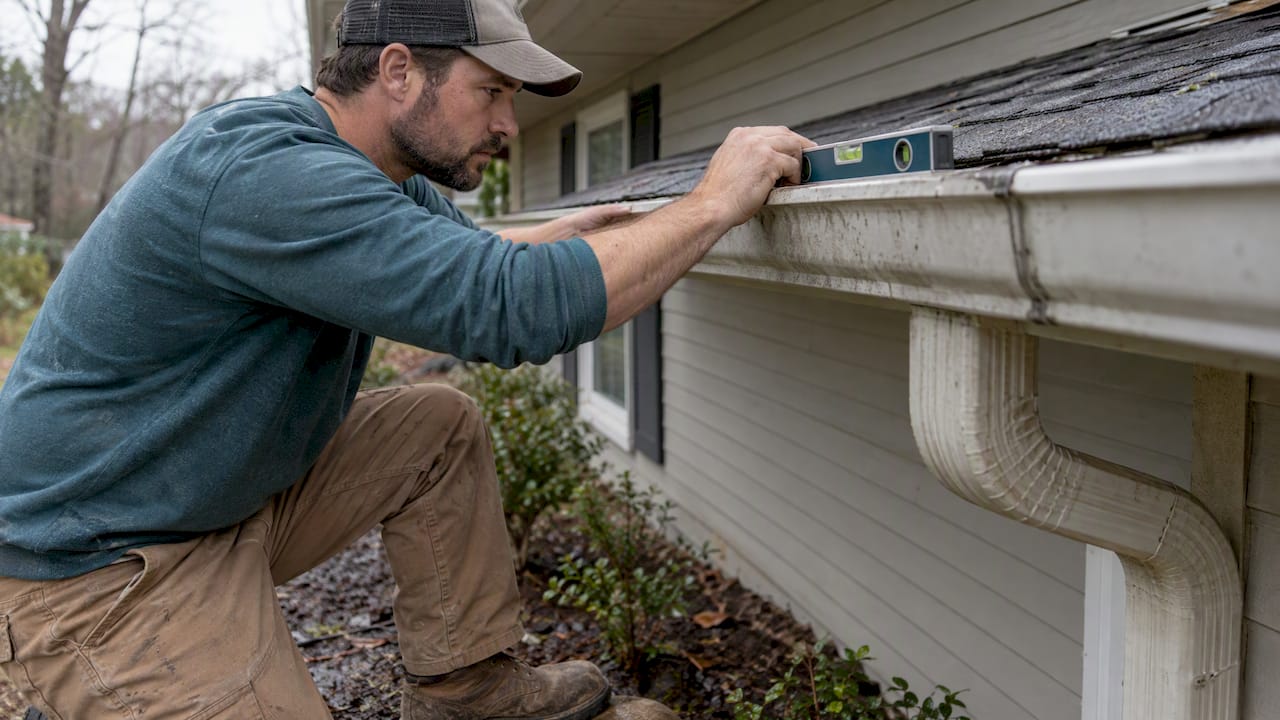
Pro Tip: Check your gutter’s pitch before blaming the downspout. A gutter that slopes the wrong way will overflow no matter how good the extension is. A quick DIY pitch check takes about 20 minutes and rules out a problem upstream of the downspout entirely.
Rock beds, dry creek beds, and splash-rock dispersal
When an extension alone leaves a soggy, eroded spot, a rock bed or dry creek bed spreads the water out and slows it down. Build it with larger cobble right where the pipe empties out, then taper into a gently sloped channel so water sheets across instead of digging a trench.
- Keep rock dispersal features at least 10 feet from the foundation when they double as an infiltration area, not just a splash pad.
- Never aim a dry creek bed toward a septic field, a neighbor’s property line, or a low spot that already floods.
- For longer runs, pair the visible rock channel with a short length of buried pipe instead of exposed rock the whole way.
- Use erosion-control fabric sparingly, only under the rock near the inflow point where scour is worse.
Check these features after heavy storms. Sediment buildup and scour marks tell you quickly whether the channel is undersized for what your roof is sending it. Our dry creek bed drainage guide covers layout details if you want to build one that holds up.
Rain barrels and cisterns: capture plus overflow management
A rain barrel is a water-harvesting tool first and a drainage fix second. Standard residential barrels hold roughly 50 to 55 gallons, which fills fast in a hard downpour, so the overflow plan matters more than the barrel itself.
- Route the overflow hose or spout to a rain garden, rock bed, or another spot well away from the foundation.
- Screen the inlet to keep mosquitoes out, and set the barrel on a stable, level pad so it will not tip when full.
- Link two or more barrels with a connector kit if your roof area produces more runoff than one barrel can hold.
Treat a barrel as useful during light rain and nearly irrelevant during a heavy storm. It is not a substitute for grading or an extension when runoff volume is high.
Rain gardens and bioretention: planted infiltration solutions
A rain garden is a shallow, planted depression that catches roof runoff and lets it soak into the ground instead of running off. Penn State Extension notes that a properly designed rain garden can allow roughly 30% more water to infiltrate than a conventional lawn area of the same size, which is a meaningful gain if your yard already holds water after storms.
- Run a percolation test first: dig a hole, fill it with water, and time how fast it drains. Soil that takes longer than 24 hours needs an underdrain or a different design.
- Site the garden at least 10 feet from the foundation, and never over a septic field or well.
- Size the garden relative to the roof area it serves. Faster-draining soil needs less area; slow clay needs more, or an underdrain.
- Build a stone or planted overflow path for the rare storm that exceeds the garden’s capacity.
Pro Tip: Choose plants that tolerate both standing water after a storm and dry soil between rains, like native sedges and swamp milkweed, rather than typical bedding plants that rot in wet feet. Our rain garden design guide walks through sizing and plant selection in more depth.
Underground options: French drains and dry wells
When surface solutions cannot keep up, a French drain or dry well moves the problem below ground. A French drain is a trench lined with gravel around a perforated pipe that carries water sideways to a safer discharge point, which works well for a long, low run where you cannot just slope the yard away.
A dry well is a buried, stone-filled chamber, or a manufactured plastic unit, that catches runoff and lets it soak into the soil around it over time. Portland’s guidance describes dry wells as a low-maintenance, long-term fix, but only after soil infiltration testing confirms the ground nearby can actually absorb the water.
- Both systems need setback distances from the foundation, property lines, and septic systems checked before digging.
- Permits are common for dry wells and for any French drain that ties into a storm system.
- Plan on inspecting silt traps and clearing sediment periodically so the system keeps working.
A landscape drainage guide for clay or slow soils is worth a look if your percolation test comes back slow, since that changes which underground option makes sense.
How to choose the right solution for your yard: checklist
Work through this in order before you commit to a design.
- Test soil infiltration at the spot you plan to use for any infiltration feature.
- Map which downspouts drain which roof sections, so you size each fix correctly.
- Measure slope and distance to the foundation, property lines, and any septic components.
- Note existing problems: standing water, erosion, or a downspout already dumping near the house.
- Combine methods where it makes sense, like a barrel feeding overflow into a rain garden, or an extension ending in a rock bed.
- If you hire a contractor, ask how they tested the soil, what setback they are using, and how overflow is handled in a heavy storm.
Our yard drainage solutions overview is a good starting point if you are still deciding between a DIY weekend project and a bigger install.
Maintenance and common mistakes to avoid
Clean gutters at least twice a year, more often under trees, and walk the downspout line after any heavy storm to check for new erosion or standing water. The mistakes we see most often: discharging into a spot too small to handle the flow, using flexible tubing as a permanent fix, skipping an overflow plan for barrels or rain gardens, and routing water straight onto a neighbor’s lawn.
- Check dry wells and French drains once a year for silt buildup near the inlet.
- Look at rain gardens after storms for standing water past 24 hours, a sign the soil needs an underdrain.
- Inspect rock beds for scour marks that mean the channel is undersized.
Pro Tip: Walk your drainage system during a real rainstorm at least once a year. You will see exactly where water pools or escapes in a way a dry-day inspection never shows.
A landscaping pro’s take on getting drainage right
Grading and a well-placed extension solve most of what we see on service calls. We only recommend a French drain or dry well once the simpler fixes have been tried and the soil still will not cooperate. Save the engineered systems for the sites that actually need them.
Ty
Village Precision Pros: professional drainage design and installation
Grading and extensions handle plenty of yards, but when a site needs a rain garden, a French drain, or a rock bed built to last through Arkansas storms, we build it right the first time. We design and install landscape and irrigation drainage systems, along with the rock beds and hardscape elements that often accompany a drainage fix.

- We handle hardscape and stone masonry work for rock beds, dry creek beds, and drainage-related retaining features.
- Our landscape and irrigation installations cover grading, drainage routing, and planting for rain gardens.
- Our annual maintenance plans keep gutters, downspouts, and drainage features working season after season.
A consultation starts with a walk-through of your yard’s slope, soil, and existing trouble spots, the same checklist we laid out above, before we recommend a fix sized to your property. Reach out through our services page to get a project started.
FAQ
What is the best way to disperse water from a downspout?
For most yards, an extension or elbow that discharges onto a vegetated area is the simplest and most effective fix. Where space allows, pairing that extension with a rain garden or rock bed spreads the water further and reduces erosion.
What is the best drainage system for downspouts?
There is no single best system since it depends on your soil and slope. Surface extensions work for most yards, while French drains and dry wells are reserved for sites where surface infiltration cannot keep up with runoff.
How far should downspouts drain from a house?
Keep discharge at least 6 feet from basement walls and at least 2 feet from crawl spaces or slabs, always sloping away from the structure. For infiltration features like rain gardens or rock beds, keep them at least 10 feet from the foundation.
Is it a good idea to bury downspouts underground?
Burying a downspout extension underground can work well if it slopes consistently to a safe discharge point and the soil around it drains adequately. Disconnecting and redirecting downspouts reduces runoff reaching storm sewers, but siting still needs to account for setbacks and local conditions.
Sources
- Soak Up the Rain: Disconnect / Redirect Downspouts, US EPA
- Rain gardens and bioretention cells, Penn State Extension
- Moisture in basements causes and solutions, University of Minnesota Extension