

If you own or plan to build on Arkansas lakefront property, three agencies decide what you can do at the water’s edge: the U.S. Army Corps of Engineers on Corps-managed lakes, the Arkansas Game and Fish Commission on Commission-owned lakes, and Arkansas DEQ whenever a project touches water quality. Docks, seawalls, vegetation clearing, and any fill or dredge work usually need a permit from one or more of them. Before you buy materials or hire a crew, pull up the shoreline allocation map for your lake and request a pre-application meeting with the right project office.
TL;DR:
- Most shoreline projects on Corps-managed lakes require both USACE shoreline use permits and a DEQ Water Quality Certification if water disturbance is involved.
- Shoreline allocation zones determine allowed activities; confirming your property’s zone with the project office prevents permit denials or delays.
- Pre-application meetings with USACE and DEQ are essential for identifying required permits early and avoiding project halts.
- Permits are usually non-transferable, so verifying permit status before property purchase saves significant time and expense.
- Incorporating erosion controls and detailed design plans early ensures structures meet environmental regulations and last through Arkansas lake conditions.
Table of Contents
- Who regulates shoreline activities in Arkansas
- Shoreline allocation zones and what you can build
- Which shoreline permits you actually need
- Your application checklist and realistic timeline
- Rules and maintenance obligations you need to design around
- Where to find maps, contacts, and boundary help
- Practical tips that keep shoreline projects moving
- Getting the most out of your regulators and your contractor
- Building shoreline work that clears permits the first time
- Sources
- FAQ
Who regulates shoreline activities in Arkansas
Arkansas lakes fall under different owners, and that ownership determines who reviews your project. On Corps-managed reservoirs like Beaver, Bull Shoals, Norfork, and Greers Ferry, the U.S. Army Corps of Engineers’ Little Rock District writes and enforces the rules through Shoreline Management Plans. These SMPs are authorized under ER 1130-2-406 and 36 CFR 327.30, and each project office (Beaver Lake, Bull Shoals, Norfork, Greers Ferry) maintains its own SMP tailored to that reservoir’s shoreline conditions and public use patterns.
The Arkansas Game and Fish Commission takes the lead on lakes it owns outright. AGFC’s land-use policy sets buffer widths, permitting rules for piers and boathouses, and restrictions on what landowners adjacent to Commission property can build without stepping onto public land.
Arkansas DEQ, part of the Division of Environmental Quality, enters the picture whenever a project could affect water quality, most often through dredging, filling, or shoreline stabilization that disturbs the lakebed. Any federal Section 404 permit for dredge or fill triggers a mandatory DEQ Section 401 Water Quality Certification, and DEQ runs its own pre-file meeting process through the state’s ePortal.
These jurisdictions overlap more often than property owners expect:
- A dock on a Corps-managed lake typically needs a USACE shoreline use permit plus a DEQ review if construction disturbs the lakebed.
- A seawall on any Arkansas lake almost always needs a Section 404/10 authorization from USACE and a companion Section 401 certification from DEQ.
- A pier on an AGFC lake needs an AGFC structure permit, and dredging near it can still pull in USACE and DEQ review.
- Vegetation modification is usually the simplest case, often needing only a shoreline use permit if your parcel sits in a Limited Development Area.
Knowing which agency owns your lake is step one. Knowing which agencies your specific activity touches is step two, and it’s the one that catches people off guard mid-project.
Shoreline allocation zones and what you can build
Every foot of shoreline on a Corps-managed lake gets assigned to a category, and that category governs what’s allowed there before anyone looks at your specific project. Arkansas lakes managed under USACE shoreline allocation systems sort land into four main types, and the practical differences between them are significant.
- Limited Development Area (LDA): This is where most private activity happens. Boat docks, limited vegetation modification, and footpaths down to the water are typically permitted here, subject to the specific SMP for your lake.
- Public Recreation Area: These stretches are set aside for public access, campgrounds, or day-use areas. Private structures are generally not permitted, since the land is managed for shared use.
- Protected Shoreline Area: Often designated for habitat, scenic value, or erosion sensitivity, these areas carry tighter restrictions on construction and vegetation removal than an LDA.
- Prohibited Access Area: Found immediately upstream or downstream of dams and around other safety-critical infrastructure, these zones bar private access entirely for security and public safety reasons.
The allocation for your specific parcel isn’t something you guess at. It’s published on the official SMP maps for each lake, and the Beaver Lake shoreline use request page confirms that permission for docks, vegetation work, and footpaths depends entirely on which allocation category covers your property. Two neighbors on the same cove can face different rules if the line between an LDA and a Protected Shoreline Area runs between their lots.
Before you plan anything, request the map for your specific lake from the project office and confirm your parcel’s designation in writing. This single step prevents the most common and expensive mistake we see: designing a dock or clearing brush for a project that was never eligible for a permit in the first place. On AGFC lakes, the equivalent step is confirming your property against the Commission’s land-use buffer, since AGFC applies its own spacing and access rules independent of the Corps’ four-category system.
Which shoreline permits you actually need
Most lakefront projects need one of four permit types, and the trigger for each one is specific enough that you can usually tell in advance which apply to you.
Shoreline use permits from USACE cover the bread-and-butter improvements: floating docks and boathouses, vegetation modification beyond routine mowing, footpaths, and ambulatory vehicle access ramps down to the water. These are issued by the project office for your specific lake and are tied to the allocation zone your parcel sits in.
AGFC structure permits apply to piers, boathouses, and boat slides on Commission-owned lakes. The application requires a plat, construction plans, and proof of ownership, and once issued, the permit runs on a three-year renewal cycle, with AGFC generally limiting landowners to one pier and one boathouse or boat slide per property.
USACE Section 404 and Section 10 permits kick in for any dredge, fill, or structural work in navigable waters, which covers most seawalls, retaining structures, and lakebed alterations. A dock that requires pilings driven into the lakebed can trigger this review even though it feels like a routine dock project.
DEQ Section 401 Water Quality Certification is the near-automatic companion to a Section 404 permit. Arkansas DEQ’s guidance is explicit: any discharge of dredge or fill material into waters of the United States requires a USACE Section 404 permit, and that action triggers a mandatory 401 review. Applicants must submit a Pre-File Meeting Request through the state’s ePortal at least 30 days before applying for an Individual 401 certification.
DEQ Short Term Activity Authorization offers a faster path for smaller or temporary projects that don’t rise to the level of a full 401 certification, and it’s worth asking the project office whether your work qualifies before assuming you need the longer process.
A few real-world examples show how these stack up:
- Dock installation on a Corps lake: shoreline use permit from USACE, plus AGFC review if the dock also touches a Commission buffer.
- Seawall construction: USACE Section 404/10 permit, DEQ 401 certification, and often a shoreline use permit for the disturbed bank area.
- Vegetation trimming within an LDA: usually just a shoreline use permit, and sometimes no permit at all for limited hand-tool work under the SMP’s routine maintenance allowance.
- Dredging to deepen a boat channel: Section 404/10 from USACE and a mandatory 401 review from DEQ, since dredge material disposal is exactly what the certification exists to control.
Sediment is one of the top pollutants tracked in Arkansas streams, according to AGFC’s Stream Habitat Program, which is a big part of why DEQ’s review process exists and why erosion control shows up as a condition on so many shoreline permits. A seawall or dock built without erosion controls in place is far more likely to draw an objection than one designed with them from the start.
Multiple permits for one project is the norm, not the exception, on Arkansas shorelines. Missing even one authorization can halt work already underway.
Your application checklist and realistic timeline
The single most effective step you can take is requesting a pre-application meeting before you submit anything. Both USACE and DEQ recommend this, and DEQ’s own guidance frames it as the step most likely to catch missing permits before they become a project delay. For DEQ reviews, this means filing a Pre-File Meeting Request through the ePortal at least 30 days ahead of your 401 application. For USACE, it means calling or emailing your lake’s project office to walk through your plans before you file.
Here’s the general sequence that keeps a shoreline project moving:
- Confirm your allocation zone using the official SMP map for your lake and verify it directly with the project office.
- Request a pre-application or pre-file meeting with USACE and, if dredge or fill is involved, with DEQ through the ePortal.
- Assemble your documentation, including a survey or plat, proof of ownership or deeded lake access, a detailed site plan and construction drawings, boat registration if you’re applying for a dock permit, and an erosion-control plan.
- Submit to the correct agency or agencies, whether that’s the USACE project office directly, AGFC’s licensing system for Commission lakes, or the DEQ ePortal for water quality certifications.
- Track your permit’s renewal terms. AGFC structure permits run on a three-year cycle, and permits generally do not transfer when you sell the property, so a new owner has to reapply.
Review windows vary by agency and by how complete your application is on day one. Incomplete construction drawings, missing surveys, and unauthorized work started before approval are the three most common reasons a straightforward project turns into a months-long back-and-forth. Fees also vary by permit type and by agency, so confirm the current fee schedule with your project office or the DEQ ePortal rather than assuming a flat rate applies statewide.
Pro Tip: Order your survey and draft your construction drawings before your pre-application meeting, not after. Showing up with real documents turns a general conversation into specific, actionable feedback.
Rules and maintenance obligations you need to design around
Permits come with strings attached, and most of them are about spacing, vegetation, and upkeep rather than the structure itself.
- Dock spacing and ownership rules typically limit each household to one primary structure, and lakes managed by USACE commonly require applicants to own at least 75 continuous feet of adjoining property or hold deeded lake access before a dock permit is even considered.
- Slip rentals are generally not allowed. A permitted dock is for the permit holder’s own use, not a side income source.
- Vegetation modification limits restrict how much can be cleared and often require hand tools rather than heavy equipment, with protected species and flowering shrubs getting extra scrutiny in some allocation zones.
- Some Corps-managed docks carry additional conditions around electrical service and renewable energy equipment, so check your lake’s specific SMP before wiring anything.
- Maintenance obligations don’t end at construction. Project offices expect structures to be kept in good repair, and unauthorized modifications after the fact, even minor ones, can trigger enforcement action.
Permits are also generally non-transferable. If you’re buying lakefront property with an existing dock or seawall, verify the permit status with the project office before closing, since the seller’s permit doesn’t automatically pass to you.
Where to find maps, contacts, and boundary help
Every Corps-managed lake publishes its own shoreline management information, and the fastest way to confirm your allocation is to go straight to the source.
- The Beaver Lake Shoreline Use Request page, the Bull Shoals Lake Shoreline Management page, and the Norfork Lake Shoreline Management page each host SMP maps, permit forms, and project office contact details specific to that reservoir.
- Greers Ferry Lake’s SMP revision materials are posted through the Little Rock District planning page, which also explains the federal authority behind the whole SMP system.
- For AGFC lakes, the AGFC land-use policy page links to licensing instructions for structure permits.
- If your property line or the Government Fee Take Line isn’t obvious on the ground, project office Rangers can help locate boundary monuments and markers, and a certified survey resolves any lingering doubt before you build.
Calling the project office before you buy lakefront property, not just before you build, is one of the simplest ways to avoid inheriting someone else’s permit problem.
Practical tips that keep shoreline projects moving
Field experience on Arkansas lakes teaches you fast that the projects with the fewest headaches are the ones designed around the permit process from day one, not bolted onto it afterward.
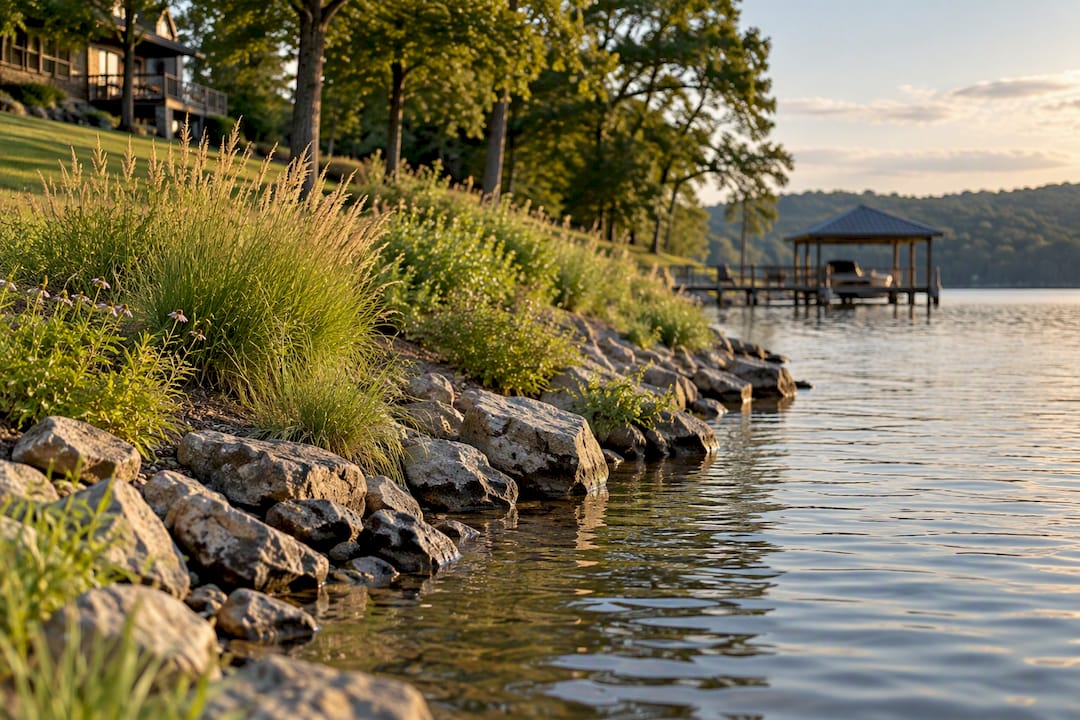
Soft stabilization methods, riprap, vegetated buffers, and graded slopes that slow runoff, tend to align well with DEQ’s water-quality concerns and often draw fewer objections during 401 review than a hard vertical wall with no erosion controls. Timing matters just as much as design. Lake drawdowns create the only windows for a lot of shoreline work, and missing one can mean waiting a full year for the water to drop again, which is why coordinating construction timing with your contractor and the project office early is worth the extra phone calls.
Clear surveys and detailed construction drawings do more to prevent re-submissions than any other single document in the application packet. Reviewers can’t approve what they can’t clearly picture, and vague sketches are the fastest way to get a request for more information instead of a permit.
Village Precision Pros builds seawalls and shoreline structures across Central Arkansas lakes and works these permit windows regularly, which shapes how projects get scheduled and documented from the start.
Pro Tip: If your project involves any lakebed disturbance, ask your contractor for construction drawings before you file for permits. A complete packet on the first submission is almost always faster than a partial one with follow-up questions.
Some permitted work, like routine vegetation trimming within an LDA, is well within reach for an owner willing to follow the rules. Seawalls, dredging, and anything involving Section 404/10 review are a different scale of project, and that’s where an experienced local contractor earns their fee by keeping the paperwork and the construction sequence aligned.
Getting the most out of your regulators and your contractor
Every delay I’ve seen on an Arkansas shoreline project traces back to the same root cause: someone skipped the pre-application meeting because it felt like an extra step instead of the step. Agencies aren’t trying to slow you down. They’re trying to catch a missing permit or an allocation mismatch before you’ve poured concrete, and that conversation is free.
The other habit worth building is checking permit status before you buy, not after. Permits on Arkansas shoreline structures generally don’t transfer with the sale, so a dock or seawall on the listing photos might not come with a valid permit at all. A five-minute call to the project office before closing can save months of retroactive paperwork.
Beyond that, the property owners who move fastest are the ones who treat their surveyor and their contractor as part of the permitting team, not as people who show up after the paperwork is done. Bring them into the pre-application conversation early, and the whole process moves in one direction instead of back and forth.
Ty
Building shoreline work that clears permits the first time
Getting a permit approved is only half the job. The structure still has to hold up against Arkansas lake conditions for decades, and that’s where the design and construction choices you make alongside the paperwork matter just as much as the permit itself. Village Precision Pros builds seawall and shoreline construction projects across Central Arkansas lakes with permit coordination built into the process, not treated as a separate hurdle.

When you bring us in early, the process typically starts with a site survey to confirm your allocation zone and property boundaries, followed by construction drawings detailed enough to support your USACE, AGFC, or DEQ application without a round of revisions. From there, we sequence the actual construction around your permit’s approved window and the lake’s drawdown schedule, so the crew is ready to move the moment conditions and paperwork line up. That includes erosion-control installation designed to meet the water-quality concerns DEQ reviewers look for.
If you’re planning a seawall, dock support structure, or shoreline stabilization project on an Arkansas lake, start with our Seawall & Shoreline Construction services page to see what a permit-ready project looks like from survey to finished structure.
Sources
These are the primary resources you’ll need throughout the permitting process, straight from the agencies that issue and enforce Arkansas shoreline permits.
- Shoreline Use Request Form: Beaver Lake (USACE Little Rock District)
- ADEQ: In-Stream Activities and 401 Water Quality Certification guidance
- AGFC land-use policy and licensing
FAQ
Do I need a permit to build a dock on an Arkansas lake?
In most cases, yes. Docks on Corps-managed lakes need a shoreline use permit tied to your parcel’s allocation zone, and docks on AGFC-owned lakes need a structure permit through the Commission’s land-use program.
Can I remove trees or brush along my shoreline without a permit?
Limited vegetation modification is often allowed within a Limited Development Area, but it’s usually restricted to hand tools and a defined clearing radius. Confirm the specific limits for your lake’s Shoreline Management Plan before clearing anything.
Does a seawall need a federal permit in Arkansas?
Most seawalls involve fill or structural work in navigable water, which triggers a USACE Section 404 or Section 10 permit. That federal permit brings a mandatory DEQ Section 401 Water Quality Certification review along with it.
How long does a shoreline permit application take to process?
Timelines depend on the agency and how complete your application is at submission. DEQ recommends filing a Pre-File Meeting Request through its ePortal at least 30 days before applying for a 401 certification, and incomplete surveys or drawings are the most common cause of longer reviews.
Do shoreline permits transfer when I sell my lakefront property?
Generally, no. Permits on Corps-managed and AGFC-managed lakes are typically issued to the individual owner and don’t automatically pass to a buyer, so verify permit status with the project office before closing on any lakefront purchase.