

Epoxy turns yellow because of its chemistry, and sunlight is the biggest trigger. The fix is to choose a UV-stable system for any floor that sees sun, and to have it installed by a crew that prepares the slab and controls the mix. In Central Arkansas, where garage doors stay open and patios take full afternoon sun, that choice decides whether a floor looks the same in year three as it did on day one. Our epoxy floors team installs coatings across Central Arkansas, and what follows is how we think about yellowing: the cause, how to read it, and what to do about it.
TL;DR
- Standard epoxy contains aromatic rings that absorb UV light, and the damage shows up as an amber tint. Indirect light through a window or garage door glass counts.
- The pattern tells you the cause: a sharp band of color where sunlight lands points to UV, while patchy, dull areas point to an application problem.
- Yellowing cannot be cleaned off. It sits inside the cured resin, so the repair is surface prep and a new UV-stable coat.
- Prevention is a UV-stable topcoat or a UV-stable system chosen for the exposure, plus correct temperature, humidity and mixing at install.
- Darker colors and flake blends hide minor shifts better than clear or pale solids.
Table of Contents
- Why epoxy turns yellow
- Read the pattern before you decide on a fix
- How fast does epoxy yellow?
- Does yellowing mean the coating is failing?
- How to prevent epoxy from yellowing
- What to look for in a UV-stable system
- Fixing a floor that has already yellowed
- Plan your epoxy floor with the sun in mind
- FAQ
- Sources
Why epoxy turns yellow
Most epoxy resins are built on bisphenol A, which carries benzene rings in its structure. Those rings absorb ultraviolet radiation, particularly in the 290 to 400 nanometer range, and the absorbed energy creates free radicals that break and rearrange bonds in the polymer. The result is a set of colored structures inside the film. That is the yellow or amber you see.
UV is not the only driver. A 2018 peer-reviewed study in the journal Polymers found that a common amine-cured epoxy yellows even at room temperature with no UV exposure, through slow oxidation that forms carbonyl groups in the polymer backbone. The researchers also found the color change was irreversible. A 2022 study in Polymer Testing reached a similar conclusion: yellowing comes from radical oxidation forming chromophores, the structures that absorb visible light.
So three things work together: the resin chemistry, light, and oxygen. Heat speeds all of it up, which matters on an Arkansas summer slab.
Read the pattern before you decide on a fix
Not every discolored floor is a UV problem, and the right repair depends on the cause. Look at where the color sits.
- A window-shaped patch or a band fading in from the garage door, with the surface still glossy. This is the classic UV signature. Sherwin-Williams describes UV discoloration as a surface darkening that is most common where sunlight is intermittent, and says you can confirm it by scraping the surface with a knife to expose the lighter film underneath.
- Patchy, dull, brownish areas unrelated to light. The same guide lists application causes: amine blush (a waxy film that forms on the surface of curing epoxy) that oxidizes to a yellow or brown layer, a mix that is off ratio, too little induction time, application below roughly 50 to 55°F, and humidity above about 85 percent.
- An even tint across the whole floor in a dark garage or shop. This points to ordinary resin aging, which can run faster when the mix carries too much hardener.
- Spots near vehicles, tire marks or chemical spills. These are often staining or heat marks on the topcoat, not ambering of the resin. A thorough cleaning is the first check.
If you are unsure which one you have, that is a good moment to have us look at it. A floor that is simply sun-aged needs a different repair than one with a bonding or cure problem.
How fast does epoxy yellow?
There is no single timeline, because it depends on exposure. Published figures give a sense of the range, though they come from different tests and should be read as ballpark guidance.
In one laboratory study of a UV-exposed epoxy, more than 95 percent of the total color change occurred in the first 100 hours of exposure. That is why sun-facing floors can shift early and then seem to stabilize. The same research found that a cycloaliphatic hardener gave better results after UV exposure than the other curing agents tested.
For real garages and patios, a few rules of thumb hold:
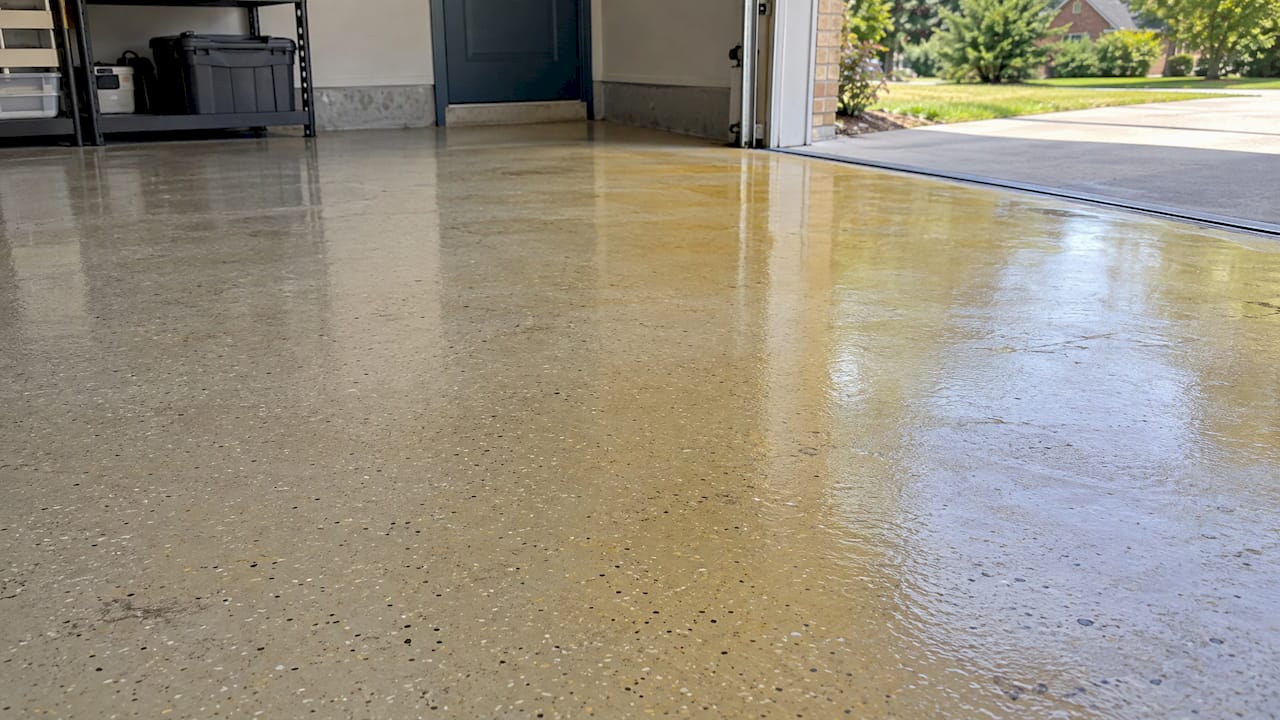
- Direct sun through open doors or glass panels: the color shift is the fastest and the most visible, and it shows first as a band.
- Partial afternoon sun: a slower, more gradual shift, often noticed first on pale or clear finishes.
- Interior rooms with only artificial lighting: the slowest, though not zero.
Glass does not fully protect the floor. Windows and garage door panels still pass UVA light, which is enough to drive the reaction.
Does yellowing mean the coating is failing?
Often it is a change in appearance first. But UV is not harmless to the film over time. In a peer-reviewed study in Materials, unprotected epoxy lost about 30 percent of its tensile strength after 800 hours of UV radiation and showed lower pull-off strength, while a sample with a UV absorber added lost about 11 percent and stayed low in yellowing. The authors explain that UV-generated radicals attack the epoxy structure and convert hydroxyl groups that help it adhere.
The practical takeaway for a homeowner or property manager: treat yellowing as an early signal about exposure. If the color is changing, the coating is seeing more light than the system was chosen for. That is the time to plan a UV-stable topcoat, before gloss loss or wear shows up as well.
How to prevent epoxy from yellowing
Prevention comes down to matching the chemistry to the exposure, then installing it under the right conditions.
Put UV-stable chemistry on top
The most widely used protection is an aliphatic polyurethane or polyaspartic topcoat over the epoxy base. Aliphatic structures lack the benzene rings that make standard epoxy vulnerable, so there is far less for UV to attack. The base epoxy still does the heavy lifting for bond and build, while the topcoat takes the light.
The topcoat has to be UV-stable itself. A clear coat applied over a non-UV-stable product does not block the light underneath. Smith’s product data sheet for a UV-stable topcoat states plainly that a clear topcoat does not block UV over a non-UV-stable product such as epoxy. Hempel’s floor troubleshooting guide takes the same approach for prevention, recommending one polyurethane coat over pigmented epoxy floors that see excessive UV or direct sunlight.
Choose a lower-yellowing resin system
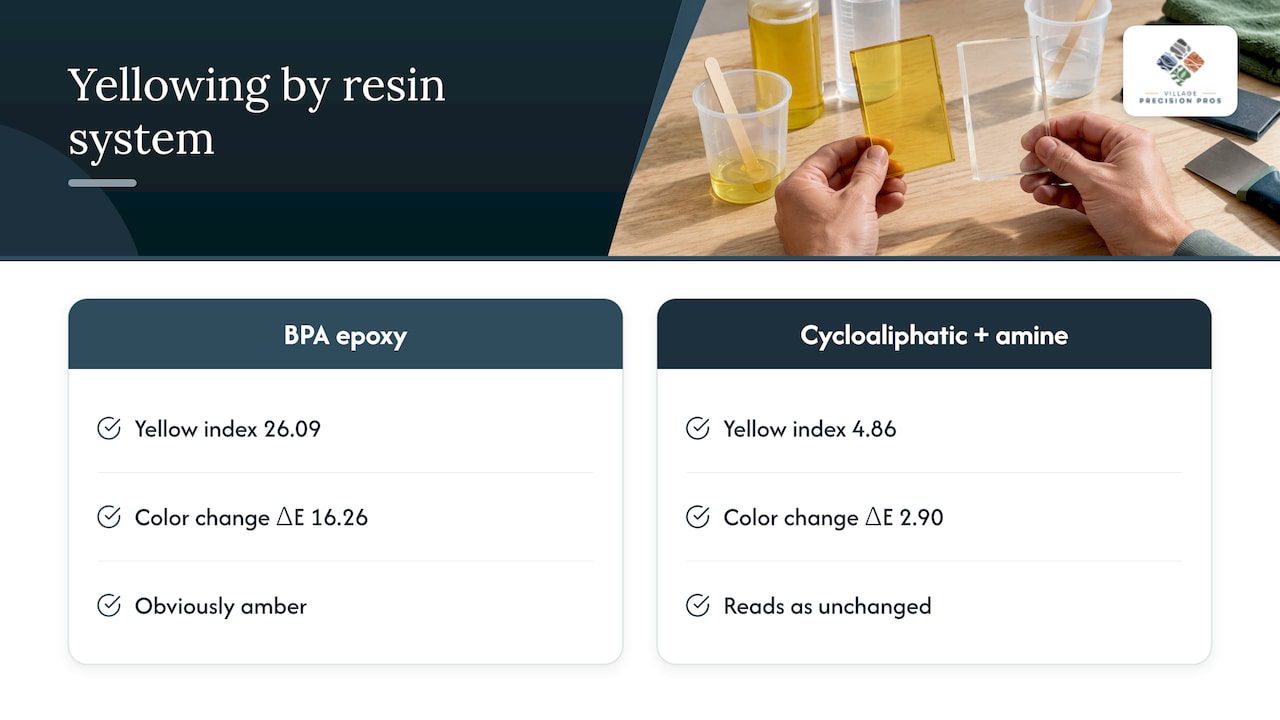
Resin and hardener choice matters. In a 2024 CoatingsTech article, a Huntsman researcher reported that after 500 hours of QUV-A exposure a standard bisphenol A epoxy reached a yellow index of 26.09 and a color change (ΔE) of 16.26, while a cycloaliphatic epoxy and amine system measured a yellow index of 4.86 and a ΔE of 2.90. A ΔE above about 3 is generally visible to the eye, so that is the difference between a floor that reads as unchanged and one that is obviously amber.
Even the improved resins are best treated as part of a system. A technical data sheet for a 100 percent solids aliphatic epoxy floor binder notes it has a reduced tendency to yellow compared with aromatic systems and recommends an aliphatic urethane topcoat to minimize the effect further under prolonged UV or high-intensity lighting.
Get the installation conditions right
Because application errors also cause yellowing, the install matters as much as the product. That means:
- Measuring and mixing at the manufacturer’s ratio, with the stated induction time.
- Applying within the temperature and humidity window, not on a cold morning or a muggy summer afternoon.
- Removing any amine blush before recoating, and respecting recoat windows.
- Checking slab moisture before anything goes down.
These are the steps that separate a floor that holds its color from one that drifts early. We cover moisture testing and prep in our homeowner guide to epoxy patio coatings.
Use color and texture to your advantage
If a space gets strong sun, a darker color or a flake blend makes minor shifts far less noticeable than a clear coat or a pale solid. Treat the strip near an open garage door as a higher-exposure zone and plan the topcoat around it. Our garage floor coating page shows the flake and metallic finishes we install.
What to look for in a UV-stable system
When you compare proposals for a sunlit floor, a few questions separate a real UV-stable system from a standard one.
| Question | Why it matters |
|---|---|
| Is the topcoat aliphatic (polyurethane or polyaspartic)? | Aliphatic chemistry avoids the benzene rings that absorb UV. |
| Does the specification cover the whole stack, base and topcoat? | The protection depends on both layers working together. |
| Is the resin and hardener a cycloaliphatic or lower-yellowing type? | Test data shows markedly smaller color change than standard bisphenol A systems. |
| Is the product rated for exterior or high-UV exposure? | Interior-rated systems are built for different light. |
| Is the mix, temperature and humidity controlled at install? | Application errors cause yellowing too. |
UV absorbers and hindered amine light stabilizers (HALS) are the usual additives in a protective topcoat. Absorbers dissipate UV as heat, and HALS trap the free radicals that UV creates. They work as a pair, and they slow the aging process on the surface. For more on what holds up outdoors in our climate, see our guide to UV-stable epoxy in Arkansas and our explainer on using epoxy flooring outside.
Fixing a floor that has already yellowed
Cleaning will not bring the color back. The change is inside the cured resin, so no cleaner, polish or degreaser removes it. What you can do is stop it from getting worse and refresh the look.
The standard repair follows a clear sequence:
- Diagnose the cause. Confirm UV, blush or staining, using the pattern checks above.
- Clean and degrease the surface. Dirt and film must go before anything bonds.
- Abrade the floor. Hempel’s guidance for smooth pigmented epoxy floors calls for pressure washing, then sanding the whole area with 60-grit paper.
- Apply a UV-stable topcoat. Hempel specifies one or two polyurethane coats. The new layer protects going forward and hides the existing tint, particularly under a pigmented or flake finish.
- Respect cure times before traffic returns.
This is not a Saturday-afternoon rolling job on a slab you plan to park on. Abrasion, even coverage and cure timing decide whether the new coat bonds or peels. If your floor is yellowing, our epoxy floors team can assess it and recommend a recoat that fits how much sun the space receives.
Our view on yellowing
When homeowners and property managers call us about amber floors, the first thing we do is ask where the sun hits. That single answer usually tells us more than the color does. A floor that yellows in a band by the garage door was specified for an interior and living in an exterior condition. The cure is not a different brand of the same chemistry. It is matching the system to the light.
At Village Precision Pros we have completed more than 2,000 projects across Central Arkansas since 2020, and our approach to any hardscape or floor starts with quality materials and skilled craftsmanship. For epoxy, that means we talk through exposure, color, finish and prep with you before we pick a system, because function and appearance have to work together on a slab that will see sun, tires and weather.
For a floor that stays in the sun, we think the smart investment is a UV-stable system from the start. It protects the look you chose and gives you easy long-term upkeep.
Ty
Plan your epoxy floor with the sun in mind
If you are planning a new garage, patio or commercial floor, or you are staring at an amber patch on an existing one, we can help you choose and install a system that holds its color. We work with homeowners, real estate agents, property managers and business owners across Central Arkansas, and epoxy floors are one of our listed services. Start on our epoxy floors page, or see the full list on our services page. Because every slab and exposure is different, we scope each project to the space itself, and our guide to what drives epoxy floor cost in Arkansas explains the factors that shape the total.

FAQ
Why is my epoxy turning yellow?
The most common reason is UV light breaking down the aromatic rings in standard epoxy, which forms colored structures in the film. Oxidation over time and heat add to it, and application issues such as amine blush or a wrong mix ratio can cause early yellowing. The pattern of the color usually shows which one you have.
Can yellowed epoxy be cleaned or polished back to clear?
No. The discoloration is chemical and sits inside the cured resin, so cleaning removes only dirt or surface film. The lasting repair is to prepare the surface and apply a UV-stable topcoat, which protects the floor from here on and covers the existing tint.
Does indirect light or a window cause yellowing?
Yes. Glass transmits UVA, and UVA still reacts with aromatic epoxy. Floors beside windows, glass garage door panels, or the area just inside an open door often show a visible band of color first.
What color of epoxy hides yellowing best?
Darker solid colors and flake blends make minor color shifts much harder to see than clear coats or pale solids. Pairing a darker or flaked finish with a UV-stable topcoat is the most dependable approach for sunny spaces.
Sources
- Overcoming UV degradation in epoxy coating systems
- Mechanism of yellowing: carbonyl formation (Polymers, 2018)
- Yellowing mechanisms of epoxy and vinyl ester resins (Polymer Testing, 2022)
- Surface degradation of DGEBA epoxy resins (2023)
- The effects of UV light on epoxy coatings (Materials, 2017)
- Epoxy Coatings Guide, Sherwin-Williams
- Troubleshooting in floor coatings, Hempel
- UV-Resistant Epoxy, CoatingsTech, September/October 2024
- DURALTEX UV technical data sheet, Euclid Chemical
- Hi-Wear 90S product data sheet, Smith’s