

A cedar pergola needs a short yearly routine: wash it in spring, check it after storms, and renew the finish when water stops beading on the wood. Do those three things and cedar stays sound, repairable and good looking for decades. Skip them and moisture finds the end grain, the post bases and the bolt holes first. We build cedar pergolas across Central Arkansas, and the routine below is the one we would hand a friend who just had one installed.
TL;DR
- Wash the pergola every spring with a garden hose or a mild detergent and a soft cloth. Skip bleach, ammonia and stiff abrasive scrubbing.
- Renew the finish when water stops beading on the wood. Depending on the product, that can be anywhere from about a year to several years.
- Inspect twice a year and after every major storm: fasteners, post bases, cracks, pooled water and blocked drainage.
- Keep soil, mulch, leaves and vines from sitting against the wood. Trapped moisture is what damages cedar, not graying.
- Probe the bottoms of the posts with a screwdriver. Soft wood means it is time for a repair, not another coat of stain.
Table of Contents
- Why cedar needs less care than most wood, and what it still needs
- A year of cedar pergola care, season by season
- How to seal a cedar pergola
- What to check every time you walk the pergola
- Warning signs that call for repair, not a fresh coat
- How long a cedar pergola lasts
- Leave it gray, stain it or paint it?
- What we do about maintenance
- Let us handle the upkeep
- FAQ
- Sources
Why cedar needs less care than most wood, and what it still needs
Western red cedar holds up outdoors because of natural compounds in the heartwood that resist decay and insects. That is why it is a favorite for pergolas, where every beam is exposed to rain and sun.
Natural resistance is not the same as no maintenance. According to Real Cedar, the trade group for western red cedar producers, cedar can be left unfinished to weather to a gray color and still have a long service life, as long as it can dry quickly after getting wet. A protective finish is still the more common choice, mostly because it slows the swelling, shrinking and checking (small surface cracks) that let water into the wood.
That last point changes how you think about the job. Gray is cosmetic. Water that sits in a joint, on top of a beam, or at the base of a post is the real threat. A good routine is built around keeping cedar dry and keeping the finish intact where water collects.
In Central Arkansas, with hot humid summers, heavy spring storms and the occasional ice event, a pergola gets tested in every season. Plan on the more attentive end of any schedule you read.
A year of cedar pergola care, season by season
Here is the routine we recommend, organized by the time of year when each task is easiest to do.
Spring: clean, tighten and look closely
Spring is the main maintenance window. Pollen, winter grime and any mildew that formed in the shade all need to come off before you decide whether the finish needs attention.
- Clear the structure. Remove leaves, seed pods and debris from the tops of beams and rafters, where they hold moisture against the wood.
- Wash it. The manufacturer care sheet for a Home Depot cedar pergola calls for a garden hose or mild detergent solution and a soft cloth, and warns against stiff or abrasive cleaners and against bleach or ammonia. Work from the top down and rinse well.
- Treat mildew properly. If dark mildew has set in, Real Cedar’s guidance is a mild oxygen bleach solution left on the wood for 30 minutes. It warns that chlorine bleach breaks down lignin, the compound that gives wood its stiffness, and can harm surrounding plants.
- Go easy with pressure. A pressure washer can raise the grain and gouge soft cedar. If you use one at all, stay far back with a wide fan tip, or choose a soft brush and a hose instead.
- Tighten hardware. Cedar swells and shrinks through the seasons, and bolts and brackets can loosen. Snug them, and note any rust-colored streaks, which point to the wrong kind of metal.
- Run the water test. Sprinkle water on a horizontal surface. If it beads, the finish is working. If it soaks in and darkens the wood, the finish is due.
Summer: keep it dry and keep it clear
Summer is for light upkeep. Trim climbing vines so they do not weigh down the structure or hold damp against the beams. Family Handyman advises trimming vines on greenery-covered pergolas for this reason. Keep mulch, soil and shrubs from piling against the posts. Vegetation that touches wood keeps it damp long after the rain stops.
Watch your sprinklers too. If irrigation heads spray the posts every morning, redirect them. Repeated soaking at the base does more harm than a rainstorm, because the wood never dries between wettings. If runoff is collecting around the posts, see our guide to landscape water drainage.
Fall: clear, then recoat while it is dry
Fall leaves are the biggest source of trapped moisture on a pergola. Clear them from beam tops and the joints where rafters meet beams. If you hang fabric shades, take them down before the wet season so they do not hold damp against the wood.
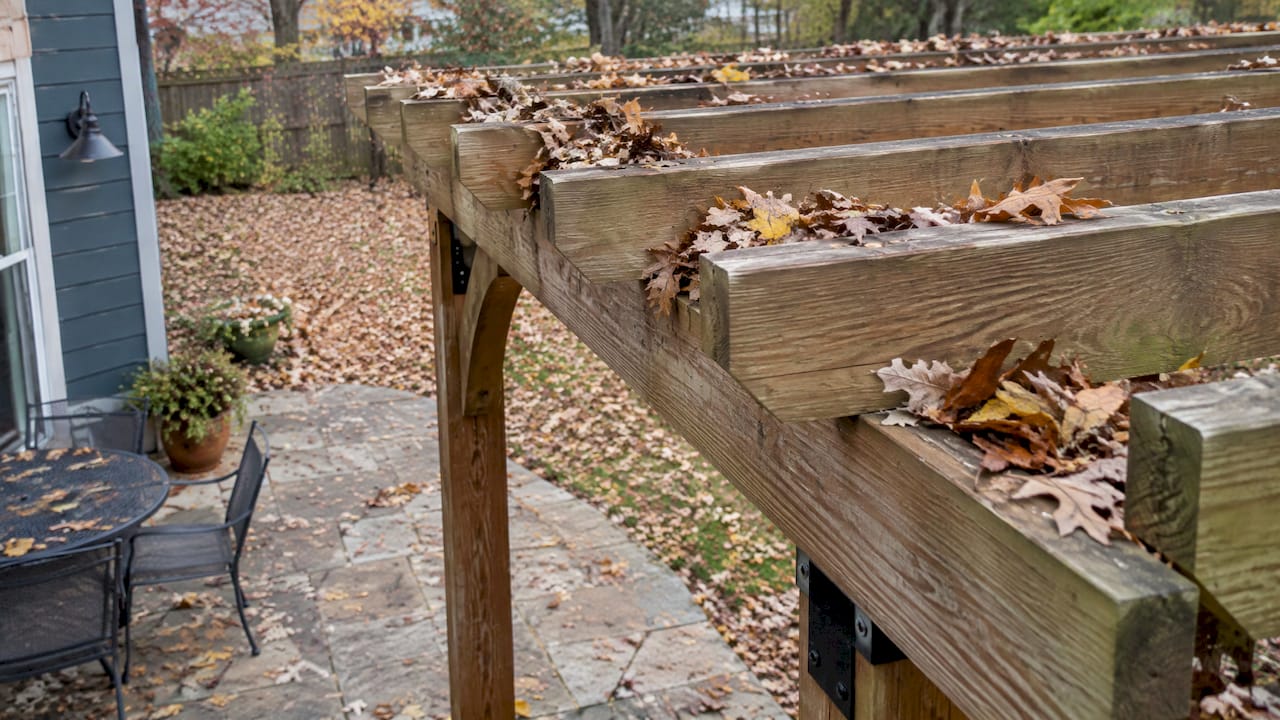
Fall is also a good time to recoat if the water test failed in spring but you were waiting on a dry week. Dry, mild days let the finish cure properly.
Winter and after storms: look, do not assume
After a major storm or ice event, walk around the structure and look for loose fasteners, cracked or warped members, shifted post bases and water pooling anywhere it should not. Catching a loose bracket early is a ten minute fix. Missing it can turn into a racked frame.
How to seal a cedar pergola
Sealing is the task people ask about most, and the one most often done in a way that shortens the finish’s life. The steps are simple. The details matter.
Start with dry, clean wood
Real Cedar says cedar should not be above 20 percent moisture content before finishing, and a Ready Seal product data sheet calls for 12 percent or less before application. In practice that means waiting for several dry, warm days after washing. Sealing damp wood traps the moisture under the coating, which is exactly what you are trying to avoid.
New cedar has its own timeline. Real Cedar notes that unfinished cedar left to weather for 12 weeks loses about 50 percent of its ability to hold a film-forming finish, so new lumber should be protected from weather and finished soon after it dries.
Choose a finish that lets cedar breathe
For fully exposed weather, Real Cedar recommends solvent-borne, oil-based semi-transparent stains if you want a natural look. These soak into the wood instead of forming a skin on top. Solid color stains and paint form a film and need a stain-blocking primer to keep cedar’s natural extractives from bleeding through.
One caution from the same guidance: transparent, non-flexible film finishes such as lacquer, shellac, urethane and varnish are not recommended for exterior cedar, because they turn brittle and crack. Once a film cracks, water gets under it and the coating peels. On overhead beams, a gel-style stain is easier to apply without drips.
Seal the end grain and the tops
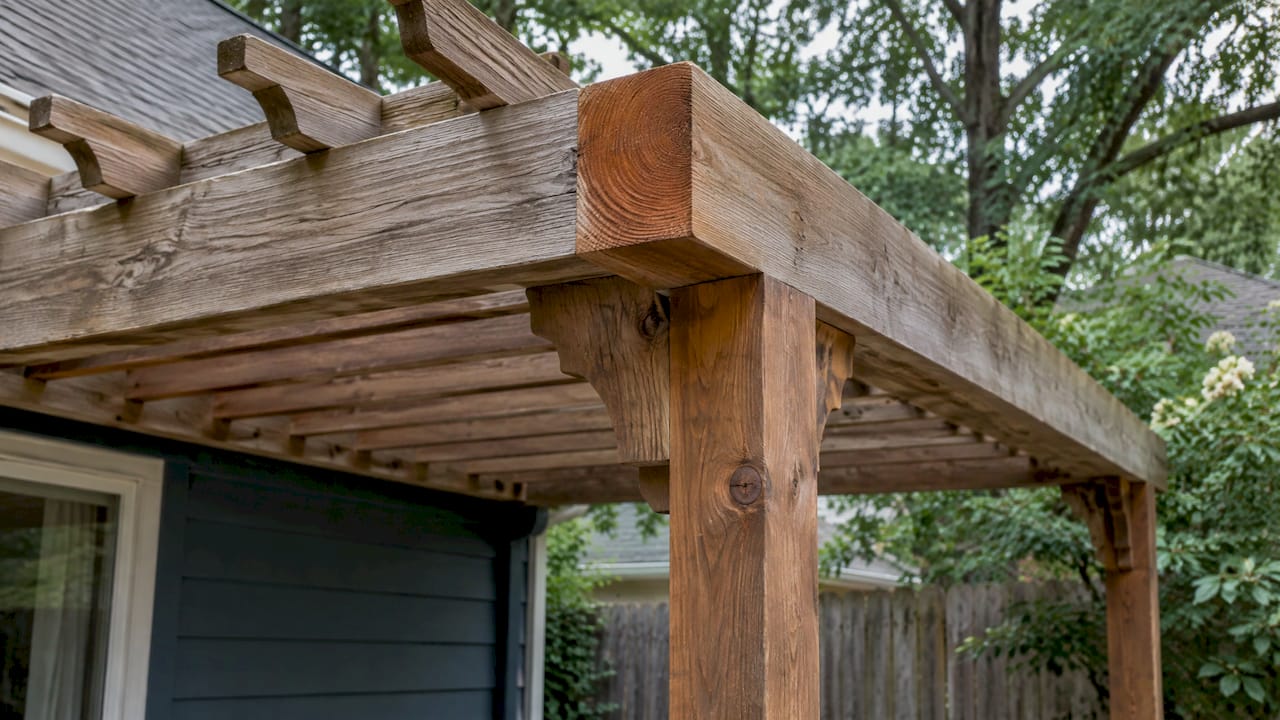
End grain, the cut ends of beams and rafters, drinks water like a straw. Give every cut end an extra coat, along with the tops of horizontal members, where water sits longest. These are the spots that fail first.
Know how long each finish lasts
Finish life varies widely by product type. The Ready Seal data sheet lists these reapplication ranges:
| Finish type | Typical reapplication |
|---|---|
| Water repellent | 6 to 24 months |
| Transparent stain | 1 to 3 years |
| Semi-transparent stain | 3 to 7 years |
| Solid color stain | 3 to 7 years |
Real Cedar puts clear water-repellent finishes on exterior cedar at roughly one year of service, and solvent-borne semi-transparent stains on siding at 3 to 6 years. A pergola is more exposed than siding, since it has no roof and horizontal surfaces catch every rain, so expect the shorter end. The water test is more reliable than the calendar. When beading stops, recoat.
A light maintenance coat applied while the finish is still mostly intact is far easier than stripping a failed one. Let it go too long and you are sanding and stripping before you can start over.
Use the right fasteners
Real Cedar recommends stainless steel, double hot-dipped galvanized or aluminum fasteners for cedar, to avoid staining and corrosion. If you see black or rust-colored streaks running down from a bolt, the hardware is the wrong metal and should be replaced.
What to check every time you walk the pergola
Keep this short list on your phone and run through it each spring, each fall and after severe weather.
- Post bases. This is where most pergolas fail first. Look for dark staining, soft spots or mulch and soil piled against the wood.
- Bolt holes and joints. Dark rings around bolt holes mean water is getting in.
- Beam tops. Look for standing water, mildew, or debris that is holding moisture.
- Cracks. Fine surface checks are normal in cedar. Wide cracks that run through a joint, or splits that open as the seasons change, deserve a closer look.
- Sag. Sight along each beam. Visible sagging at mid-span points to a structural problem.
- Insects. Look for fine sawdust, small exit holes or mud tubes.
Family Handyman suggests cleaning, treating or repainting a wooden pergola at least once every two years and checking regularly for mildew and termite damage. That is a reasonable floor, not a ceiling, in a humid state like ours.
Warning signs that call for repair, not a fresh coat
Stain does not fix rot. Press a screwdriver into the base of each post and into the underside of low beams. Firm wood resists. Wood that gives way easily is decayed and the piece needs replacing. We explain the same probe test in our article on deck replacement or repair, and it works the same way on a pergola.
Other signs to act on promptly:
- Rust-colored staining around hardware: replace it with the correct metal.
- Dark discoloration around bolt holes: moisture is getting in, and the joint needs sealing and attention.
- Beams that sag or posts that lean: have the structure assessed before the next storm season.
The good news with cedar is that repairs can be local. A damaged board or a rotted post base can be replaced without rebuilding the whole structure.
How long a cedar pergola lasts
With regular care, a cedar pergola can last decades, and the range depends on climate, installation quality and how consistently you keep up the finish. Humid, rainy regions push toward the shorter end of that range. The single biggest factor is how the posts meet the ground. A post set directly into concrete or soil holds moisture against the wood, and that is where decay tends to begin. Keeping the wood off the soil and concrete lets it dry between rains.
That is why we wrote about it in why cedar pergola posts should never touch the soil. If you are planning a new pergola, how it is anchored matters more to its lifespan than any stain you choose. Size and layout matter too, and our pergola size guide starts with furniture, since the right footprint is the one you will actually use.
Leave it gray, stain it or paint it?
This is a style decision with a maintenance consequence.
- Natural gray. Unfinished cedar weathers to silvery gray, and the graying is only a thin surface effect. It asks the least of you up front, but the wood is more exposed to moisture and mildew as it ages, so the yearly inspection matters more.
- Semi-transparent oil-based stain. This is the choice that keeps the grain visible and is the easiest to refresh, because there is no film to peel. For most homeowners, it is the best balance.
- Solid stain or paint. This gives a uniform color and covers weathered wood, but it needs primer and careful prep, and eventually needs scraping when it fails.
If the pergola sits over a patio you entertain on, a stain that you can refresh with a quick coat each season keeps the work small. A color that hides wear tends to look good longer from a distance but costs more effort when it finally fails.
What we do about maintenance
We build cedar pergolas, patios and decks in Central Arkansas, and what we have learned is simple: the finish is only half the story. A pergola that lasts is one that sheds water, keeps its posts off wet ground and gets looked at twice a year. That is why we talk about anchoring and drainage with every pergola conversation, and why we pair installation with an honest plan for care afterward.
Most homeowners do not skip maintenance because they do not care. They skip it because it falls between seasons, weekends and everything else on the list. A recurring plan fixes that. Our annual maintenance plans are built to keep outdoor spaces on a schedule, so the spring wash, the fall clear-out and the post-storm walk-around do not depend on anyone remembering.
If you are choosing between building something that looks great on day one and building something that looks great in year ten, we will always argue for year ten. That means quality materials, solid joinery and a structure designed so water has somewhere to go.
Ty
Let us handle the upkeep
If you would rather spend your weekends under the pergola than on a ladder, we can build it right and keep it that way. Our Decks & Patios work covers custom wood structures for Central Arkansas homes, and our annual maintenance plans keep seasonal property care on a schedule for homeowners, property managers and businesses. Contact us through our site to talk about your pergola.

For property managers and agents, a pergola that is washed, sealed and structurally sound reads as a well-kept property. The same routine applies on a commercial site, and our commercial landscape maintenance checklist shows how it fits into a wider schedule. Homeowners can pair it with our spring landscape maintenance checklist.
FAQ
How often should I seal a cedar pergola?
It depends on the product. Water repellents and transparent stains need renewing the soonest, often within one to three years, while semi-transparent and solid color stains can run several years according to a Ready Seal data sheet. The most reliable signal is the water test: when water stops beading on horizontal surfaces, it is time to recoat.
Can I pressure wash a cedar pergola?
It is safer to use a garden hose, a soft brush and a mild detergent, as manufacturer care instructions recommend. High pressure can roughen cedar and force water into joints. If mildew is stubborn, use an oxygen bleach solution rather than chlorine bleach, which can damage the wood and nearby plants.
Is it better to stain or paint a cedar pergola?
For most pergolas, an oil-based semi-transparent stain is the easier choice, since it soaks in and can be refreshed without stripping. Paint and solid stains give a uniform color but need a stain-blocking primer and more prep when they eventually wear out.
How long does a cedar pergola last?
Well cared for, a cedar pergola can last decades. Climate, how the posts are anchored and how consistently the finish is renewed all play a part. Keeping the wood off wet soil and concrete, and clearing debris from beam tops, protects it most.
Sources
- Proper Finishing of Cedar for Exteriors and Interiors (Real Cedar)
- Wood Pergola Safety and Care Instructions
- Ready Seal product data sheet
- The Homeowner’s Guide to Pergolas (Family Handyman)