


Color changing landscape lights let one set of fixtures glow warm white on an ordinary evening and shift to green, red, blue or any shade you pick for a holiday or a party. They work well when the system is planned as a whole: a warm white base, color used as an accent, and wiring and power sized so every fixture on the run looks the same. We design and install outdoor lighting across Central Arkansas, and the same pattern holds on nearly every yard: the lights that disappoint are rarely the fixtures. They are the layout, the power and the color plan behind them.
TL;DR
- RGB fixtures mix red, green and blue LEDs to make color. RGBW fixtures add a dedicated white chip, which gives you a clean everyday white.
- Keep a warm white base for paths, steps and patios, and use color as an accent on a wall, a tree or an entrance.
- Low-voltage 12V or 24V systems are the usual choice for homes. Size the transformer to the total load and plan cable runs to avoid dimming at the far end.
- Controls and compatibility matter as much as the fixture: confirm voltage, load and controller before you commit.
- A planned layout, done before hardscape and planting are finished, keeps wiring hidden and the result clean.
Table of Contents
- How color changing landscape lights work
- Fixture types: path lights, spots, floods and wells
- Planning color: warm white first, accents second
- What to check before you choose fixtures
- Installation and safe upkeep
- Our perspective
- Lighting planned with your patio and landscape
- FAQ
- Sources
How color changing landscape lights work
These fixtures are usually called RGB lights, and the name tells you how they work. Each fixture contains red, green and blue LEDs, and a controller adjusts how bright each one is. Each channel can be dialed from 0 to 100 percent, and mixing them produces a theoretical range of over 16 million colors. Red and green together read as yellow, all three at full strength approximate white, and everything else falls in between.
That last point is where homeowners get surprised. White made from red, green and blue often looks slightly cool or tinted next to a true warm white bulb. This is why many fixtures add a fourth chip:
- RGB: red, green and blue only.
- RGBW: adds a dedicated white diode, typically in the 2700K to 3000K range, for clean everyday white.
- RGBWW and RGBCCT: add a warm white channel, or both warm and cool white channels, so you can tune the white itself.
In a well-built RGBW fixture the four chips sit in one package, which gives a tighter fixture and better color mixing than four separate LEDs. For a home, we point most people toward a white-capable fixture, because you will use white far more often than purple.
Kelvin (K) is the scale for how warm or cool a white looks. Lower numbers are warmer and more candle-like. If you are weighing the white setting, our comparison of 2700K vs 3000K landscape lighting explains which suits brick, stone, siding and foliage.
Fixture types: path lights, spots, floods and wells
Color changing is a feature of the light source. Where you put the fixture decides what you see. The common types, with the beam and size ranges listed in one landscape lighting buyer’s guide, are:
- Path lights: 6 to 12 inches tall, spaced roughly 20 to 30 feet apart in that guide, at 1 to 3 watts each. They throw a pool of light on the ground and mark a walkway edge.
- Spotlights: a narrow 30 to 45 degree beam for trees and architectural features.
- Wall wash lights: a wide 60 to 90 degree beam for a facade or fence.
- Step lights: small fixtures set into risers or walls for safety.
- In-ground well lights: fixtures flush with the ground that uplight a trunk or column, with weatherproof ratings suited to wet ground.
Color changing path lights are popular because they are simple to picture, but path lights are also where color is least useful. A path exists to help people see where they step. We usually keep path lights in a steady warm white and put color on the features around them. If you want a layout approach for the walkway itself, we explain how to stake and test spacing at night in our guide to path light spacing.
Spots, wall washers and wells are where RGB earns its place. A pecan or oak lit from below in soft green, or a stone wall washed in deep blue, reads as a scene rather than a gadget.
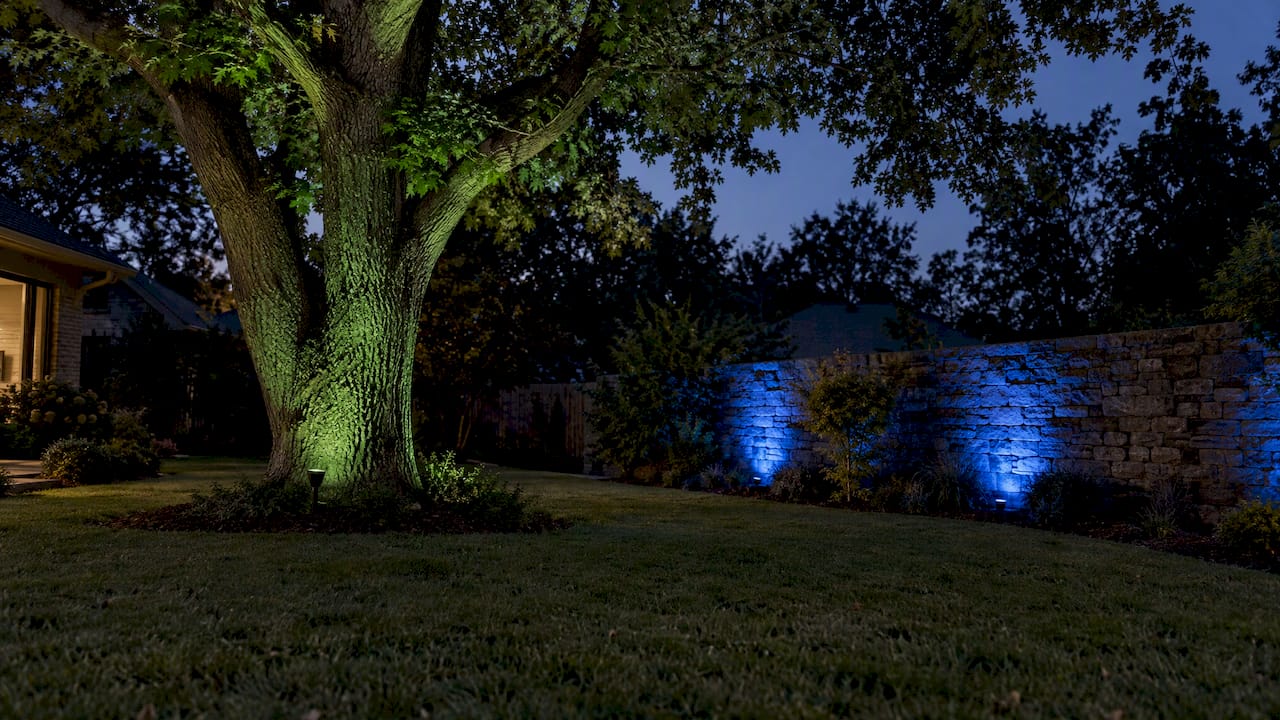
Planning color: warm white first, accents second
The most common mistake with color changing lights is treating them as a full-color system. Lit entirely in magenta, a yard looks like a nightclub, and it stops being usable the moment you want to read a menu on the patio.
A sound rule is to hold a consistent warm white base around 2700K to 3000K for functional areas, and keep colored accents to roughly 10 to 20 percent of the design. That means:
- Light the working spaces in white. Steps, walkways, the grill area and the patio seating should always be bright and natural in tone.
- Choose two or three features for color. A feature wall, a specimen tree, a water element or the front entrance carry color best.
- Save the bold settings for occasions. Holidays, football season, a birthday or a family gathering are good reasons to change the whole look from your phone or remote.
- Avoid color on faces and seating. Colored light shifts skin tones and food, so keep it off the places where people sit and talk.
Families who host often get the most from this approach. The patio stays comfortable on a weeknight and turns festive on a Saturday, with no fixture swapped. For homes being listed, a restrained warm white with one tasteful accent usually photographs and shows better than a full-color display.
For the bigger picture on balancing brightness, shadow and focal points, see our landscape lighting design guide for homeowners. For ideas rooted in local conditions, we also cover outdoor lighting ideas for Arkansas landscapes.
What to check before you choose fixtures
Color changing capability does not guarantee that different products work together. Input voltage, load capacity and controller compatibility all need to line up for a stable system. A practical checklist:
Power source and voltage
Low-voltage 12V or 24V DC systems are the standard for most residential projects. They are safe to handle and suited to shallow cable in planting beds. The tradeoff is that long runs can cause voltage drop, which shows up as dimming or color shifts toward the end of the line. RGB fixtures make this easy to spot, because a starved fixture often looks tinted instead of just dim. We explain the causes and fixes in our article on landscape lighting voltage drop, and for general planning of lighting around a yard, backyard outdoor living ideas can help you picture how lighting fits with decks and seating areas.
Transformer size
Low-voltage RGB fixtures need a transformer sized to the total connected load, with headroom for voltage drop. Add up the watts of every fixture on the system, then leave margin for future additions. A transformer pushed to its limit is the usual reason a system that worked on day one flickers a year later.
Brightness and efficiency
White-capable fixtures have an advantage here. Because each channel can run independently at higher brightness, RGBW can use less energy than RGB, where all three channels must work together at lower output to make a color. White light is also the setting you will run most nights.
Controls
Controllers and smart hubs manage color transitions, often through a mobile app or home automation, with pre-programmed schedules. Decide up front who will use it. A property manager may want a simple timer and a few fixed scenes. A family may want app control for every holiday. Our page on smart landscape lighting for homeowners covers an app-first setup.
Weather resistance
Arkansas brings humid summers, heavy rain and the occasional ice storm, so fixtures need a sealed housing and a durable finish, and every connection needs to be properly sealed. Look for a clear ingress protection (IP) rating on in-ground fixtures, such as IP67 on the in-ground wells in this buyer’s guide.
Installation and safe upkeep
A low-voltage installation follows the same sequence whether it is a few path lights or a full property:
- Map the layout. Decide which features get light, where fixtures sit and where the transformer goes. Spotlights usually sit 2 to 4 inches from the feature they light, then are secured.
- Run the cable. Lay the main line, buried shallow in beds, and keep it clear of foot traffic and garden tools.
- Connect to power. The transformer plugs into an outdoor receptacle. The National Electrical Code has required ground-fault circuit interrupter (GFCI) protection on outdoor receptacles since 1973, and a GFCI cuts power quickly if current leaks, which protects you in wet conditions.
- Check the load. Add up the devices on the branch circuit so you avoid overloads that can trip breakers and cause hidden damage.
- Set up controls. Pair the controller or app, name your scenes and set a schedule.
When you are working on an existing patio, the order matters most. Cutting a finished patio to bury one wire is far more disruptive than running conduit before the pavers go down. We explain this in our piece on landscape lighting layout. If you are curious about the steps in more detail, we also publish a low voltage outdoor lighting installation guide.
For upkeep, walk the property a few times a year. Inspect cords for fraying, cracking or damage, and keep cords out of paths where they can be tripped over or crushed. Clear mulch and growth away from fixtures so light is not blocked, and check that nothing has shifted after storms or mowing.
Our perspective
We install outdoor lighting alongside patios, hardscapes and landscape work, and that shapes how we think about color changing lights. The fixture is the easy part. What makes a yard look finished is that the wiring was planned with the stone, the planting and the drainage, so nothing was cut open afterward.
Our advice is to design the white light first. Get the patio, steps and walkways right in warm white, then choose the two or three features that deserve color. Our crews size the transformer to the full load and lay out runs so the last fixture matches the first. That is the difference between a system that looks the same in year three and one that drifts.
For homeowners, that means a yard you can use every night and dress up for special days. For property managers and businesses, it means a system that is simple to operate and easy to keep up under an annual maintenance plan. For agents preparing a listing, it means curb appeal that reads as intentional.
Ty
Lighting planned with your patio and landscape
Village Precision Pros has served Central Arkansas since 2020 and has completed over 1,750 projects, from patios and stone masonry to woodworking features and outdoor lighting. Because lighting is part of the same work as the hardscape and landscape, we can plan fixture locations and wiring before surfaces are finished. See our services or our decks and patios work, and ask us about annual maintenance plans to keep a lighting system running well after installation.

To talk through your yard, start at villageprecisionpros.com.
FAQ
What are color changing LEDs called?
They are usually called RGB LEDs, after the red, green and blue diodes inside. Versions with an added white chip are called RGBW, and those with warm and cool white channels are RGBCCT. Varying the intensity of each diode produces the wide range of colors.
Which color light is best for outdoors?
Warm white, around 2700K to 3000K, is the best everyday choice for homes because it flatters materials and plants and keeps walkways comfortable. Color works best as an accent on a wall, tree or entrance, and for holidays or events.
Are color changing path lights a good idea?
They can be, as long as they have a warm white setting and you keep the walkway in white for most nights. Use color for special occasions, and put it on nearby features rather than where people need to see steps clearly.
Can color changing lights run on a regular outdoor outlet?
Low-voltage systems plug into a transformer, and the transformer plugs into an outdoor receptacle with GFCI protection. Add up the total load on the circuit first so you do not overload it. For larger or line-voltage setups, hire a licensed electrician or a lighting installer.
Sources
- RGB vs RGBW vs RGBIC permanent outdoor lights guide
- Lighting training guide on RGBW chip design
- How to choose color changing landscape lighting
- Landscape lighting buyer’s guide
- RGB landscape lighting ideas for patios and gardens
- RGB landscape lighting collection and transformer sizing
- Outdoor RGB and RGBW lights
- Color changing LED landscape lighting guidance
- How to install landscape lighting
- GFCI fact sheet, CPSC
- Outdoor electrical safety check booklet, ESFI
- Home electrical safety checklist, CPSC
- Color changing landscape lights explained