


The fastest path to a safe floor is a two-step move: deep clean and add temporary traction now, then lock in a professional anti-slip topcoat or broadcast aggregate for the long haul. Your verification benchmark should be a wet DCOF of 0.42 or higher under ANSI A326.3. If the slab has oil contamination, covers a large commercial area, or you need documented test results for liability reasons, that is your signal to call in a licensed installer rather than tackle it yourself.
TL;DR:
- The safe wet coefficient of friction for epoxy floors is at least 0.42, measured under ANSI A326.3 testing standards, which most DIY fixes cannot reliably achieve.
- Proper surface preparation, including moisture testing, grinding, and contamination removal, is critical to the success of any anti-slip retrofit.
- Broadcast aluminum oxide provides the highest durability and slip resistance, especially suitable for high-abrasion environments like pools, kitchens, and ramps.
- Regular cleaning with alkaline degreasers and a proper maintenance schedule can extend the lifespan of slip-resistant coatings, often requiring reapplication every 3 to 5 years.
- DIY approaches like grit additives are often insufficient without professional application and documented testing, particularly in commercial or liability-sensitive settings.
Table of Contents
- Why Epoxy Gets Slippery When Wet, and How Traction Gets Measured
- What Can You Do Today to Reduce Slip Risk?
- Broadcast Aggregates, Mix-In Additives, or Grit Sealers: Which Retrofit Fits?
- How Do You Prep an Epoxy Floor Before Adding Anti-Slip Texture?
- How Often Should You Recoat an Anti-Slip Epoxy Floor?
- How Village Precision Pros Evaluates and Fixes a Slippery Epoxy Floor
- What the Research Actually Supports
- Get Your Epoxy Floor’s Grip Properly Fixed
- Sources
- FAQ
Why Epoxy Gets Slippery When Wet, and How Traction Gets Measured
Epoxy coatings cure into a smooth, glassy film, and that smoothness is exactly what makes them dangerous once water hits the surface. A dry epoxy floor can feel perfectly grippy underfoot, but the same surface wet can drop to a coefficient of friction (COF) as low as 0.20, well under what anyone would call safe. Water fills in the microscopic peaks and valleys that your shoes or bare feet rely on for grip, and without enough surface texture to break through that film, you are essentially walking on a thin layer of lubricant.
This is where the industry’s actual measurement standard matters. ANSI A326.3 sets the benchmark for wet dynamic coefficient of friction, tested with a tribometer or pendulum (PTV) device, and it defines what “slip resistant” means in numbers rather than marketing language.
Statistic Callout: Under ANSI A326.3, level interior walkways need a wet DCOF of at least 0.42 to be considered reasonably safe. Exterior areas, ramps, and anywhere grease or oil is a factor often require a higher threshold.
A few things push epoxy floors below that line even when the coating itself was installed correctly:
- Smooth, uncoated epoxy that never had texture added during installation
- Grease, soap film, or cleaning residue that fills in whatever texture exists
- Worn broadcast aggregate that has burnished flat under years of foot or wheel traffic
- Standing water pooling in low spots where drainage is inadequate
Knowing the number your floor needs to hit changes the conversation from “does this feel slippery” to “does this floor pass a wet DCOF test.” That distinction is what separates a real fix from a temporary patch.
What Can You Do Today to Reduce Slip Risk?
Before you spend money on a retrofit, rule out the cheapest possible cause: dirt. Hidden grease, soap scum, and cleaning product residue are a leading reason mature epoxy floors feel newly slippery, and a rigorous cleaning often restores a surprising amount of grip on its own.
- Deep clean with the right chemistry. Use a mildly alkaline degreaser in the pH 9 to 11 range, not a generic all-purpose cleaner, and let it dwell before agitating.
- Agitate mechanically. A stiff-bristle deck brush or a rented auto-scrubber breaks up embedded residue that mopping alone leaves behind.
- Rinse thoroughly and repeat if needed. Leftover degreaser residue can be almost as slippery as the grease it removed, so rinse until the water runs clear.
- Add temporary traction at entry points and wet zones. Rubber-backed mats, non-slip adhesive tape, or textured runners at doorways, sinks, and shower transitions buy you time.
- Post signage and restrict access where risk is highest. A wet-floor sign at a garage entrance or pool deck costs nothing and prevents the worst outcomes while you plan a permanent fix.
Mats and tape have real limits. They shift, they trap moisture underneath, and in barefoot areas like a pool deck or mudroom, they are not a substitute for a textured surface. Treat them as a bridge, not a destination.
Pro Tip: Test your cleaning results before assuming you need a full retrofit. Walk the floor wet in your regular shoes right after a deep clean. If it still feels slick, the problem is the coating profile itself, not dirt, and you are looking at a durable retrofit.
Broadcast Aggregates, Mix-In Additives, or Grit Sealers: Which Retrofit Fits?
Once cleaning and temporary fixes have run their course, the durable options fall into three categories, and each one trades off differently between grip, cleanability, and comfort.
Broadcast aggregates get spread into a wet epoxy basecoat and then locked in with a clear topcoat. Silica sand, aluminum oxide, and polymeric beads are the three most common choices, and aluminum oxide is the toughest of the group, rating around 9 on the Mohs hardness scale compared to roughly 7 for silica sand. That hardness makes aluminum oxide the go-to for pool decks, commercial kitchens, and loading ramps that see constant abrasion and moisture.
Mix-in additives blend the grit directly into the topcoat rather than broadcasting it separately, which produces a lower-profile texture. This approach suits decorative floors and barefoot zones where homeowners want grip without the coarse feel of a heavy broadcast. The trade-off is durability: a lighter texture wears down faster under heavy traffic than a full broadcast system.
Urethane grit sealers and hybrid topcoats sit in the middle, offering a balance of cleanability and long-term wear resistance. Field data on properly specified urethane-aluminum oxide systems shows they can cut slip incidents by roughly 78% in industrial settings when installed and maintained correctly.
Concentration matters more than most homeowners expect. A common reference point for mix-in aggregate is around 100 grams per liter of topcoat, though the right ratio depends on the specific product and desired texture level. Here is how the three approaches generally stack up:
- Best for pools, kitchens, ramps: broadcast aluminum oxide or silica sand
- Best for barefoot comfort and decorative garages: low-profile polymer bead mix-ins
- Best for balancing durability with easy cleaning: urethane grit sealers or hybrid topcoats
- Most durable overall: aluminum oxide broadcast, thanks to its hardness and abrasion resistance
- Softest underfoot but fastest to wear: polymeric beads
Texture is a wear item no matter which system you choose. Every aggregate-based surface loses some grip over time as traffic and cleaning burnish it down, which is exactly why the maintenance schedule below matters as much as the initial installation.
How Do You Prep an Epoxy Floor Before Adding Anti-Slip Texture?
Skipping prep is the single most common reason a retrofit fails within a year. Texture applied over a dirty, damp, or improperly profiled slab will not bond properly, no matter how good the aggregate is.
- Run a moisture test first. Slabs need to read under roughly 4 pounds MVER before any new coating goes down, since trapped moisture causes delamination.
- Grind or shot-blast to the correct profile. A CSP-3 or CSP-4 concrete surface profile gives the new coating enough mechanical bite to hold.
- HEPA vacuum the entire surface. Dust left behind after grinding weakens adhesion more than most people realize.
- Degrease or solvent-wipe any remaining contamination. This step matters especially in garages and kitchens where oil has soaked into the old coating.
- Broadcast to refusal while the basecoat is still wet, meaning you keep adding aggregate until the surface will not absorb any more, then apply one to two topcoats to lock it in.
Installers typically wear spike-soled shoes during broadcast work and keep the material moving with continuous agitation, working backward toward an exit so nobody has to walk across the wet coating. Recoat windows are unforgiving, too. Wait too long between the basecoat and topcoat and the two layers can fail to bond correctly.
Pro Tip: If your slab has a history of moisture problems, cracking, or a previous coating failure, that is a job for a licensed installer, not a weekend project. Large commercial areas carry the same advice, since a failed DIY attempt on a 2,000-square-foot warehouse floor is a far costlier mistake than on a one-car garage.
DIY grit additives sold for touch-up work can help on small, low-traffic areas, but grinding equipment, moisture meters, and proper mix ratios are where most homeowner attempts fall apart. If the numbers matter to you, whether for a rental property, a commercial kitchen, or a pool deck with liability exposure, a professional retrofit with documented testing is worth the added cost.
How Often Should You Recoat an Anti-Slip Epoxy Floor?
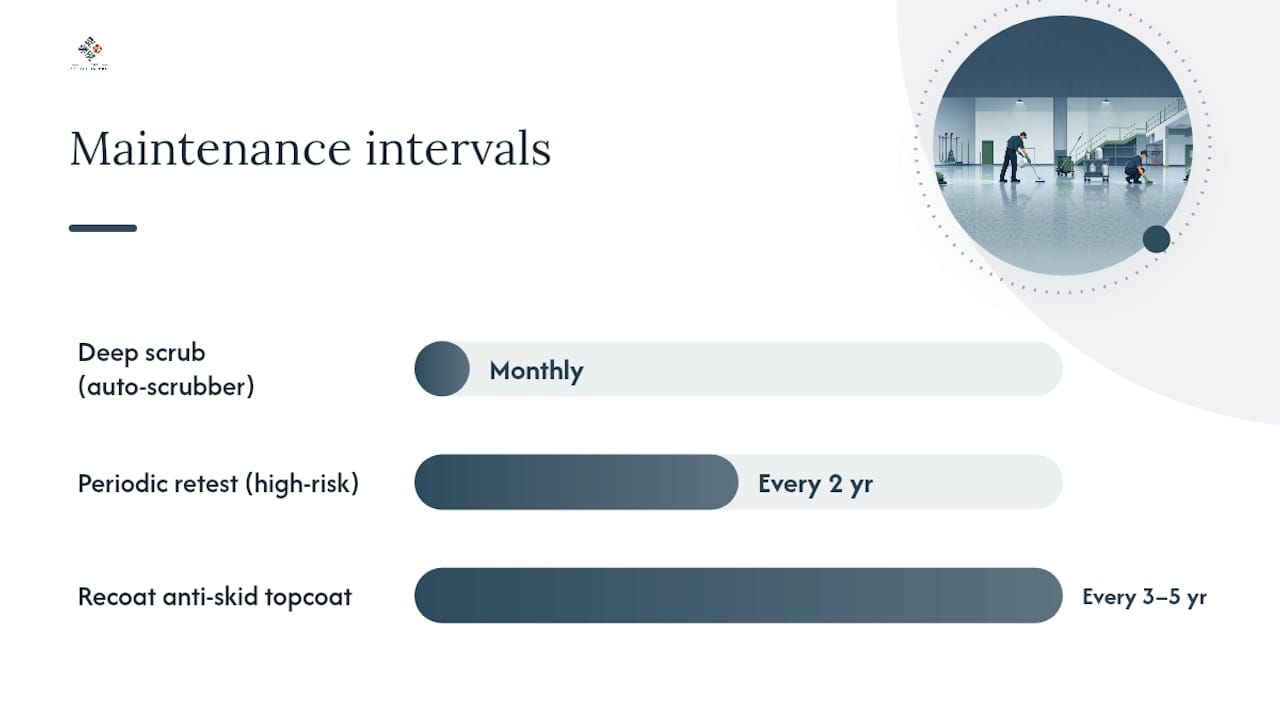
Anti-skid topcoats are wear items, not permanent fixtures. Under heavy traffic, expect to recoat every 3 to 5 years to maintain the texture that keeps wet DCOF above the safety threshold.
Cleaning technique matters just as much as the recoat schedule. Use an auto-scrubber with a mildly alkaline degreaser on a regular rotation, and avoid anything waxy or oil-based. Wax fills in the texture you paid for and defeats the entire purpose of the retrofit.
- Sweep or dust-mop textured floors before wet cleaning to avoid grinding grit into the surface
- Use pH-neutral to mildly alkaline cleaners, never soap-based products that leave a film
- Schedule a deep scrub with an auto-scrubber monthly in high-traffic commercial areas
- Rinse thoroughly; leftover degreaser is a slip hazard of its own
Statistic Callout: Urethane-modified systems with aluminum oxide aggregate can hold wet COF at 0.60 or higher in industrial environments when properly maintained, well above the 0.42 minimum set by ANSI A326.3.
Documentation closes the loop. Request a wet DCOF or pendulum (PTV) test at completion, and for high-risk areas like pool decks or commercial kitchens, schedule a periodic retest every couple of years to confirm the texture is still performing.
How Village Precision Pros Evaluates and Fixes a Slippery Epoxy Floor
Every job starts with an on-site assessment, not a phone quote. We look at contamination sources, slab condition, moisture history, and how the space actually gets used, since a home garage and a commercial kitchen call for different aggregate choices entirely.
From there, the typical scope includes:
- Surface prep: moisture testing, grinding or shot-blasting to the right profile, thorough cleaning
- Aggregate selection and broadcast or mix-in application, matched to traffic and comfort needs
- Locking topcoat application within the correct recoat window
- Completion testing with wet DCOF or PTV results documented in writing
- A written maintenance plan covering cleaning products, frequency, and expected recoat timing
Every project wraps up with handover deliverables: the DCOF test report, product data sheets for the materials used, and clear maintenance instructions so you know exactly what keeps that grip performing for years, not months.
What the Research Actually Supports
Most articles on this topic treat “non-slip additive” like a magic sprinkle you dump on a floor once and forget. The evidence says otherwise. Texture is a consumable. It wears down under foot traffic, wheel traffic, and repeated cleaning, and the aggregate you choose today determines how fast that clock runs out.
The conventional advice oversells DIY kits and undersells the number that actually matters: wet DCOF. A bag of grit additive from a hardware store might feel gritty in the can, but without a locking topcoat applied at the right concentration and cured on the correct schedule, you are gambling on a texture that could burnish flat within a season.
If there is one priority worth acting on first, it is this: clean the floor properly before you assume you need a retrofit at all, since contamination fools a lot of homeowners into replacing a coating that was never the actual problem. But once cleaning has been ruled out, do not settle for a product that merely claims “slip resistant” on the label. Ask for a number. A floor that passes 0.42 wet DCOF on paper is a floor you can trust with your family or your customers walking across it barefoot, in socks, or soaking wet.
Ty
Get Your Epoxy Floor’s Grip Properly Fixed
Village Precision Pros gives Central Arkansas homeowners and property managers something a hardware-store additive kit cannot: a documented fix, not a guess. Where DIY kits leave you hoping the texture holds, our crews handle the moisture testing, surface prep, aggregate selection, and topcoat application as one professional workflow, then hand you a written wet DCOF test report at the end.

A site visit gets you a real scope of work, a rough quote, and a testing plan tailored to how your space actually gets used, whether that is a garage, a pool deck, or a commercial kitchen floor. We will walk the space with you, point out contamination or wear you might have missed, and lay out exactly what a durable anti-skid retrofit would involve before you commit to anything. If you are ready to stop guessing whether your floor is actually safe, schedule a consultation with our team and get a plan built around your slab, your traffic, and your budget.
Sources
For deeper technical grounding, review ANSI A326.3’s updated wet DCOF thresholds, installer-level guidance on aggregate selection and slip resistance, and a buying guide covering anti-skid epoxy systems and their expected performance.
- Updated standard ANSI A326.3 (walkwaymg)
- Best epoxy floor anti-slip additives (Wexford Ins)
- Anti Skid Epoxy Flooring: Pros, Cons, and Buying Guide (D and G Flooring)
FAQ
How Can I Make My Epoxy Floor Less Slippery?
Start with a deep clean using a mildly alkaline degreaser to rule out grease or residue, then add temporary traction like mats at wet zones while you plan a durable fix. For a lasting solution, have a professional apply a broadcast aggregate or anti-slip topcoat verified to hit a wet DCOF of at least 0.42.
Why Is My Epoxy Garage Floor Slippery When It’s Wet?
Smooth epoxy can drop to a wet coefficient of friction around 0.20, which is well below the safe threshold, because water fills in the surface texture your shoes need for grip. Oil, grease, or cleaning residue on garage floors makes this worse by coating whatever texture remains.
How Do You Make Epoxy Grippy?
Broadcast an aggregate like aluminum oxide or silica sand into the wet basecoat, or blend in a mix-in additive, then lock it in with a clear topcoat applied within the correct recoat window. The right approach depends on whether you need maximum durability, like a garage or commercial kitchen, or barefoot comfort, like a pool deck.
What Are Good Anti-Slip Additives for Epoxy Coatings?
Aluminum oxide is the hardest and most durable option, rated around 9 on the Mohs scale, making it ideal for high-abrasion areas. Silica sand offers solid grip at a lower cost, and polymeric beads give a softer, more comfortable texture for barefoot zones but wear down faster under heavy traffic.