
Arkansas contractors typically bill full-service commercial landscape maintenance per acre, by the month or by the year. They bill mowing-only contracts and one-time installs separately. Request a site-specific estimate and build your budget from the bottom up using crew-hours, not just acreage.
TL;DR:
- Contractors bill full-service commercial landscape maintenance per acre monthly, and smaller properties pay higher per-acre mowing rates.
- Contracts priced on a per-acre, crew-hour, flat monthly, or time-and-materials basis require clear scope definitions and detailed cost breakdowns to ensure accurate comparisons.
- Cost influences include labor burden, equipment depreciation, irrigation oversight, insurance, travel, and specialty services, often leading to change orders if not priced upfront.
- Larger properties typically have lower per-acre mowing rates, but dense or complex sites like office parks and retail centers demand higher costs due to scope intricacies.
- Site-specific estimates based on a detailed scope and crew-hour calculations offer more reliable budgeting than generic national averages.
Table of Contents
- What Do Commercial Landscaping Services Cost in Arkansas?
- How Are Commercial Landscaping Contracts Priced?
- What Drives Up a Commercial Landscaping Bid?
- How to Build a Commercial Landscaping Estimate
- Sample Scopes for Arkansas Commercial Properties
- Contract Terms Arkansas Property Managers Should Require
- How Do You Choose the Right Landscaping Partner?
- Does Property Type or Size Change the Price?
- What’s the Full Cost Breakdown, Setup to Ongoing Maintenance?
- How Long Does a Commercial Landscaping Project Take?
- How Does Arkansas Weather Change Landscaping Costs?
- What Village Precision Pros Brings to Arkansas Commercial Properties
- Get a Site-Specific Commercial Landscaping Estimate
- Sources
- FAQ
What Do Commercial Landscaping Services Cost in Arkansas?
Full-service programs cover mowing, edging, bed maintenance, seasonal color rotation, and irrigation checks. The monthly bill per acre depends on visit frequency and plant density.
Mowing-only contracts price differently by property size. Smaller commercial lots under 5 acres typically run higher per acre. Properties over 5 acres often drop lower because crews cover more ground per visit with less setup time. Worker labor for commercial landscaping commonly bills by the hour.
One-time installation work adds its own line items. Sod installation, irrigation zones, basic paver walkways, and seasonal color plantings each carry separate pricing that a maintenance contract does not cover.
Quick benchmarks to sanity-check a bid:
- Full-service maintenance: billed per acre per month
- Mowing only, under 5 acres: a higher rate per acre
- Mowing only, 5+ acres: a lower rate per acre
- Labor rate: billed per hour per worker
Pro Tip: If a vendor’s per-acre number sits well below the other bids you collect, ask what’s excluded. Underpriced bids almost always mean thinner service frequency or materials billed separately later.
How Are Commercial Landscaping Contracts Priced?
Vendors structure commercial landscaping bids around a handful of common models, and knowing which one you’re looking at lets you compare two proposals on equal footing.
- Per-acre or per-square-foot pricing works well for uniform turf and simple bed layouts, but it breaks down fast on properties with dense plantings, slopes, or heavy irrigation. Two five-acre lots can have wildly different labor needs even at the same “per acre” rate.
- Crew-hour and loaded crew-hour billing starts with the true cost of putting a crew on-site: wages, payroll burden, equipment, and fuel. Contractors then apply a billing multiplier of 1.5 to 2.5 times the loaded crew-hour to reach a stable rate.
- Flat monthly contracts should specify exactly what’s included: visit count, mowing height, bed edging frequency, and irrigation checks. A flat price without a defined scope is where change orders start piling up.
- Time-and-materials billing separates labor from materials, and materials get passed through at cost or marked up, usually 10 to 20%, depending on the vendor’s overhead structure.
What Drives Up a Commercial Landscaping Bid?
Several cost factors push a bid well past the base per-acre number, and most of them show up as change orders if they weren’t priced in from the start.
- Labor and payroll burden. Wages are just the starting point. Payroll taxes, workers’ compensation, and benefits typically add 15% to 25% on top of base wages, and off-hours or emergency work carries a premium.
- Equipment costs. Mowers, trimmers, and specialized machinery depreciate with every crew-hour, and specialty equipment for irrigation or hardscape work adds more.
- Irrigation oversight. Someone has to check controllers, catch broken heads, and adjust schedules seasonally. This is often billed separately from mowing.
- Insurance and indemnification. Commercial jobs carry more liability exposure than residential work, and contractors who underprice risk into their commercial bids often find out the hard way at renewal.
- Travel time and specialty services. Multi-site portfolios add drive time between stops, and specialty work like erosion control or seasonal color installs gets priced outside the base contract.
Pro Tip: Ask any bidder to show you their loaded crew-hour math. If they can’t explain how they got from wages to a billing rate, the number on the page is a guess, not a calculation.
How to Build a Commercial Landscaping Estimate
A defensible bid starts with scope, not a per-acre guess. Here’s the method we use with commercial clients.
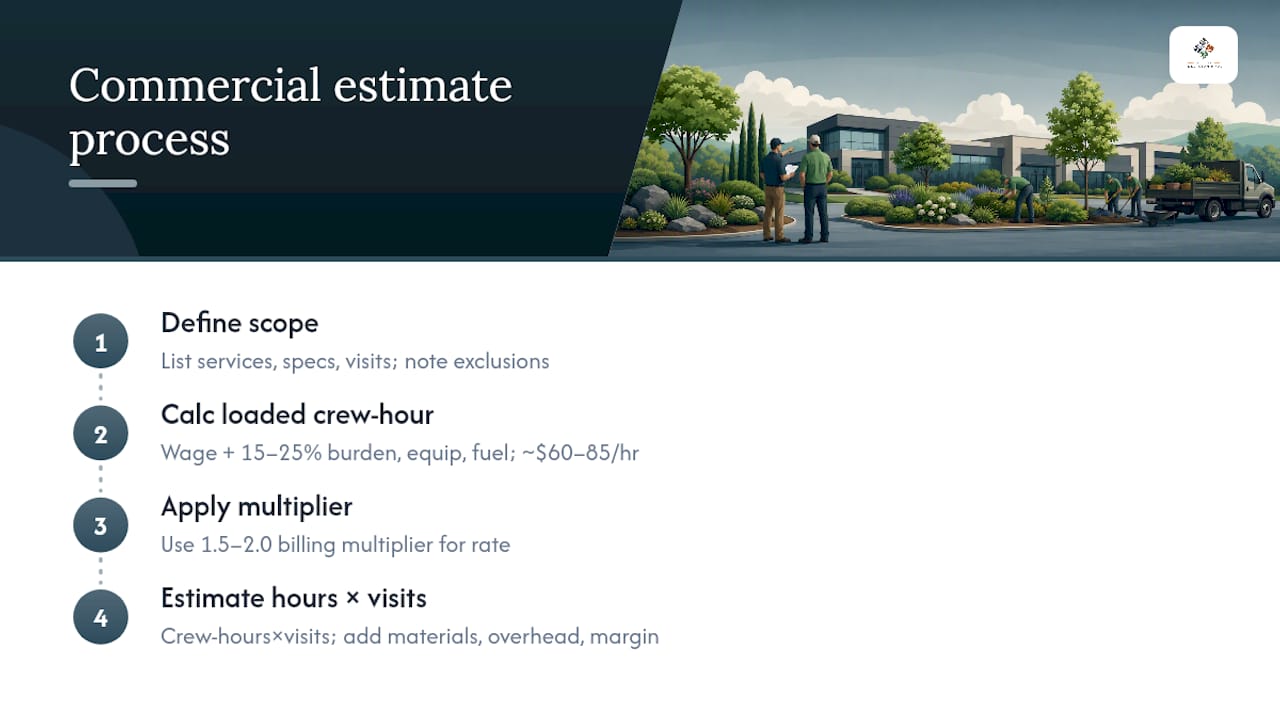
Step 1: Define the scope. List every service by name, mowing height, bed edging frequency, seasonal color swaps, irrigation checks, and how many visits per year each service gets. Note what’s excluded (storm cleanup, tree removal, snow response) so nothing gets assumed into the base price.
Step 2: Calculate loaded crew-hour cost. Add wage, 15 to 25% labor burden, equipment depreciation, fuel, and a proportional overhead share.
Step 3: Apply a billing multiplier. A multiplier of 1.5 to 2.0 turns loaded cost into a stable billing rate, with higher multipliers reserved for tight access sites or premium finish work.
Step 4: Estimate hours and multiply by visits. Crew-hours per visit times visits per year gives your labor total. Add materials at cost or with a modest markup, then layer in overhead and your target margin.
A retail property with light irrigation needs lands toward the low end per acre. Run a per-acre sanity check against the benchmark range every time; if your math lands far outside it, revisit your hour estimates before you send the number.
Sample Scopes for Arkansas Commercial Properties
Real-world Arkansas figures track close to national ranges, with local listings showing smaller commercial projects at the low end and larger campus-style properties climbing higher.
| Property Type | Size | Scope |
|---|---|---|
| Small retail lot | Under 1 acre | Mowing, edging, seasonal color |
| Office park | 3 to 5 acres | Full-service, irrigation checks, bed maintenance |
| POA common area | 5 to 10 acres | Mowing, bed care, tree trimming, seasonal cleanup |
| Industrial site | 8 to 15 acres | Mowing, drainage checks, minimal color |
Notes worth flagging on every one of these: irrigation repairs, storm debris cleanup, and mulch refreshes are frequent change-order items that a base contract often excludes. Seasonal cleanup and leaf removal in particular tends to get quoted separately from the year-round maintenance line.
Contract Terms Arkansas Property Managers Should Require
A solid commercial landscaping contract protects both sides, and a short checklist catches most of the gaps before you sign.
- Liability minimums: expect general liability limits per occurrence and in aggregate, plus workers’ compensation, with your property named as additional insured.
- Payment terms: net-30 is standard; some vendors extend to net-60, and either arrangement usually means the price includes a small cash-flow buffer.
- Escalation clauses: contracts running multiple years should specify how labor and material cost increases get passed through.
- Service-level definitions: spell out response times for irrigation breaks, storm damage, and other urgent issues.
- Change-order procedures: require written approval and pricing before any out-of-scope work begins.
When you send out an RFP, list services the way a service catalog does, itemized and specific, so every bidder is pricing the same scope.
How Do You Choose the Right Landscaping Partner?
Vet vendors on more than the bottom-line number. Ask how they calculate pricing (per-acre, crew-hour, or flat), and request proof of insurance before signing anything. Confirm crew size and equipment ownership versus rental, since rented equipment often means less schedule flexibility.
Ask direct questions: Do they subcontract irrigation work? Who’s liable if a sprinkler head floods a parking lot? What’s the warranty on new plantings? A vendor with real Arkansas experience should answer without hesitation.
Red flags include vague scope language, no certificate of insurance on request, and bids far below the benchmark ranges with no explanation.
Does Property Type or Size Change the Price?
Property type changes the cost structure more than raw acreage does. A 3-acre office park with dense ornamental beds and multiple irrigation zones can cost more to maintain than a 6-acre industrial lot that’s mostly open turf.
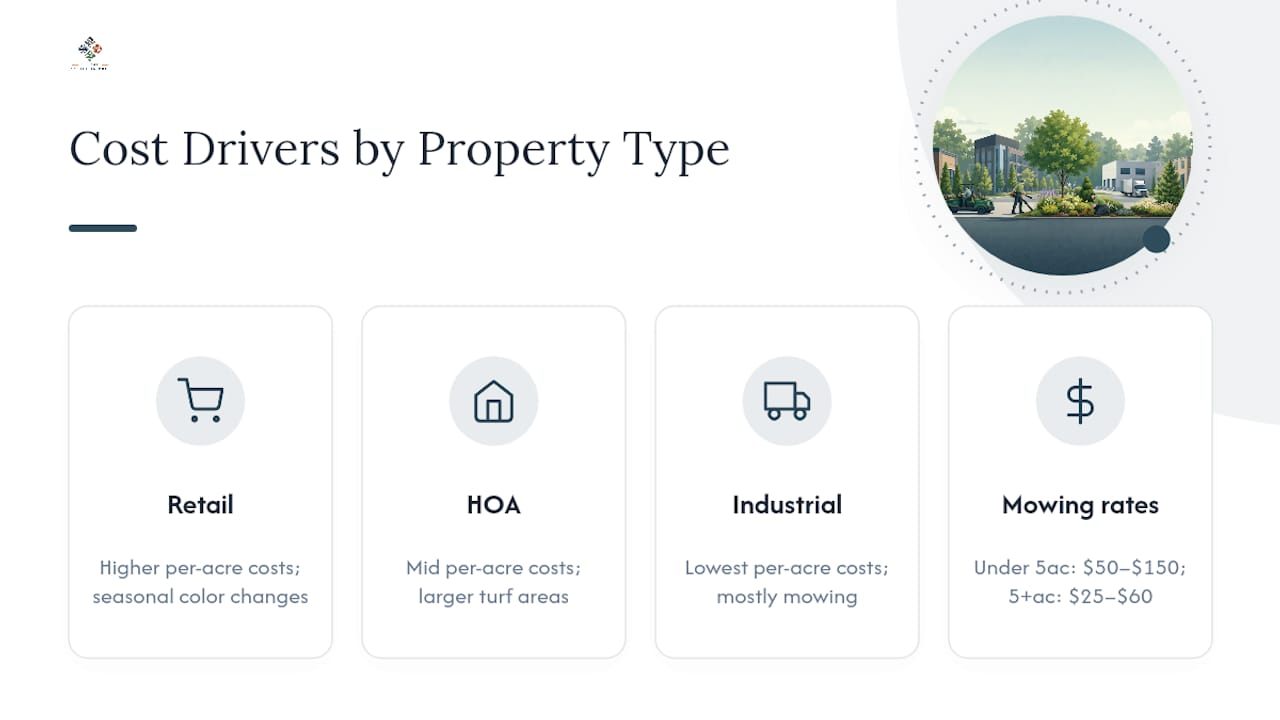
Retail centers and office parks usually carry higher per-acre costs because they need frequent seasonal color changes and tighter curb appeal standards. POA common areas often fall in the middle, with moderate bed maintenance but larger turf areas that benefit from the lower per-acre mowing rate at scale. Industrial and warehouse sites tend to be the least expensive per acre since they prioritize function over appearance, mostly mowing, edging, and drainage maintenance.
Size matters too, but not in a straight line. Mowing rates actually drop as acreage increases, from lots under 5 acres down to properties at 5+ acres, because fixed setup and travel time get spread across more billable ground. That means a 12-acre property won’t cost twice as much per acre as a 6-acre one. Multi-building campuses add complexity through drive time between sections, which shows up as extra crew-hours rather than a straightforward acreage markup.
What’s the Full Cost Breakdown, Setup to Ongoing Maintenance?
Total commercial landscaping cost splits into two distinct buckets: one-time setup and recurring maintenance, and budgeting for only one of them is the most common mistake we see in Arkansas RFPs.
Initial setup covers anything installed once: sod, irrigation systems, hardscape features, and the first round of seasonal plantings. This work gets quoted as a lump sum separate from the maintenance contract, and it grows from a small retail entrance to a full irrigation retrofit across a multi-acre site.
Recurring maintenance is the monthly or annual figure most property managers focus on. But that number assumes a stable scope. Rising labor and material costs across the industry mean maintenance contracts often carry small annual increases, particularly if the agreement runs multiple years without an escalation clause.
How Long Does a Commercial Landscaping Project Take?
Timelines depend heavily on whether you’re signing a maintenance agreement or commissioning a physical installation.
Maintenance contracts move fast. Once you approve a proposal, most Arkansas vendors can start service within one to two weeks, since crews are already routing through nearby properties and adding a stop is mostly a scheduling exercise.
Installation work runs longer. A basic irrigation zone install or sod replacement on a small commercial lot typically takes one to two weeks from contract signing to completion, weather permitting. Larger projects, full irrigation system retrofits, hardscape installs, or multi-acre color bed overhauls, can stretch to four to eight weeks once you account for material lead times and site prep. Grading and drainage corrections add time on top of that if the site has standing water or compaction issues.
Seasonal timing matters as much as project size. Spring and early fall are peak install seasons in Arkansas, which means booking further out, often three to four weeks ahead, gets you a better shot at your preferred start date.
How Does Arkansas Weather Change Landscaping Costs?
Arkansas’s climate adds real variables that national pricing guides don’t account for. The growing season runs long, roughly March through November, which means more mowing visits per year than a shorter-season state, and that visit count is baked directly into the per-acre annual figure.
Summer heat and humidity stress cool-season turf and push more properties toward warm-season grasses or drought-tolerant plantings, which changes both install and maintenance costs. Winter is mild enough that some properties still need occasional mowing or cleanup visits, unlike states with a hard dormant season.
Irrigation is where regional adjustment matters most. Central Arkansas’s clay-heavy soil and uneven rainfall pattern mean irrigation systems need more oversight than they would in a consistently wet climate, and summer dry spells can spike water usage and repair calls. Plant availability also shifts by season. Spring and fall nurseries stock the widest range of Arkansas-appropriate species, while ordering outside those windows can mean paying a premium or waiting on special orders.
What Village Precision Pros Brings to Arkansas Commercial Properties
Village Precision Pros has completed more than 2,000 projects across Central Arkansas since 2020, from hardscapes to ongoing property maintenance. On commercial work, we build every estimate around a defined scope and loaded crew-hour math, not a vague per-acre guess, so property managers see exactly what a line item covers before signing anything.
Ty
Get a Site-Specific Commercial Landscaping Estimate
Villageprecisionpros gives Arkansas property managers a faster path to a real number than piecing together national averages and hoping they translate. Instead of guessing at per-acre bands, you get a site walk, a documented scope checklist, and a ballpark estimate built on the same bottom-up crew-hour method covered above.

Our consultation covers the property in person, flags likely change-order items like irrigation repairs or seasonal color, and includes sample contract language so you know what you’re signing before a proposal lands in your inbox. We’ve worked across Central Arkansas since 2020 and typically respond to consultation requests within a day or two. If you’re ready to turn planning ranges into a firm number, schedule your commercial landscaping consultation and see our full process at how we work.
Sources
- How to Bid Commercial Lawn Maintenance Contracts in 2026 · EosLog
- Commercial lawn care cost · HomeGuide
- Why landscaping contractors underprice commercial jobs · Wexford Insurance
- How to get commercial landscaping contracts (2026) · Landscapey Blog
FAQ
How Much Do Commercial Landscapers Charge Per Acre?
Landscapers typically bill full-service maintenance per acre per month, and mowing-only service runs lower per acre on properties over 5 acres than on smaller lots.
What Is a Typical Profit Margin for a Landscaping Business?
Margins vary by scope and overhead, but contractors commonly apply a billing multiplier of 1.5 to 2.5 times their loaded crew-hour cost, which is designed to cover overhead and leave a stable margin after direct costs.
How Much Does It Cost to Start a Small Landscaping Business?
Startup costs vary widely based on equipment owned versus financed and crew size, and no single reliable figure applies across markets, so a new operator should build a budget from equipment, insurance, and labor costs specific to their planned service area.
Do Landscapers Need a Contractor License in Arkansas?
Requirements depend on the scope of work. Landscape maintenance generally has lighter licensing requirements than hardscape or structural work, so property managers should confirm a vendor’s specific licensing and insurance for the services being contracted.