

Stamped concrete is a strong choice for most homeowners who want the look of natural stone or brick at a lower upfront cost. Per-square-foot installed costs run $8–$28, compared to $15–$30 or more for natural stone, and the pattern and color options are genuinely wide. The honest trade-off: stamped concrete requires disciplined maintenance, can crack in freeze-thaw climates without proper prep, and is difficult to repair invisibly when damage does occur.
- Cost advantage: Stamped concrete typically costs 20–40% less upfront than comparable paver or natural stone installations.
- Aesthetic flexibility: Integral color, color hardeners, and chemical stains let installers mimic slate, flagstone, cobblestone, or wood grain convincingly.
- Caution: In areas with significant freeze-thaw cycles or unstable soil, cracking and color fading are real risks that require mitigation from day one.
The single best next step is an on-site evaluation by a qualified installer who can assess your soil, drainage, and climate exposure before you commit to any material.
Pro Tip: Ask your installer specifically whether they use air-entrained concrete mixes for freeze-thaw resistance. That one question separates experienced crews from those who cut corners on mix design.
Key Takeaways
Stamped concrete delivers strong upfront value for most homeowners, but long-term performance depends on proper installation, climate-appropriate mix design, and a consistent reseal schedule.
| Point | Details |
|---|---|
| Upfront cost advantage | Stamped concrete runs $8–$28 per sq ft installed, typically 20–40% less than pavers upfront. |
| long-term cost convergence | Resealing and repair costs can erase that savings gap by year 20; long-term owners should weigh lifetime cost. |
| Maintenance commitment | Reseal every 2–4 years; skip a cycle and color fading and surface wear accelerate noticeably. |
| Climate and site prep | Air-entrained mix, compacted aggregate base, and proper drainage are non-negotiable in freeze-thaw climates. |
| Villageprecisionpros | Over 1,750 Central Arkansas projects; every stamped concrete install includes a drainage plan, engineered base, and written reseal schedule. |
Table of Contents
- What are the real advantages of a stamped concrete patio?
- What are the drawbacks of stamped concrete, and how do you reduce them?
- How much does a stamped concrete patio cost?
- What maintenance does a stamped concrete patio actually need?
- Stamped concrete vs. pavers vs. natural stone: which should you pick?
- Why hire a pro, and what questions should you ask before signing?
- The case for being honest about what stamped concrete can and can’t do
- Villageprecisionpros can design and install your stamped patio
- Sources and further reading
- FAQ
What are the real advantages of a stamped concrete patio?
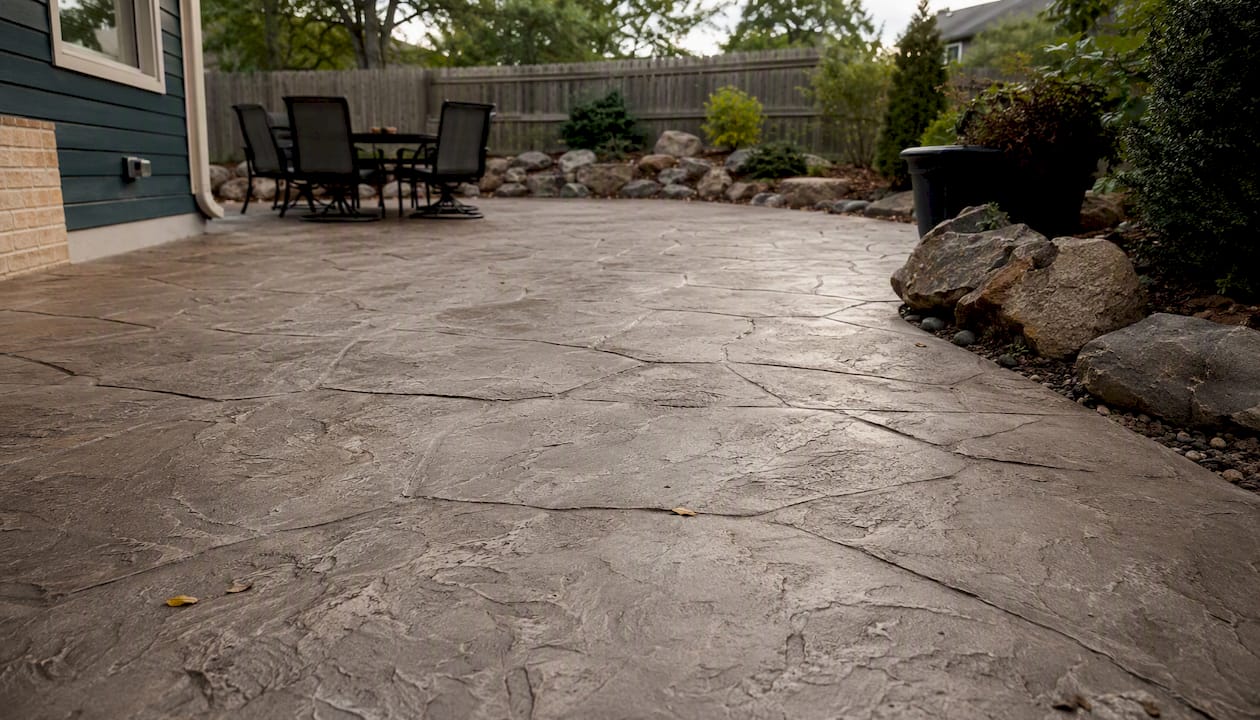
Stamped concrete’s biggest selling point is that it looks like it grew out of the landscape. A skilled crew can press slate, cobblestone, or wood-plank patterns into fresh concrete and layer two or three tones of color to produce a surface that reads as natural stone from ten feet away. That visual range is hard to match at the same price point.
The monolithic surface is a practical win, too. No joints between individual units means no gaps for weeds to root, no pavers shifting out of plane, and no sand base washing away after heavy rain. For a patio that gets regular foot traffic, that seamless quality translates to easy long-term upkeep between reseal cycles.
According to BHG, a properly installed stamped concrete patio is relatively low-maintenance beyond periodic washing and sealing, and it can convincingly mimic higher-end materials. That combination of low daily effort and high visual impact is why stamped concrete remains one of the most requested patio surfaces we install at Villageprecisionpros.
Speed of installation is another real advantage. A concrete pour, stamp, and initial cure typically wraps in one to two days, whereas a large paver or natural stone installation can stretch over a week. For homeowners on a tight project timeline, that matters.
U.S. News notes that a well-maintained stamped concrete patio can add curb appeal and resale value. The condition of the surface is what drives that outcome: a crisp, freshly sealed patio reads as a premium feature to buyers, while a cracked or faded one does the opposite.
What are the drawbacks of stamped concrete, and how do you reduce them?
Concrete cracks. That is not a flaw in stamped concrete specifically; it is the nature of the material. What separates a durable stamped patio from a problem one is how well the installer manages that reality from the start.
The main stamped concrete problems and their mitigations:
- Cracking: Caused by soil movement, freeze-thaw expansion, inadequate subbase, or missing control joints. Mitigation: a compacted aggregate base, steel reinforcement or fiber mesh, and control joints strategically placed at regular intervals. BHG confirms that proper subbase prep and reinforcement reduce but do not eliminate cracking risk.
- Color fading: UV exposure and surface wear break down the color hardener or stain over time. Mitigation: reseal every 2–4 years with a UV-resistant sealer; skipping even one cycle accelerates fading noticeably.
- Slipperiness when wet: Film-forming sealers create a smooth, slick surface. Mitigation: add an anti-slip additive to the sealer mix. Creststone Concrete notes that anti-slip additives incur a moderate additional cost per application and meaningfully improve traction, though they do not fully eliminate slipperiness on all pattern types.
- Repair difficulty: A patched section almost never matches the original color and texture. Options include full resurfacing with a stamped overlay or replacing the damaged section entirely, both of which carry visible seams. Angi’s comparison points out that this is where pavers hold a clear advantage: a single damaged unit can be swapped out without touching the rest of the surface.
Pro Tip: When your installer places control joints, ask them to align the joint lines with the stamp pattern. A joint that follows a “grout line” in a cobblestone pattern is nearly invisible; a joint that cuts across a pattern at random is not.
Heavy vehicle traffic is a genuine poor-use case for stamped concrete. The compressive strength of a standard residential slab is not designed for repeated truck or RV loads, and the decorative surface layer is the first thing to fail under that stress.
How much does a stamped concrete patio cost?
HomeAdvisor’s cost data shows that cost drivers include slab thickness, pattern complexity, color systems, reinforcement, base prep, and regional labor. A single-color, simple pattern starts at the low end of the range; multi-tone borders and intricate textures push toward the top.
| Patio size | Basic stamped (est.) | Complex stamped (est.) | Pavers (est.) |
|---|---|---|---|
| — | $8–$28 per sq ft | $15–$30 per sq ft | $15–$30 per sq ft |
| 20×20 (400 sq ft) | $4,800–$11,200 | $6,000–$12,000 | $6,000–$12,000 |
| — | $8–$28 per sq ft | $15–$30 per sq ft | $15–$30 per sq ft |
Ranges based on UseCalcPro’s 2026 analysis. Local labor rates in Central Arkansas may vary.
Add-ons that homeowners often overlook: demolition of an existing slab ($1–$3 per sq ft), grading and drainage correction, decorative borders (which require a second stamp pass), and steps or transitions to the yard. Each adds to the base number.
The long-term cost picture shifts when you factor in resealing. HomeAdvisor estimates professional resealing at a small cost per square foot, totaling a few hundred to over a thousand dollars depending on patio size. Over 20 years at a 3-year reseal cycle, that adds up to six or seven reseal events. LocalConcreteContractor’s full-cost comparison shows that the initial 20–40% savings over pavers can largely disappear by year 20 once resealing and repairs are included.
What maintenance does a stamped concrete patio actually need?
A stamped patio is not a set-it-and-forget-it surface, but the maintenance burden is manageable with a simple schedule. The two things that kill stamped concrete prematurely are skipped reseal cycles and harsh chemical cleaners.
Annual checklist:
- Inspect the surface in early spring for new cracks, spalling, or areas where the sealer has worn thin (a dull, chalky look is the tell).
- Clean with a mild detergent and a low-pressure rinse. Pressure washing above 1,500 PSI can lift the sealer and damage the color layer.
- Address any cracks wider than a hairline with a color-matched concrete caulk before they allow water infiltration.
- Reseal every 2–4 years, or sooner if the surface loses its sheen or water no longer beads on the surface.
Sealer selection matters. Solvent-based acrylic sealers provide the deepest color enhancement and longest protection but require good ventilation during application. Water-based acrylics are easier to apply and more environmentally friendly, with slightly shorter recoat intervals. Penetrating sealers offer freeze-thaw protection without a film layer, making them a smart choice in climates with hard winters.
A well-maintained stamped concrete patio typically lasts approximately two to three decades. Pavers can last 30–50+ years with comparable care, largely because individual units can be replaced rather than patched. Signs that a stamped surface needs major work: widespread map cracking, delaminating color layer, or sections that have heaved more than a half-inch out of plane.
Stamped concrete vs. pavers vs. natural stone: which should you pick?
| Dimension | Stamped concrete | Pavers | Natural stone |
|---|---|---|---|
| Upfront cost (per sq ft) | $8–$28 | $15–$30+ | $20–$50+ |
| Expected lifespan | approximately two to three decades | 30–50+ years | 50+ years |
| Repairability | Difficult; patches visible | Easy; swap individual units | Moderate; matching stone varies |
| Maintenance frequency | Reseal every 2–4 years | Occasional re-sanding joints | Periodic sealing; varies by stone |
| Customization | High; many patterns and colors | Moderate; unit colors and layouts | Lower; natural variation only |
| Slip resistance | Lower when sealed; additive needed | Moderate; textured surface | Moderate to high; depends on finish |
| DIY potential | Very low | Moderate | Low to moderate |
| Freeze-thaw suitability | Moderate with mitigation | Good | Good |
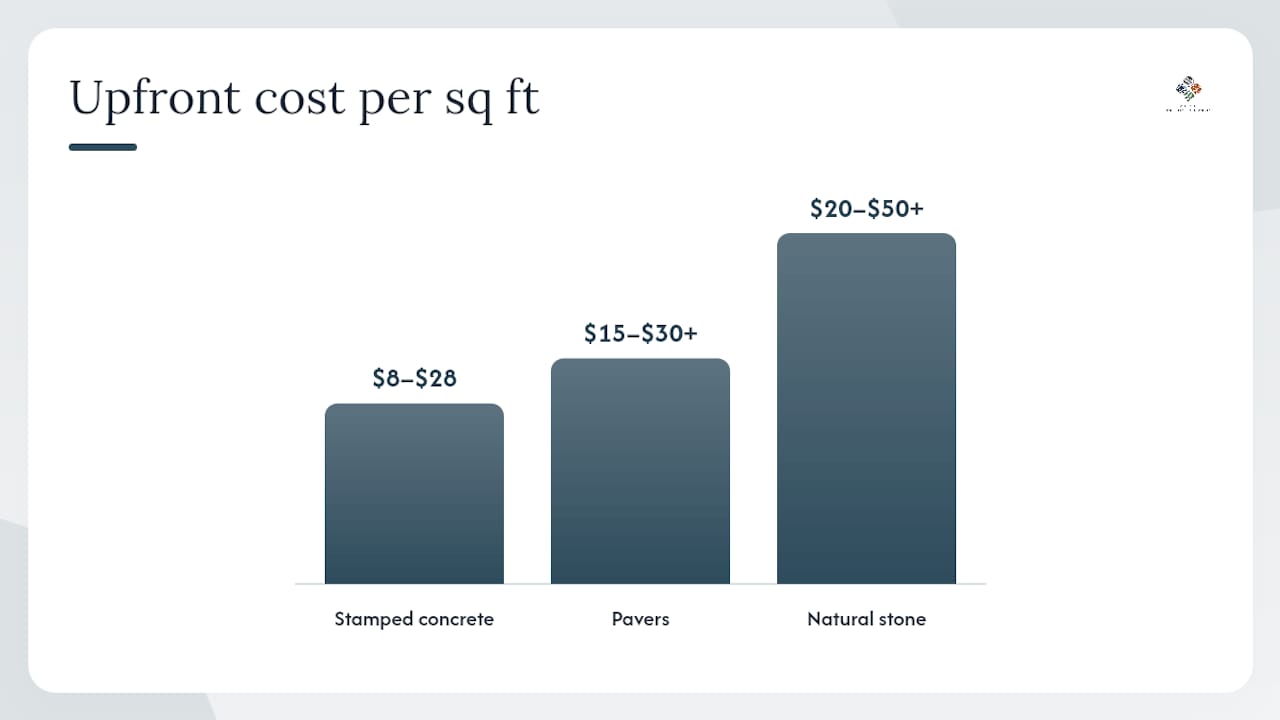
The long-term cost convergence is the number most homeowners miss. Stamped concrete’s lower upfront price looks compelling, but once you add six or seven reseal cycles and any repair work, the lifetime cost often converges with pavers. For homeowners who plan to sell within 10–15 years, stamped concrete’s lower initial investment and fast install make it the rational choice. Long-term owners who want minimal repair headaches often favor durable paver stones for the repairability advantage.
Natural stone wins on longevity and authenticity but carries the highest upfront cost and the most variable installation complexity. For a deeper look at how these materials perform in Central Arkansas specifically, our stone vs. concrete patio comparison covers local soil and climate factors in detail.
Why hire a pro, and what questions should you ask before signing?
Stamped concrete is not a DIY project for most homeowners. The pour, coloring, and stamping must happen within a narrow time window, and mistakes made during that window are permanent. UseCalcPro confirms that errors in timing or technique are costly to correct and often require full removal.
Installation sequence:
- Site prep: excavation, grading, and drainage correction.
- Form setting and subbase compaction (minimum 4-inch compacted aggregate base).
- Reinforcement placement: rebar grid or fiber mesh, depending on load requirements.
- Concrete pour with specified mix design (air entrainment for freeze-thaw areas).
- Color application: integral color in the mix, color hardener broadcast on the surface, or both.
- Stamping: pattern mats pressed into the surface before the concrete sets.
- Release agent removal and initial wash-down.
- Curing: minimum 28 days for full compressive strength; light foot traffic typically after 24–48 hours.
- Sealer application after full cure.
Questions to ask every contractor:
- How many stamped concrete patios have you installed in the last two years? Can I see three recent examples?
- What mix design do you specify, and does it include air entrainment?
- How do you lay out control joints, and will they align with the stamp pattern?
- What sealer do you use, and what reseal interval do you recommend?
- What does your warranty cover, and for how long?
- What is included in your base prep, and how deep will you excavate?
Red flags: No portfolio or references. A bid that skips line items for base prep or reinforcement. A warranty that covers only materials, not workmanship. A price that is 30% below every other bid without a clear explanation.
Pro Tip: Get the control joint layout in writing as part of the contract. Verbal agreements about joint placement disappear after the pour.
The case for being honest about what stamped concrete can and can’t do
Most articles about stamped concrete read like a sales brochure for one side or the other. The reality is more nuanced, and homeowners deserve a straight answer.
Stamped concrete is genuinely good at two things: delivering a high-design look at a price point that natural stone cannot match, and doing it fast. For a homeowner who wants a beautiful patio, plans to sell in the next decade, and is willing to reseal on schedule, it is often the smartest financial decision on the table.
Where I see homeowners get burned is not in the material itself but in the installation. A stamped patio poured on a poorly compacted base, without control joints, in a low-bid situation where the contractor skipped air entrainment, will crack and fade within five years. That outcome gets blamed on stamped concrete when it should be blamed on the contractor.
The other honest point: if you hate maintenance, pavers are a better fit. Not because stamped concrete is fragile, but because pavers forgive neglect more gracefully. A paver patio that misses a few maintenance cycles looks a little tired. A stamped patio that misses reseal cycles looks genuinely damaged.
Choose stamped concrete with clear eyes about the commitment. Hire a crew that can show you their base prep process, not just their portfolio photos. And get the reseal schedule in writing.
Villageprecisionpros can design and install your stamped patio
A stamped concrete patio is one of the best-value outdoor investments you can make in Central Arkansas, and Villageprecisionpros has the local experience to do it right. With over 1,750 completed projects, our crews know how Arkansas clay soil, seasonal drainage, and freeze-thaw cycles affect long-term performance. We handle every step from drainage correction and base prep through color selection, stamping, and final sealing.

Every project includes a written drainage plan, a specified concrete mix, and a reseal schedule you can actually follow. Our patio design and installation service covers the full scope, and our portfolio shows real Central Arkansas results. Ready to see what your yard can look like? Schedule a landscaping consultation and we will walk your site, assess your drainage, and give you a written estimate with no obligation.
Sources and further reading
- Stamped Concrete vs. Pavers Cost in 2026: Patio & Driveway Comparison | UseCalcPro
- Stamped Concrete patio install — HomeAdvisor
- Considering a Stamped Concrete Patio? Here Are Pros and Cons to Consider — BHG
- Pros and cons comparison of pavers and stamped concrete — Angi
- Stamped Concrete vs. Pavers Cost: Full Comparison — LocalConcreteContractor
- Stamped Concrete vs Pavers — Creststone Concrete
- The Pros and Cons of Stamped Concrete Patios and Driveways — U.S. News
FAQ
What are the main drawbacks of a stamped concrete patio?
Cracking, color fading, slipperiness when wet, and difficult-to-match repairs are the four primary drawbacks. Proper installation with control joints, reinforcement, and a compacted base reduces cracking risk, but no stamped surface is immune to it over time.
How much does a 20×20 stamped concrete patio cost?
A 400 sq ft stamped concrete patio typically costs $4,800–$8,000 installed, depending on pattern complexity, color systems, and regional labor rates. Simple single-color patterns fall at the lower end; multi-tone borders and intricate textures push toward the top.
Is stamped concrete outdated?
No. Stamped concrete remains one of the most requested patio surfaces because modern stamp patterns and color systems produce results that closely mimic natural stone and brick at a lower price point. The look has evolved well beyond the flat, uniform textures of earlier decades.
Is stamped concrete cheaper than pavers?
Upfront, yes. Stamped concrete typically costs 20–40% less than comparable paver installations. Over 20 years, however, resealing and repair costs can close that gap, making the lifetime costs of both materials more comparable than the initial bids suggest.