

Geogrid and geotextile are both synthetic sheets that go under your hardscape, but they do different jobs. A geotextile is a fabric that keeps soil and stone from mixing and lets water pass. A geogrid is an open grid that locks into the stone above it and helps the base hold its shape under load. Which one belongs under your patio, path or wall depends on your soil, your water and what will sit on top. At Village Precision Pros, we plan that layer as part of the whole build, because a patio is only as good as what you cannot see after it is finished.
TL;DR
- Geotextile is a fabric. It separates soil from base stone, filters water and, in some types, adds strength.
- Geogrid is a grid. Its openings interlock with base stone, so it is used mainly to reinforce and stabilize the base.
- Neither one replaces a properly compacted base or a drainage plan. Both sit on top of good groundwork.
- Many projects use a fabric alone, a grid alone, or both, depending on soil, slope, water and load.
- Sunlight damages many geotextiles, so installation and coverage matter as much as the product.
Table of Contents
- What each material is
- Side by side
- Drainage is not reinforcement
- When to use which
- Choosing in four questions
- Where installations go wrong
- What the choice means for cost
- Our perspective
- Plan the layer under your project with us
- FAQ
- Sources
What each material is
Geotextile: the fabric layer
Geotextiles are woven or nonwoven fabrics made from synthetic fibers. The Iowa Department of Transportation’s geosynthetic design guidance explains that woven fabrics can provide separation and reinforcement, while nonwoven fabrics are also used for filtration and drainage.
In a yard, that translates into three practical jobs:
- Separation. The fabric keeps the soft soil underneath from working its way up into your base stone, and keeps the stone from sinking down into the soil.
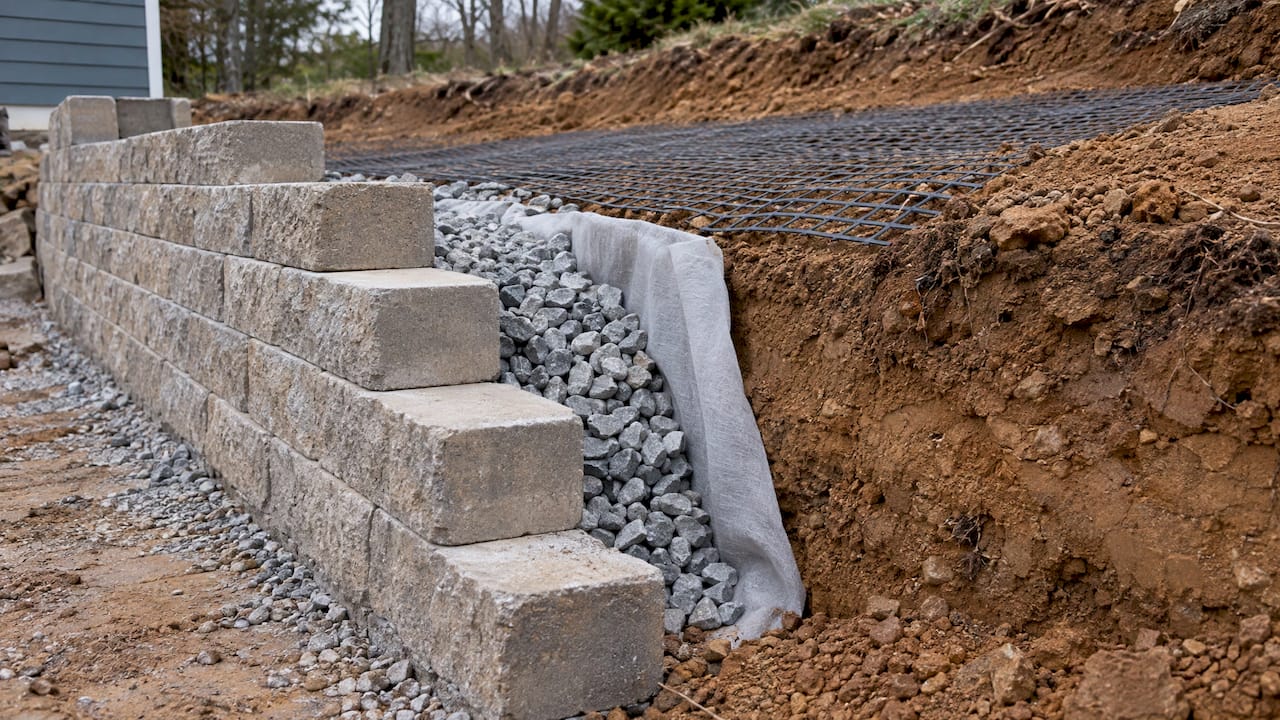
- Filtration. Water moves through the fabric while fine soil particles stay behind. That matters around drains, trenches and the back of a retaining wall.
- Protection. The U.S. EPA notes that geotextiles can separate riprap (large angular stone used to armor slopes and channels) from soil, line stormwater channels and protect exposed soil.
Geogrid: the reinforcing grid
A geogrid looks like a stiff net, with regular openings between strong ribs. The Iowa DOT guidance describes geogrids as networks of tensile elements whose openings interlock with the fill, and says their principal use is soil reinforcement and subgrade stabilization. A subgrade is the native ground your base sits on.
A peer-reviewed review in Polymer Reviews attributes much of a geogrid’s reinforcing effect to aggregate interlocking through the grid apertures. Put simply, stone settles into the openings and is held in place, so the base spreads loads and resists shifting sideways.
The one-line difference
The fabric manages the boundary between soil and stone. The grid strengthens the stone layer itself. A geotextile mainly separates and filters, and a geogrid mainly reinforces. Some woven fabrics also add strength, which is why the two overlap on paper and why homeowners get confused.
Side by side
| Question | Geotextile | Geogrid |
|---|---|---|
| What it looks like | Woven or nonwoven fabric sheet | Open grid of ribs with large openings |
| Main job | Separation and filtration, sometimes reinforcement | Reinforcement and base stabilization |
| Water | Passes water, holds back fine soil | Does not filter anything, water passes freely |
| How it works | Sits between soil and stone | Interlocks with the stone placed on it |
| Good fit | Drain trenches, wall backfill, soft or wet soil under bases | Heavy loads, driveways, wall bases, weak subgrades |
| Weak point | Sunlight exposure before it is covered | Does nothing to keep fines out of the stone |
That last row is the reason the two are often used together. A grid inside the base gives strength, and a fabric under it keeps the soil from pumping up into the stone.
Drainage is not reinforcement
One mistake shows up again and again in yard projects: expecting a drainage product to strengthen the ground, or a strong product to solve a water problem. The Texas Department of Transportation’s pavement manual separates reinforcement of pavement layers from drainage and moisture control, and warns that drainage is not itself reinforcement.
For a homeowner, the lesson is simple. If water collects under your patio or behind a wall, fabric and a grid will not fix it alone. You need a way for the water to leave. We cover that in our guides on dry wells and French drains and on retaining wall drainage.
When to use which
Patios and walkways
For a paver patio or walkway under normal foot traffic, the base does most of the work. A well-chosen, well-compacted aggregate base is what keeps pavers flat through wet and dry seasons. Our guide to paver base materials walks through what goes under a patio.
A geotextile earns its place where the soil is soft, silty or stays wet. It stops the base stone from slowly disappearing into the ground, which is a common cause of dips and low corners. A geogrid becomes worth considering where the soil is weak and the surface will carry more than people and patio furniture, such as a hot tub pad, an outdoor kitchen, a driveway apron or a parking area.
Retaining walls and terraces
Walls ask the most of these materials. Soil pushes on a wall all the time, and water makes that push heavier. Fabric against the drainage stone behind a wall keeps fine soil from clogging the drain. A geogrid, when a wall design calls for it, extends back into the soil to tie the wall to the earth behind it. Taller or heavily loaded walls are engineered, and the grid type, length and spacing come from the design, not from a guess. You can see the kind of work we do in our retaining walls and terraces portfolio.
Drain trenches and erosion areas
Where you are moving water, the fabric is the right tool. It lines the trench so the drainage stone stays clean, and it protects slopes and channels, as the EPA describes in its guidance on geotextiles for stormwater conveyances and exposed soil. A grid has no role in filtering.
Gravel patios and driveways
Loose stone surfaces rut and migrate when the layer under them is soft. Fabric keeps the stone from sinking into the soil, and a grid can hold the stone layer together on weak ground. Our pieces on the gravel patio base and on gravel driveway repair show how much of the result comes from what is under the stone.
Choosing in four questions
- What is the soil like? Soft, silty or clay-heavy ground that stays wet pushes you toward a geotextile at minimum. Firm, well-drained ground may need no sheet at all if the base is built properly.
- What will the surface carry? Foot traffic and furniture are one thing. Vehicles, heavy planters, water features and masonry features are another. Heavier loads raise the case for a geogrid.
- Where does the water go? If the answer is “nowhere,” solve that first. No sheet material turns a wet spot into a dry one.
- Is there a slope or a wall? Slopes and walls add sideways force. That is where reinforcement and filtration are most often specified together.
A worked example
Say you want a 16 by 20 foot paver patio off the back door, on a gentle slope, with soil that stays soggy after rain. The ground is soft, so we would look at a geotextile over the compacted subgrade to keep the base stone clean, then a compacted aggregate base placed in layers, then bedding material and pavers. If the plan also includes a seat wall or a grill island, the load goes up, and the base design may add a geogrid in the stone layer under the heavy features. Grading and a drainage route would be set before any of that goes in, so water leaves the patio instead of sitting under it.
Your yard will differ, which is the point. The same patio on firm, well-drained ground might use fabric only, or none.
Where installations go wrong
The materials are inexpensive compared with the labor around them, so mistakes are rarely about the sheet itself. They are about what surrounds it.
- Sun exposure. The EPA’s geotextile guide warns that many geotextiles degrade quickly in sunlight. A fabric left uncovered for weeks while a project drags on loses value. It should be covered with stone soon after it goes down.
- Poor soil contact. The same guide warns that poor contact with the soil, or poor installation, can let erosion run underneath the material. Fabric laid over loose, uneven ground does not do its job.
- Skipping the compaction. A sheet over soft, uncompacted soil is a sheet over a future dip. The subgrade is compacted first, then the sheet, then the base in layers.
- Wrong sheet for the job. The EPA says woven geotextiles suit uses where impermeability matters, such as silt fences, while nonwovens are used where water needs to pass. A grid used where a filter fabric was needed leaves fines free to migrate into the stone.
- Thin overlaps and wrinkles. Seams need proper overlap so soil cannot slip between sheets, and the sheet needs to lie flat.
- No drainage plan. As covered above, material layers do not remove water.
From your side, the most useful question to ask any contractor is not which brand they use but how they plan to handle your soil and your water. A clear answer to both tells you the base will be built for your yard.
What the choice means for cost
We do not quote prices in articles, because the right answer depends on the site. What drives the total is the area, how much excavation and haul-off the soil needs, which sheet or grid the design calls for, the depth of base stone, access for equipment and the drainage work. A grid often adds expense because it is a more engineered product and usually goes with a deeper design, while a fabric is a smaller line item. In most projects the larger cost swing comes from excavation and base depth, not from the sheet.
Our perspective
We build outdoor spaces that have to hold up through Arkansas rain and heat, so we think about the layers under a patio before we think about the pavers on top. Since 2020, our crews have completed more than 2,000 projects across Central Arkansas, and drainage and uneven ground come up on a large share of them.
Our view is that the sheet material is a tool, not a plan. A fabric or a grid helps when it is matched to the soil, the load and the water on that specific lot. That is why we look at the whole system: the grade, the way water leaves, the compacted base and the surface. Patios, walkways, retaining walls and stone masonry all follow that same logic.
For homeowners, that means one team looks at your ground and decides how it should be built. For property managers and real estate agents, it means a hardscape that is built to stay flat and drain well, so it still looks right at the next walkthrough. We would rather explain what is going under your project than leave it as a line on a bid.
Ty
Plan the layer under your project with us
If you are planning a patio, path, wall or stone feature in Central Arkansas, we handle the design and installation, including the groundwork that decides how long it lasts. Our hardscape and stone masonry service covers patios, walls and masonry features, and our decks and patios service covers outdoor living areas for gatherings. Tell us about your soil and water and we will plan the right base for your yard.

If you want to see finished work first, browse our patios and pavers portfolio.
FAQ
Is geogrid a type of geotextile?
They are both geosynthetics, which is the broader family of synthetic materials used with soil. In practice they are treated as different products. A geotextile is a fabric, and a geogrid is an open grid that interlocks with stone, as the Iowa DOT guidance describes. Some documents group geogrids under a wider geotextile heading, which is why the terms get mixed.
Can I use both under the same patio?
Yes. A common arrangement puts a fabric against the soil to keep the base clean and a grid inside the stone layer for added strength where loads are heavy. Whether both are needed depends on your soil and what the surface will carry.
Why does geogrid sometimes cost more?
It is a more engineered product and it usually appears in projects with heavier loads, deeper base designs or walls. The total for any project depends on area, excavation, base depth, access and drainage, so the sheet itself is only part of the picture.
Does fabric under pavers stop weeds?
It can slow weeds that try to come up from the soil below, but it does not stop seeds that land and sprout in the joints. Proper joint material and edge restraints do more for the surface. We cover that routine in our maintenance work, including annual maintenance plans.
Brass or aluminum for landscape lighting fixtures?
This is a separate question from base materials, and it is mainly for homeowners adding outdoor lighting. Brass is generally heavier and develops a natural patina, while aluminum is lighter and relies on its coating for its finish. Beyond the metal, seals, hardware and installation affect how a fixture handles weather. Our woodworking and lighting work is listed on our services page.
Sources
- Iowa DOT, 200F-9: Geosynthetic Design
- U.S. EPA, Geotextiles, Matting and Netting
- TxDOT, Section 10: Geosynthetics in Pavement Structures
- Polymer Geogrids: A Review of Material, Design and Structure