


The right fix for a trip hazard depends on one thing: why the walkway is uneven. A slab that has sunk can often be lifted. A raised edge of an inch or less can be ground down. A walkway pushed up by roots, or settling over wet soil, needs the cause corrected, or the hazard comes back. We build and repair hardscapes across Central Arkansas, and the jobs that last are the ones where the cause was fixed first and the surface second.
This guide shows you how to measure the problem, read what it is telling you, and choose between grinding, lifting, resetting and replacing. It is written for homeowners, property managers, agents preparing a listing and business owners who have a walkway someone could trip on.
TL;DR
- A vertical step of half an inch or more is treated as a trip hazard by federal sidewalk guidance. HUD’s housing inspection standard uses three quarters of an inch.
- Grinding suits lips of about half an inch to one inch. Lifting suits slabs that have sunk. Neither lasts if water or roots are still doing the damage.
- Pavers are the easiest surface to reset, because individual units come up and go back on a rebuilt base.
- Find the cause before you choose the repair: drainage, a soft base, tree roots or disturbed soil after utility work.
- Large or repeating problems, steps, and commercial properties are worth a professional assessment before anyone patches anything.
Table of Contents
- What counts as a trip hazard
- Why walkways become uneven
- Choosing the repair
- When a patch is only temporary
- Trees and roots
- Safety, permits and who is responsible
- Why this work is better handed to a crew
- Let our crews look at your walkway
- What drives the total for a walkway repair
- FAQ
- Sources
What counts as a trip hazard
People trip on small changes in height. The Federal Highway Administration’s sidewalk design guide defines a step separation, its term for a trip hazard, as a vertical displacement of 0.5 inch or more at any point on the walkway. That is enough to catch a toe, stop a stroller wheel or halt a wheelchair.
HUD uses a slightly looser line for the housing it inspects. Its NSPIRE trip hazard standard counts an unintended vertical difference of three quarters of an inch or more, or an unintended horizontal gap of 2 inches across the path of travel. It gives a 30-day correction timeframe. It also excludes designed features, such as a raised manhole cover.
If you manage rental or commercial property, treat half an inch as your own working limit. It is the stricter of the two and it protects the people using the walkway.
How to measure it
- Lay a straight board or a level across the joint or crack.
- Slide a tape or a ruler under the board at the high side and read the gap.
- Check several points along the joint, because the lip is often larger at one end.
- Note whether the low slab is tilted toward the house, toward a drain or toward a tree.
- Take a dated photo with the tape in frame. Property managers and agents will want that record.
The tilt matters as much as the height. A slab tilting toward a building is a drainage problem waiting to become a foundation problem.
Why walkways become uneven
A repair that ignores the cause is a repair you will pay for twice. The federal guide lists causes that include settled areas that trap water, tree root damage, and poor patching after utility work. In Central Arkansas yards, we see the same families of causes again and again.
- Water. Downspouts, grading that slopes toward the walk, or irrigation overspray soften the soil under the base. The slab or pavers then sink where the soil is weakest.
- A thin or uncompacted base. Surfaces laid over loose fill settle unevenly as it consolidates.
- Roots. Roots thicken over the years and lift slabs from below. The lip usually forms on the tree side.
- Trenches. Utility or irrigation work that was backfilled without compaction leaves a soft stripe across the walk.
- Freeze and thaw and clay movement. Soil that swells and shrinks moves the surface with it.
If you can name which one is at work, the choice of repair mostly makes itself.
Choosing the repair
| Situation | Usual fix | Lasts when |
|---|---|---|
| Lip of about 0.5 to 1 inch between solid slabs | Grinding | The slabs have stopped moving |
| Whole slab has sunk, surface is sound | Lifting (slab raising) | Water and soft soil are corrected |
| Raised by roots | Root-aware rebuild | Roots are managed or the route changes |
| Cracked and broken across the slab | Replace the section | The base is rebuilt and drained |
| Pavers or flagstone uneven | Lift, rebuild base, reset | Base is compacted and water is directed away |
The sections below explain each row.
Grinding a raised edge
Grinding removes the high side of a joint with a diamond blade so the lip becomes a gentle slope. A city repair guide from Oregon, Ohio recommends it for lips between half an inch and one inch. It suggests grinding back about 6 inches for a half-inch lip and 12 inches for a one-inch lip, so the result is a gradual slope rather than a sharp edge.
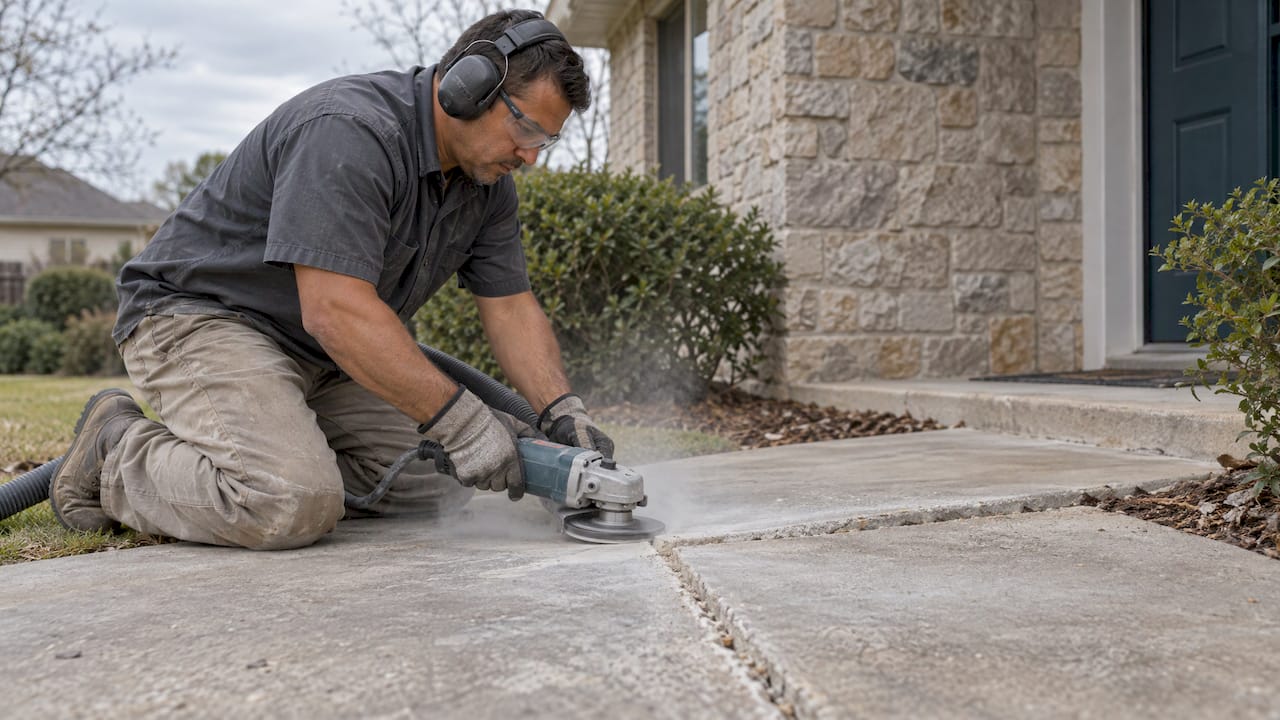
Two cautions apply. First, the Portland sidewalk repair manual limits grinding to 1 inch of vertical difference and wants the ground surface roughened so it stays slip resistant. A smooth, polished ground patch can be slick when wet. Second, the same manual warns that grinding a lip caused by tree roots may only be temporary, since the roots keep growing.
Grinding is a good choice for a stable slab with a modest lip. It is a poor choice for a slab that is still sinking, because the lip returns.
Lifting a sunken slab
When a slab has dropped as one piece and the surface is otherwise sound, raising it can be quicker and less disruptive than replacing it. Oregon, Ohio’s guide describes slabjacking, or concrete raising, as a less costly repair that is only effective on sunken sidewalks. It will not fix a slab that is cracked into pieces or that has been pushed up from below.
The lifting material matters. Our guide to mudjacking versus polyurethane foam compares the two, and our overview of sunken sidewalk repair options walks through when to lift, grind or replace.
Before lifting, answer one question: why did it sink? If a downspout dumps beside the walk, the void will reopen. Our write-up on landscape water drainage solutions explains how grading, drains and downspout extensions keep the soil under a walkway stable.
Resetting pavers and stone
Pavers are forgiving. A low spot means the base moved, so the units are lifted, the base is rebuilt and compacted, and the same pavers go back. Iowa State University Extension notes that pavers with unmortared joints let you remove blocks that lift too high, which is a real advantage over poured concrete near trees.
Resetting only on top of the existing base usually fails, since the base is what moved. Our guide to sinking paver repair covers causes, fixes and when a full rebuild is the better call. If the problem is flagstone near a downspout, read flagstone patio repair. For rocking steps, see our page on wobbly stone steps.
Replacing a section
Replace when the slab is cracked through, crumbling, or heaved so far that grinding would leave a steep ramp. Replacement also makes sense when a repair would only be cosmetic over a failed base. The Portland manual notes that concrete can go on bare soil only if the soil is firm and undisturbed, to prevent future settling. In practice that means digging out soft material, compacting a proper aggregate base and then pouring or laying the new surface.
A replacement section should tie into the old walkway at the same height, with the slope of the walk toward drainage rather than toward the house.
When a patch is only temporary
Three signs tell you a surface repair is a stopgap.
- The lip returns within a season or two. The base is still moving.
- Cracks reopen. Resurfacer manufacturers say it directly: old cracks can reappear because of movement in the concrete underneath. A thin overlay cannot hold a slab that keeps shifting.
- The problem sits beside a tree. Roots keep growing, so a ground-down lip tends to come back.
In each case the lasting fix goes below the surface: correct the water, rebuild the base or deal with the roots.
Trees and roots
Roots are the hardest cause to fix because the tree matters too. Iowa State University Extension recommends, where pavement is rebuilt near trees, either a root barrier at least 18 inches deep with its top above the soil and mulch, or a root-excluding base of washed coarse gravel at least 4 inches thick. It adds that gravel works only in well-drained soils. Rigid foam boards are a third option, and two 2-inch boards glued together make a 4-inch base.
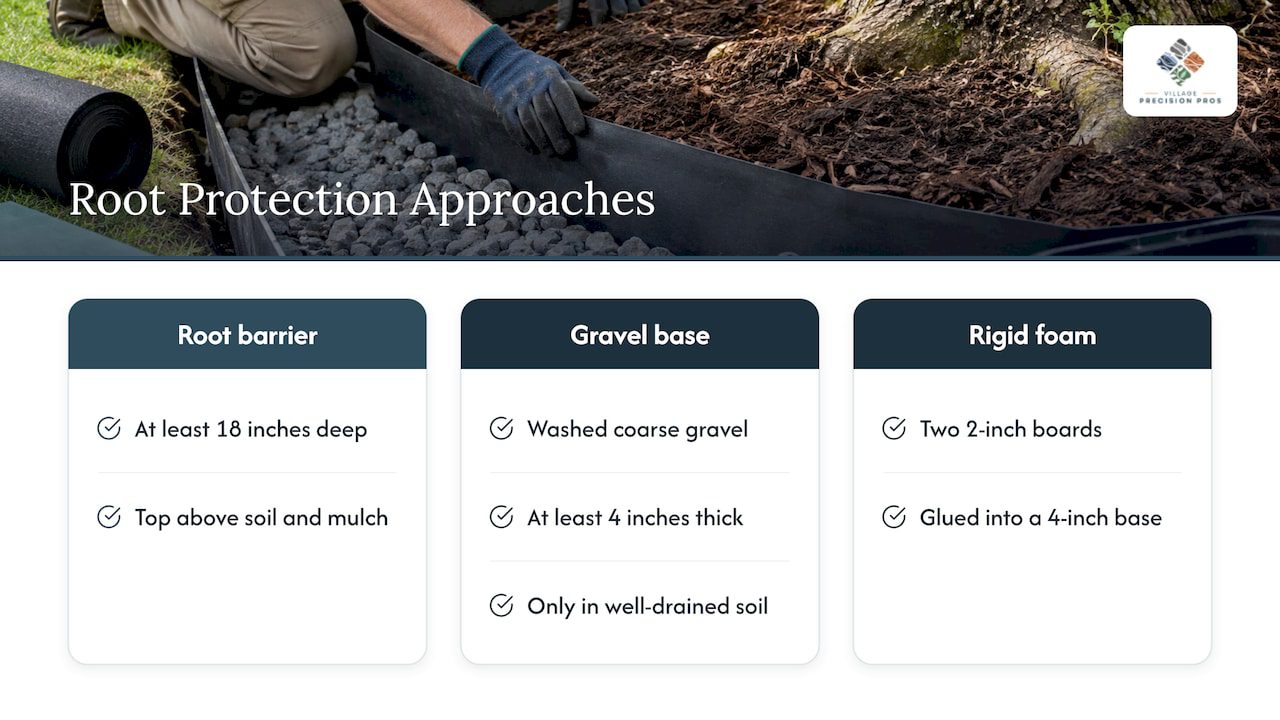
The same guide describes replacing concrete with interlocking pavers over the roots. The crew removes concrete and base above the roots, clears soil between them with an air excavation tool, builds a compacted sand or pea gravel sub-base, lays geotextile fabric, adds a compacted sand base and sets pavers with joints that are not mortared.
That is skilled work, and cutting the wrong root can harm the tree. If the walkway runs next to a mature tree you want to keep, plan the route and base around the roots, not through them.
Safety, permits and who is responsible
Who owns the walkway changes the rules.
- Private walkways on your property are yours to fix. You decide how, when and by whom.
- Public sidewalks in front of your property may be your responsibility or the city’s. The federal guide notes that where owners maintain sidewalks, they may hire a contractor, do the work themselves or have the city repair, and that local laws may require a professional contractor. It also says municipal inspectors should review and approve repairs. Call your city or county public works office before you start.
- A permit is often required to work in the public right-of-way. Portland’s manual states that the contractor is responsible for the permit if one is hired. Local rules in Arkansas cities differ, so ask your city.
On any active repair, keep people off the work area. Portland’s manual requires freestanding barricades at least 36 inches tall at sidewalk work sites, and states that the permit holder is liable for accidents or injuries during construction. If someone could be hurt before the repair is done, cone or barricade the hazard now. Handle grinding dust, which contains silica, with the protective equipment a contractor uses.
When the work is finished, you will want the area clean, especially if it sits by an entry. A post-construction cleaning checklist helps you tidy dust and debris from the entry and interior afterward.
For accessibility, remember that a walkway can be flat and still fail someone who uses a wheelchair if the slope is too steep. Our guide to ADA walkway slope checks shows how owners and managers can check a path in the field.
Why this work is better handed to a crew
Measuring is easy. The hard parts are reading the cause, matching the fix to it and building a base that stays put. Portland’s manual itself says that placing concrete is difficult work that requires an advanced skill set and knowledge of city codes, and it recommends considering a professional for the best results.
A crew that works on hardscapes, drainage and irrigation can look at the whole picture in a single visit: the surface, the base under it, the downspout beside it and the sprinkler head that has been soaking it. That is the difference between a patch and a repair.
Our view: fix the ground, then the surface
We started Village Precision Pros in 2020 and have completed more than 2,000 projects across Central Arkansas. Many of the walkway calls we get begin the same way: someone grinds or patches a lip and it returns.
Our approach combines design with function. We look at drainage and uneven ground first, because a walkway is only as good as what is under it. A compacted aggregate base, correct slope and quality materials are what let a path shrug off years of weather and foot traffic.
That is why we treat a trip hazard as a symptom. A ground edge is fine on a stable slab. A sunken slab needs the void and the water source handled. A paver path wants a rebuilt base. Matching the fix to the cause is what makes the walkway easy to maintain for the long term.
Ty
Let our crews look at your walkway
If you have a walkway that trips people up, our hardscape and stone masonry team builds and repairs patios, pathways and stone work for homes and commercial properties in Central Arkansas. Our foundation leveling and other services cover uneven ground, and our annual maintenance plans help property managers keep walkways, drainage and grounds in shape year round.

To discuss your walkway, reach us through villageprecisionpros.com.
What drives the total for a walkway repair
We do not publish price figures here, because the total depends on the job. These are the factors that decide it:
- Length and number of problem spots. A single joint is a different job from a whole run.
- Cause. Surface grinding is simpler than rebuilding a base or dealing with roots.
- Material. Poured concrete, pavers and natural stone each need different labor.
- Access. Tight side yards and steps slow the work.
- Drainage work. Redirecting a downspout or regrading adds scope but protects the repair.
- Permits. Work in a public right-of-way may add steps.
Bring photos with a tape in frame and the measurements from the section above, and you will get a more accurate assessment.
FAQ
How high does an uneven edge have to be to count as a trip hazard?
Federal sidewalk guidance treats a vertical step of 0.5 inch or more as a trip hazard. HUD’s inspection standard uses three quarters of an inch. For safety, treat anything near half an inch as worth fixing.
Can I just grind down a raised slab?
Grinding works for a stable slab with a lip of roughly half an inch to one inch. If the slab is still sinking, or roots are pushing it up, the lip will return. In that case, the base or the cause needs attention first.
Is lifting a sunken sidewalk better than replacing it?
Lifting suits a slab that has sunk but is otherwise intact, and it is typically less disruptive. A slab that is cracked into pieces or heaved from below is usually better replaced. Our guide to lifting, grinding or replacing covers the decision.
Do I need a permit to repair a walkway?
On your own private walkway, usually not, though you should confirm with your city. A public sidewalk in the right-of-way commonly needs a permit, and local rules may require a licensed contractor. Call your city or county public works office before work starts.
Sources
- FHWA Sidewalk Best Practices Design Guide
- HUD NSPIRE Standard: Trip Hazard
- City of Oregon, Ohio: How to Repair Sidewalk
- City of Portland Sidewalk Repair Manual
- Iowa State University Extension: Sidewalk Repair Near Trees
- QUIKRETE: Resurfacing Concrete