


Weed barrier fabric looks like a smart shortcut, but in planted beds it tends to clog, tear and grow weeds on top of it, while starving the soil underneath. The lasting fix is a thick layer of organic mulch in beds and a properly built base under gravel and stone, and that is the work our crews do across Central Arkansas, from hardscape and stone masonry to annual maintenance plans.
This guide is for homeowners, property managers, agents and business owners who have fabric in a bed that is now weedy, or who are deciding whether to put it in.
TL;DR
- Over time, soil and decomposing mulch fill the fabric’s pores, and weed seeds sprout in the mulch on top of it, so the barrier ends up growing weeds instead of stopping them.
- Fabric slows water and gas exchange between soil and air, which can compact the soil and stress the plants you want to keep.
- Fabric still has a place under gravel paths, walkways and other hard surfaces where no plants are rooted.
- In planted beds, extension programs recommend a thick layer of organic mulch, refreshed once or twice a year, or dense groundcovers.
- Old fabric can be removed at any age, and doing so improves the bed whatever its condition.
Table of Contents
- Why fabric looks like such a good idea
- The most common weed barrier problems
- Where fabric still belongs
- What to use instead of weed barrier fabric
- How to remove old weed barrier fabric
- What we do about it
- Getting your beds back under control
- FAQ
- Sources
Why fabric looks like such a good idea
The pitch is simple: lay a sheet over the soil, cut holes for plants, cover it with mulch, and weeds can’t get light. For the first season that often holds true. The 2007 mulch review by horticulture researcher Linda Chalker-Scott notes that plastic films and landscape fabrics are highly effective at eliminating weeds right away, yet should not be relied on as a long-term weed control approach.
That gap between the first year and the fifth is where homeowners get frustrated. The material was not designed for ornamental beds in the first place. Illinois Extension points out that landscape fabric was originally developed for commercial vegetable growing and structural uses such as retaining walls. Moving it into a perennial bed asks it to do a job it wasn’t built for.
The most common weed barrier problems
Weeds grow on top of the fabric
This is the problem people notice first. Soil, dust, leaves and breaking-down mulch slowly collect on the surface. UF/IFAS Extension explains that soil particles and decomposing mulch fill the fabric’s porous spaces, and weed seeds from nearby lawns and beds land in the mulch above it, so a full crop of weeds can grow above the barrier. Finely ground commercial mulch breaks down quickly, and a Piedmont Master Gardeners writer reports that it decomposes during the first year, letting surface seeds germinate above the fabric.
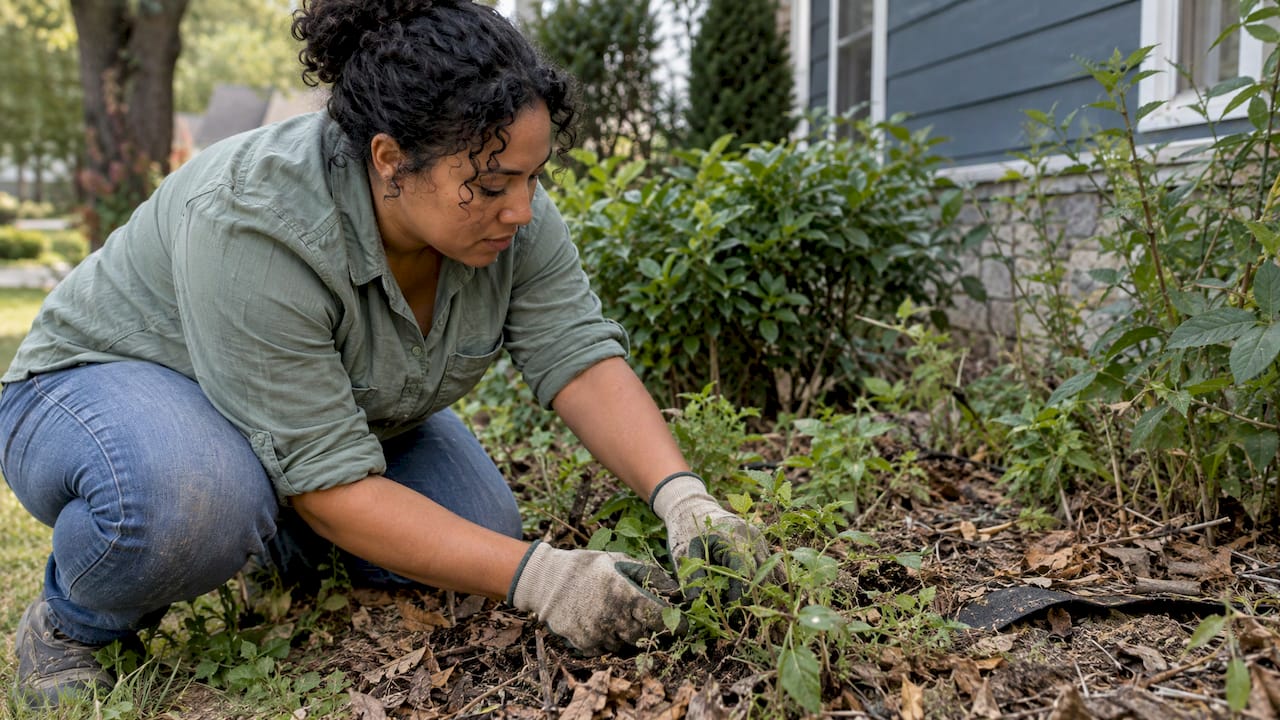
North Carolina Cooperative Extension adds that research going back to the 1980s shows fabric topped with organic mulch can become just as weedy as bare mulched soil, and takes about the same time to hand-pull or spray.
Weeds root through it
Once a weed roots into the fabric, it is harder to remove, not easier. Cornell’s weed identification program lists that new weeds can root into the fabric, making weeding more difficult. Perennial weeds are worse: UF/IFAS notes that torpedograss and purple nutsedge eventually push right through. When you pull a rooted weed, the fabric can lift with it, leaving torn edges and exposed soil.
The fabric breaks down in sun
Any exposed edge, tear or planting hole becomes a weak point. Fabric left in sunlight becomes brittle and shreds. Washington State University Extension describes it degrading into brittle, torn pieces in sun, with dark fabric overheating and able to damage tender roots and seedlings. Illinois Extension adds that frequent replanting turns a sheet into what its author calls Swiss cheese fabric, full of holes where weeds enter.
For property managers, this is a recurring cost. Torn fabric, mulch that has migrated, and weeds poking through all show up on the walkthrough long before the plants themselves look unhealthy.
It changes the soil under your plants
Healthy soil breathes. Water goes in, oxygen and carbon dioxide move out. A sheet over the top interrupts that. Research by Chalker-Scott, cited by WSU Extension, found that landscape fabric reduces carbon dioxide movement between soil and air about 1,000 times more than wood chip mulch.
The consequences, according to UC Master Gardeners, are that soil microorganisms die off, and the soil turns cracked, compacted and sour smelling. Plants surrounded by clogged fabric also tend to spread shallow surface roots, and the fabric can be bone dry even after a deep soaking rain. Shallow roots are a particular concern in Arkansas summers, when heat and dry spells follow heavy storms.
Roots also grow into the fabric itself. A peer-reviewed study in Arboriculture & Urban Forestry found that red maple and Japanese holly roots grew into, through and on top of spunbonded fabrics, so pulling or lifting it later risks damaging them.
Plastic sheeting is worse
Solid black plastic blocks water and air completely. AP News reports that plastic sheeting overheats roots and releases microplastics, and that in perennial beds fabric of any kind creates heat pockets and keeps plants from spreading and self-seeding.
Mulch slides off
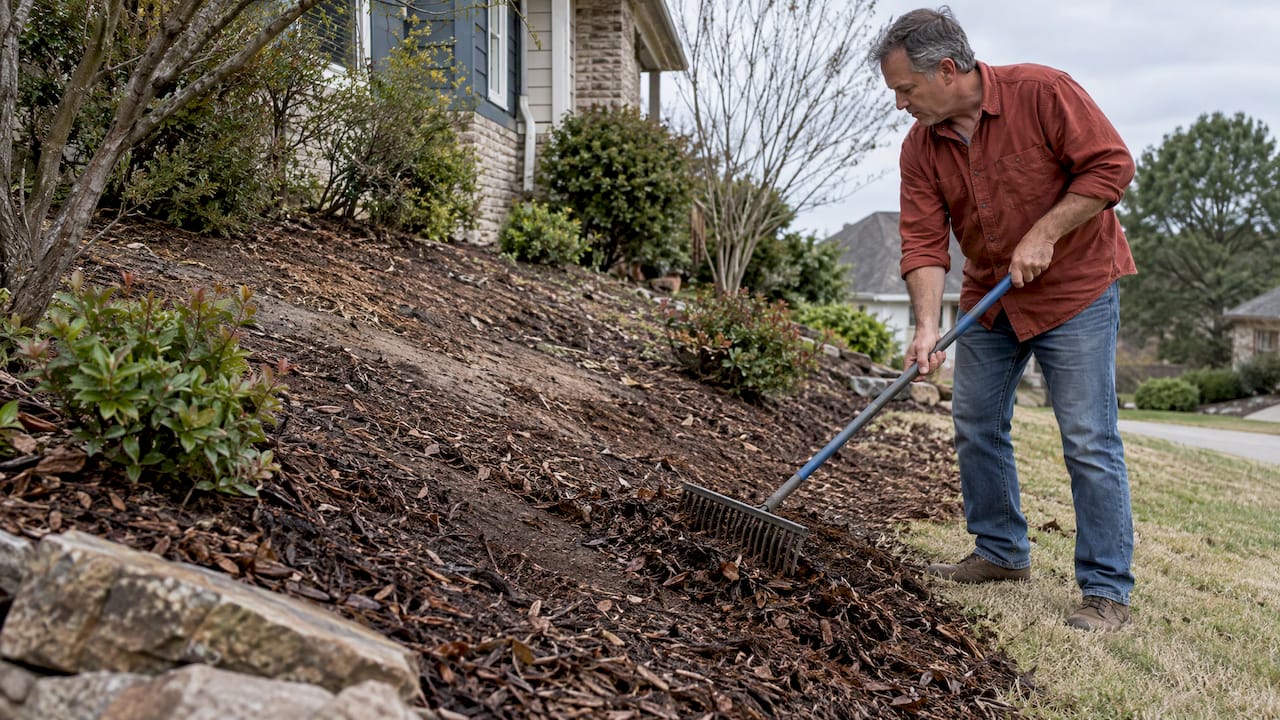
Mulch sitting on a smooth sheet has nothing to grip. Kansas State Extension notes that in windy conditions the fabric ends up unsightly and flapping once loose mulch blows away. On a slope in Central Arkansas, heavy rain does the same job as wind. If mulch is moving in your beds, our guide to mulch washout solutions covers how to hold it in place.
Where fabric still belongs
Not every use is a problem. Extension sources agree that fabric works where nothing is meant to root. North Carolina Cooperative Extension says it suits nursery settings and high-traffic paths with no plant-root competition. AP News says it can help under gravel or stone paths and walkways by separating the hardscape from the soil. UF/IFAS puts the best place for it under mulched paths and areas without ornamental plantings.
That is the logic behind separation layers beneath patios and pathways. Whether a patio needs a woven separation fabric or a reinforcing grid depends on the soil and the load, and we explain the difference in geogrid vs geotextile. A compacted aggregate base with the right separation layer is what keeps a stone surface from sinking, and it is part of the job when we build patios and walkways.
One more point for paved areas: weeds that appear in the joints between pavers come from the surface, not the soil below, so fabric is not the answer. Our guide to weeds between pavers walks through removal and prevention. And if a gravel or concrete surface turns green, moss control on concrete is a separate issue from weeds, driven by shade and moisture.
What to use instead of weed barrier fabric
The consistent advice from extension programs is to let thick organic material do the work fabric was supposed to do.
Thick organic mulch
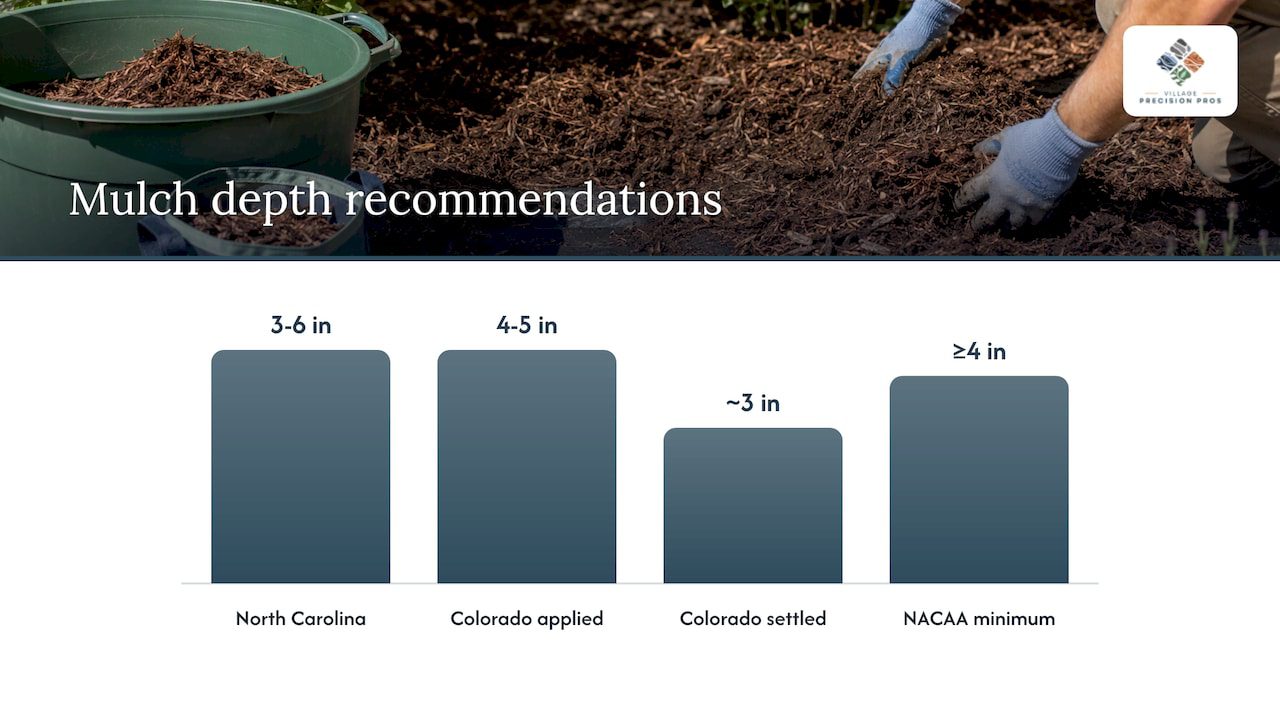
North Carolina Cooperative Extension recommends pine straw, arborist chips, compost or leaf mold at 3 to 6 inches, applied once or twice a year in planted beds. Colorado’s Ask Extension service advises 4 to 5 inches of wood mulch, which settles to about 3 inches after watering. The NACAA review by Chalker-Scott and Andrew Downer recommends at least 4 inches of arborist wood chips, topped up at least once a year or whenever depth drops below 4 inches, and no fabric beneath.
Keep mulch a few inches back from trunks and stems. Piling it against bark holds moisture where it shouldn’t be.
Dense groundcovers
WSU Extension suggests mat-forming living mulch such as sedum, vinca, pachysandra and Geranium ‘Biokova’, which suppress weeds, hold moisture and control erosion. They take a season or two to fill in, so mulch the gaps while they establish. Check which are suited to your yard’s sun and drainage before choosing.
Crushed rock, installed properly
For a clean, low-water look, Ask Extension notes that 4 inches of crushed rock can be used in place of a fabric barrier. Depth matters: thin rock lets weeds through and sinks into soft ground. Rock beds should sit on prepared ground with defined edges, so landscape edging options are worth planning at the same time.
Fix the cause: water and ground
A bed that stays wet, washes out or sinks grows weeds faster and loses mulch. Good landscape water drainage and a downspout that doesn’t dump into the bed keep your weed control from being undone by the first heavy storm.
Replace the lawn entirely
For areas where weeding never ends and a lawn is more work than it’s worth, artificial turf installation removes the weeding question from that space. For beds and borders, our low-maintenance landscaping ideas for Arkansas yards show how to combine these options.
How to remove old weed barrier fabric
North Carolina Cooperative Extension advises starting to remove fabric from flower beds and from under trees, and says replacing it with organic mulch will make a difference no matter how long the fabric has been in place. A sound sequence looks like this:
- Clear the surface. Rake off the old mulch, which is usually thin, broken down and full of seed.
- Cut around plants. Work in sections, and cut the fabric away from roots that have grown through it instead of yanking.
- Pull out the pieces. AP News describes the work as painstaking, pulling up fragments and cutting them from roots above, below and through the fabric. Chalker-Scott recommends a mattock for the fabric that is completely colonized by weeds.
- Pull the weeds that were growing above it, and loosen compacted soil. Fabric-covered soil is often dense and dry.
- Re-mulch to full depth. Apply the thick organic layer described above, then set a schedule to top it up.
On a large property or a bed with established shrubs and trees, this is slow and physical, and it is easy to damage roots by pulling too hard. This is the kind of renovation our crews take on, and it pairs naturally with ongoing upkeep under our annual maintenance plans.
What we do about it
Most of the weed barrier calls we get start the same way. The fabric was fine for a season, and now the bed is full of weeds and the plants look tired. Homeowners assume they installed it wrong. Usually the material simply wasn’t the right choice for a planted bed.
We think about a landscape in layers. Under a patio or walkway, a compacted aggregate base and the right separation material keep the surface stable, and that is where fabric belongs. In planting areas, healthy soil, proper drainage and a thick mulch layer do the weed control, and they improve with age instead of breaking down.
That is why we pair design with function. A bed that drains properly, with clean edges and the right depth of mulch, is easier to keep up than one fighting a plastic sheet. Since 2020 and across more than 2,000 projects, we have built our work around materials and craftsmanship that hold up, so the finished space looks good and stays easy to maintain.
Ty
Getting your beds back under control
If your beds have fabric that is failing, or you want a property that stays clean with less weekly effort, Village Precision Pros designs and installs landscapes, hardscapes and irrigation across Central Arkansas, and offers annual maintenance plans for residential and commercial properties. Our landscape and irrigation service covers the bed work, and our team can also handle the paving, edging and drainage around it.

To talk through your property, start at villageprecisionpros.com or see how our working process runs from first conversation to finished project.
FAQ
Does weed barrier fabric ever work?
Yes, in the right place. It does its job under gravel or stone paths and walkways and in other spots where no plant roots compete. In planted beds, extension sources describe it clogging, tearing and growing weeds on top within a few seasons.
What can I use instead of landscape fabric?
A layer of organic mulch 3 to 6 inches deep, refreshed once or twice a year, is the standard recommendation from university extension programs. Dense groundcovers and a properly installed layer of crushed rock are other options. Pair any of them with good drainage so mulch stays in place.
Should I remove old fabric from my beds?
In flower beds and under trees, yes. North Carolina Cooperative Extension advises removing it and replacing it with organic mulch, and says the change helps regardless of how long the fabric has been down. Expect slow work where roots and weeds have grown through it.
Why are there weeds growing through my fabric?
There are two reasons. Seeds land in the mulch on top, where decomposing material gives them a place to root, and perennial weeds can push their roots right through the sheet. The fabric holds the weeds in place and makes them harder to pull.
Sources
- Landscape Fabric: Good Idea? (WSU Yakima County Extension)
- Knowing Better: The Appropriate Use of Landscape Fabric (N.C. Cooperative Extension)
- Weed Barriers (Cornell Turfgrass and Landscape Weed ID)
- Impact of Mulches on Landscape Plants and the Environment (Chalker-Scott, 2007)
- Consider Landscape Fabric Carefully (UF/IFAS Extension)
- The disadvantages of landscape fabric (Illinois Extension)
- Landscape Fabric for Garden Bed Weed Control (Piedmont Master Gardeners)
- Landscape Fabric: A Cautionary Tale (UC Master Gardeners)
- Arboriculture & Urban Forestry study on fabrics and roots
- Why landscape fabric is often a bad idea for your garden (AP News)
- Nonchemical Weed Control Methods for Landscape Beds (K-State)
- Garden Myth-Busting for Extension Educators (NACAA)
- landscape fabric (Ask Extension)
- Keep the fabrics in your closet and off of your soil (Garden Professors)