

Crumbling mortar joints are a repair job, not a cosmetic flaw. The fix is to cut out the failed mortar, find out why it failed, and repoint the joints with a mortar that is softer than the brick or stone around it. Done right, the wall sheds water again and the masonry units stay intact. Done wrong, with a hard bagged mix and a shallow skim, the new joints fail and the brick starts to flake.
This guide explains how to tell whether your joints need work, what the process involves, and where it most often goes wrong. If you own a home, a rental, a commercial building or a listing in Central Arkansas, our masonry crews at Village Precision Pros handle hardscape and stone masonry projects like this one.
TL;DR
- Mortar is the sacrificial part of a masonry wall. Some weathering is normal, but disintegrating, cracked or open joints need repointing.
- Fix the cause first: leaking gutters, roof runoff, settlement and rising damp will destroy new mortar just as they destroyed the old.
- Use a mortar softer and more permeable than your brick or stone. Premixed bagged mortar is often too hard for older walls.
- Cut joints out to roughly 3/4 inch deep, fill in layers, and keep the new mortar damp while it cures.
- Vertical or diagonal cracks that run through bricks, or loose units, call for a professional assessment.
Table of Contents
- Why Mortar Joints Crumble
- Does Your Wall Need Repointing?
- Why Mortar Strength Matters More Than You Think
- How Masonry Joint Repair Is Done
- Can You Put New Mortar Over Old Mortar?
- Tuckpointing a Stone Wall
- When to Call a Professional
- What Drives the Total
- Let Us Look at Your Wall
- FAQ
- Sources
Why Mortar Joints Crumble
Mortar is not meant to outlast the wall. Virginia’s Department of Historic Resources describes joints as an expendable part of a masonry wall, and the weathering of joints is part of how a wall is designed to age. That is why repointing, which means removing the outer layer of old mortar and replacing it, is a normal maintenance task every few decades.
When joints crumble sooner than that, something is usually accelerating the damage:
- Water. The National Park Service says leaking roofs or gutters, rising damp and extreme weather exposure should be addressed before repointing, or the deterioration will continue. A downspout that dumps beside a wall or a patio is a classic culprit. Water from buried lines can also soak the ground beside masonry, and the signs and causes of a water leak under a driveway show how to recognize that kind of hidden moisture.
- Freeze and thaw. Mortar that holds water can freeze inside the wall and break apart. The General Services Administration notes that mortar has to let water pass through it as liquid and vapor, because trapped water can freeze and seriously damage masonry.
- Movement. Brick walls expand in warm weather and contract in cool weather. The NPS explains that this builds stresses that cause cyclical cracks, which open in cold weather and close in heat.
- Settlement. If the footing or soil under a wall moves, joints open along the line of movement. Our guide on foundation cracks and when to worry covers how to read that pattern.
- The wrong mortar. A previous repair done with mortar that is harder than the masonry can leave the joints looking perfect while the bricks themselves crumble. More on that below.
Does Your Wall Need Repointing?
Not every worn joint needs work. Virginia’s guidance says pointing that is firm, intact and eroded less than one-third inch should be left alone. Only joints that are open, deeply eroded, cracked or separated need repointing.
The NPS lists these signs as reasons to repoint: disintegrating mortar, cracks in joints, loose bricks or stones, damp walls and damaged plaster. The City of Round Rock, Texas, adds a practical test: eroded mortar of 1/4 inch or more, or mortar that crumbles, means repointing is necessary.
A quick walk around the wall tells you a lot:
- Press a screwdriver or key into the joint. Mortar that powders, falls out or lets the tool sink in is failing.
- Look for gaps you can slide a fingernail into, or a joint recessed noticeably behind the brick face.
- Check the base of the wall and the area under downspouts, where water concentrates.
- Look at the bricks or stones themselves. Flaking faces beside tight, hard joints suggest the mortar is too strong for the masonry.
- Note where the cracks run. Hairline cracks limited to the mortar joints are less severe and can be monitored, according to the City of Redlands, California. Vertical or diagonal cracks through walls or units often point to differential settlement and warrant a professional’s opinion.
If a quarter to half of a wall needs work, consider doing all of it. Round Rock’s guide notes that when 25 to 50 percent of a wall needs repointing, the whole wall may be the more cost-effective job, and it leaves you with one consistent color and texture.
Why Mortar Strength Matters More Than You Think
This is the part of masonry repair that homeowners most often get wrong. The instinct is to choose the strongest mortar available. For most walls, that is a mistake.
A wall moves with temperature and moisture. Those stresses have to be released somewhere. Mack and Speweik, in the NPS repointing brief, describe how the mortar should be the part that gives. Katie Daniel of The Construction Specifier explains the mechanism: where mortar is harder than the masonry, stresses are relieved by spalling the masonry units instead of the mortar. The joints stay intact while the brick or stone face breaks away. That kind of damage cannot be patched; the unit has to be replaced.
The guideline from the same article is to use a mortar no stronger than necessary, softer than both the adjacent masonry and the original mortar. It also notes how wide the range is: masonry units run from under 600 psi for soft brick to over 19,000 psi for granite. A mix right for granite would be wrong for an old, soft brick.
The NPS brief states what a good replacement looks like. It should match the original in color, texture and tooling, use matching sand, and be more vapor-permeable and softer than the masonry units. Virginia’s guidance warns that premixed bagged mortars are almost always too hard for historic masonry. It also recommends having the mason prepare samples that vary color, cement, sand and lime rather than guessing.
One more point: even laboratory analysis of old mortar is a guide, not a recipe. The NPS brief cautions that analysis helps identify sand gradation and color, but cannot reveal original water content, curing rate or mixing method, so the lab report should not be the only basis for the specification. A mason who can read the wall and test sample patches is worth a great deal here.
How Masonry Joint Repair Is Done
This is the process a professional follows. It is also a good checklist for judging any crew’s work.
1. Fix the water problem
Redirect downspouts, repair flashing and gutters, and correct grading that sends water toward the wall. Our piece on flagstone patio repair and the downspout shows how often the stone is not the real problem. If drainage is part of the cause, landscape water drainage solutions handle it at the source.
2. Cut out the old mortar
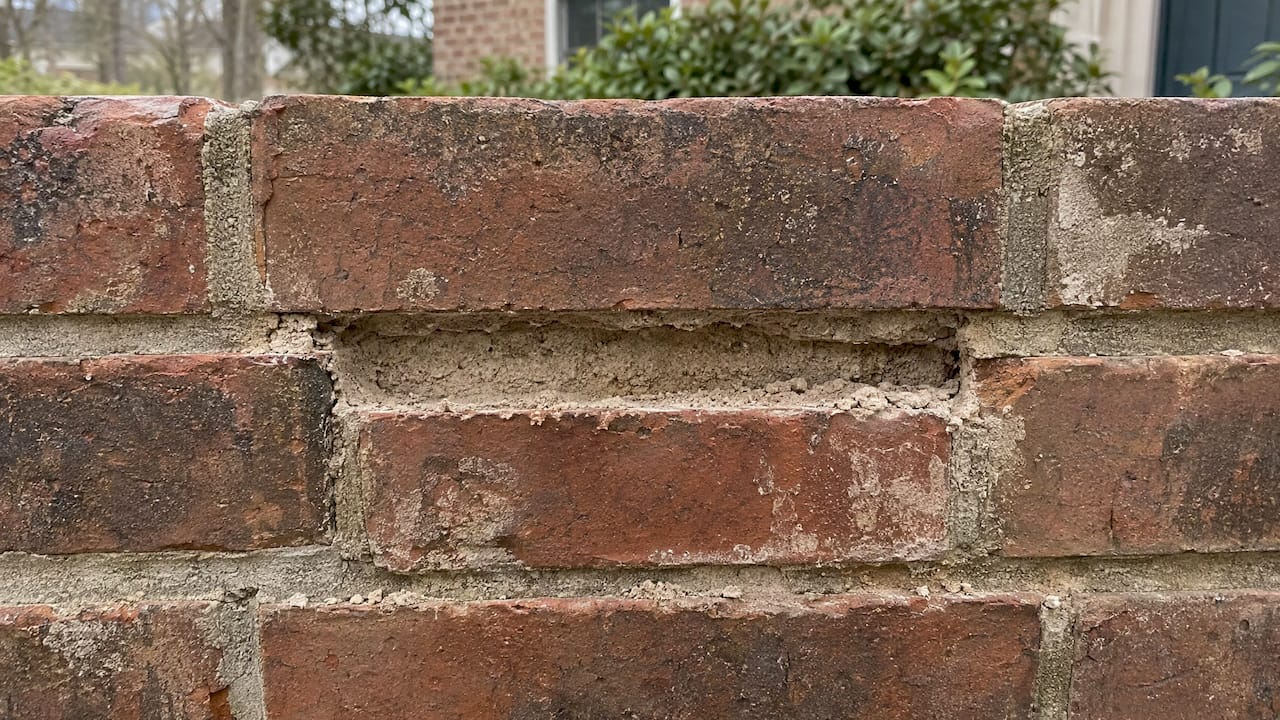
The depth matters. This Old House explains that new mortar bonds to the brick, not to old mortar, so damaged mortar should come out to about 3/4 inch deep. Round Rock’s guide asks for a minimum of 2 to 2-1/2 times the joint width. The Redlands guidelines call for hand chisels, small pneumatic tools or grinders, without over-cutting joints or chipping the units. Cutting into the edge of a brick or stone is the most common way a rushed job leaves permanent damage. Goggles and a dust mask are essential, since cutting mortar throws fine dust.
3. Clean and dampen
Brush or rinse out the dust. GSA’s specification asks for joints that are damp but not wet before pointing. Dry brick pulls water out of fresh mortar and weakens the bond. Standing water does the opposite.
4. Mix and test the mortar
Mix a sample, let it dry, and compare it to the existing joints. Color shifts as mortar cures, so judge the dried patch, not the wet mix.
5. Fill in layers
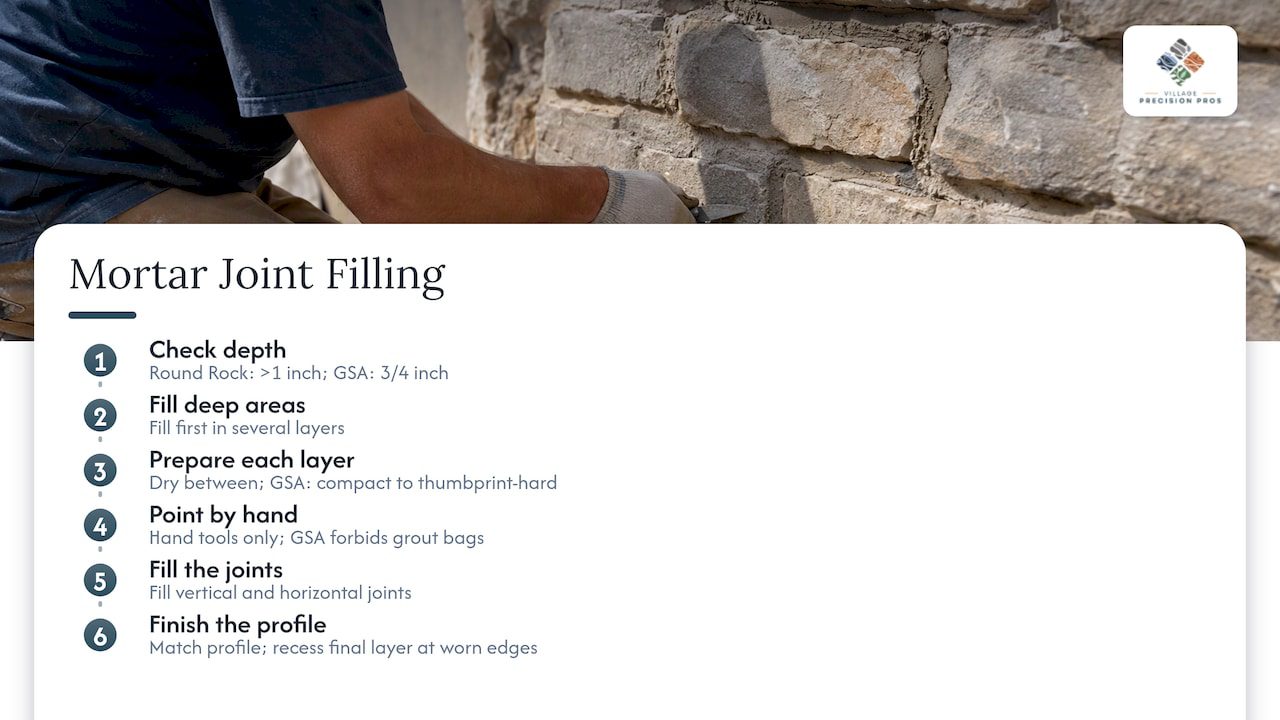
Round Rock says that where removal goes deeper than 1 inch, the deeper areas should be filled first in several layers, letting each dry between layers. GSA sets the threshold at 3/4 inch, with each layer compacted and allowed to become thumbprint-hard before the next. Pointing is done by hand with hand tools, and grout bags are not allowed in that specification. Fill the vertical joints and the horizontal joints, then tool them to match the original profile. On worn, rounded edges, recess the final layer slightly from the face.
6. Clean the face
Remove excess mortar with a stiff natural-bristle brush. GSA rules out metal brushes, which scratch the masonry.
7. Cure slowly
New mortar needs time. This Old House says it takes 36 to 48 hours to cure completely, depending on weather. GSA’s specification for historic work calls for a minimum of 72 consecutive hours of damp curing, for example under wet burlap and plastic with periodic misting. It also says any hairline cracking or edge separation that appears during curing should be removed and repointed.
Weather window
Round Rock specifies wall temperatures between 40°F and 95°F, so the mortar water does not freeze or evaporate too fast, and recommends working in shade. In Central Arkansas that usually means spring and fall are the best seasons, and the hottest summer afternoons are the wrong time to point a south-facing wall.
Can You Put New Mortar Over Old Mortar?
Skimming fresh mortar over crumbling joints looks tidy for a season, then peels. Because new mortar bonds to the masonry units rather than to old mortar, a surface coat has nothing sound to grip. The failed material has to come out to full depth first.
Hairline cracks are a different case. The NPS notes that active cracks, which open and close with the seasons, should be sealed with flexible sealant, while inactive cracks may be pointed. A rigid mortar patch over a moving crack will simply split again.
Tuckpointing a Stone Wall
Stone walls follow the same principles as brick, with a few differences that raise the stakes:
- Joints are irregular. Stones vary in size, and joints can be wide and deep. Work stays slow and entirely by hand, and layers matter even more.
- Stone is often softer than people assume. Limestone and sandstone can be damaged by a hard mortar the same way soft brick can. The rule stays the same: mortar softer than the stone.
- Chisel control is critical. Stone edges chip easily, and a chipped edge cannot be put back. Small hand tools beat a grinder on tight or uneven joints.
- Matching matters visually. Stone walls show their joints prominently, so sand, color and tooling make the difference between a repair that disappears and one that looks like a scar.
For retaining walls, the stakes include structure as well as looks. If joints are opening because the wall is leaning or bulging, read our guide on retaining wall repair in Arkansas to judge whether repointing is enough or the wall needs rebuilding. Stone steps that shift under foot are a separate problem, covered in wobbly stone steps and when to call.
When to Call a Professional
Masonry repointing looks simple and is not. Virginia’s guidance says masonry work is generally not something the inexperienced homeowner should take on, and it points out that aggressive marketing of quick-fix products is a main reason masonry is treated inappropriately.
Bring in a professional when:
- Bricks or stones are loose, shifting or falling out.
- Cracks run vertically or diagonally through the wall or the units.
- The wall is tall, on a second story, or part of a chimney.
- The masonry itself is flaking, which suggests an earlier repair used the wrong mortar.
- The wall is part of a property you manage or are selling, where an even, consistent finish matters.
When comparing contractors, our seven quality checks before you hire is a useful list to hold up to any quote. If you are not sure whether your project is hardscape or masonry, this comparison of hardscapes and masonry explains the difference.
What Drives the Total
We do not quote numbers in an article, because every wall is different. These factors move the total most:
- How much of the wall is affected, and whether partial or full repointing makes more sense.
- Joint depth and width, which set how much mortar comes out and goes back in.
- The height and access: ladders, scaffolding or tight spaces add time.
- Whether the mortar must be custom matched to older masonry.
- Whether water, drainage or settlement has to be corrected first.
- Stone versus brick, since irregular stone joints take longer.
Our View: Repoint Once, Repoint Right
We have completed more than 1,750 projects across Central Arkansas since 2020, and the pattern with masonry is consistent: the joint is rarely the first thing to go wrong. Water arrives first, then the mortar gives way. So we look at the downspout, the grade and the footing before we look at the trowel.
Our approach combines design with function. A repaired wall should shed water, carry its load and look like it belongs with the rest of the property. That means quality materials, skilled craftsmanship, and a mortar chosen to protect your brick or stone rather than punish it.
If you have a wall, a patio edge or a set of steps with crumbling joints, we would rather walk it with you and explain what we see than sell you a patch. Durable repairs come from careful removal, the right mix and patient curing.
Ty
Let Us Look at Your Wall
Village Precision Pros serves homeowners, property managers, real estate agents and business owners in Central Arkansas. Our hardscape and stone masonry service covers the walls, patios and pathways where mortar problems show up, and our annual maintenance plans help property owners catch small joint problems before they turn into large ones. Tell us where the joints are failing, and we will assess the cause along with the repair.

To start, visit villageprecisionpros.com and send us your project details.
FAQ
Can I put new mortar over old mortar?
No. New mortar bonds to the brick or stone, not to old mortar, so crumbling material must be removed to about 3/4 inch deep first. A surface skim looks fine briefly, then flakes off.
Is repair mortar strong enough?
It should be softer than the masonry, not stronger. Mortar that is harder than the brick relieves wall stress by cracking the brick instead of itself. A mason matches the mix to the units and to the original mortar.
How do I handle hairline cracks in mortar joints?
Decide whether the crack is active or inactive. The National Park Service says active cracks, which open and close with temperature, should be sealed with flexible sealant, while inactive cracks may be pointed. Hairline cracks confined to joints can also simply be monitored.
How long does new mortar take to cure?
This Old House puts full curing at 36 to 48 hours, depending on weather. For best results, keep fresh joints damp for several days. GSA’s specification for historic work calls for at least 72 hours of damp curing.
When is the best time to repoint in Arkansas?
Mild weather. Round Rock’s guide sets wall temperatures between 40°F and 95°F, working in shade where possible. Spring and fall generally fit that window better than midsummer or midwinter.
Sources
- Preservation Brief 2: Repointing Mortar Joints in Historic Masonry Buildings (National Park Service)
- Repointing Mortar (Virginia Department of Historic Resources)
- Preparing Lime Mortar For Repointing Masonry (GSA)
- Repointing historic masonry (GSA)
- Keeping mortar compatible (The Construction Specifier)
- Mortar Repair (City of Round Rock, Texas)
- Tuckpointing: What It Is, Benefits, and Costs (This Old House)
- Common Problems with Brick Masonry (National Park Service)
- Historic Architectural Design Guidelines (City of Redlands)