


No standard epoxy is truly UV stable on its own. Ordinary epoxy resin is aromatic, and sunlight breaks it down, so it yellows, chalks and loses gloss. Products labeled “UV resistant” slow that process, but the most dependable outdoor system is epoxy as the structural layer with an aliphatic urethane topcoat over it as the sun shield. This guide explains why, how to read a product label, and what we do on patios, walkways and garage aprons across Central Arkansas.
TL;DR
- Standard epoxy is prone to yellowing and photodegradation in sunlight, and “UV resistant” on a label does not mean color stays put for years.
- Aliphatic epoxy formulations and additives help, but for exposed exterior surfaces the proven approach is an aliphatic urethane topcoat over the epoxy.
- Surface prep matters as much as chemistry: moisture, dew point and a fully cured slab decide whether the coating bonds.
- Shaded garages and covered patios are good candidates. Full-sun slabs need the layered system, and some need a different material entirely.
Table of Contents
- What “UV stable” actually means for epoxy
- Why the topcoat does the heavy lifting
- How to read a “UV resistant epoxy” label
- Where epoxy works outdoors and where it does not
- Prep decides whether any of this lasts
- When to choose something other than epoxy
- Our perspective
- Care and recoating over the years
- Working with Village Precision Pros
- FAQ
- Sources
What “UV stable” actually means for epoxy
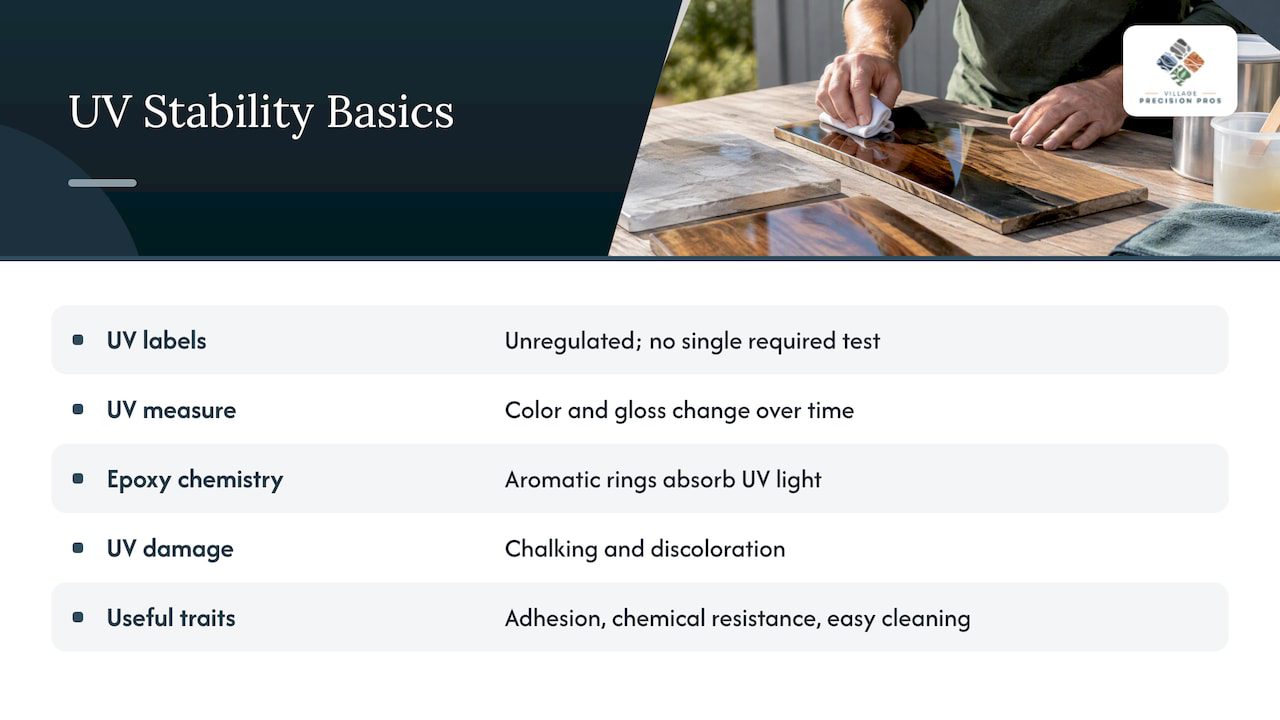
The terms UV stable and UV resistant are used almost interchangeably in marketing. They are not regulated labels, and there is no single test a product must pass to carry them. What you are really asking is how much a coating’s color and gloss change after months and years of sun.
The chemistry explains the problem. Epoxy in its common form is built on aromatic rings, and those rings absorb ultraviolet light. A 2014 study in the International Journal of Polymer Science describes the result: epoxies chalk and discolor under UV exposure because of photodegradation, which is why their exterior durability suffers. A separate 2019 paper from the University of Waterloo team says plainly that epoxy is a poor UV absorber and degrades under UV light, leading to discoloration.
This does not make epoxy a bad material. It is an excellent one: strong adhesion, chemical resistance, a dense and easy to clean surface. It is simply built for the job underneath the sun shield, not as the sun shield.
Yellowing is an oxidation problem
A 2022 study in Polymer Testing looked at how epoxy and vinyl ester resins yellow under heat, UV and natural aging. It assessed the usual fixes: air isolation, antioxidants and UV absorbers. Its finding is the one most product pages skip. Yellowing is fundamentally a radical oxidation reaction, so additives alone often disappoint, while keeping air away from the resin works best. In its tests, aromatic epoxy panels reached a yellow index of 26.09 after only 500 hours of exposure, and some delaminated before 1,000 hours.
You cannot isolate a patio from the air, but you can put a barrier layer between the epoxy and the sky. That is what a topcoat does.
Why the topcoat does the heavy lifting
An aliphatic urethane does not have the same UV-absorbing ring structure, so it holds color and gloss far longer in sun. Industry technical data sheets reflect this. One seamless UV epoxy binder data sheet describes the product as having good UV resistance, and it still calls for an aliphatic urethane topcoat over it. Even the product built to resist UV is not treated as the final exterior surface.
That is the layered logic we follow:
- Prepared concrete. Clean, profiled and tested for moisture.
- Epoxy primer and build coat. Bond, strength and fill for minor surface flaws.
- Aliphatic urethane topcoat. UV protection, gloss retention and abrasion resistance.
- Texture or grit additive where needed. Traction when the surface gets wet.
The epoxy is the foundation. The urethane is the shield. Think of it the way you think of a deck stain over lumber: the structure does the work, and the finish keeps the weather off it.
How to read a “UV resistant epoxy” label
When you see these products online or at a supply store, these questions sort the useful from the hopeful.
Is it aromatic or aliphatic?
An aliphatic formulation is the better starting point for anything seeing sun. Some commercial floor products, such as an aliphatic epoxy floor coating with a UV-resistant label, are formulated for this. Even so, read the data sheet for the intended environment and recoat guidance before assuming exterior use.
What is the product designed to be?
A casting resin for jewelry, a tabletop kit and a floor coating are different things. Many of the top search results for this topic are craft and tabletop resins, and their UV claims describe a small, flat piece, often indoors or on a covered table. A resin that stays clear on a river table is not proof of anything on a concrete patio that bakes in July, freezes in January and takes foot traffic. Likewise, adhesives sold as UV-resistant, such as marine-grade bonding products, are made for bonding fiberglass and plastic, not coating a slab.
Does the maker call for a topcoat?
If a technical data sheet recommends an aliphatic urethane topcoat for exterior or sun-exposed use, believe it. That is the manufacturer telling you its own epoxy is the base layer.
What do additives really do?
UV absorbers and hindered amine stabilizers are real and they help, but research keeps pointing to limits. The Waterloo group needed specialized nanofillers to make epoxy structurally resistant, and the silane work in the 2014 paper reported a 45% reduction in yellowing compared with neat epoxy. That is a meaningful improvement in a lab and still not the same as no yellowing. None of this is what you are buying in a standard jobsite kit.
Where epoxy works outdoors and where it does not
Here is how we sort sites in Central Arkansas, where summer sun is intense and humidity is high.
| Location | Sun exposure | Our usual approach |
|---|---|---|
| Garage floor and apron inside the door line | Low to moderate | Epoxy with a urethane topcoat, flake or metallic finish |
| Covered patio or porch | Moderate, indirect | Epoxy base with urethane topcoat and a traction additive |
| Open patio slab in full sun | High | Layered system, or consider pavers, stone or stamped options instead |
| Pool deck or lake-side surface | High, plus constant water | Often better served by masonry or textured hardscape |
| Steps and walkways | Varies, slip risk when wet | Usually stone or pavers, see our guide on outdoor step materials |
We go into the broader question in our guide to using epoxy flooring outside, and into patio specifics in our page on epoxy patio coating, prep and moisture testing.
Slip resistance is part of UV planning
A glossy, UV-stable topcoat that is slick when wet is a bad trade. Outdoor surfaces need grit or a textured finish, and you should check the result when the surface is wet, not dry. We wrote up how we correct this in fixing slippery epoxy floors.
Prep decides whether any of this lasts
A perfect UV system on a bad slab still fails. Outdoors, three things cause most of the trouble.
- Moisture vapor from below. Concrete on grade can pass moisture upward. Without a moisture test, bubbles and lifting show up within a season. A new slab should be fully cured before coating, and data sheets commonly specify a cure period of about 30 days. Check the sheet for the product in question.
- Dew point. Technical guidance for epoxy flooring warns against applying when the surface temperature is within 5 degrees Fahrenheit of the dew point, because blushing and improper curing follow. You can read that kind of application limit in a manufacturer data sheet. Arkansas mornings are humid, so timing the pour matters.
- Surface profile. The slab has to be mechanically ground or profiled so the coating grips. Acid etching is inconsistent, and a smooth trowel finish can reject the coating.
If you have cracks, settling or low spots, fix those first. Coating over movement just paints the problem. Our crews also handle foundation leveling and related services, and drainage planning is covered in our landscape water drainage guide. Standing water on a coated slab shortens its life far more than sun does.
When to choose something other than epoxy
Sometimes the honest answer is not a coating. An open, south-facing patio that you want to look the same in ten years is often better built from pavers, natural stone or stamped and sealed concrete. Those materials carry their color all the way through, so they do not rely on a thin film surviving sun.
If you go that route, joints deserve attention too. Sun, rain and temperature swings hit joint material just as hard as surface material, and this overview of outdoor joint solutions by surface shows how the right choice depends on the covering. For paver patios in our area, we also explain why timing matters when you set joints in our piece on polymeric sand problems.
A quick way to decide:
- Want a seamless, easy-to-clean surface and the area is shaded or covered? Epoxy with a urethane topcoat is a strong fit.
- Want long-term color in open sun, with minimal maintenance? Pavers, stone or stamped concrete usually win.
- Dealing with water edges, steps or slopes? Choose texture and drainage first, finish second.
Our perspective
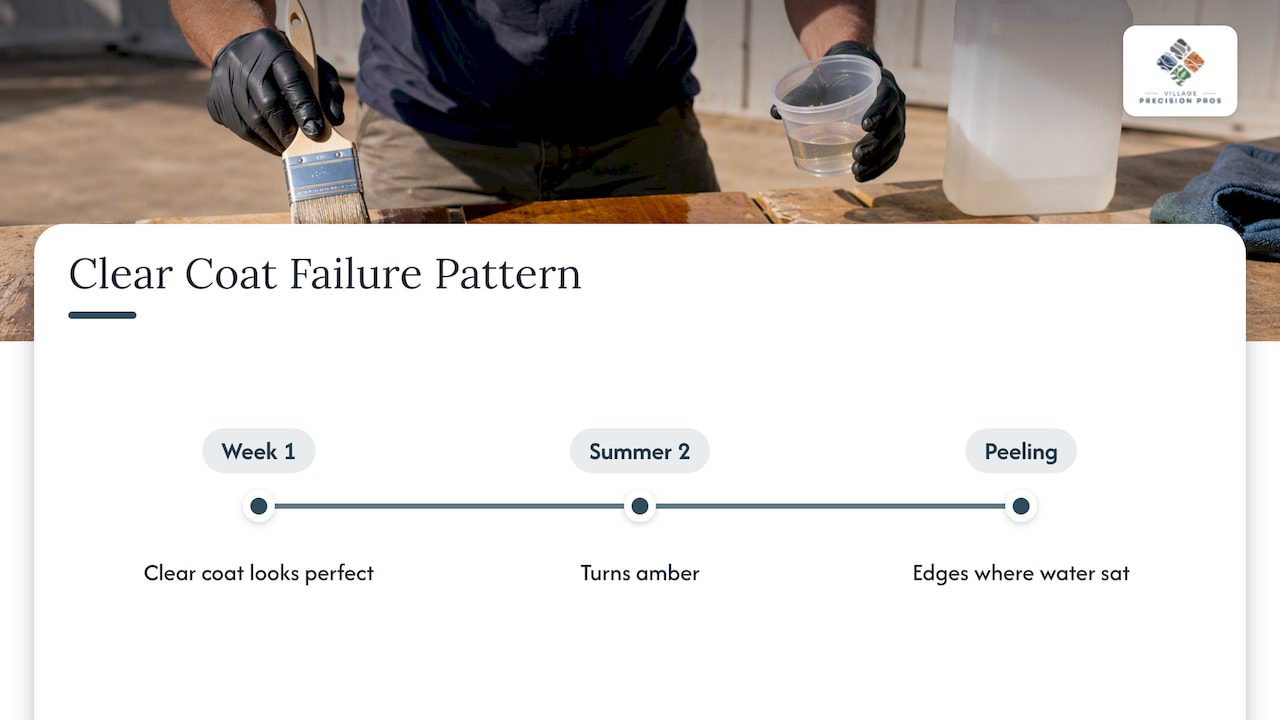
We get this question from homeowners who have already tried a kit. The pattern is consistent: a clear coat that looked perfect in week one turns amber by the second summer, then starts to peel at the edges where water sat. Nobody did anything careless. The product was simply asked to do a job its chemistry cannot do alone.
So we treat the epoxy as the structural foundation and the aliphatic urethane as the weather-defending shield. We tell clients up front when a slab sees too much sun for a coating to be the smartest investment, and we say so even when it means a different service from our menu. Our crews have completed more than 2,000 projects since 2020, and the ones that age best share the same habits: a tested slab, careful prep, the right layers and a finish chosen for how the space is used.
One more thing we tell everyone. Ask any contractor, including us, what the system is, what the topcoat is, and what the manufacturer’s data sheet says about exterior use. A good answer comes quickly and in specifics.
Ty
Care and recoating over the years
Even the best system is not permanent. Plan for these habits:
- Wash with mild detergent and a soft brush or mop. Harsh solvents and abrasive pads dull the topcoat.
- Keep leaf litter and standing water off the surface. Tannin stains and trapped moisture shorten finish life.
- Use furniture pads and lift, do not drag. Scratches let UV and water reach lower layers.
- Recoat the topcoat before the epoxy is exposed. A fresh urethane layer over a lightly scuffed surface is far simpler than a full strip. When you notice gloss fading in sun-facing areas, that is your cue.
Our annual maintenance plans let property managers and homeowners keep an eye on hardscape and outdoor surfaces as part of regular upkeep.
Working with Village Precision Pros
We design and install epoxy floors, patios, hardscapes and stone masonry for homeowners, real estate agents, property managers and businesses across Central Arkansas. If you have a garage, porch or patio and want to know whether a UV-stable system makes sense, we will look at the slab, test for moisture and tell you plainly what we would put on it. Start with our epoxy floors service page, or see how epoxy compares with other surfaces in our hardscape and stone masonry work. On cost, the main drivers are slab condition and repair needs, square footage, the number of layers, texture requirements and site access, which is why we quote after seeing the space.
FAQ
Does epoxy last outside?
It can, with the right conditions. In shade or under cover, a properly prepped epoxy system with a urethane topcoat can serve well. In direct sun, unprotected epoxy tends to yellow and lose gloss, as the research on epoxy photodegradation describes, so the topcoat is not optional.
What is a good UV inhibitor for epoxy resin?
UV absorbers and stabilizers help somewhat, but they are not a full fix, since yellowing is driven by oxidation. For anything outdoors, the more reliable protection is a separate aliphatic urethane topcoat over the cured epoxy.
Is UV resistant epoxy the same as UV stable epoxy?
In marketing, usually yes, and that is the problem. Neither term guarantees long-term color stability. Read the technical data sheet, check whether it is aliphatic, and see whether the manufacturer calls for a topcoat in sun-exposed use.
Can I use a craft resin or kit on a patio?
We would not. Craft and tabletop resins are formulated for small, mostly indoor pieces, and a concrete slab faces moisture, heat swings, abrasion and constant sun. For a slab, use a floor-grade system installed over a tested, profiled surface.
Sources
- Effect of Methyltrimethoxy Silane Modification on Yellowing of Epoxy Coating on UV (B) Exposure
- Tailored cellulose nanocrystals as a functional ultraviolet absorbing nanofiller of epoxy polymers
- Yellowing mechanisms of epoxy and vinyl ester resins under thermal, UV and natural aging conditions
- USI seamless UV resistant epoxy binder technical data
- DURALTEX UV technical data sheet
- J-B Weld product catalog