

Tree moonlighting is a landscape lighting technique that places a small, warm light high in a mature tree and aims it down, so the branches cast soft, moving shadows across the lawn, patio or path below. Done well, it looks like real moonlight filtering through leaves. Done poorly, it looks like a floodlight in a tree. The difference comes down to height, brightness, color and who does the climbing.
This guide explains how moonlighting works, which trees suit it, how to choose and aim fixtures, and how to protect both the tree and your neighbors’ night sky.
TL;DR
- Moonlighting is downlighting from high in a tree. The light is soft and aimed gently down, so branches throw natural shadows on the ground below.
- Large, tall deciduous trees near a patio, deck or seating area work best, because their leaves and branches create a dappled pattern.
- Use warm-toned LED fixtures, keep the source hidden, and avoid anything bright enough to glare.
- Fixtures go very high, so hire a trained, equipped crew. Tree-friendly mounting hardware protects the tree for years.
- Moonlighting pairs well with uplighting on the same tree, and a timer or dimmer keeps it gentle on trees and wildlife.
Table of Contents
- What tree moonlighting is and how it creates the effect
- Moonlighting vs. uplighting and other tree techniques
- Which trees and locations work best
- Height, fixture placement and aiming
- Fixtures, brightness and color
- Protecting the tree
- Why the installation is a job for trained crews
- What shapes the total for a moonlighting project
- Moonlighting in Arkansas yards
- Our perspective
- Plan your tree lighting with us
- FAQ
- Sources
What tree moonlighting is and how it creates the effect
The name says it: you are recreating the look of the moon shining through a tree. Instead of lighting a tree from the ground, you mount the fixture up in the canopy and shine it downward. Light passes through leaves and around limbs, and the ground picks up a soft pattern of light and shadow that shifts slightly when the breeze moves the branches.
That is what separates moonlighting from most other outdoor lighting. Most fixtures call attention to an object, such as a trunk, a wall or a statue. Moonlighting lights a space. The tree becomes the source, and the patio, lawn or garden bed beneath it becomes the scene. Kichler’s tree lighting guide describes it as high-mounted downlighting that casts natural, subtle light and shadows, in contrast to uplighting, which sits at ground level and highlights tree structure and trunk texture.
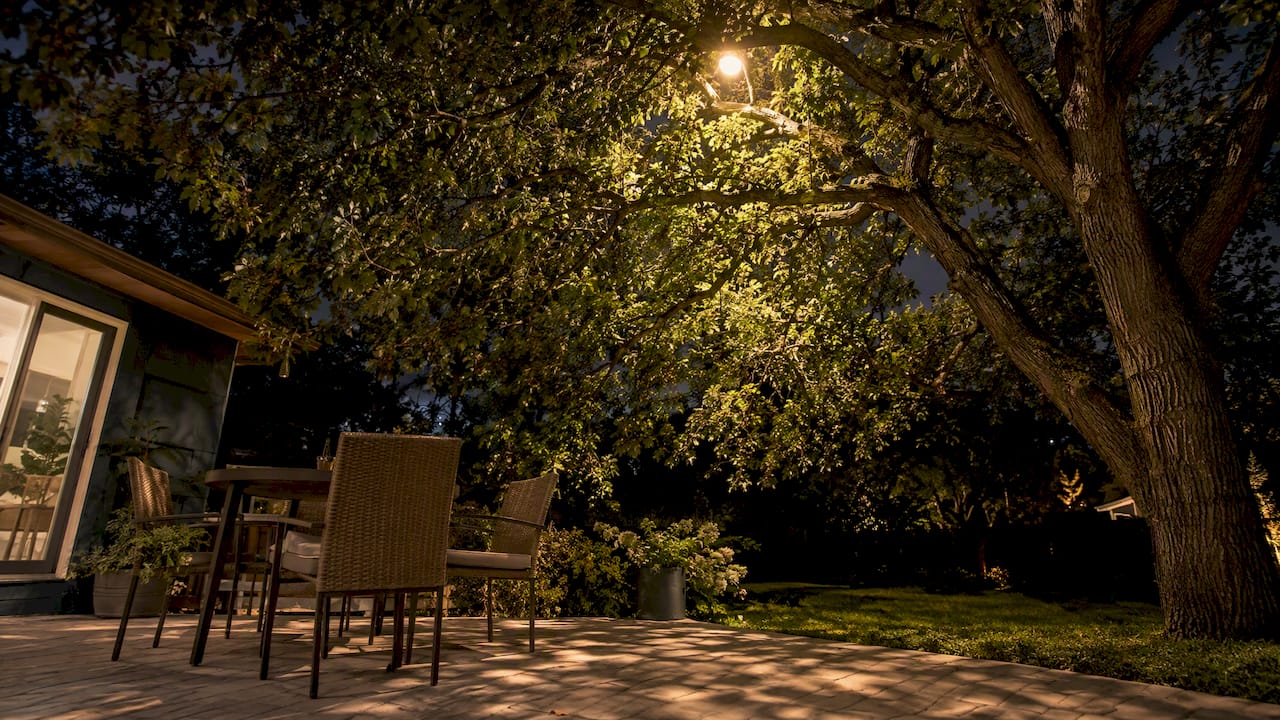
Design writers describe the goal the same way: intimacy rather than brightness. A Livingetc feature on garden moonlighting recommends warm-toned LED spotlights mounted high and angled gently downward, with the angle kept subtle so you avoid harsh beams.
Why homeowners choose it
Moonlighting solves a common problem: a patio that looks good by day and feels dark and flat after sunset. Wall lights and path lights illuminate the edges. A high, soft light from above fills the middle, so people can see faces, food and steps without feeling spotlit.
Three practical benefits stand out:
- Usable evening space. A seating area under a mature tree becomes comfortable after dark without a bright overhead fixture.
- Fewer fixtures on the ground. One well-placed light can cover an area that would otherwise need several path or wall lights.
- A natural look. There is no visible hardware at eye level, which suits a landscape where you want the lighting to feel like it belongs.
Moonlighting vs. uplighting and other tree techniques
The two techniques do different jobs, and they are often combined.
| Technique | Fixture position | What it does | Best for |
|---|---|---|---|
| Moonlighting (downlighting) | High in the canopy, aimed down | Soft light and branch shadows on the ground | Patios, seating areas, lawns, garden beds |
| Uplighting | At ground level, aimed up | Highlights trunk texture and branch structure | Trees with strong form, bark or canopy shape |
| Combined | Both | Depth from the ground to the canopy and the surface beneath | A signature tree that anchors the yard |
Kichler notes that uplighting and downlighting can be used together on the same tree for maximum effect. That is our usual approach on a standout tree: a gentle moonlight from above for the space below, plus restrained uplighting to keep the trunk and lower limbs from disappearing. If your tree has attractive bark or a bare trunk you want to feature, our guide to tree uplighting ideas covers that side of the design.
Which trees and locations work best
Not every tree is a good candidate. Look for these traits:
- Size and height. Kichler recommends a large, tall deciduous tree near an outdoor living space, with branches that start high up. A smaller tree can also work, but the effect changes with the height of the fixture.
- Deciduous leaves and branching. Deciduous trees tend to create a dappled pattern on the ground, and fixtures are generally easier to mount in them, according to a 2025 landscape lighting article. In Central Arkansas, oaks, maples and sweetgums are common mature shade trees that fit this description. Check with a certified arborist if you are unsure of your tree’s health.
- Location. The tree should be close enough to the area you want to light that the light reaches it. A tree at the edge of the property that is nowhere near a patio, deck or walkway adds little.
- Structure. Strong, healthy limbs with no dead wood. A tree in decline is a poor place to put hardware and a poor investment.
Because leaves filter the light, a thick evergreen canopy will block more than it passes. In winter, a deciduous tree will have fewer leaves and the shadows become sharper and more graphic. Plan on the pattern changing with the seasons. Many homeowners like that.
Height, fixture placement and aiming
Height is where moonlighting succeeds or fails. Kichler’s guidance places a 60° accent light at least four feet above the lowest tier of branches, ideally around 20 to 25 feet high, aimed downward to create branch shadows. The goal is that nobody can see the light source or be blinded by it.
Here is how we think through placement:
- Start from the ground. Stand where people will sit and look up. Identify the limbs that will hide the fixture from every seat and from the house windows.
- Choose the branch. Pick a sturdy limb high enough to spread the light and create shadows. Higher mounting widens the pool of light and softens its edge.
- Set the angle. Aim down and slightly outward, not straight down onto a single spot. A subtle angle avoids harsh beams and hot spots.
- Check from several seats. After a test at dusk, adjust. Move any fixture that creates glare for your guests or the neighbors.
- Layer carefully. If the tree is large, one fixture may be all it needs. Kichler’s example for downlighting describes one 60° accent light in a suitable tree. Add a second only if there is a clearly unlit zone.
The number of fixtures depends on the tree’s canopy and the size of the space, not on a formula. Fewer, better-placed lights nearly always look more natural.
Fixtures, brightness and color
The fixture for moonlighting is a small LED spotlight or accent light on a low-voltage system. Low-voltage systems, typically 12V in the U.S., are the common choice for residential landscape lighting, and they are safer and easier to run around the yard than line-voltage wiring. If you want background on how those systems are laid out, our low-voltage outdoor lighting installation guide explains the components. For fixtures you plan to add to nearby walls, this outdoor wall lights buying guide shows the range of styles that can sit alongside the tree light.
What to look for:
- Warm color. Choose warm-toned LEDs. Cool white light reads as clinical and harsh, and it carries more blue light, which draws insects and can bother wildlife.
- Low output. Moonlighting is supposed to be subtle. If the light is bright enough to read by, it is too bright. One common complaint from lighting designers is the use of oversized, high-wattage fixtures in trees that wash everything out, which defeats the natural look.
- Shielding. A fixture that hides the bulb or has a built-in shield or louver keeps glare out of eyes and out of neighboring windows.
- Weather-rated housing. The fixture will sit in rain, ice and summer heat for years, and it is expensive to reach, so build quality matters more than usual.
The International Dark-Sky Association’s residential lighting guide emphasizes fully shielded fixtures to reduce glare and light trespass, which also lets human eyes adapt naturally to lower light levels. That principle fits moonlighting well: lower light, better aimed, looks better and works better than more light.
Protecting the tree
A tree is a living thing you are attaching hardware to, so how you mount matters as much as where.
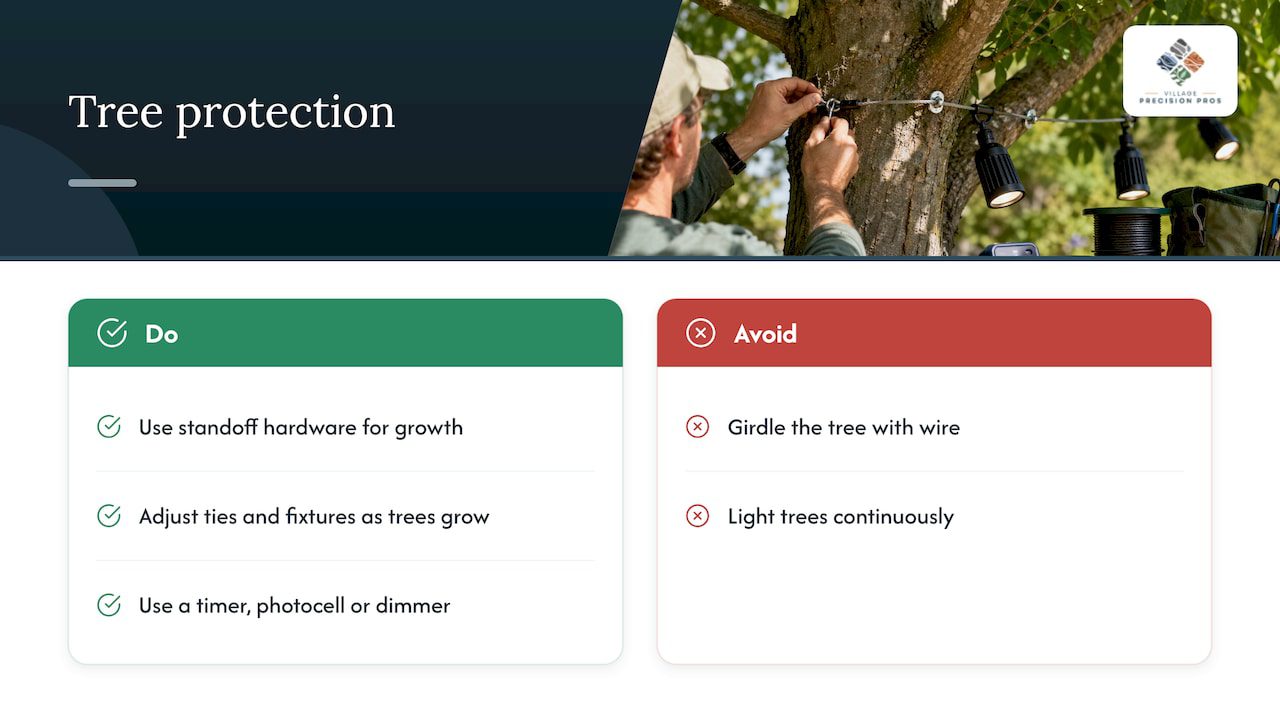
Use tree-friendly mounting. Volt Lighting describes a Tree Light Management Kit that uses screws, spacers and zip ties to secure fixture wire in a way that is gentler on the tree. Standoff hardware matters because a tree keeps growing. Without room for growth, bark can swallow brackets and staples or be girdled by wire, and fixtures and cable end up buried in the trunk.
Plan for growth. Whoever installs the lights should expect to come back and adjust the ties and fixture position as the tree grows. A maintenance plan for the property can include a check of the fixtures after the growing season.
Limit the hours. Artificial light at night can interfere with the natural processes of trees, including dormancy, flowering and growth patterns, according to Purdue Extension. Purdue recommends turning lights off or dimming them during off-peak hours rather than lighting trees continuously. A timer, photocell or dimmer does this automatically, and moonlighting is meant for the hours when you are outside anyway.
Consider insects and neighbors
A 2021 Smithsonian study in a tropical forest found that amber-filtered LEDs that remove blue light reduced insect attraction compared with white LEDs. The same Smithsonian guidance recommends full-cutoff fixtures, motion activators and dimmers so that light is used only when and where it is needed. The study took place in Peru, not in Arkansas, but the lesson carries over: warm, shielded, dimmable light is gentler on the night environment and more pleasant on your patio.
Why the installation is a job for trained crews
The fixture sits 20 to 25 feet up, or higher, in a living tree. That is a fall risk, an electrical risk and a tree-health risk. Volt Lighting cautions against installing high-mounted downlights without proper equipment, skill and experience, and the 2025 article above also recommends hiring people who are trained and equipped to work high off the ground.
This is not a weekend ladder project. A professional crew will:
- assess the limb strength and tree health before attaching anything,
- use proper climbing or lift equipment and safety gear,
- mount with standoff hardware rather than nails or bare staples,
- route low-voltage wire neatly down the trunk and underground to the transformer,
- test the aim at dusk and adjust until the light source is hidden and the shadows look natural.
We also look at where the cable will run through the yard before anyone digs, which is why we pair this kind of work with a lighting layout. Once a patio, path or turf area is finished, adding a wire afterward can mean cutting into finished work. Our piece on landscape lighting layout explains why planning conduit and wire runs early saves trouble. If you have a new patio or deck planned, tell us about the tree before the hardscape goes in.
What shapes the total for a moonlighting project
We do not quote numbers in an article, because every yard is different. These factors drive the total:
- Tree height and access. Taller trees and tight access need more equipment and time.
- Number of fixtures. One light in one tree is a small project. Multiple trees with layered uplighting and downlighting are larger.
- Distance from the transformer. Longer wire runs mean more trenching and more material.
- Controls. Timers, dimmers and smart controls add to the system but give you finer control of the effect and hours. See our overview of smart landscape lighting for what is possible.
- Ground conditions. Rock, roots, pavers and existing irrigation affect how wire gets from point to point.
For a broader view, our guide to what drives outdoor lighting installation totals walks through the same factors, and our landscape lighting design guide shows how moonlighting fits with the rest of a plan.
Moonlighting in Arkansas yards
Central Arkansas has what moonlighting needs: mature hardwoods, long summer evenings, and patios and decks that get used from spring through fall. Lake properties and wooded lots often have tall trees close to the house, so a single high fixture can light a deck, a stairway or a walk to the water. Our collection of outdoor lighting ideas for Arkansas landscapes shows how homeowners here combine tree lighting with path and accent lighting.
Winter storms are worth planning for. Ice and wind can bring down limbs, so fixtures and wire should be installed with slack for movement, and the tree should be inspected before and after storm season. A professional installation accounts for that.
Our perspective
We have been designing and building outdoor spaces in Central Arkansas since 2020, and more than 2,000 projects have taught us one thing about lighting: it should finish a space, not decorate it. Moonlighting is the clearest example. When it is right, nobody asks where the light is coming from. They just notice that the patio feels good at night.
Our approach is to treat the tree as part of the design. We look at the patio, the sight lines from the house, the health of the tree and the path of the wire before we choose a fixture. Our crews care about quality materials and clean craftsmanship, which means tree-friendly mounting, hidden sources, warm color and restrained brightness.
We also think lighting belongs in the plan early. A patio, walkway or deck built with lighting in mind costs less in effort and disruption than one that has to be opened up later. That is why we bring lighting into the same conversation as hardscape, drainage and planting, so each part supports the others.
If you have a mature tree beside your outdoor living space, it is probably already the best lighting fixture you own. Our job is to help it do the work.
Ty
Plan your tree lighting with us
Village Precision Pros designs and installs outdoor spaces across Central Arkansas for homeowners, property managers, real estate agents and business owners. If you are building or upgrading a patio, deck or hardscape and want the tree above it to light the evening, we can plan the lighting with the project. Browse our decks and patios work or see everything we offer on our services page.

For ongoing care, our annual maintenance plans can include seasonal checks so your lighting and landscape keep looking as designed. Visit Village Precision Pros to request a consultation.
FAQ
How high should moonlighting fixtures be mounted?
Kichler’s guidance puts the fixture at least four feet above the lowest tier of branches, ideally about 20 to 25 feet up. Height widens the spread and softens the edge of the light. A smaller tree can work, but the effect is more focused.
Can I use moonlighting on an evergreen tree?
It is possible, but deciduous trees give a better result. Their leaves and branches create the dappled shadow pattern on the ground, and fixtures are easier to mount in them. A dense evergreen canopy tends to block the light instead of filtering it.
Does moonlighting harm the tree?
Not when it is installed with tree-friendly hardware and run on a schedule. Standoff mounting and spacers leave room for growth, and Purdue Extension recommends dimming or switching lights off during off-peak hours. Avoid nails and tight wire wraps, which can damage bark as the tree grows.
Can I install tree moonlighting myself?
We recommend a trained crew. The fixtures go very high in a living tree, and manufacturers advise against installing high-mounted downlights without proper equipment, skill and experience. A professional also gets the aim, wire routing and tree protection right the first time.
Can I combine moonlighting with uplighting?
Yes. Kichler notes the two can be used on the same tree for maximum effect. Downlighting lights the space below, while uplighting brings out the trunk and structure. Keep both subtle so the tree still looks natural.
Sources
- Tree Lighting Techniques & Tips, Kichler Lighting
- Why You Should Be Moonlighting Your Garden, Livingetc
- What is Landscape Moonlighting?
- Guide to Outdoor Downlighting, Volt Lighting
- Does Night Lighting Harm Trees? Purdue Extension
- Smithsonian study on artificial light at night in tropical forests
- IDA Practical Guide to residential lighting
- Outdoor Wall Lights: Complete Buying Guide