


A soggy backyard is almost always a water-routing problem, not a lawn problem. Water is arriving faster than the ground can take it, or it has nowhere to go once it arrives. The fix starts with finding out which, and the answer usually points to one of a handful of repairs: redirect roof water, regrade low spots, loosen compacted soil, or add a drain that carries water to a safe outlet.
Below, we walk through how to read your yard, the fixes in the order we would try them, and when it is time to bring in a crew.
TL;DR
- A healthy yard clears standing water within about 48 hours of a rain event. If yours stays wet longer, something is wrong with grade, soil or roof runoff.
- Walk the yard during a rain and map where water collects and where it comes from before you dig anything.
- Start with the simple repairs: extend downspouts, clear swales, fix irrigation settings, and relieve compaction with organic matter.
- If surface fixes fall short, a French drain, a regraded yard or a rain garden can move or absorb the water, as long as the outlet is legal and does not erode.
- Cost depends on access, soil, the length of the run and the outlet, so get a site visit before you compare numbers.
Table of Contents
- Why your backyard stays soggy
- Diagnose before you dig
- Fixes to try first
- Regrading low spots and slopes
- When you need a drain
- Let the yard absorb it
- Matching the fix to the symptom
- Our perspective: fix the water path first
- When to call a pro
- Work with us in Central Arkansas
- FAQ
- Sources
Why your backyard stays soggy
Water pooling in a yard has a short list of causes. Most yards have more than one at work.
- Low grading. The spot sits below its surroundings, so water runs in and has no path out.
- Roof runoff. Gutters and downspouts that dump next to the house or onto flat ground load one area with far more water than rain alone would.
- Compacted soil. Construction traffic and foot traffic crush the pore spaces that let water move down. The Iowa State Extension notes that compaction is especially common around new construction, and that walking or driving over soil limits the oxygen and water that can enter it.
- Dense subsoil or hardpan. Water soaks into the top few inches, then stops at a layer that will not let it through.
- High water table. In wet seasons, groundwater sits close enough to the surface that the soil is already full.
- Over-irrigation. Many drainage complaints trace back to sprinkler schedules and roof runoff, which is why the county drainage guidance suggests checking those before any earthwork.
The University of California guide to yard drainage points out that most minor garden and lawn drainage trouble comes from clay soil, which is dense and drains slowly. If your yard turns sticky and slick after a storm and cracks in a dry spell, clay is a likely suspect.
Diagnose before you dig
A fix aimed at the wrong cause wastes a weekend and sometimes makes things worse. Spend one rainy afternoon and one dry one on diagnosis.
Walk the yard during a rain
Put on boots and go out while it is raining, or right after. Note where water enters the yard, where it collects, and where it leaves. Look at every downspout outlet. Look at the neighbor’s side of the fence line and any slope above you. Take photos and mark the wet spots with flags. Local drainage guidance describes this mapping as the step that often shows the answer is a few targeted changes, such as extending downspouts or clearing swales, rather than a full yard overhaul.
Run the hole test
Dig a hole about twelve inches deep in the wet area and fill it with water. Colorado State Extension says a hole that has not drained in thirty minutes signals a drainage problem, and one that is still full after twenty-four hours points to waterlogged conditions. The Arkansas Extension service also recommends a simple fill-the-hole drainage test before you plant or amend a bed.
Repeat it in two or three spots. A dry hole in one area and a full one in another tells you the problem is local, which usually means grade or compaction rather than the whole yard.
Watch the clock
If the yard is still wet two days after a rain, treat it as a real drainage problem. A single heavy storm can leave a wet lawn for a day. A yard that stays boggy for a week is telling you something about its grade, soil or water source.
Before you dig anywhere, call 811 so buried utility lines are marked. It takes a few days, so make the call early.
Fixes to try first
These are the repairs we would do before spending serious money. Each one removes water or improves the soil’s ability to take it.
1. Send roof water away from the house
A roof sheds a lot of water in a short time, and a downspout that ends at the foundation concentrates all of it in one place. Extend downspouts at least eight to ten feet from the foundation, so the water does not soak in and cycle back toward the house. Use solid pipe buried at a steady slope, or a splash surface that spreads the flow. Our guide to downspout drainage ideas covers the options in more detail.
2. Clear and shape the paths water already uses
A shallow swale, a planted channel that carries water across the yard, can do quiet work when it is the right depth and slope and free of debris. Leaves, soil build-up and thatch can block an existing swale. If you need to cut a new one, see our notes on drainage swale design.
3. Check the irrigation
If the wet area appears even in dry weeks, look at the sprinkler zone that covers it. A stuck valve, a leak or a schedule set for summer heat in October will keep ground saturated. Adjusting a controller costs nothing and rules out a cause. If you suspect a broken line, our landscape and irrigation service can trace it.
4. Stay off wet turf
Walking or mowing on saturated soil squeezes out the air spaces that drainage depends on. Soil scientists at the University of Nebraska make the point that compaction is much easier to prevent than to repair. Wait until the surface firms up before you mow, and route traffic along one path instead of across the whole yard.
5. Rebuild the soil, not just the surface
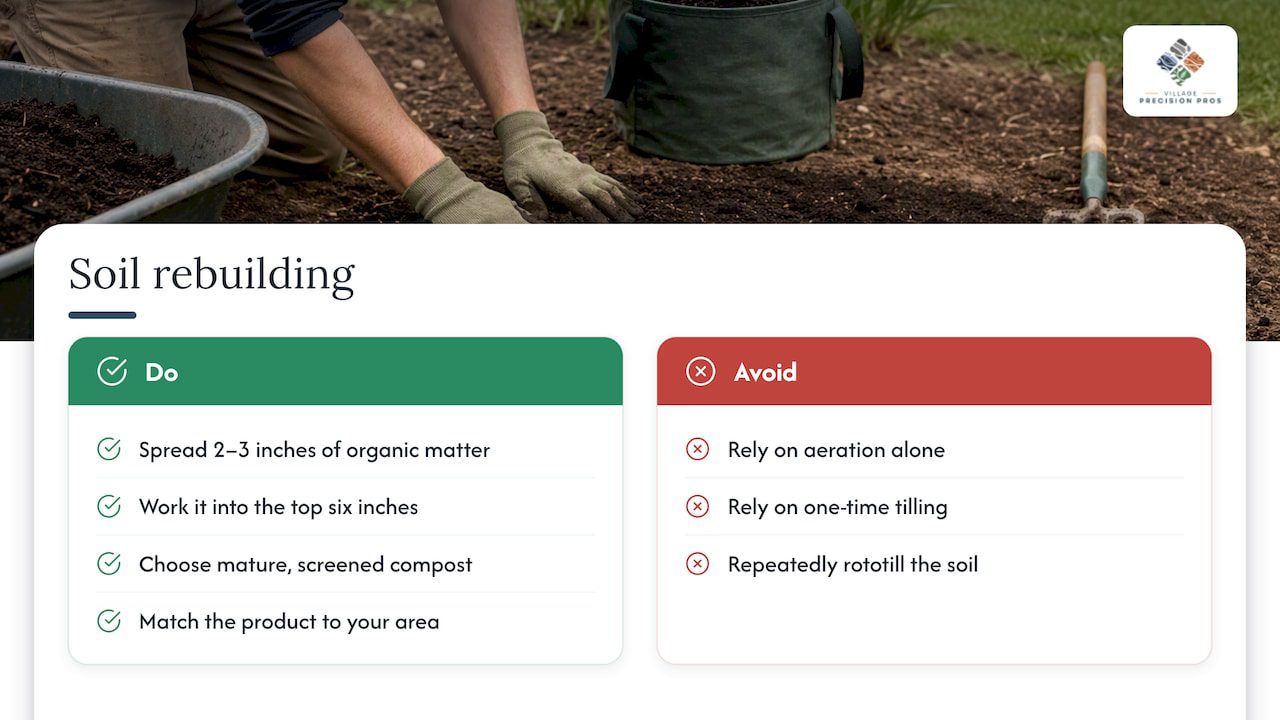
Renting an aerator or tilling the area once will not hold. The same Nebraska guidance warns that tilling or aerating in isolation is not a lasting answer, and that repeated rototilling breaks down the soil aggregates that let water move. The better approach is to spread a two to three inch layer of organic matter such as compost and work it into roughly the top six inches. That builds structure that lasts through many storms.
Quality matters here. A mature, screened compost, such as a bagged organic compost sold for garden beds, mixes in evenly and does not tie up nitrogen the way raw material can. Match the product to your area and buy from a supplier near you if you are ordering by the yard.
Regrading low spots and slopes
When the wet area is a depression, no amount of aeration will fix it. The answer is to fill it, reshape it and give water somewhere to go.
Colorado State Extension recommends a grade of at least one to three percent so surface water flows away from where it is a problem. Near the house, the ground should fall away from the foundation, never toward it. One to three percent is a gentle slope, about one to three feet of drop over a hundred feet, so it is often invisible to the eye and easy to get wrong without a level and string line.
A sound regrade follows this order:
- Mark the high and low points and decide where water will leave the yard.
- Strip sod from the low area and set it aside.
- Build up with suitable fill in thin, compacted lifts, not one deep dump of loose soil that will settle into a new dip.
- Shape a continuous slope toward the outlet.
- Top with topsoil, re-lay sod or seed, and protect the area until it roots.
The fill has to be the right material. Pure clay stacked on clay just makes a new pond. For a full walk-through, read how to level an uneven yard.
If a low corner is simply too wet to fill and you want to use it, gravel can help. A layer of clean drainage stone near the house breaks up pooling along the foundation, and this guide to using drainage stone around a house explains how stone size affects flow. Stone is a surface measure, though. It does not replace a proper slope.
When you need a drain
If grading and downspouts do not solve it, subsurface drainage may. Colorado State Extension describes the common option: a French drain, a gravel-filled trench with a perforated pipe, which intercepts water and sends it to a gravity-flow outlet.
What makes a French drain work
- Continuous fall. The pipe must slope toward the outlet along its full length. A flat or sagging pipe holds water.
- A real outlet. Daylight at a lower point, a storm inlet you are allowed to use, or a dry well sized for the load.
- Clean stone and fabric. Clean, washed stone around the pipe, with filter fabric to keep silt out. Silt is what kills most older drains.
- Placement. The trench goes where the water is, usually uphill of the wet zone or along the wet edge, not in the middle of it.
Our article on when a French drain beats a sump pump goes deeper on that decision, and our broader piece on yard drainage solutions covers the sequence we suggest.
Where the water goes matters
The outfall is where many do-it-yourself drains go wrong. Water discharged onto a slope can erode it. An outlet less than eight to ten feet from your foundation can recycle the water into your own house. And pointing a discharge at a neighbor’s lot or across a sidewalk or curb is often illegal and creates liability. Rules vary by city and county, so check with your local planning or public works office before you route water toward a street or property line.
Let the yard absorb it
Not every wet spot needs piping. Some are better handled by giving water a place to soak in.
Rain gardens
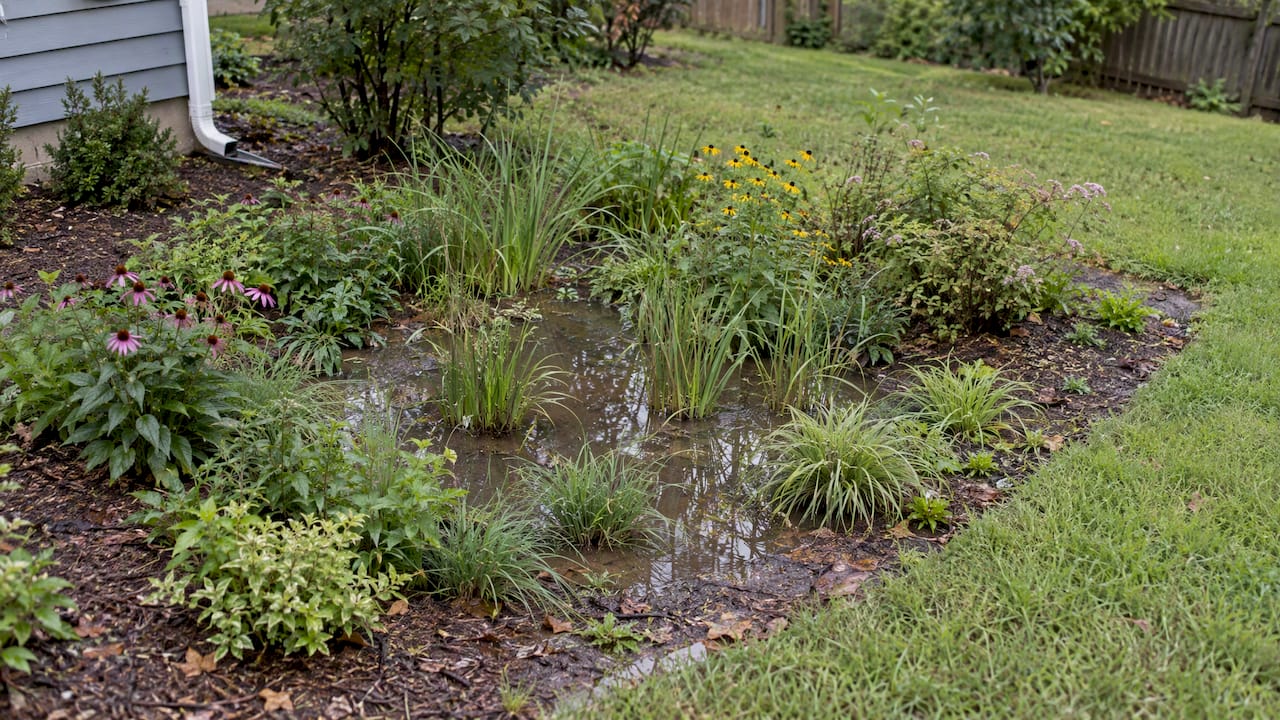
A rain garden is a depressed, planted area that collects runoff from a roof, driveway or street and lets it soak into the ground, as the EPA describes. The University of Minnesota Extension adds that a rain garden can remove pollutants and slow erosion. Local guidance suggests keeping one at least ten feet from a building foundation. Rain gardens work best where the soil still drains reasonably well once amended. In dense clay, they often need an underdrain. See our rain garden design guide for sizing and plant choices.
Permeable surfaces
If the soggy zone is next to a patio or walkway, the paving may be part of the cause. The EPA lists permeable pavement options such as pervious concrete and interlocking pavers that let rain pass through instead of running off. If you are planning new hardscape, ask about a permeable paver patio, and make sure any patio you build has the slope it needs to shed water.
Green infrastructure in general
The EPA’s overview of green infrastructure types includes bioretention areas, which let water pond temporarily and then soak in or pass through an underdrain. These systems work with natural infiltration, which is why they tend to need less upkeep than hidden pipework when they are designed well.
Matching the fix to the symptom
| What you see | Likely cause | First move |
|---|---|---|
| Wet strip along the house after rain | Downspouts or flat grade at the foundation | Extend downspouts, regrade away from the wall |
| One low pocket that holds water for days | Depression in the grade | Fill, compact and reshape toward an outlet |
| Whole yard spongy, even in dry spells | Overwatering or high water table | Check irrigation, then consider a drain |
| Hard, shiny soil with puddles on top | Compaction | Stay off it, add organic matter, then aerate |
| Water arrives from uphill or a neighbor | Runoff from outside your yard | Swale or French drain at the high edge |
| Wet zone beside a patio or driveway | Hard surface shedding water onto turf | Redirect, add permeable surfaces or a drain |
Our perspective: fix the water path first
We have built and repaired outdoor spaces across Central Arkansas since 2020, and the pattern is consistent. People call about a soggy lawn, and the lawn is rarely the real issue. A downspout empties at the corner of the patio. A new walkway blocked the old runoff path. A back corner sits half a foot lower than the fence. Treating the grass does nothing when the water has no route.
Our approach is to combine function with appearance, so the drainage work does not have to look like drainage work. A swale can be planted so it looks like it grew out of the landscape. A buried pipe disappears under sod. A dry creek bed of river stone is both a channel and a feature. We like quality materials and compacted aggregate bases because they hold their shape through repeated freeze and thaw and heavy rain, and that is what keeps a repair from coming back in two years.
We would also tell you when not to hire us. If extending a downspout and cutting back a clogged swale fixes it, do that. Spend money on the larger work only when the diagnosis calls for it, and make sure whoever you hire explains where the water will go once the work is done.
Ty
When to call a pro
Call a professional if any of these apply:
- Water reaches the foundation, crawl space or garage, or you see cracks, staining or doors that stick.
- The wet area has not improved after you fixed downspouts and irrigation.
- The only exit for the water is toward a neighbor, a street or a slope that could erode.
- You need a regrade of more than a small patch, or a trench run over a long distance.
- The yard sits on a lake shoreline or steep bank where erosion is part of the story. Our piece on hillside erosion solutions covers that case.
Foundation movement is its own question. If you suspect settling, a structural engineer or foundation specialist should assess it. We can level the ground and manage the water around the house, which is often part of preventing further movement.
What drives the total for a drainage project is straightforward: how much of the yard has to be opened, how deep and long the trench or regrade runs, the soil you are working in, whether utilities or tree roots are in the way, how far the water has to travel to a legal outlet, and what you want the finished surface to look like. A site visit tells you more than any general figure could.
Work with us in Central Arkansas
Our crews handle drainage, grading and the hardscape and landscape work that goes with it. If your soggy backyard needs a regrade, a drain, a new patio laid on a proper base or a planted swale, start with our landscape and irrigation service or see the full list of services. For homes and commercial properties that need steady upkeep after the work is done, we also offer annual maintenance plans. To talk through your yard, reach us through our website.
FAQ
How long should a yard stay wet after rain?
A yard with adequate drainage should clear standing water within about two days of a rain event. If water lingers longer, look for compaction, a low grade, high groundwater or roof runoff dumping in one spot. A single very heavy storm can be an exception.
How do I dry out a soggy lawn quickly?
Keep off the turf, redirect any downspouts or sprinklers feeding the area, and let the surface firm up before mowing. Quick fixes only take the edge off. For a lasting result, you need to fix the grade or soil that is holding water, and that usually takes a few weeks or a repair project, not a day.
Is a French drain the best fix for water pooling in a yard?
Only sometimes. A French drain works well when water moves through the soil toward a wet area and you have a legal outlet downhill. If the cause is a downspout or a low pocket, extending the downspout or regrading is simpler and often enough.
Can I fix backyard drainage problems myself?
Yes, for the small ones. Extending downspouts, clearing a swale, adjusting irrigation and adding organic matter are manageable weekend jobs. Call 811 before digging, and bring in a professional when water threatens the house or has to cross a property line.
Sources
- A Homeowner’s Guide to Drainage Problems and Solutions, Prince George’s County
- Soil Drainage, Colorado State University Extension
- Testing and Improving Soil Drainage, Iowa State Extension
- Manage Soils to Improve Drainage and Prevent Compaction, University of Nebraska
- Garden Drainage, University of California
- General Info: Soils, University of Arkansas Extension
- Building a rain garden, University of Minnesota Extension
- Soak Up the Rain: Rain Gardens, US EPA
- Soak Up the Rain: Permeable Pavement, US EPA
- Types of Green Infrastructure, US EPA