


The main patio edging options are brick, stone, concrete, metal, plastic and wood. The right one depends on your patio surface, your soil and how much upkeep you want. If your patio is built from interlocking pavers, you also need a true edge restraint, because the edge is what holds the whole surface together. Below we walk through each material, how it behaves in practice, and how to match it to a Central Arkansas yard.
TL;DR
- Brick, stone and concrete give a permanent, natural look. Steel and aluminum give clean lines and bend around curves. Plastic is the easiest to install but the shortest-lived.
- Pavers need an edge restraint. Without one, the surface can shift and separate, especially under traffic and weather.
- Edging only works on top of a compacted base and a surface that sheds water. Get the grade and base right first.
- Heavy clay soil, frost heave and drainage all affect which edging holds up. Match the material to the site, not just the look.
- Our crews build edging into the patio itself, so the edge, base and drainage are planned together.
Table of Contents
- What patio edging actually does
- Patio edging options, material by material
- Quick comparison
- Paver edge restraints: the part you cannot skip
- Match the edging to your site
- The base and the grade decide how long any edge lasts
- Perspective
- Care and maintenance through the year
- Let us build the edge and the patio together
- FAQ
- Sources
What patio edging actually does
Edging is not decoration alone. K-State Research and Extension describes edging as a way to contain spreading grass and path materials, define the space, reduce maintenance and help prevent erosion or washout.
In our work, a good patio edge does three jobs:
- It holds the surface in place. Loose materials such as gravel, pea gravel or crushed stone, and the outer pavers on a segmental patio, need something firm at the perimeter.
- It draws a clean line. The border between patio, lawn and planting beds is the first thing people notice. A crisp edge makes the whole space look finished.
- It handles daily pressure. Foot traffic, heavy outdoor furniture, mower wheels and shifting ground all push on the perimeter.
If an edge fails at any one of those, you see it quickly: a wavy line, pavers that tilt at the border, gravel spilling into the grass.
Patio edging options, material by material
Brick and paver borders
Brick is the classic choice. It is typically laid in a narrow trench, and it can be set vertically, at an angle for a toothed look, or over a concealed footing so the edge nearly disappears. K-State notes that bricks and pavers come in numerous shapes and colors, follow curves and grade changes, and can be laid flat, on edge, upright or on a diagonal.
A flat row of brick or small setts set level with the lawn is often called a mower strip. The mower wheel rides on it, so you do not need a string trimmer along the border. We like it where a patio meets turf because it cuts the trimming work.
Best for: traditional homes, brick or stone patios, and anyone who wants a border that matches the main surface.
Natural stone
Stone edging can be flagstone, pebbles, rocks or boulders. It suits a natural, relaxed look, and a stone border can look like it grew out of the landscape when the colors echo the patio. Larger stones give a bold edge. Smaller stones are easier to set along tight curves.
Stone is permanent and takes very little upkeep, but it needs a stable base so individual pieces do not settle unevenly. If your patio is built from natural stone, a stone border is usually the most cohesive choice. Our hardscape and stone masonry work covers this kind of detail.
Poured or cast concrete
Concrete edging helps retain the paving and can double as a mowing strip. It can be smooth or finished decoratively, with color or texture. Because it is rigid and continuous, it gives a very firm perimeter and is one of the more permanent options.
The trade-off is that a rigid edge asks for a properly prepared base and sensible joints. Done well, it shrugs off years of traffic.
Best for: driveways turned patios, large entertaining areas, and homeowners who want a set-and-forget border.
Steel and aluminum
Metal edging is sleek and nearly seamless, and it is among the most durable choices. University of Illinois Extension reports that metal, including steel and aluminum, is among the longest-lasting edging materials. Steel or aluminum can also bend around curves, which makes it a favorite for organic shapes and for holding gravel or mulch next to a patio.
A few practical points from our crews:
- Stake spacing matters. Stakes set too far apart, or weak backfill behind the strip, let a thin edge flex outward over time.
- Weathering steel develops a rust-colored patina that suits natural planting and needs no painting.
- Metal reads as modern. It pairs well with clean-lined concrete or large-format pavers.
Best for: contemporary designs, gravel patios, and curved borders where you want a thin visual line.
Plastic and recycled edging
Plastic or recycled edging comes in flexible strips and can be covered with soil or sod. It is inexpensive, easy to install and good at containing loose material, pavers or brick. That is why it is common in do-it-yourself projects.
It also has limits. The Illinois Extension guidance notes that plastic has poorer durability than metal and may look artificial. Sun exposure and freeze-thaw movement can make light plastic strips brittle or push them up. For a patio you plan to enjoy for decades, we usually steer clients toward something more permanent.
Wood
Wood edging can be lumber, timbers, logs, posts or bamboo. It warms up a garden-style space and is easy to cut to length. Wood is best used around beds and casual patios rather than as the main restraint for a paver surface, since it is the material most affected by moisture, soil contact and insects over time. Our woodworking team can build custom timber borders and raised edges that are detailed to last, and they are part of our woodworking and lighting services.
Quick comparison
| Material | Look | Durability | Upkeep | Curves | Best use |
|---|---|---|---|---|---|
| Brick | Traditional, flexible patterns | High when set on a firm base | Low | Good | Brick or paver patios, mower strips |
| Natural stone | Natural, varied | High | Very low | Fair | Stone patios, informal borders |
| Concrete | Clean, can be colored or textured | Very high | Very low | Fair | Permanent borders, large patios |
| Steel or aluminum | Slim, modern | Very high | Virtually none | Excellent | Gravel, curves, contemporary designs |
| Plastic or recycled | Basic, can look artificial | Lowest of the group | Low, but may need resetting | Excellent | Light-duty beds and temporary needs |
| Wood | Warm, rustic | Moderate, depends on moisture exposure | Moderate | Fair | Garden beds, casual patios |
The general guidance from landscape references lines up with this: brick or stone for a natural look, plastic or metal for a modern decorative feel, and steel or concrete when you want permanent edging.
Paver edge restraints: the part you cannot skip
If your patio is built from interlocking concrete pavers, the edge is structural. Oregon State University Extension states that edge restraints are essential to prevent paver movement and separation, especially under high traffic or harsh weather.
Here is how that works. Pavers lock together through friction in the joints, and that friction depends on the units being held tightly against each other. The bedding and base can only push outward. If nothing at the perimeter pushes back, the outer rows creep, joints open and the surface loosens.
Common restraint types
- Concrete or stone borders. A soldier course of pavers set in concrete, or a poured curb, gives the most rigid restraint. We favor this for driveways and heavily used patios.
- Manufactured plastic edge restraints. These sit along the base and are held with spikes. They are the usual choice for lighter residential patios.
- Metal restraints. Steel or aluminum strips with stakes work well on curves and give a thin edge.
- Existing structures. A house foundation, a curb or a retaining wall can serve as part of the restraint on one or more sides.
One detail worth knowing: when a spike-based restraint is used, the minimum distance from the outside edge of the base to the spikes should equal the thickness of the base. That keeps the spikes anchored in firm, compacted material rather than at the loose margin. This is why the base should extend past the paver edge instead of stopping exactly at it.
People in the trade do debate how well spikes hold over years of ground movement, so the restraint should never be treated as a stand-in for a good base. If you want to see what sits underneath, our guide to paver base depth and exact specs explains how deep to go and how to order material.
Match the edging to your site
Lowe’s buying guide lists climate, soil type, maintenance, design style and local rules or POA covenants as the factors that should shape your pick. It also notes that flexible plastic or metal suits sandy or loamy soil, while stone and concrete may suit hard-packed clay.
In Central Arkansas, clay-heavy soil is common, and it swells when wet and shrinks when dry. Here is how we think it through:
- Soil. Clay soil moves, so we focus on a deep, compacted base and rigid or well-anchored edges. Thin, lightly staked strips on poorly prepared clay are the ones we see wave and lift.
- Slope and water. If water collects at the border, the best edge material will still fail. Check how the yard drains before you pick a border. Our patio drainage design guide covers slope in detail, and a sloped backyard patio often needs the edge to double as a small retaining detail.
- Surface. Pavers need a true restraint. Gravel needs a deep, firm border so it stays put. Poured concrete often needs none beyond a clean perimeter. If you are weighing gravel, read our notes on gravel patio pros and cons.
- Use. A patio with a grill, a dining set and kids has more edge pressure than a small seating nook.
- Neighborhood rules. Some POAs set rules for visible hardscape materials. Check before you order.
For a broader look at border materials around beds and paths, see our landscape edging options overview.
The base and the grade decide how long any edge lasts
Edging gets blamed for problems that start underneath. Three things matter more than the material you pick.
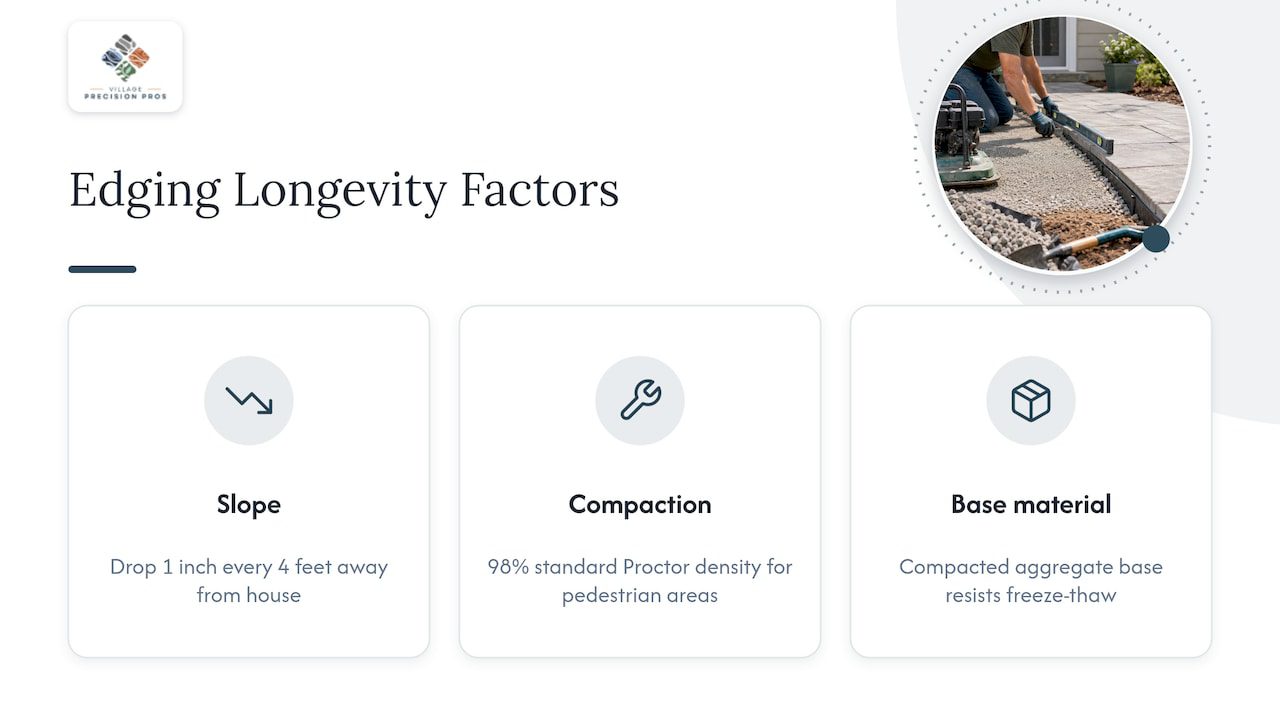
Slope. Water should run off the surface and away from the house. Standard guidance suggests a drop of one inch every four feet away from the structure. Oregon State’s installation guide also tells installers to plan the slope so water runs off the pavers. An edge that dams water at the border turns into a pond line.
Compaction. Industry guidance for segmental paving recommends compacting the soil subgrade to at least 98 percent standard Proctor density for pedestrian areas and residential driveways, with modified Proctor density for heavy vehicle areas. You do not measure this by eye. It is why our crews compact in lifts with proper equipment.
Base material. A compacted aggregate base gives freeze-thaw resistance and lets water move through instead of sitting under the surface. If you are curious about water-passing designs, see our page on the permeable paver patio.
When those three are right, even a modest edge performs well. When they are wrong, the most expensive edge in the catalog will not save the patio.
Perspective
Edging is where a patio either looks professional or looks like a weekend project. After years of building patios across Central Arkansas, we treat the edge as part of the structure, not a trim piece added at the end.
Our approach is to plan the perimeter at the same time as the base and drainage. We decide where water will go, how far the compacted base extends past the finished surface, and which restraint suits the soil and the traffic the patio will carry. A rigid, well-anchored border beside a compacted aggregate base is what keeps joints tight and lines straight year after year.
We also believe the right material is the one that suits the home. Stone and brick borders look natural beside traditional architecture. Steel gives a crisp contemporary line. Concrete gives the most permanent answer for heavy use. Because our crews handle hardscape, masonry, woodworking and drainage under one roof, the edge, the surface and the grade are designed to work together rather than patched in later.
That is why homeowners come to us after a patio edge has shifted or a plastic strip has popped up. We can usually trace the cause back to the base, then rebuild the edge the right way.
Ty
Care and maintenance through the year
Good edging should be low-maintenance, but a seasonal glance helps.
- Spring. Look for lifted strips, open joints and any spot where soil has washed over the border. Reset or add backfill early.
- Summer. Keep mulch and soil below the patio surface so water can leave. Trim vegetation that creeps over the border.
- Fall. Clear leaves from the perimeter so water drains and moss does not take hold.
- Winter. Plastic edging is the most likely to heave in freeze-thaw cycles. Be careful with shovels and plows near the border. Knowing how to approach clearing snow from pavers helps you avoid catching an edge or chipping a paver when snow does arrive.
If you would rather not track this yourself, our annual maintenance plans cover ongoing property care for homeowners, businesses and property managers.
Let us build the edge and the patio together
If you are planning a new patio, or fixing one with a border that has shifted, we design and install the whole system: base, grade, surface and edge. Our crews work with pavers, natural stone, concrete and custom woodwork across Central Arkansas, and we tailor the finish to your home and how you use the space.

See our decks and patios service, browse finished work in our patios and pavers portfolio, or contact us through our site to talk through your project. Exact totals depend on the size of the patio, the material, access and site preparation, so we price each job after seeing the yard.
FAQ
What is the most durable patio edging?
Metal such as steel or aluminum, and rigid options such as concrete or natural stone, are the longest-lasting choices. University of Illinois Extension lists metal among the longest-lasting edging materials. Durability still depends on a compacted base and good drainage behind the edge.
Do pavers always need an edge restraint?
For interlocking concrete pavers, yes. Extension guidance says restraints are essential to prevent paver movement and separation. The restraint can be a concrete border, a manufactured strip or an adjoining structure, as long as it holds the outer rows firmly.
Can I use plastic edging on a paver patio?
Manufactured plastic restraints are widely used on lighter residential patios, but they rely on a well-compacted base and properly placed spikes. In areas with heavy use, ground movement or steep grades, we recommend a rigid border instead, such as a concrete-set paver course or stone.
What edging works best next to a lawn?
A flat row of brick or small setts set level with the grass works as a mower strip, so the mower rides along it and you skip hand trimming. Steel is another clean option for a thin, crisp line between patio and turf.
How do I know if my patio edge is failing?
Watch for wavy lines, outer pavers that tilt or sink, open joints near the border, and soil or gravel spilling onto the surface. These usually point to a base, compaction or drainage issue under the edge, so the fix often goes deeper than replacing the strip.
Sources
- Materials for Landscape Edging, Patios, and Paths
- All About Edging, K-State Research and Extension
- Bed Edges, Illinois Extension
- 10-step guide to installing pavers, Oregon State Extension
- Guide Specification for the Construction of Interlocking Concrete Pavements
- Installing Concrete Pavers, Part Two, Iowa State Extension
- Choose the Right Landscape Edging, Lowe’s