


If your mulch keeps ending up on the driveway or the lawn after a storm, adding another few bags will not fix it. Washout is almost always a water problem first and a mulch problem second. The lasting fixes are to control where the water goes, hold the bed edge with something solid, choose a material that resists floating, and anchor mulch on slopes where loose material cannot stay put.
We work on drainage, grading and hardscape across Central Arkansas, and we see the same pattern again and again: a homeowner re-mulches every spring, the first hard rain moves it, and the cycle repeats. This guide walks through why that happens and what to do about it, from a ten-minute edging job to a regraded slope.
TL;DR
- Mulch moves when water concentrates. Find where the water comes from (downspout, driveway, slope, low spot) and fix that path before you re-mulch.
- Solid edging, heavier or interlocking materials, and the right depth (about 2 to 3 inches) solve most flat-bed washout.
- On steep slopes, loose mulch is the wrong tool. Matting, netting, tackifier, plant roots, terracing or a retaining wall hold ground far better.
- “Mulch glue” is real, but it is a binder, not a drainage fix.
- Repeated washout in the same spot usually means a grading or drainage fault that a landscaper should correct.
Table of Contents
- Why mulch washes away in the first place
- Step one: control the water before touching the mulch
- Fix the edge: borders that actually hold
- Choose heavier materials that interlock
- Get the depth right, and avoid the volcano
- Solutions for sloped beds
- Does mulch glue work?
- A repair sequence that lasts
- What shapes the total on a washout repair
- Our point of view: stop re-mulching, start redirecting
- When to call a professional
- FAQ
- Sources
Why mulch washes away in the first place
Rain does two jobs on a bed. First, raindrops knock loose particles free. Then moving water carries them off. University extension erosion guidance describes how raindrops detach particles and how sheet, rill or gully flow then transports them once water concentrates. Mulch is light, so it travels before heavy soil does.
That is why recurring washout usually points to one of these causes:
- A downspout or gutter outlet dumping a stream onto the bed.
- Runoff from a driveway, patio or roof edge that sheets across the bed.
- A slope that gives water speed.
- A low spot or swale where water collects and then overflows.
- Light material such as fine bark or shredded mulch that floats and mats on the surface.
- No edge, so mulch has an open path to the lawn or pavement.
A quick test: watch the bed during the next heavy rain. If you see a defined stream, you have a flow problem. If water moves in a thin sheet across the whole bed, you have a cover and slope problem. The fix differs for each.
Step one: control the water before touching the mulch
Federal and state erosion guidance is consistent here. The U.S. EPA notes that loose mulch should not be used alone where stormwater is concentrated or slopes are steep. When water has a defined path, design and stabilize that path. When water is diffuse, improve cover, infiltration and soil structure.
Downspouts and roof runoff
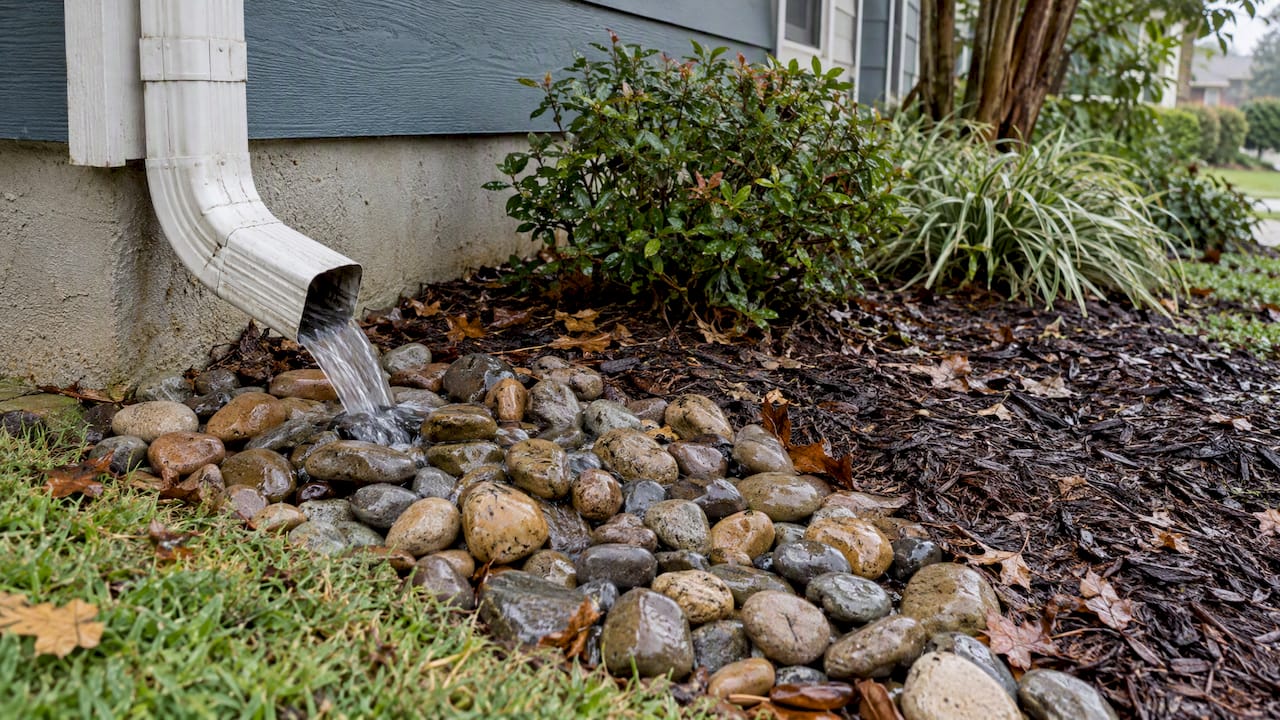
A single downspout can move a lot of water in a short storm. Extending it with a solid pipe to a safe discharge point, or tying it into a buried line, takes the biggest force off the bed. We cover options in our guide to downspout drainage ideas a landscaper trusts. Where water must surface, a landing of cobble or rock spreads and slows it so it does not scour the bed.
Swales and low spots
If water crosses your yard in a line, give it a shaped channel instead of letting it choose one through your mulch. A properly graded swale carries water off the property or to a planted infiltration area. See our walkthrough of drainage swale design and the broader overview of landscape water drainage solutions. Small rock check dams can slow flow in a swale that keeps eroding.
Hard surfaces that shed water onto beds
Patios and driveways that tilt toward a bed push water straight into your mulch. A patio should slope away from the house and toward a place that can take the water. Our article on patio drainage design explains the 2 percent slope idea and how to avoid pooling.
Rain gardens for chronic wet areas
Where a yard collects water for days, a rain garden can turn the problem into a feature. Guidance for rain gardens recommends dense wood-based mulch rather than light bark or straw in wet areas, plus cobble or rock where pipes or swales feed water in. The same handbook gives a design example with a basin about 8 to 10 inches deep and no more than 6 inches of ponded water, though your own soils and local rules should shape the final design. Read our rain garden design guide for the planning side.
When water has been falling for days, do these things first: keep inflow and overflow paths open, clear deposited sediment, stabilize bare soil and keep plants healthy. Then re-mulch.
Fix the edge: borders that actually hold
Once the water path is sorted, the bed edge is the next weak point. A border does two things: it blocks mulch from sliding out, and it gives water a boundary to slow against.
| Edging type | Best for | Watch out for |
|---|---|---|
| Thin metal or steel edging | Clean lines on flat or gently sloped beds | Needs deep, firm staking; can shift if the soil heaves |
| Stone or paver borders | Beds beside driveways and walks | Need a compacted base so they do not sink or tilt |
| Poured or precast concrete curbing | Heavy runoff beds | Needs weep or overflow points so water can leave |
| Natural stone or boulder edge | Informal beds and slopes | Gaps let mulch through unless backed with fabric or stone dust |
| Plastic or rubber edging | Light-duty, level beds | Easily pushed out by flowing water |
The edge needs to sit above the mulch line by an inch or two and be anchored below grade. A border that is flush with the mulch gives water an easy exit and mulch an easy ride.
For beds along driveways, a hard edge of stone or pavers also keeps wheels, mowers and runoff from chewing up the boundary. Our hardscape and stone masonry crews build these borders on a compacted aggregate base so they hold through freeze-thaw and heavy rain.
One caution: a solid border that traps water can overflow in the worst spot. Plan where water leaves the bed, not only where mulch stays.
Choose heavier materials that interlock
Not all mulch behaves alike in a downpour. Fine, shredded or dyed light mulches float. Coarser, chunkier wood products tangle together and resist moving. Gravel and river rock stay put in all but the strongest flow.
- Coarse hardwood or double-shredded bark: knits together better than fine mulch and is easy to refresh.
- Large bark nuggets: attractive but they float; use them only on flat beds with good edging.
- Composted mulch: a University of California Cooperative Extension and USDA NRCS hillside study reported that composted mulch reduced measured sediment by 78 to 98 percent across four vineyard sites over seven months. That supports it as a soil-protection layer, but it was a site-specific study and no promise that decorative mulch will stay on a residential slope.
- Gravel or river rock: USDA specifies inorganic mulch at least 0.75 inch in particle size and at least 2 inches deep for erosion protection. Stone suits drip-line strips beside foundations, swale inflows and downspout landings. It is not ideal under trees that drop leaves, since debris builds up between stones.
We often steer homeowners toward a mix: stone where water is fast, wood mulch where it is calm.
Get the depth right, and avoid the volcano
USDA and Caltrans guidance puts wood or bark mulch for erosion protection at a minimum of about 2 inches, with 2 to 3 inches commonly specified on slopes. Too little leaves soil exposed. Too much, or tightly packed mulch, can create wet, oxygen-poor conditions and a slick layer that slides.
NC State Extension advises that protective mulch cover at least 85 percent of exposed soil, so thin patches and bare strips defeat the purpose.
What about the 3-3-3 rule?
The 3-3-3 rule is a tree guideline, not a washout fix. It calls for a ring at least 3 feet across, about 3 inches deep and 3 inches away from the trunk. It protects the bark from rot. It will not stop runoff moving downhill. Piling mulch against a trunk, the so-called mulch volcano, harms trees and does nothing for erosion.
Solutions for sloped beds
Slope changes everything. UGA Extension describes slopes of 20 percent or more as steep with special planting needs, and notes that a 30 percent slope is too steep to mow. On those sites it points to retaining walls, terracing, rooted vegetation, strategically placed rock and anchored erosion-control materials rather than loose mulch alone.
For a homeowner asking how to keep mulch from sliding downhill, here is the ladder we use, from gentle to steep:
- Gentle slopes (under about 5 percent): coarse mulch at 2 to 3 inches, solid edging and ground cover plants.
- Moderate slopes: add rooted plants, rock accents at flow points and, where needed, netting or matting pinned over the mulch.
- Steep slopes: terraces or retaining walls to break the grade into level beds, with planting and mulch on the flat tiers.
- Very steep slopes: engineered stabilization and dense vegetation, not mulch beds.
Matting, netting and hydromulch
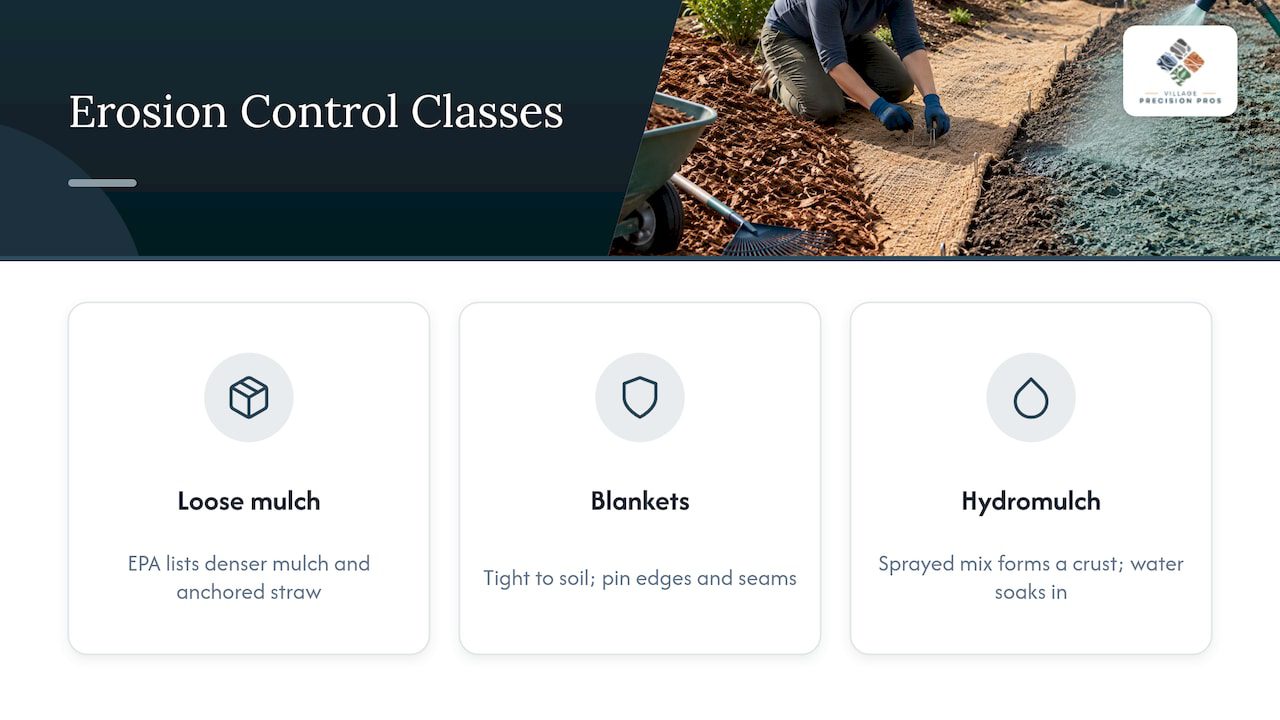
NC State identifies three basic classes: loose mulch, erosion-control blankets and hydraulically applied mulch. The EPA lists denser mulch, blankets or matting, netting, tackifiers, anchored straw and hydromulch as the main answers. Hydromulch is a sprayed mixture of water, mulch and tackifier that forms a crust which still lets water soak in. It needs time to dry, and the EPA notes it should go on at least 24 hours before a storm, subject to the manufacturer’s instructions.
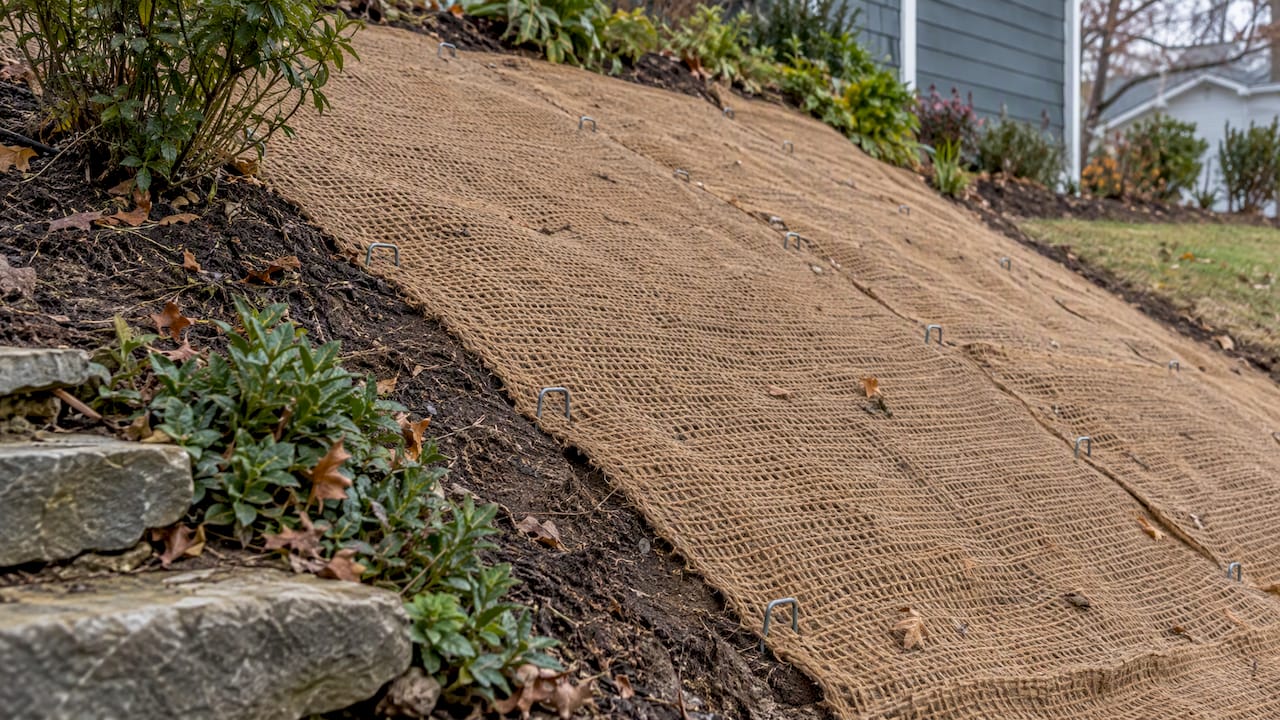
Installation matters as much as product. University of California guidance says erosion can continue underneath a blanket when it bridges over voids. Matting should sit tight against smoothed soil and be pinned along its edges and seams.
Terraces and retaining walls
When a slope is too steep for any surface treatment, reshape it. Terraces turn one fast slope into several slow, level beds where mulch behaves normally. Our resources on terraced backyard ideas, retaining wall types and retaining wall materials and drainage explain why drainage behind the wall comes before looks. You can also browse finished retaining walls and terraces. For a deeper look at the whole problem, see our hillside erosion solutions.
Temporary supports can help while stabilization takes shape. For example, guidance on keeping structures off wet ground shows how gravel pads and raised bases deal with a defined runoff path, the same principle you use at a downspout landing or a wet corner of the yard.
Does mulch glue work?
Yes, with limits. The professional term is tackifier. The EPA and state guidance describe it as a binder for loose mulch, not a cure for uncontrolled drainage. South Carolina’s erosion guidance says to use it at the manufacturer’s rate, apply it evenly and pair it with netting, matting, pinning or flow control where runoff is concentrated.
In practice:
- It helps on small, moderate slopes and fresh installs where the mulch has not yet knit together.
- It will not save a bed that sits in the path of a downspout.
- Follow the label, because over-application can crust and shed water.
- Follow the weather window on the product so it can cure before rain.
A repair sequence that lasts
When we correct a washed-out bed, the order matters. It tracks what extension and EPA guidance describe:
- Read the water. Walk the property during or just after rain and mark the flow paths.
- Remove loose and silted material. Sediment left in place blocks drainage and invites more washout.
- Correct the flow path. Extend downspouts, shape a swale, add a stone landing or regrade.
- Prepare and stabilize the soil. Smooth, compact where needed and plant rooted cover.
- Seat the control material. Edging, matting or netting should sit in firm contact with the soil.
- Apply mulch at the right depth. About 2 to 3 inches of a heavier product.
- Inspect after storms. South Carolina guidance calls for inspection every 7 days and within 24 hours after a half-inch rain on active sites. A home bed does not need that schedule, but a check after every big storm catches small failures early.
What shapes the total on a washout repair
We do not publish figures here because no two yards are alike. These are the factors that move the scope:
- How far the water travels and how fast it arrives
- Slope steepness and soil type
- Whether grading, a swale or a buried drain line is needed
- The edging or wall material and the length of bed
- Access for equipment
- Whether plants, matting or hydromulch are part of the solution
A good proposal spells out the mulch type, thickness, site preparation, anchoring method, timing and follow-up inspections. If a bid just says “install mulch,” ask what happens when it rains.
Our point of view: stop re-mulching, start redirecting
Over the years we have seen the same yards come back for the same problem. In our experience, a yard that washes out every spring is telling you something about grade or drainage. Mulch is a finish layer, and it cannot compensate for water that has nowhere to go.
We prefer to solve the cause with durable materials: compacted aggregate bases, stone borders with interlocking joints, rock at the points where water arrives, and plantings with real roots. A bed built that way looks like it grew out of the landscape, and it shrugs off a storm that would send fresh mulch into the street. It also leaves you with easy long-term upkeep rather than a yearly rescue job.
We also say plainly when mulch is the wrong tool. On a steep bank, we would rather recommend terracing or a wall than sell you another load of bark.
Ty
When to call a professional
Try the simple fixes yourself if the bed is flat, the water is diffuse and the damage is minor. Bring in a landscaper when:
- Washout returns in the same spot after a repair
- A downspout or driveway sends a stream into the bed
- The slope is steep enough that mowing it feels unsafe
- Water reaches a foundation, patio or retaining wall
- Sediment is washing onto a street, neighbor or lake
Our crews handle landscape and irrigation work, grading, drainage correction, stone borders, terraces and walls throughout Central Arkansas. If you would rather prevent the problem year after year, our annual maintenance plans keep beds, edges and drainage points inspected. To talk through your yard, start at villageprecisionpros.com and tell us what happens when it rains.
FAQ
How do I keep mulch from sliding down a hill?
Start by slowing the water with plants, rock or terraces, then use coarse mulch at 2 to 3 inches over soil that is smoothed and firm. On moderate slopes, pin netting or matting over the mulch. On steep slopes, loose mulch alone is not reliable, and a wall or terrace is the better answer.
Does mulch glue really work?
It can, as a binder that helps loose mulch knit together, especially on small slopes and new installs. It does not fix concentrated runoff, so pair it with netting, pinning or drainage correction. Follow the manufacturer’s rate and curing time.
What should I do when my garden is rained on for days in a row?
Keep inflow and overflow paths clear, remove deposited sediment and protect bare soil. Dense wood-based mulch holds better than light bark or straw in wet areas, and rock helps where water enters. If standing water lingers, the site likely needs drainage work.
What is the 3-3-3 rule for mulch?
It is a tree-care guideline: a ring at least 3 feet across, about 3 inches deep and 3 inches from the trunk. It prevents trunk rot but does nothing about runoff on a slope.
Sources
- Missouri Extension, erosion control guidance
- U.S. EPA, Mulching best management practice
- Snohomish County, Rain Garden Handbook
- UC Cooperative Extension and USDA NRCS composted mulch study
- USDA NRCS, Mulching Conservation Practice Standard 484
- Caltrans, Erosion Control Toolbox: Mulch
- NC State Extension, Mulch Options for Erosion Control
- North Dakota State, Dakota Gardener
- University of Vermont Extension, Beware the Mulch Volcano
- UGA Extension, Meeting the landscape challenges of slopes and hillsides
- UC guidance, Mulching
- South Carolina DES, Mulching