

For a standard residential driveway, use concrete pavers at least 2-3/8 inches (60 mm) thick. If the driveway will regularly carry delivery trucks, RVs, or heavier equipment, step up to 3-1/8 inches (80 mm). The Concrete Masonry & Hardscapes Association (CMHA) tech note sets those two minimums. Thickness is only part of the answer, though. The compacted base under the pavers, the soil under the base, and the laying pattern decide whether the driveway stays flat for decades or ruts in three winters.
This guide explains how to choose a thickness, what the numbers mean, and what changes on the expansive clay we build on in Central Arkansas. It also covers paver strength, pattern, and color, since those questions come up in the same conversation.
TL;DR
- Residential driveways: 2-3/8 inch (60 mm) pavers are the industry minimum. Heavy vehicle areas call for 3-1/8 inch (80 mm).
- A thicker paver does not rescue a thin base. Driveway bases typically run far deeper than patio bases, and clay soil adds more requirements.
- Look for pavers that meet ASTM C936: at least 8,000 psi average compressive strength and no more than 5% absorption.
- Lay driveways in a 45 or 90 degree herringbone pattern so the units lock together when vehicles brake and turn.
- Choose color last, after thickness, base, and pattern are settled.
Table of Contents
- The short answer on paver thickness
- When 2-3/8 inches is enough, and when to go thicker
- Why the base matters more than the paver
- What Arkansas clay changes
- Paver strength: what to look for besides thickness
- Pattern: the other half of interlock
- Choosing the best paver for a driveway
- How to choose paver colors for a driveway
- What drives the total on a paver driveway
- Our perspective: where driveways go wrong
- Planning a paver driveway with us
- Before you order: a quick checklist
- FAQ
- Sources
The short answer on paver thickness
Paver thickness is sold in millimeters even in the United States, and the inch sizes are conversions. Here is how the common sizes line up with real use.
| Nominal thickness | Inches | Typical use |
|---|---|---|
| 40 mm | about 1-5/8 | Pedestrian only, not for driveways |
| 50 mm | about 2 | Patios and walkways |
| 60 mm | 2-3/8 | Residential driveways, patios, walkways |
| 80 mm | 3-1/8 | Heavy vehicle areas, commercial lots, streets |
The 60 mm and 80 mm figures come from the CMHA technical bulletin, which gives 2-3/8 inches as the minimum for residential driveways and 3-1/8 inches as the minimum for streets and areas with heavy vehicular traffic. Concrete Network likewise lists 2-3/8 inches as the standard residential patio and driveway paver, with thinner and thicker options for other jobs.
Manufacturers build their driveway lines around those two sizes. One national manufacturer’s driveway paver line lists 4 by 8 inch units at 2-3/8 inches thick and 4 by 12 inch permeable units at 3-1/8 inches thick.
Can you use 2-inch pavers for a driveway?
It is a bad bet. A 2 inch (50 mm) unit is a patio and walkway product. Under a parked car it may hold, but under a car turning its wheels on the spot, or a loaded truck backing in, thin units tend to rock and shift. The cost of a thinner paver is small next to the cost of lifting and relaying a driveway, so we do not specify them for vehicle areas.
When 2-3/8 inches is enough, and when to go thicker
Most family driveways in our area carry two cars, the occasional visitor, and a trash truck rolling to the curb. The 60 mm paver is the proven choice for that. We recommend moving up to 80 mm in these situations:
- Large or heavy vehicles park or turn on the surface. Think box trucks, work trailers, RVs, or a boat on a tandem axle.
- Delivery or service trucks use the driveway regularly. A home business or a property with frequent deliveries falls here.
- The driveway is a commercial or multifamily entrance. Property managers should plan for a heavier duty class from the start.
- Tight turning areas. Wheels turned while the vehicle is stationary create the harshest twisting load on any paver surface.
We often suggest the thicker unit when there is any doubt about future use. The taller, heavier unit improves rotational interlock, which is the resistance of each paver to twisting in place. The extra material is a modest part of the overall project, since excavation, base stone, and labor make up most of the work.
Thicker is not automatically better, though. Going to 80 mm on a driveway that only ever sees a pair of sedans does not remove the need for the base and edge work, and a thicker paver on a poor base still fails. Spend the extra effort where it is needed.
Why the base matters more than the paver
Homeowners often assume the paver carries the load. It does not. The paver is the wearing surface. The base spreads the weight of the vehicle over the soil below. CMHA’s guidance treats thickness as one component of a structural system, and in freeze-thaw climates a properly compacted aggregate base lets moisture expand into its void spaces instead of pushing the surface upward.
Here is how much base the published guides call for:
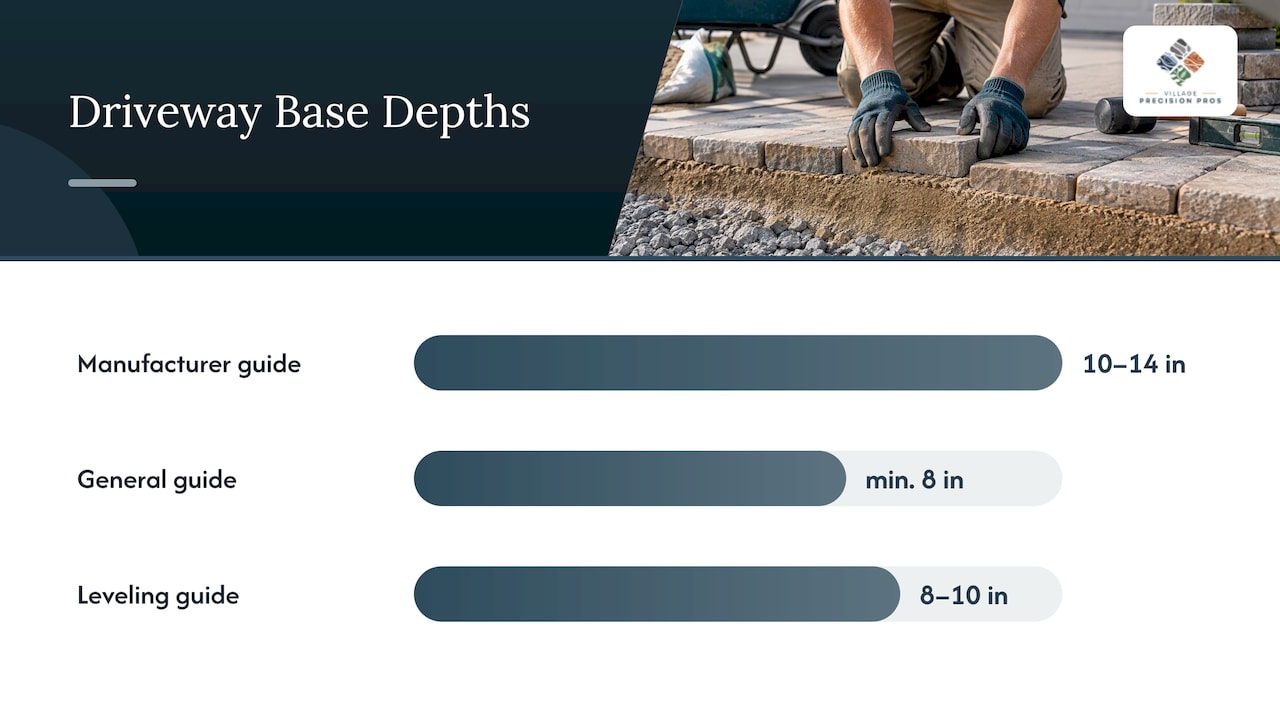
- A manufacturer’s installation guide lists gravel base of 6 to 8 inches for patios and walkways, and 10 to 14 inches for driveways.
- A general paver installation guide recommends a minimum of 4 inches of compacted aggregate for patios and walkways, and 8 inches for residential driveways.
- A step by step leveling guide suggests excavating 8 to 10 inches for driveways, deeper in freeze-thaw climates, and rebuilding in compacted layers.
The spread between 8 and 14 inches is real. It reflects soil type, climate, and the load the driveway will see. Our approach is to size the base to the site rather than a single number, and to compact it in thin lifts so every layer is dense. For a closer look at how base depth is measured and ordered, read our paver base depth guide.
What Arkansas clay changes
Central Arkansas sits on clay that swells when wet and shrinks when dry. Clay holds moisture and moves, so the soil under your driveway is rarely still. Research on Arkansas clay and hardscape drainage points to a few practical responses:
- Dig to firm subgrade. Soft organic topsoil comes out. If the clay is too soft when wet, deeper excavation and replacement or stabilization may be needed.
- Separate clay from stone. Geotextile fabric between the clay subgrade and the aggregate base keeps the clay from working up into the gravel, which is what causes a driveway to sink over time.
- Slope the surface away from the house. A minimum of 2% (1/4 inch per foot) moves the intense seasonal downpours off the pavement and away from your foundation.
The unglamorous truth is that failures usually trace back to water. Poor subgrade drainage is among the most common causes of early hardscape failure, according to the manufacturer guide we reviewed. A driveway built with thicker pavers over an undrained clay base will still settle. A driveway with a well drained, geotextile-separated, compacted base and standard 60 mm pavers will outlast it.
If you want to see how the same thinking applies to a lighter-duty surface, our page on stone walkway installation on Arkansas clay walks through it.
Paver strength: what to look for besides thickness
Two pavers can share a thickness and perform very differently. For concrete pavers made in the United States, ASTM C936 requires an average compressive strength of at least 8,000 psi (55 MPa) and average water absorption of no more than 5%. Strength carries the load. Low absorption helps the unit shrug off freeze-thaw cycles and the staining that comes with water uptake.
When you compare products, ask the supplier for the ASTM C936 test results. If the product is brick or natural stone, ask what standard it is tested to and whether the thickness suits vehicle loads. A thin natural stone slab that looks right for a patio may be wrong for a driveway.
Pattern: the other half of interlock
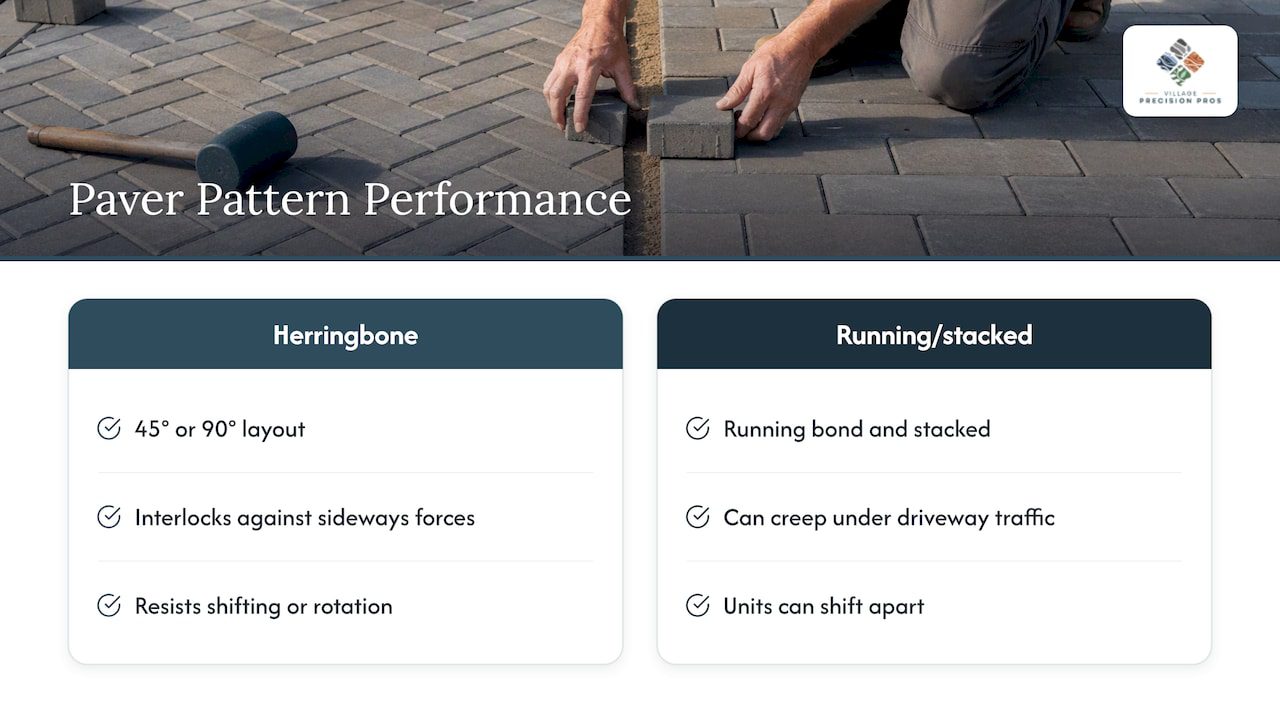
A paver driveway holds together through friction between units, edge restraint, and joint sand. Pattern matters because vehicles push sideways when they brake, accelerate, and turn. A 45 or 90 degree herringbone pattern is the industry preference for driveways, since it interlocks the units against those horizontal forces and keeps them from shifting or rotating. Running bond and stacked patterns look fine on patios but let units creep apart under driveway traffic.
If you like a different pattern for the front of the house, we can often use herringbone for the vehicle area and a border or accent band for the look you want. Our paver patio ideas page shows how borders and layouts come together.
Choosing the best paver for a driveway
Most homeowners end up choosing among three families of material:
- Concrete pavers. The most common driveway choice. They come in the standard 60 mm and 80 mm thicknesses, a wide range of shapes and colors, and test data you can verify against ASTM C936.
- Clay brick pavers. A classic look with deep, durable color. Confirm the thickness and the rated use for vehicles.
- Natural stone. Beautiful, but thickness, hardness, and joint design need careful review for vehicle loads. We treat it as a case by case decision.
Permeable pavers are worth a look when drainage is a concern. They use open joints and a clean stone base to let water move through the surface. Read about the tradeoffs in our permeable paver guide.
A comparison point we hear often is poured concrete. A concrete slab driveway is typically placed at a minimum of 4 inches thick, and its thickness is a major factor in structural capacity. A slab is rigid and a paver system is flexible, which is why many homeowners on clay prefer pavers: individual units can be lifted and reset after soil movement without patching the whole surface.
How to choose paver colors for a driveway
Color is the fun part, and it is also the easiest to get right once the structure is settled. A few guidelines we share with homeowners:
- Start with fixed elements. Roof, brick, siding, and stone are not changing. Pick paver tones that sit comfortably with them.
- Choose a field color and one accent. A single main color with a contrasting border or soldier course looks intentional. Three or four competing colors can look busy over a large driveway.
- Go mid-tone. Very light pavers show tire marks and leaf stains, and very dark ones show dust and fade in strong sun. Blended mid-range colors hide everyday wear best.
- View samples outdoors. Look at them wet and dry, in morning and afternoon light, laid next to your house.
- Plan for color across the whole property. If you are also planning a patio or walkway, matching or complementing tones ties the property together.
Common pairings include warm grays with charcoal borders, tan and brown blends with a darker edge, and neutral field colors with a lighter band at the garage apron. Blended colors are a good choice because they hide small differences from batch to batch. Mixed colors also forgive minor staining.
One maintenance note: white haze on new pavers is usually efflorescence, a natural mineral deposit and not a defect in strength. Our guide to removing paver efflorescence explains the fix.
What drives the total on a paver driveway
We do not publish prices, because every driveway is different, and we would rather quote from your site than from a guess. These are the factors that move the total:
- Size and shape. Square footage, curves, and cut pavers all add labor and material.
- Excavation depth and soil. Clay with poor drainage may need deeper digging, geotextile, and more base stone.
- Paver thickness and type. 80 mm units and natural stone differ from standard 60 mm concrete pavers.
- Pattern and borders. Herringbone and detailed borders take more time to lay and cut than simple layouts.
- Edge restraint and drainage. Proper edging, slope, and any drains are part of a durable system.
- Access and removal. Existing concrete or gravel to remove, and how equipment reaches the site, matter.
The cheapest-looking proposal tends to leave out base depth or drainage work. Ask every contractor to put the excavation depth, base material, compaction method, and paver specification in writing.
Our perspective: where driveways go wrong
We have completed more than 2,000 projects across Central Arkansas since 2020, and the patterns on driveway and hardscape work are consistent. Homeowners come to us asking which paver thickness to buy. Our answer is always a question first: what is underneath it, and where does the water go?
Our view is simple. Choose 60 mm for ordinary residential use and 80 mm when you have any real prospect of heavy vehicles. Then put the effort into the parts you will never see again once the pavers go down: the excavation, the geotextile over clay, the compacted base in thin layers, the slope away from the home, and the edge restraint. We would take a standard paver on an excellent base over a thick paver on a rushed one every time.
We also push for herringbone on any surface that cars drive on. It costs nothing extra in material, and it is the difference between a driveway that holds its lines and one that slowly spreads. If a contractor cannot explain the base and drainage plan for your lot in plain words, keep looking. Our seven quality checks before you hire can help you ask better questions.
Ty
Planning a paver driveway with us
If you are weighing a paver driveway, our crews design and install hardscapes across Central Arkansas, from the excavation to the final joint sand. See our Hardscape & Stone Masonry service or browse finished work in our patios and pavers portfolio. Tell us about your site, your vehicles, and the look you want, and we will recommend a thickness, base, and pattern that fit. Once the work is done, our annual maintenance plans can help keep the surrounding property in shape.
Before you order: a quick checklist
- Confirm the paver is at least 2-3/8 inches (60 mm), or 3-1/8 inches (80 mm) for heavy use.
- Ask for ASTM C936 test results: 8,000 psi average compressive strength and 5% maximum absorption.
- Get the base depth in writing, sized to your soil and load.
- Confirm geotextile separation over clay subgrade.
- Confirm slope of at least 2% away from the home.
- Confirm a 45 or 90 degree herringbone pattern for the vehicle area.
- Call to have underground utilities located before any digging begins, as installation guides advise.
- Choose colors from samples viewed outdoors next to your house.
FAQ
How thick should driveway pavers be?
At least 2-3/8 inches (60 mm) for a typical residential driveway, according to CMHA guidance. Use 3-1/8 inches (80 mm) where heavy vehicles are expected. The base beneath matters just as much as the unit.
What is the strongest paver pattern for a driveway?
A 45 or 90 degree herringbone. The angled units interlock against the sideways forces from braking, accelerating, and turning, so they resist shifting and rotating. Running bond and stacked layouts are better kept for patios.
How deep should the base be for a paver driveway?
Published guides range from 8 inches up to 10 to 14 inches of compacted aggregate, depending on soil, climate, and load. On Central Arkansas clay we plan toward the deeper end and add geotextile fabric. Your site conditions set the final depth.
Is a thicker paver always better?
No. An 80 mm paver suits heavy vehicles, but it does not replace a properly built base. For a driveway that carries only passenger cars, a 60 mm paver on a well compacted, well drained base performs well.
Sources
- CMHA Tech Note: Construction of Interlocking Concrete Pavements
- Unilock Paver Installation Guide
- General Paver Installation Guide
- How to Level Ground for Pavers
- What Does Arkansas Clay Soil Mean For Hardscape Drainage
- Unilock Series Driveway Pavers
- Thickness of Concrete Pavers, Concrete Network
- Concrete Driveway Installation, Concrete Network